Categories
free trade & free markets general freedom ideological culture moral hazard nannyism national politics & policies responsibility too much government

Escape from New York

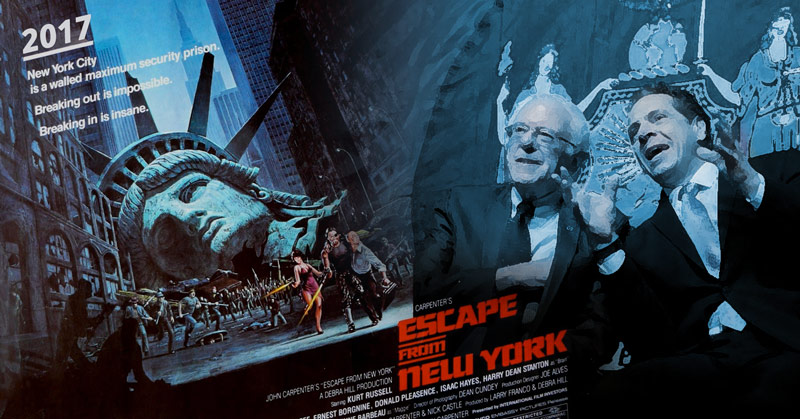
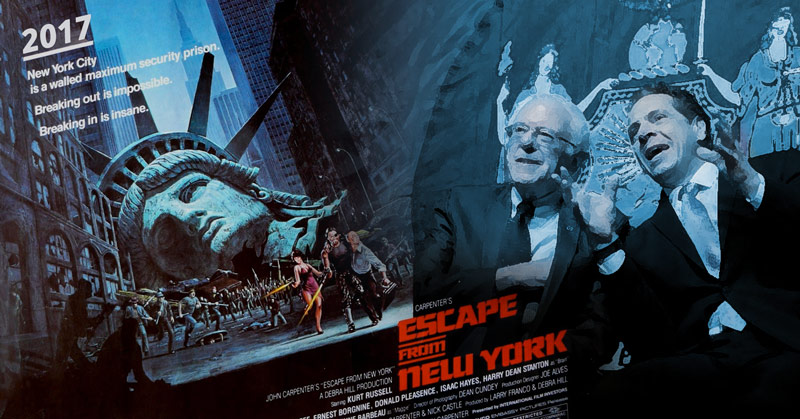
“New York City is a walled maximum security prison,” exclaimed posters for Escape from New York (1981, R). “Breaking out is impossible.”

Now, as part of new legislation giving “free college” to New Yorkers, politicians take the same high concept from the film and extend it to the entire state.  

What, you ask, does Escape from New York have to do with free college?

First, it’s not actually free college, but only free tuition for state and city colleges.* And note that tuition costs currently run less than half the price tag of room-and-board, books and fees. Moreover, the freebie is only for students whose parents earn less than $100,000 annually, beginning in Fall 2017. In 2018, the threshold jumps to $110,000 and to $125,000 in 2018.*

Gov. Andrew Cuomo, a likely 2020 Democratic Party presidential candidate, pushed the idea of bestowing free tuition in his State of the State address months ago. He also brought in Vermont Senator Bernie Sanders, who dangled free college during the 2016 campaign and has now introduced legislation in Congress.

But the Empire State Legislature amended the bill. Knowing full well the economic climate created by their previous policies, these venerable solons feared New Yorkers might take the free tuition, earn a degree and quickly move.

To someplace with jobs, perhaps.

So, the legislation requires student recipients of the free money to remain in the state – not escape – for as many years as they received the free moolah.

How will they keep graduates from leaving? Well, the movie trailer hyped that, “The bridges are mined. The rivers are patrolled.”

And those who leave also must pay back the tuition as a loan.

If caught.

This is Common Sense. I’m Paul Jacob. 


* There’s also a subsidy program for those attending private institutions of higher learning, if those colleges match the $3,000 the State puts up.

** New York state ranks 16th in median household income, at $60,850 in 2014. Therefore, the cap will deny this benefit to quite a few upper middle class and wealthier families.


Printable PDF


Categories
folly media and media people responsibility too much government

The Missing Links?

Is giving presidents a hard time for playing too much golf itself a pastime?

In Fahrenheit 911, filmmaker Michael Moore portrayed then-President George W. Bush, as more golfer than president — as if W. had secured the nation’s top job as a ruse to convince his wife to let him golf more.

Likewise, Republicans attacked President Barack Obama for incessantly hitting the links. In 2014, when ISIS came frighteningly close to Baghdad, Obama went golfing, causing Washington Post columnist Dana Milbank to bemoan the fact that “Obama’s golf habit needlessly hands his critics a gimme.”

An amusing website documented all of Obama’s golf outings . . . and plays audio of him pledging not to rest “until the dream of healthcare reform is finally achieved” and “until every American who is able and ready and willing to work can find a job,” etc.

Note: Obama never promised not to tee off.*

“Between 2011 and 2016,” SB-Nation reports, Donald Trump “tweeted at least 26 complaints, jokes, or scoldings about Barack Obama playing golf while president.”

Now, President Trump is getting the backswing scrutiny. While Obama didn’t golf during his first four months in office, Politico informs that Trump went golfing after two weeks and, in nine weeks, has already played a dozen rounds of golf.

Good. I wish all the politicians in Washington spent more time on the course and less “governing.”

Even more so as Republicans consider taking a mulligan on healthcare . . .  and Mr. Trump invited Sen. Rand Paul to join him on the fairway.

This is Common Sense. I’m Paul Jacob.


* In the closing days of the Obama administration, Golf Digest published a story lauding Obama’s “deep commitment to supporting the golf industry.” However, the publication informed readers that, while Obama golfed more than his immediate predecessors, Presidents Clinton and Bush 43, he didn’t hit the links nearly as much as Presidents Dwight D. Eisenhower and Woodrow Wilson.


Printable PDF


Categories
Accountability crime and punishment government transparency responsibility

Ferguson Finally Wins

Yesterday, on the 49th anniversary of Martin Luther King’s assassination,* voters in Ferguson, Missouri, passed a charter amendment requiring police to wear body cameras while on duty. The measure also provides the public access to that footage, along with reasonable rules about privacy.

In August 2014, Ferguson came to the nation’s attention — and the world’s — when a black resident was shot and killed by a white policeman. In the aftermath, the nation witnessed a militarized police response to senseless riots that destroyed 17 local businesses.

People there and across the country jumped to fact-free conclusions about who was at fault: the deceased Michael Brown or the policeman, Officer Darren Wilson.

“If there’s one thing that I think everybody in Ferguson would agree on, it’s that we’d like to have a video of what happened on Canfield Drive back in August of 2014,” remarked ballot measure proponent Nick Kasoff.** “If we had that, Ferguson wouldn’t be a hashtag. It would be just another quiet suburb of St. Louis.”

Police began wearing body cameras after the Michael Brown shooting, and the consent decree the city reached with the Department of Justice set some useful parameters. But the rules in the just-enacted charter amendment go much further to guarantee the public access to the video.

Not to mention that just this week, Attorney General Jeff Sessions announced a review of all such consent decrees nationwide. Without yesterday’s victory at the ballot box, the police cams policy might simply be abandoned.

Not now. The voters have spoken, 71 to 29 percent.

Spurred by Ferguson, there’s been a ton of talk about reforming criminal justice in recent years. But I like action a whole lot better.

This is Common Sense. I’m Paul Jacob.


* Yesterday also reminds me of 1984, George Orwell’s classic dystopian novel, because the book’s protagonist Winston Smith begins his diary on April 4, 1984.

It’s my favorite book, and has enjoyed quite a surge in sales since last November’s election. Yesterday, the movie was shown in nearly 200 theaters in the U.S., the U.K., Canada, Croatia and Sweden.  

** Nick Kasoff led the six-resident committee that drafted and petitioned the measure onto the city ballot, with assistance from Liberty Initiative Fund (LIFe). Regular readers may remember that LIFe is where I have my day job — and that without contributions like yours, fewer successful measures like this Ferguson body camera initiative get off the ground.


More on the issue

Townhall: “Finding Ferguson

Townhall: “First Step for Ferguson

USA Today: “Ferguson residents push for body cameras

Townhall: “The Citizens Are In Session


Printable PDF


Categories
ideological culture local leaders national politics & policies responsibility

From Brexit to Calexit

When last we touched upon the strangely over-the-top Californian reaction to the Trump presidency, the secession movement, I took the occasion to bring up the rather less radical separatists in the north. “Already 21 of the 23 northernmost counties,” I wrote, “have made declarations to form the State of Jefferson.”

But now there is a new wrinkle.

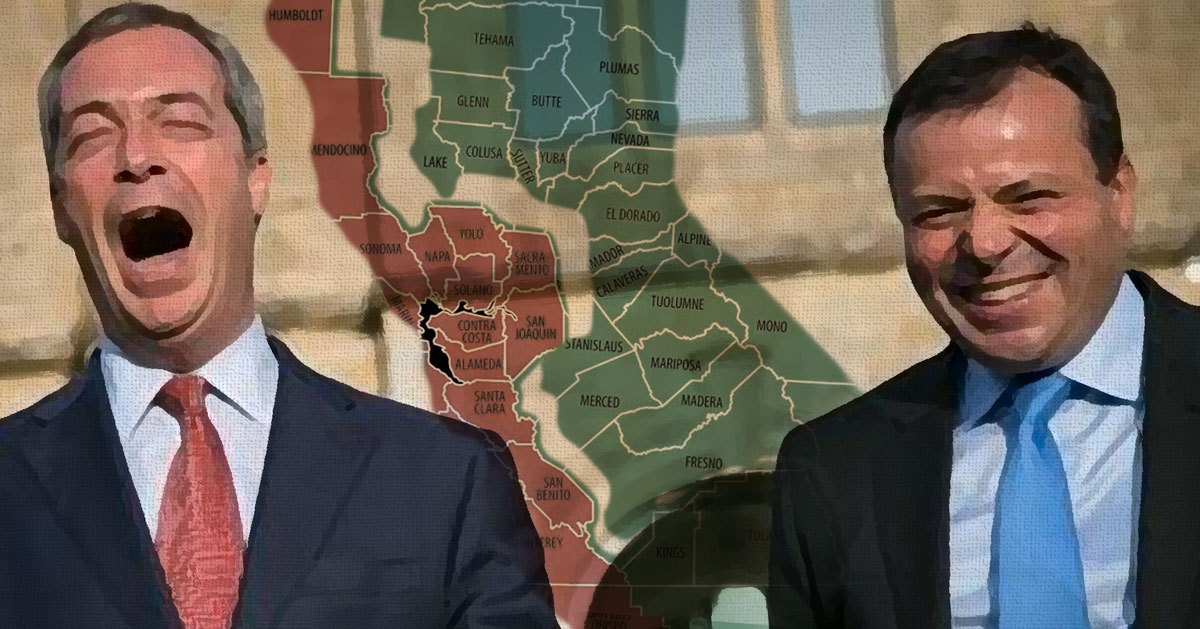
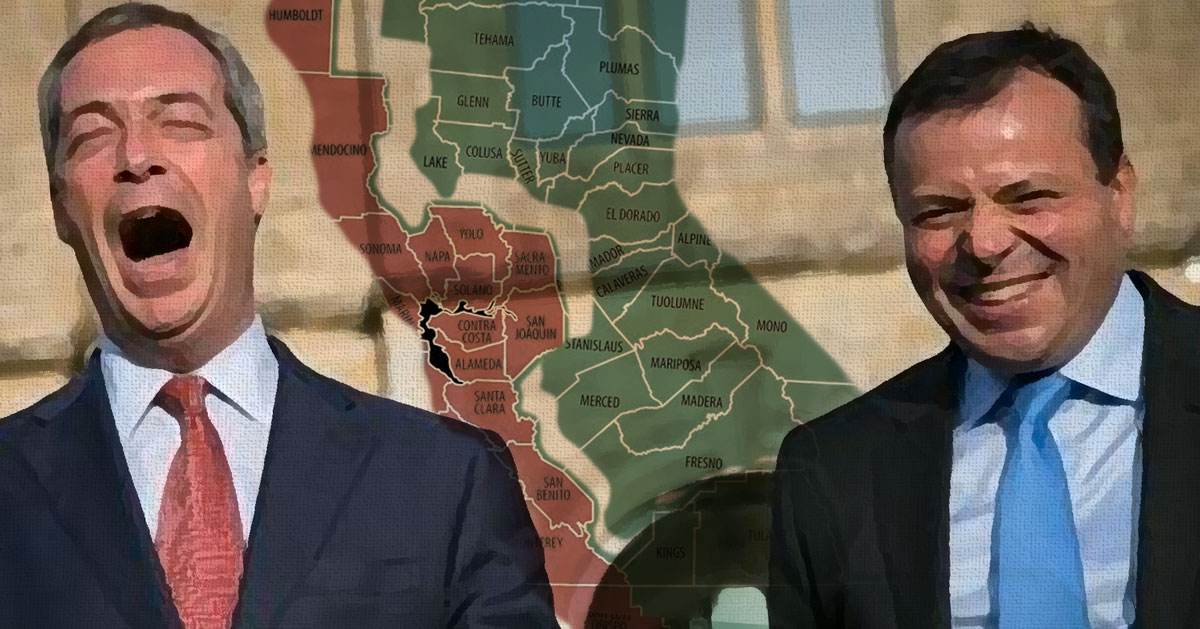
“Former UKip leader Nigel Farage and Leave backer Arron Banks recently helped raise $1 million for Calexit, which would split California into eastern and western regions,” we learn from the Daily Mail and the World Tribune. Banks, citing the high disapproval ratings Californians give their government, said that “he and Farage wanted to show people in California ‘how to light a fire and win’ the Calexit referendum.”

Their proposal is distinct from complete secession. It would amount to a California split, with the west coast (Los Angeles and north to the border) splitting off from the rest of the state. This would form an East California and a West California.

Politically, this might appease the conservatives and moderates who live in more rural east and Southern California, especially since they are coming to increasingly despise Left Coast “liberals” (read: progressives). Whom they not implausibly blame for ruining the state.

But it leaves some Jefferson secessionists stuck with those “liberals.” This, if an oversight, is a big one. Would this not doom the scheme?

While the failed initiative effort of 2014 to split the state into six separate states was far too complicated to wrap one’s head around, the new Calexit effort seems too . . . simple.

This is Common Sense. I’m Paul Jacob.


Printable PDF


Categories
Accountability government transparency ideological culture moral hazard nannyism national politics & policies political challengers porkbarrel politics responsibility too much government

Legislating in the Real World

Rolling back Big Government is not easy, especially when you are not that into it.

Robert Draper, profiling Steve Bannon in the New York Times, gives us a view into the mind of Trump’s right-hand man, who appears to think GOP insiders are obsessed with principles. “[I]t’s all this theoretical Cato Institute, Austrian economics, limited government — which just doesn’t have any depth to it. They’re not living in the real world.”

At best, this only fits the Freedom Caucus members, who killed RyanCare. But who is avoiding reality, here?

“Bannon clearly is not as familiar with the mindset of congressional Republicans as he imagines,” counters Jeff Deist, head of the “Austrian” Mises Institute. “They are primarily concerned with how the whole ‘repeal and replace’ debacle plays back home.”

Like Deist, I see the spectacular fizzle of RyanCare as evidence of the increasing irrelevance of Republican compromising. “The GOP is the party of trillion dollar military budgets,” Deist insists, noting that it “won’t even kill an openly cronyist program like the Export-Import Bank.”

If keeping Big Government secure is all Republicans can do, what use are they?

“All around us are the almost unimaginable benefits of markets, cooperation, and technology,” Deist explains, “yet somehow we’re naïve if we don’t want to funnel human activity through government cattle chutes.”

Bannon will not secure solid GOP support if he keeps pushing the usual establishment compromises while pretending they are either realistic or revolutionary. Freedom Caucus Republicans seem bent on doing something Republicans usually avoid: change “the real world” for the better by practically limiting government.

Not just in theory.

Bannon seems to have other goals.

This is Common Sense. I’m Paul Jacob.


Printable PDF


Categories
free trade & free markets moral hazard nannyism national politics & policies property rights responsibility subsidy too much government

TrumpCare Trumped

It took awhile for the Obama Administration to accept the term “ObamaCare.” Nancy Pelosi was the initial driver of the massive scheme to permanently alter American medicine and insurance, and “PelosiCare” would have been a fit moniker for the wildly mis-named “Affordable Care Act.” But the administration put the whole of the new president’s political capital behind it, and the ACA went into law popularly known as “ObamaCare.”

The Republicans pledged to repeal it, from Day One. And repeatedly passed repeal bills, certain to be vetoed by the president named Obama. They needed a Republican in the White House.

Donald Trump ran, in part, on the promise of getting rid of ObamaCare. But upon taking the reins, two things became obvious: Republicans in Congress lacked the guts to repeal the ACA, and even lacked a coherent scheme to alter it.

The new president could hardly be expected to possess the plan they lacked, though on the campaign trail he suggested* the best approach: repeal, then open up insurance markets across state lines. The GOP Congress, on the other hand, was all promise and no clue.

So Speaker of the House Paul Ryan hastily cooked up what was to be the new TrumpCare — a ridiculous reform package with nothing much to say for it.

He failed to gain support from Democrats (of course) and Freedom Caucus representatives.

TrumpCare, trumped, became RyanCare. A failure.

The Freedom Caucus representatives? They breathe freely.

Sure, they “betrayed” the new president, “robbing” him of glory. But they also saved the country from a “reform” in many ways worse than ObamaCare.

This is Common Sense. I’m Paul Jacob.


* It’s worth keeping in mind that Trump had been for socialized medicine before running for office. This is why there was no reason to expect policy leadership on his part.


Printable PDF


Categories
Accountability free trade & free markets moral hazard national politics & policies political challengers porkbarrel politics responsibility subsidy too much government

Trump Proposes a Budget

Will Donald Trump, infamously successful businessman, actually do something about the federal government’s out-of-control deficits and mounting debt?

Economist Pierre Lemieux, writing in the Financial Post, finds some reason for hope in President Trump’s “America First: A Budget Blueprint to Make America Great Again”:

The proposal to eliminate funding for agencies like the Corporation for Public Broadcasting, the National Endowment for the Arts, and the National Endowment for the Humanities is welcome. Artists should be able to stand on their own two feet with the support of private sponsors and organizations, of which there are many in America. Lovers of concerts should finance their own passion.

Though Lemieux gives good reason to want to cut “official arts and humanities” subsidies even sans their budgetary implications, imagine the backlash from Democrats, the media and the whole collegiate sector!

Actually, the backlash has already begun.

Can united government under the GOP cut even these most obviously least necessary aspects of government subsidy?

I’m not holding any pockets of air in my two lungs.

“Many monstrous bureaucracies would be reined in,” Lemieux goes on, listing proposed cuts to the Environmental Protection Agency (-31 percent), Department of Labor (-21 percent), and other departments of the so-called “discretionary” budget. But this is all small potatoes. “Really cutting federal expenditures would require reducing the welfare state — which Trump has no intention of doing.”

And the fortunes Trump wishes to throw at the military? No knack for parsimony there.

Though we can expect a little exceptional hack-and-slashery from Trump, Lemieux remains skeptical of any overall major effect.

Get used to ballooning debt.

Like you haven’t already.

This is Common Sense. I’m Paul Jacob.


Printable PDF


Categories
folly general freedom ideological culture media and media people moral hazard nannyism political challengers responsibility too much government

Dutch Election Oddities

There were many strange forces at play in the Netherlands’ elections on Wednesday. In my report, I concentrated on the biggest story, the possibility that Geert Wilders’s Freedom Party might take a huge number of parliamentary seats — though I quoted The Atlantic’s coverage predicting a narrow loss to Mark Rutte’s Liberal Party.

What I did not mention were some of the . . . oddities.

Did you know that Geert Wilders is the only official member of the Freedom Party?

Did you know that there is a 50+ Party in Holland — to represent folks . . . in my age bracket?

Irksome. A party organized just for an age group bugs me almost as much as the most extreme elements of Wilders’s anti-Islamism. But then, all parties bug me a bit, for the same reason the founding fathers desperately feared “factions” . . . that is, political parties. Factionalism turns government into tribal warfare, with legislation counting as . . . counting coup.

But no one in the Netherlands is asking how “bugged” I may or may not be.

The outcome of the March 15 elections? Labour lost the most, and the Freedom Party did not do as well as predicted . . . or feared. Instead of over 20 seats, it won 16, according to Bloomberg (quoting i & o research).

Here’s a not-so-odd oddity: I had to wade through quite a few reports on the election before I found any actual numerical results. The papers all seemed too busy gloating that the Freedom Party failed. I guess that counts as enough reporting. For them.

More evidence that we live in a post-fact society?

This is Common Sense. I’m Paul Jacob.


Printable PDF


Pictured: Ledger drawing of a mounted Cheyenne warrior counting coup with lance on a dismounted Crow warrior, 1880s.


Categories
Accountability folly free trade & free markets general freedom moral hazard nannyism national politics & policies responsibility too much government

DumpCare

Speaker of the House Paul Ryan insists that his “TrumpCare” plan to replace ObamaCare will decrease medical insurance rates. Others argue that his American Health Care Act will increase those rates. Likewise, he expects it to reduce strain on federal budgets; others deny this outright. The “coverage” issue is just as contentious.

TrumpCare is a mess because it is isn’t “DumpCare.” What’s needed is not yet another regulation-plus-subsidy system. We need repeal and then . . . more repeals.

Unfortunately, President Donald Trump has never really been on board with this. He has promised that no one would lose “coverage,” assuming that “coverage” is “health care.”

It is not. State charity programs like Medicaid (upon which ObamaCare relied way too much) are merely ways to pay for services. Dumping a gimcrack payment system is not the same as decreasing medical services. “DumpCare” wouldn’t dump care, only insane government.

For example, we know that health care outcomes for poor folks without Medicaid turn out to be better than poor folks with Medicaid.* Increasing the number of people on formalized subsidy programs is no panacea.

Besides, ObamaCare severely under-delivered on “coverage.”

New programs, nevertheless, are traps, regardless of demerit: once you provide a benefit, folks come to rely on it and demand more — objecting when it’s taken away. Which is why few programs are ever repealed, despite failing to meet original expectations.

So far, the “small government party” hasn’t found the courage to actually limit government. Do Republicans really believe what they say, that fewer regulations and subsidies will lead to lower costs and better service?

It seems Republicans won’t take their own prescription.

This is Common Sense. I’m Paul Jacob.


* Oregon’s 2008 Medicaid “natural experiment” provides reasons to question the merits of the program. As the initial, randomized, controlled study found, “Medicaid coverage generated no significant improvements in measured physical health outcomes in the first 2 years, but it did increase use of health care services. . . .”


Printable PDF


Categories
Accountability crime and punishment folly ideological culture moral hazard nannyism responsibility

Walk on the Wilders Side?

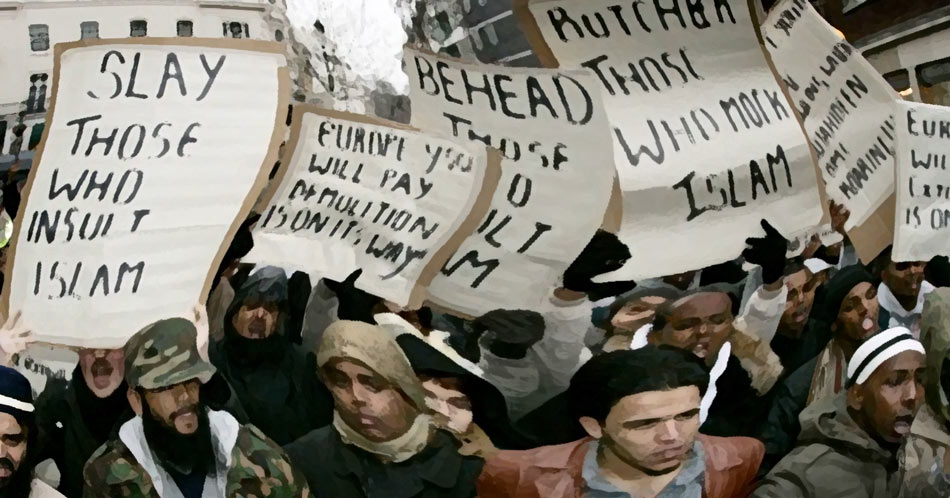
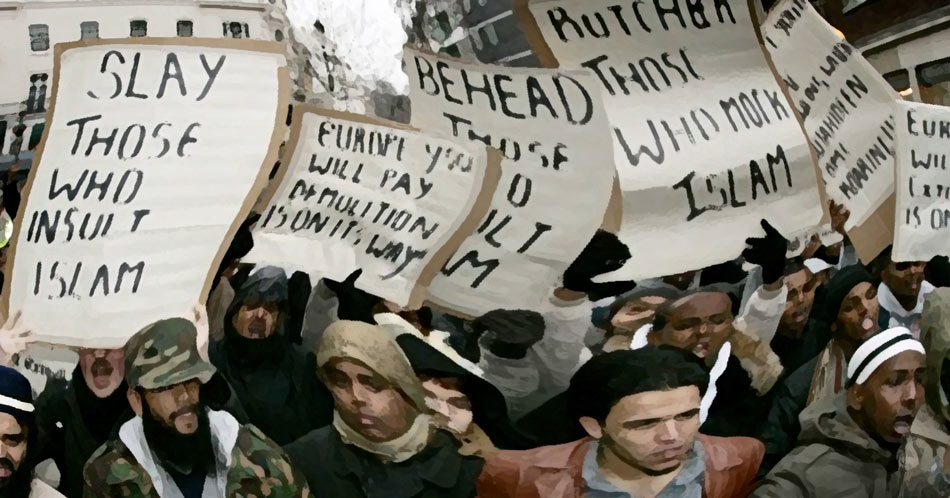
The Dutch were among the first to witness Islamic extremist violence against free speech. The November 2004 murder of Theo van Gogh by a Dutch citizen of Moroccan descent — a man whose first name, Mohammed, almost no one thinks is merely coincidental — stirred the nation.

And the world.

Van Gogh made a short film, with Somalian émigré Ayaan Hirsi Ali, about the unjust treatment of women in Islamic countries. The film criticizes Islam as well as the Muslim majority countries, and was considered an affront by many Muslims.

After van Gogh’s death, Ms. Ali fled to the United States.

This event is only the most famous of many similar conflicts between free-speech Dutch values and regulated-speech Islamist ones. The fact that the country has anti-blasphemy and anti-insult laws on the books, and these have been directed against a popular politician, has exacerbated the growing antagonism.

That very politician is today’s big news. According to The Atlantic, the “center-right People’s Party (VVD) for Freedom and Democracy is projected to win 24 seats in [today’s] election, slightly ahead of Geert Wilders’s far-right Dutch Freedom Party (PVV), which is expected to gain 22.”**

The Dutch center-left, like similar ruling groups in Britain, Germany, France and Sweden, often seems weak and timid before the rising illiberalism of Islamist terrorism and Sharia law.* Many suspect that the recent decision to block Turkish ministers from speaking at rallies in Holland, before Turkey’s referendum next month, is designed to counter this narrative.

Meanwhile, though Wilders is generally liberal (not “far right”) on most cultural issues, his “de-Islamization” program seeks to close mosques and outlaw the Quran***.

One extreme to another.

This is Common Sense. I’m Paul Jacob.


* This is not just a bugaboo. In 2006 the Minister of Justice floated the possibility of incorporating Sharia law into the constitution.

** The projection is within the margin of error, and with mass immigrant Turkish protests taking place over the weekend, the chance of a Trump-like upset is more than possible.

*** Geert Wilders compares the Quran to Adolf Hitler’s Mein Kampf.


Printable PDF