Categories
Common Sense general freedom ideological culture moral hazard too much government

A Tree Fell In a Forest

It’s neither “iconic” nor “ironic.”

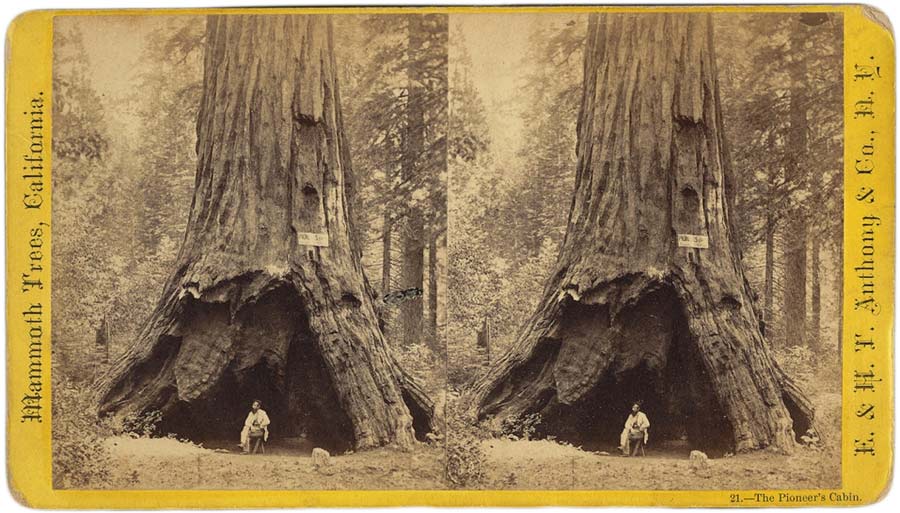
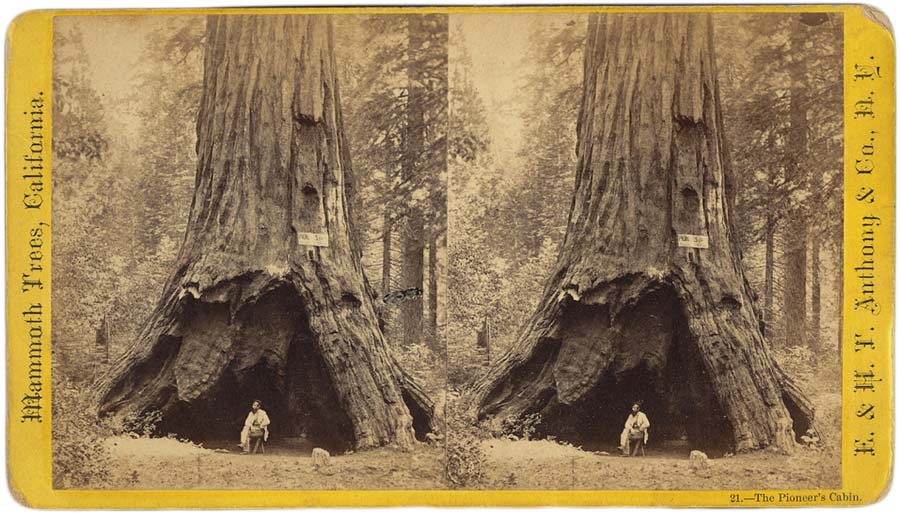
Storm fells one of California’s iconic drive-through tunnel trees, carved 137 years ago,” Travis M. Anderson’s title informs us. Calaveras Big Trees State Park is famous for its hollowed-at-the-trunk Pioneer Cabin Tree, a sequoia you have seen in hundreds of photos.

It fell, almost certainly, because of a storm. The ground got wet, undermining the sturdiness of the tree’s root system. And the winds got fast, sending the tree crashing to the ground.

But that’s not the hole — er, whole story.

The obvious reason it fell down is that the “hollowed-out” tunnel amounted to a huge cut. It is almost as if loggers started the felling job nearly seven score ago, and it took all that time to fall.

That is not “ironic,” in case you were wondering. It’s to be expected. The real wonder is that it stayed up so long.

Which should remind us: more than one cause can contribute to a singular effect. We are always tempted to focus on only one factor when we argue about an event. But in society, as in trees and forests, multiple influences are always at work.

Life isn’t monocausal, to put it in professor-speak.

Anderson dubbed the tree “iconic.” Now, an icon is an image used to stand in for other things that look similar. That tree didn’t stand in or represent, did it, other trees in the forest? It stood in memory by standing out as different, distinct — one of a very few hallowed, hollowed California sequoias. The opposite of “iconic.”

Still, in using the tree’s toppling as an object lesson in complexity, the fallen timber might be iconic. It stands for a common sense view of how tragedies happen.

This is Common Sense. I’m Paul Jacob.

Printable PDF

Calaveras Big Trees State Park is famous for its hollowed-at- the- trunk Pioneer Cabin Tree, a sequoia


Categories
Accountability government transparency ideological culture insider corruption meme moral hazard national politics & policies

Corporate influence. . .

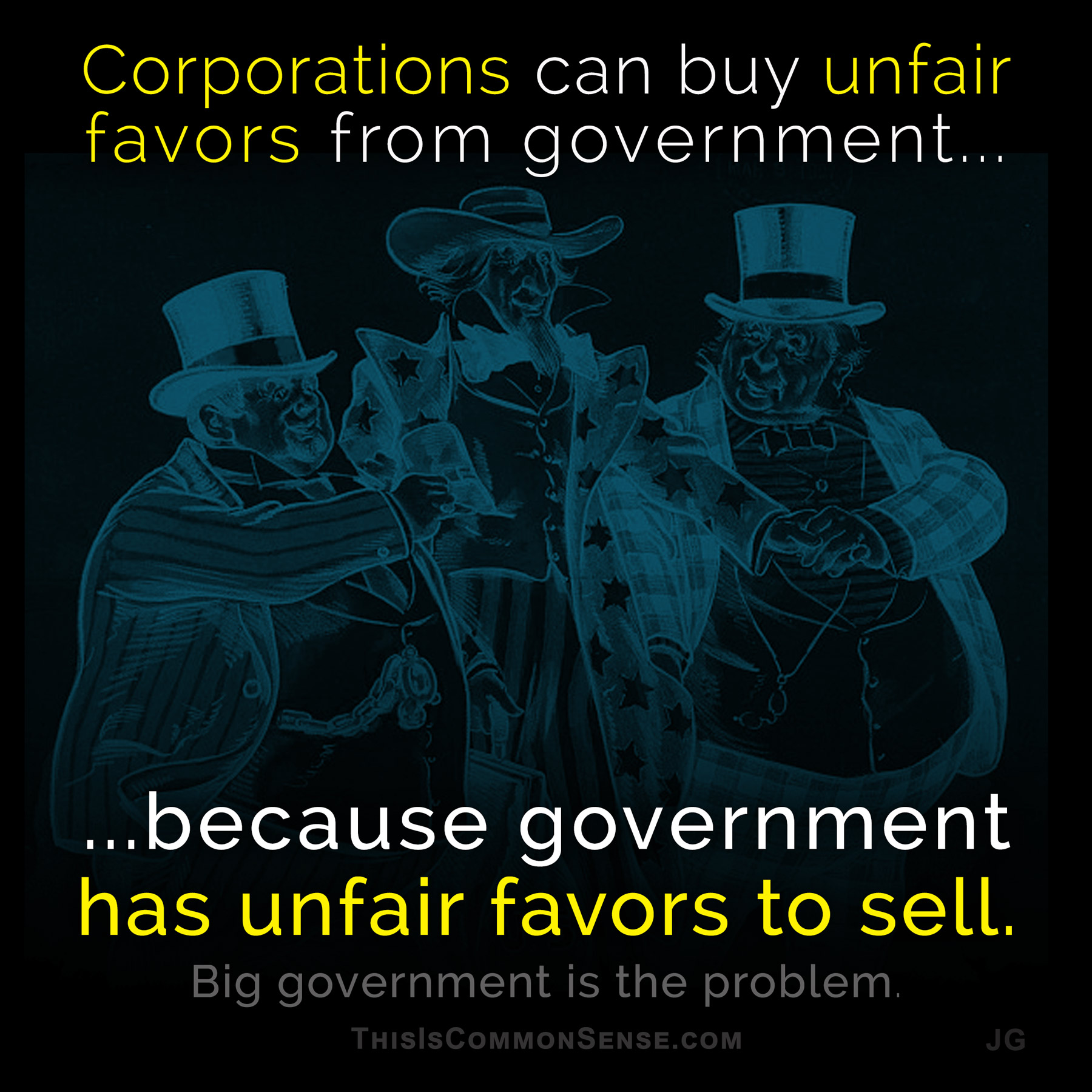
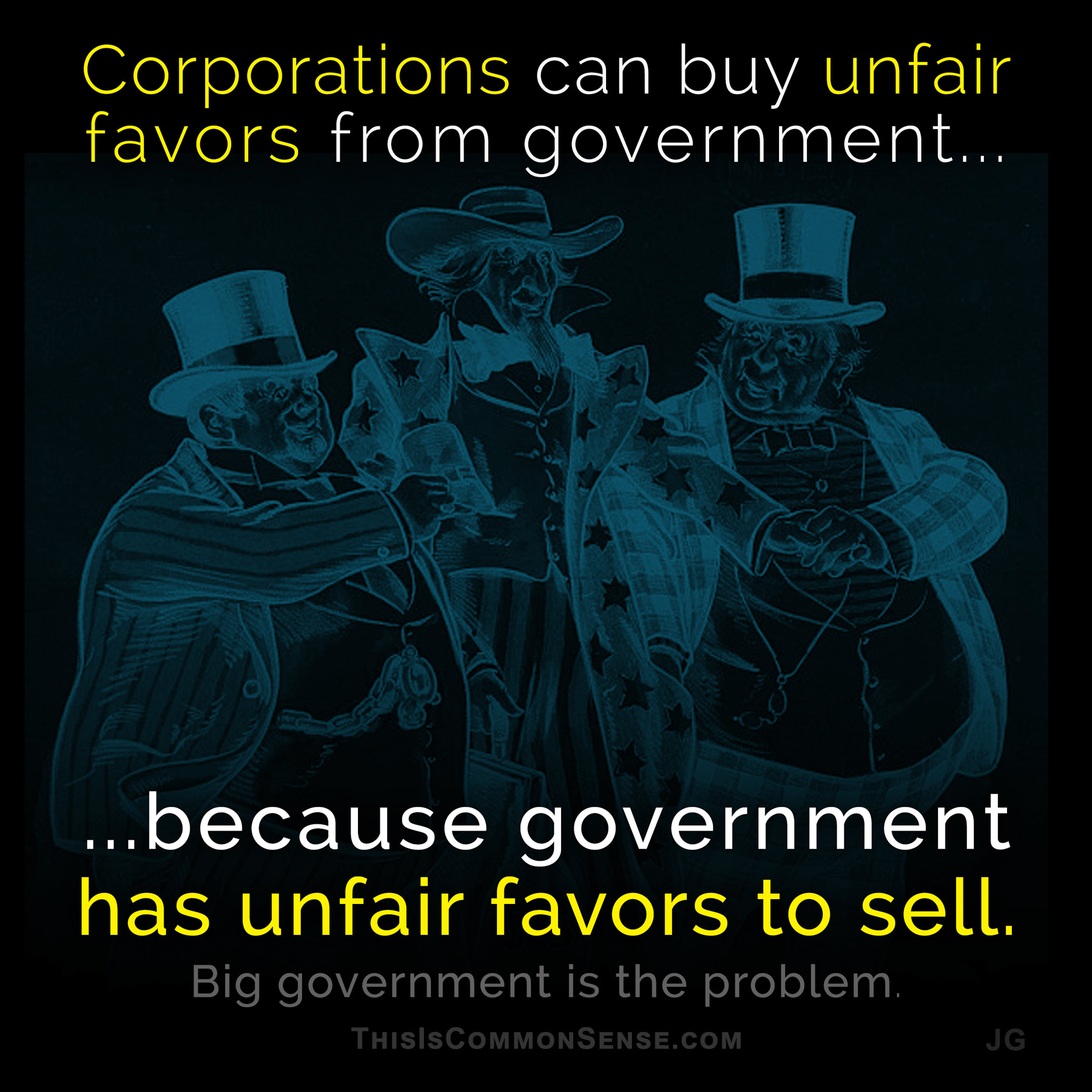
Corporations can buy unfair favors from government…because government has unfair favors to sell.

Big Government is the problem.


Click below for a high resolution version of this image:

corporations, influence, corporation, democracy, power, government, big government, meme, Common Sense, illustration


Categories
crime and punishment free trade & free markets general freedom meme moral hazard national politics & policies too much government

Which is more dangerous?

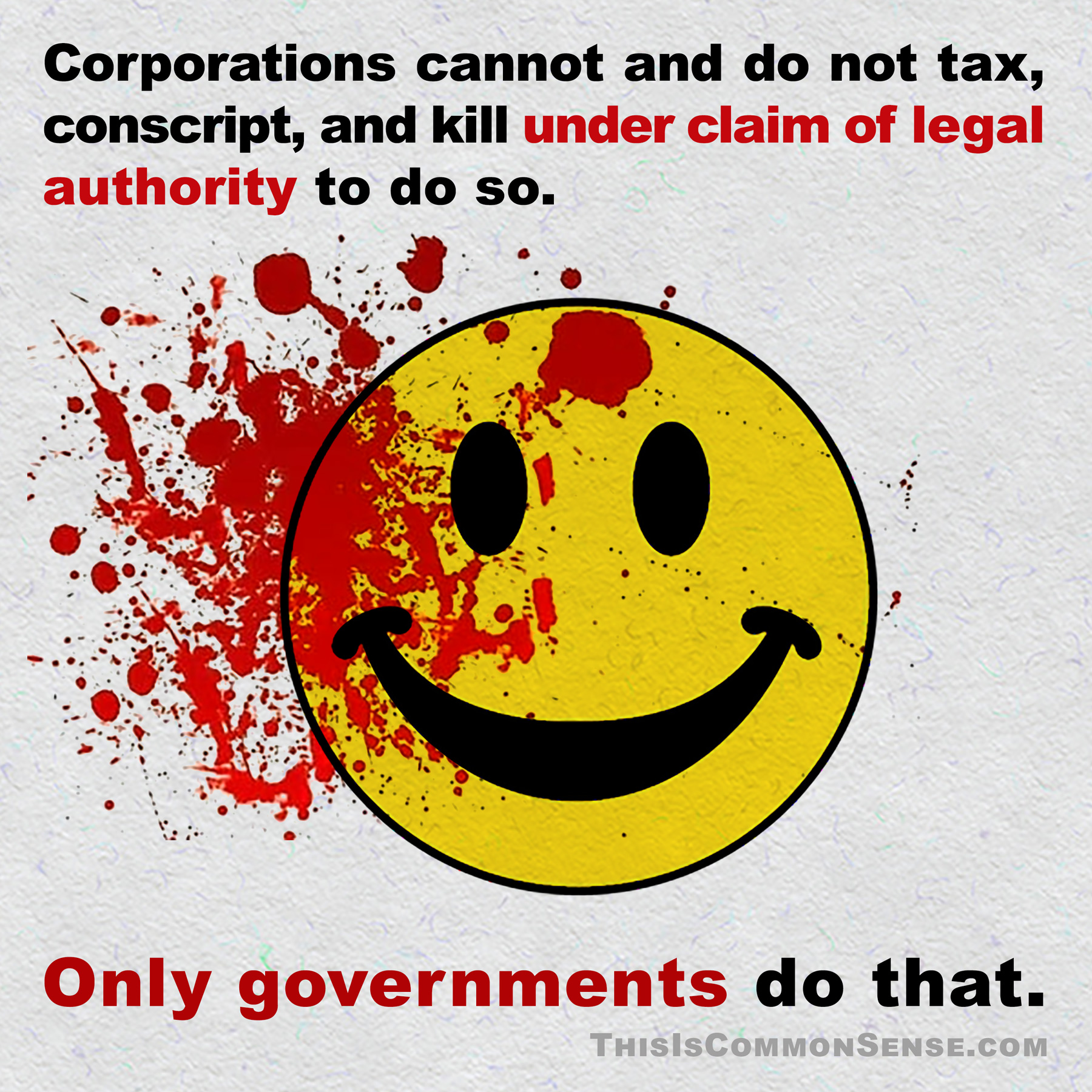
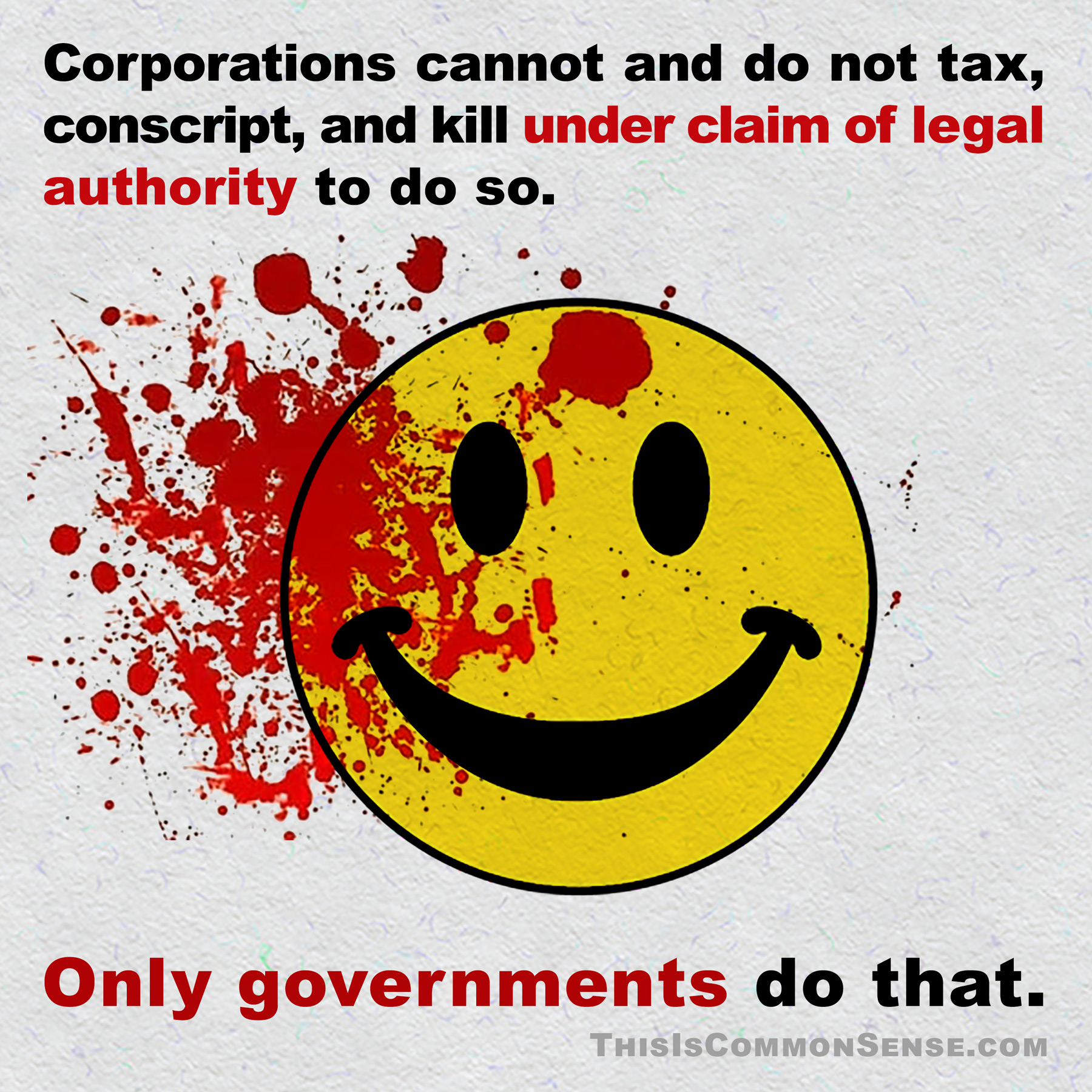
Corporations cannot and do not tax, conscript, and kill under claim of legal authority to do so.
Only governments do that. 

Click below for a high resolution version of the image:
corporations, government, power, danger, government vs. corporation, which is more dangerous, law, corruption, meme, illustration, Jim Gill, Paul Jacob, Common Sense
Categories
Accountability government transparency insider corruption local leaders moral hazard responsibility term limits

Politicians Bearing GIFs

Yesterday, we discovered that the biggest term limits opponent in Arkansas — former state senator Jon Woods — also allegedly led an elaborate legislative fraud scheme, whereby he and a state representative traded tax dollars for cash bribes.

For now, Woods is an unindicted co-conspirator. But last week, the representative involved pled guilty to a felony carrying a possible 20-year prison term and directly implicated Sen. Woods.

Woods’s alleged criminality involves the GIF program — General Improvement Funds. Legislators can personally direct GIF dollars to pet projects and favored cronies, taking political credit. The process is similar to congressional earmarks. And just as corrupting.

In an article entitled, “How a 1997 Power Grab is costing Arkansas taxpayers millions on pet projects,” the grassroots group Conduit for Action explains that the GIF rules changed just before our new millennium, when term limits first cleaned out the state House (1998). The old batch of legislators gave themselves unchecked control over this vote-buying slush fund.

And that is when even bigger corruption surfaced. “A Federal grand jury shook the Arkansas political establishment today with a long list of political corruption indictments that reaches to the apex of the state Legislature,” the New York Times reported in 1999.

Back then, Sen. Nick Wilson was Arkansas’s loudest term limits critic . . . until his three-decade-long career ended with a guilty plea to 133 counts of racketeering and other public corruption.

Interesting that top legislative enemies of term limits, both past and present, wear the Scarlet Letter “C” for corruption. Coincidence?

Term limits are no friend to corruption. And vice-versa.

This is Common Sense. I’m Paul Jacob.

Printable PDF

Arkansas, corruption, term limits, Jon Woods, GIF


Categories
free trade & free markets general freedom moral hazard nannyism national politics & policies

Best Plan Is No Plan

“Republicans would create chaos in the health care system because they are stuck,” Senate Minority Leader Chuck Schumer says, “between a rock and a cliché.”

Oh. Off by a word or two. But I don’t need to fix it.

What needs to be fixed is the whole system. “Head clown”* Schumer gloats that it cannot be done. The “delicate balance” that is the Affordable Care Act makes it impregnable. For all Republicans’ talk of repeal, “for five years now they’ve had nothing to put in its place.”

Schumer sees the trap. He set it when he and his comrades voted Obamacare in without reading it. Any new program with any new constituency always presents a set of . . . political hurdles . . . that quickly become “impossible” to jump.

The President-elect, he notes, has supported three of the “most popular” regulations in Obamacare: “pre-existing conditions,” “26-year-olds on parents’ plans,” and sex equality re: insurance rates.

What Schumer fails to mention is that these are three huge drivers of spiraling insurance prices. The Affordable Care Act “delicately balances” medical markets by shifting who pays for what, hoping that the biggest losers† don’t complain too much and the obvious winners never cease protesting‡ any change.

The truth? Obamacare can be repealed. But replacing it would be a disaster. The best plan is no plan. Repeal all the regulations. The federal government should completely deregulate the markets, and prevent states from ruining interstate markets in insurance and health care.

Do what the Commerce clause was designed to do.

Schumer is counting on Republicans to do nothing. Despite signs they’re cooking up something.

This is Common Sense. I’m Paul Jacob.
 

*What Trump called Schumer. And in the same tweet dubbed Obamacare “a lie.” Truer words never spoken?

† Obamacare presents a huge burden on the self-employed, self-insured, and on the previously insured, since it is these people who most obviously pay for all the newly insureds. Of course, in the end, everybody pays . . . from increasing prices and decreasing rates of progress.

‡ At least they are the focus of advocacy groups. The poor neatly serve as innocent shields of the spoliators.

N. B. Adapted from this weekend’s Townhall column.


Printable PDF

Obamacare, ACA, Healthcare, reform, replace, policy, insurance


Categories
folly general freedom moral hazard nannyism national politics & policies responsibility

Town, County, Stasis

The savvier economists (and intellectuals like Steven Pinker) like to remind us that it is progress that must be explained; poverty is natural.

But when you see poverty settle in like an infestation of slime mold, staining a whole modern city or region, you begin to wonder. As Ron Bailey wonders in his excellent Reason report on West Virginia’s impoverished McDowell County . . .

WHY DON’T THESE PEOPLE JUST MOVE?

The feeling of being trapped in your community — in your hovel, in your own blighted life — does not come, these days, from mere poverty alone. I remember the Joads in The Grapes of Wrath; my family has a history. Once upon a time, folks in America, when industry ran out, left. Traveled. Migrated — to find work where industry boomed.

And sure, McDowell used to be much more populated. Bailey’s family left two generations ago.

But the stragglers?

Almost any community has its specific enticements.

But one thing becomes clear, as you read through Bailey’s sad survey (in part memoir, since he has family ties there): government is the worst culprit.

A lot of welfare goes into McDowell, and a huge percentage of the population is retired or on disability.

“If you get public assistance to supply your needs without any effort from you,” explains one young man who came back to his beleaguered hometown, “you’ve got no incentive to better yourself or your situation.”

Government subsidizes poverty. Sure, it prevents destitution. Utter misery. But it also traps people, robbing them of their wherewithal to get up and go and achieve something.

Modern government is in the stasis business. Our assistance programs don’t just assist.

A modern American nightmare.

This is Common Sense. I’m Paul Jacob.

Printable PDF

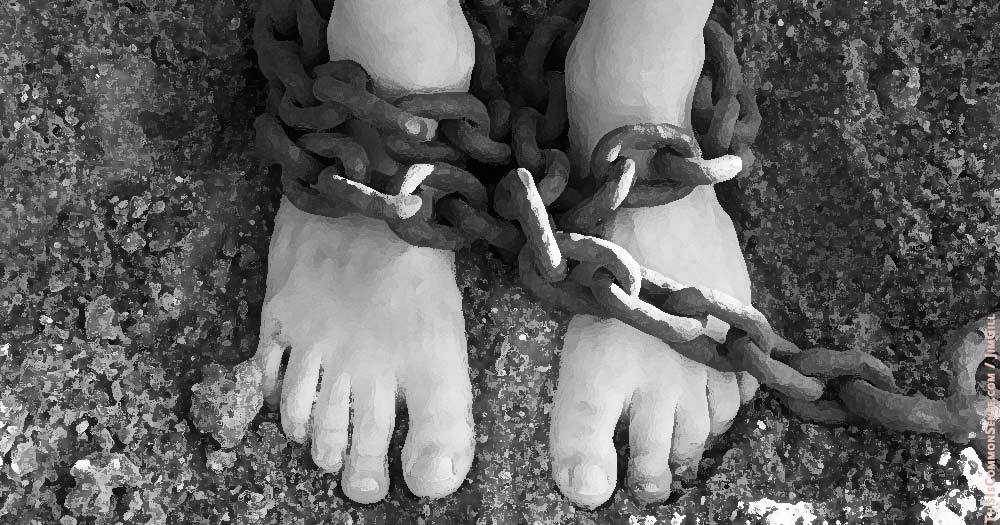
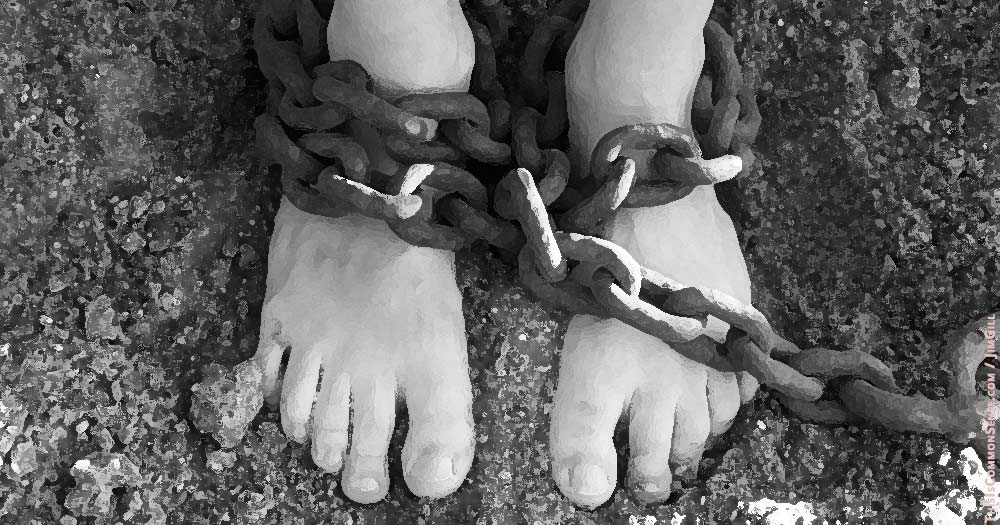
chained, West Virginia, poverty, welfare,


Categories
Accountability crime and punishment general freedom moral hazard national politics & policies privacy responsibility

In Plain Sight

The Berlin terrorist attack just a little over a week ago fit a noteworthy pattern. German authorities had investigated Anis Amri — the Tunisian man who drove that large truck into a crowded Christmas market, killing 12 and wounding 56 others — and found “links with Islamic extremists.”

Later killed in Milan, Italy, Amri had been wanted in Tunisia for “hijacking a van” and jailed in Italy for arson and a “violent assault at his migrant reception center.” And yet with all that known or easily knowable, the German authorities couldn’t prevent him from killing innocent Germans.

It’s not just a European phenomenon, either.

Consider Omar Mateen, this country’s worst mass shooter, having massacred 49 people in Orlando’s Pulse nightclub. The FBI had spent ten months looking into Mateen.

Years before the Boston Marathon bombing, the FBI had tracked Tamerlan Tsarnaev, one of the bombers.*

“In case after case . . . authorities have come forward after the fact to say that they had enough cause to place the suspect under surveillance well before the violence,” the Washington Post recently noted. This was the case with the majority of recent lone-wolf terrorism plots.

“If any lesson can be learned from studying the perpetrators of recent attacks,” a report in The Intercept concluded, “it is that there needs to be a greater investment in conducting targeted surveillance of known terror suspects and a move away from the constant knee-jerk expansion of dragnet surveillance . . .”

Yet intelligence agencies are still grabbing our metadata in violation of the Fourth Amendment. That needs to stop.

The fact that known threats are consistently not being stopped suggests curtailing mass surveillance won’t hurt our security, but improve it.

This is Common Sense. I’m Paul Jacob.
 

* The same is true regarding the Ft. Hood (work-place) shooter, Nidal Hasan. Likewise, Abdulhakim Mujahid Muhammad (formerly Carlos Bledsoe), who was under the active eye of the FBI after returning from Yemen . . . until he opened fire on a Little Rock, Arkansas, recruiting station killing one soldier and wounding another. Ditto Ahmad Khan Rahami, the less deadly bomber in New York City and New Jersey.


Printable PDF

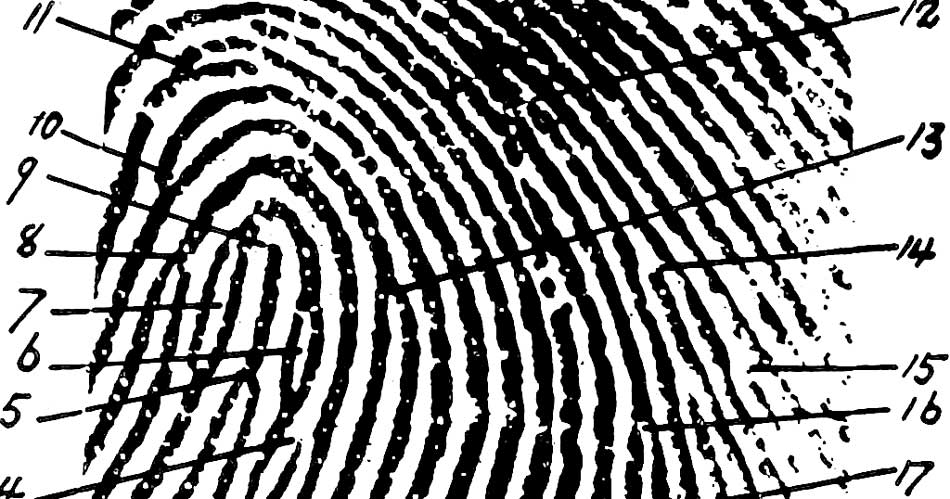
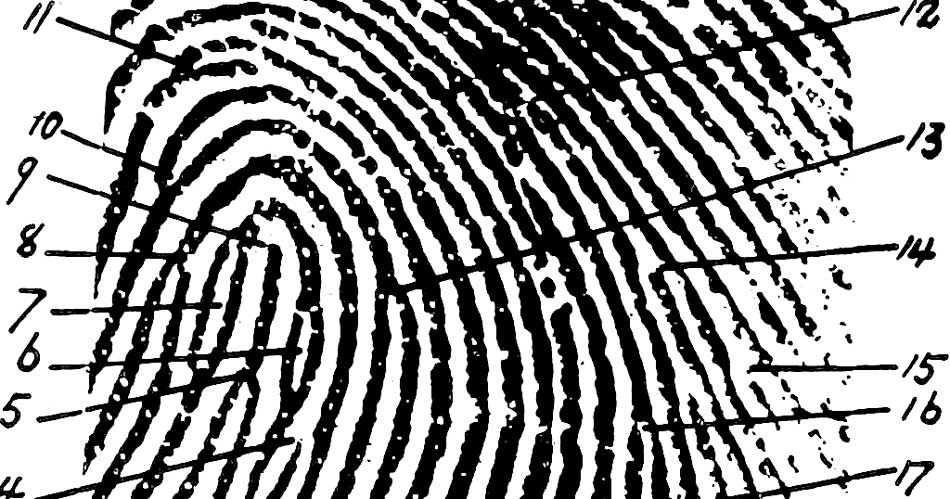
terrorism, surveillance, privacy, fingerprint, targeted, illustration


Categories
Accountability government transparency initiative, referendum, and recall local leaders moral hazard

Rules for Rulers?

Politicians in Tampa, Florida, have forced citizens there to vote for term limits, and then vote to keep those term limits again and again — against attempts to repeal or weaken the limits. So I keep my eye out for news from the city.

Earlier this month, Mike Deeson, an investigative reporter with WTSP 10 News, Tampa Bay’s CBS affiliate, exposed Mayor Bob Buckhorn’s open violation of the city charter’s requirement that all department heads must be city residents. Buckhorn hired Sonja Little, now the city’s highest paid employee, to serve as his Chief Financial officer, and admits on camera that he promised her she would not have to move into the city.

“The question is,” the mayor explained, “do you want talent or do you really make the residency — she’s only about a mile away from the city border — the issue?” Buckhorn answers his own question, “I would rather have talent” . . . than follow the law.

In even slipperier fashion, Mayor Buckhorn has attempted to get around the clear, unequivocal wording in the charter by claiming Ms. Little has served as the “interim” Chief Financial officer for the last five years!

Reporter Deeson asks the operative question: “[I]f you’re going to ignore the residency requirement, what other parts of the charter should you just ignore?”

Deeson worries about provisions requiring competitive bidding, guarding against conflicts of interest and mandating term limits, which is “particularly problematic for a mayor who is in his second term and has to leave office when it’s over.”

On social media, Tampa residents are unloading on the mayor with numerous variants of: “This is truly what’s wrong with government.”

This is Common Sense. I’m Paul Jacob.

Printable PDF

Tampa, initiative, corruption, Mayor, Mike Deeson, Mayor Bob Buckhorn


Categories
Accountability crime and punishment initiative, referendum, and recall moral hazard national politics & policies

Stealing Now Unpopular

Civil asset forfeiture is stealing. So, why is it still happening?

Police seize boats, cars, houses and cash that they allege were used in the commission of a crime or were proceeds from the crime. Sometimes they simply take cash found on a motorist in a normal traffic stop, claiming it’s “drug money.”

Tragically, only 13 percent of forfeiture is criminal, i.e. involving a conviction. The rest is civil, wherein the person hasn’t been convicted of anything. Often not even charged.

When officials confiscate property without due process of law, it’s theft. The legal rationale government uses to snatch our stuff via civil forfeiture is a sick joke. Our property can be deemed “guilty” without enjoying our presumption of innocence. Instead, we have to go to court to prove our stuff is innocent.

Often officials negotiate a large cut, because hiring an attorney to get one’s money back might well cost more than the money itself.

The good news? People are becoming aware of civil asset forfeiture and overwhelmingly oppose it. A Cato Institute/YouGov poll found 84 percent of Americans against taking property without a criminal conviction.

While New Mexico and Nebraska have outlawed civil forfeiture, and some other states have sought to at least minimize its abuse, there is still significant pushback from police and prosecutors, who like getting all that dough. And who often have the ears of decision-makers.

The time has come to short-circuit the watered-down half-measure. Twenty-four states and a majority of cities enjoy the initiative process.

Let’s do it ourselves.

This is Common Sense. I’m Paul Jacob.

Printable PDF

Civil Asset Forfeiture, crime, drugs, marijuana, stealing, theft, police abuse


Categories
Accountability ideological culture media and media people moral hazard nannyism national politics & policies

The Revenge of the Gatekeepers

We saw glimmerings last year when Twitter began to selectively enforce “policy” against some (Milo Yiannoupolis) and not against others (the hordes of leftists who threatened to assassinate Donald Trump).

You could see it in Hillary Clinton’s campaign; after Trump won, it loomed to eclipse all reason.

And on Thursday I noted Congress’s reaction.

I refer to the hysteria over non-Democratic “memes” and “fake news” that trumped the erstwhile gatekeepers of the Fourth Estate and the political classes — including the lobbying and bureaucratic cliques — and stymied the ascension of Mrs. Clinton to the Most Powerful Office in the Whole Wide World.

Now Facebook has come on board with a way to combat this freewheeling flow of ideas.

Fact-checking.

Hayley Tsukayama, writing in the Washington Post, explained the new program:

The social network is going to partner with the Poynter International Fact-Checking Network, which includes groups such as Snopes, to evaluate articles flagged by Facebook users.

If those articles don’t pass the smell test for the fact-checkers, Facebook will pass on that evaluation with a little label whenever they are posted or shared, along with a link to the organization that debunked the story.

The problem, here, is not a First Amendment issue: Facebook is not the government; when it tampers with your communications, it does not break the law.

The problem is that the Internet’s self-proclaimed fact-checkers are not exactly fair-minded, or even capable of sticking to the facts. I quoted Nietzsche yesterday (“there are no facts, only interpretations”), today I will merely reference Ben Shapiro, who has a history with false fact-checkers, and riff off of Juvenal: who will fact check the fact checkers? (Obvious, I know.)

Meanwhile, the folks behind new social media service minds.com offer an innovative posting promotion system, and promise never to sneakily favor some ideas over others.

The proper response to a business firm’s discriminatory policy is to provide market pressure.

This is Common Sense. I’m Paul Jacob.


Printable PDF

watchers, watchmen, media, fake news, fact check, illustration