Categories
ideological culture judiciary litigation

Trouble with Definitions

Is it time to push for a complete wall of separation between Sports and State?

The First Amendment helped the United States — together and separately — protect religion from the ravages of regulation, taxation, suppression, and favoritism. Maybe it’s time to extend the concept. 

This came to mind as I skimmed through the transcript to a current case before the Supreme Court, Little v. Hecox (Docket No. 24 – 38), which involves a challenge to Idaho’s law restricting “transgender women and girls” from participating in women’s and girls’ sports.

I doubt the forthcoming ruling will get government out of sports generally, much less out of sports in public schools — which is what this is all about, Idaho’s law applying only to athletic teams sponsored by public educational institutions (or certain nonpublic ones competing against public ones), not to purely private teams. 

One lawyer for the respondents, Kathleen R. Hartnett, Esq., got stuck with the “tough” job. She was asked by Justice Alito if an understanding of what men and boys are, and what women and girls are, was relevant to the Equal Protection Clause. She said yes, but then confessed to lacking a definition of the sexes for the Court.

Then “how can a court determine that there’s discrimination on the basis of sex,” Alito inquired, “without knowing what sex means.… ?”

Her answer started out on a most unpromising note: “I think here we just know …” immediately pivoting to the statute’s applicability. Alito went on to challenge her on a key notion in trans ideology, that one becomes trans just by saying so.

I see a lot of people online chortling on the comedy of it all.

But I think here we just know it’s … seriously troublesome.

This is Common Sense. I’m Paul Jacob.


PDF for printing

Illustration created with Nano Banana

See all recent commentary
(simplified and organized)
See recent popular posts

Categories
litigation property rights

Miami’s Property-​Grabbing Vice

All Chad Tausch wanted to do was add a few rooms to his Miami home.

In many cities, homeowners need a permit to make such additions. But although the city had no problem with his proposed construction, it required something more than a permit fee: half of Tausch’s front yard — without even offering to pay for it. No land surrender, no permit.

The city has been making the same demand of other homeowners who need alteration permits. 

The city has a plan, a goal: Pile up land that the city might one day use to widen roads. The Institute for Justice (IJ) has identified “more than 1,000 homes threatened by this scheme across 66 streets.”

“The right to prevent the government from unlawfully taking your property is a right recognized from the very start of this nation,” says Suranjan Sen, an attorney with IJ. “The city of Miami cannot simply decide to take your property away because it wants it.”

Well, thus far, the city has thus simply decided. It’s been operating the scheme for years. The question is whether it’s constitutionally entitled to do so; obviously, no.

Tausch didn’t submit to the extortion. Instead, he turned to IJ for help in challenging Miami’s practice in court. As a result of the litigation, the city has waived the land-​for-​permit requirement in his case.

Victory! But what about all those other homes on the 66 streets, which remain in jeopardy?

Well, the Institute for Justice is continuing the lawsuit, seeking to liberate all Miami homeowners from the city’s sneaky scheme.

This is Common Sense. I’m Paul Jacob.


PDF for printing

Illustration created with Nano Banana and Firefly

See all recent commentary
(simplified and organized)
See recent popular posts

Categories
litigation Tenth Amendment federalism U.S. Constitution

Planned Parenthood Gets the Boot

Medicaid is a huge handout and also a massive burden, straining resources and tax revenues, and (of course) adding to the debt. It is also known for its complexity, a federal program run by the states. 

Some reformers, seeing the program as an over-complicated mess, yearn to “simplify” it by providing medical care as a “free” federal program. Others, concerned about the dangers of centralization and the obvious incompetence of bureaucracies far removed from taxpayers, advise collapsing Medicaid completely back to the states, to be organized and funded locally.

In this context, the Supreme Court’s ruling yesterday allowing South Carolina to remove Planned Parenthood from its Medicaid program is instructive.

“The majority opinion in the 6 – 3 decision in Medina v. Planned Parenthood South Atlantic was written by Justice Neil Gorsuch,” explains Matthew Vadum in The Epoch Times. “The new ruling reverses a federal appeals court decision that blocked South Carolina from excluding Planned Parenthood from the program.”

The key issue in the litigation regards a supposed right to choose medical providers: South Carolina, by dropping Planned Parenthood, was alleged to be abridging the right of recipients to choose their medical providers.

Remember that choosing your doctor was falsely promised by President Barack Obama in his medical insurance scheme — so, obviously, the option is highly valued by Americans. But is it a “right”?

“New rights for some mean new duties for others,” Justice Gorsuch wrote, elucidating a basic principle of legal philosophy. 

Applying the idea of rights to government handouts (in which taxpayers are on the hook) is a recipe for disaster. 

Applying federalism, on the other hand, makes not only constitutional sense, but — because the states are closer to both taxpayers and those in need — Common Sense.

I’m Paul Jacob.


PDF for printing

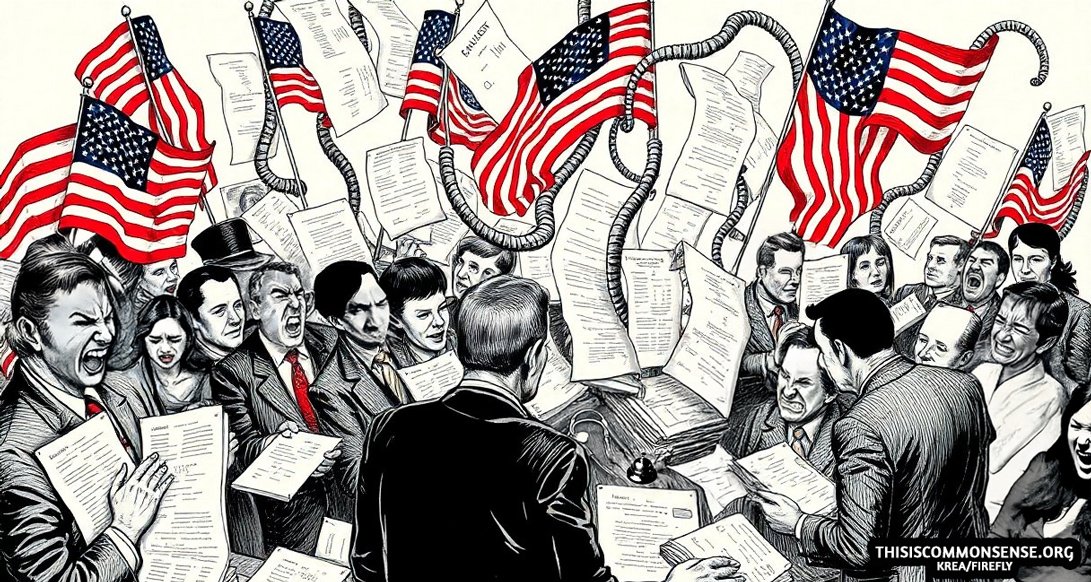
Illustration created with Krea and Firefly

See all recent commentary
(simplified and organized)
See recent popular posts
Categories
litigation property rights U.S. Constitution

The Stealing Goes On

“On March 24, 2025, the Supreme Court of the United States declined to take up the case of Bowers Development, LLC. v. Oneida County Industrial Development Agency Et. Al.,” writes Conner Drigotas, “a decision that allows the practice of legalized theft through eminent domain to continue throughout America.”

This is not good news, as Mr. Drigotas explains. “In that case, Bryan Bowers had asked the Justices to review a ruling from the Supreme Court of New York that allowed Utica city officials to take land on which he had a contract to build and give it to a different private corporation for a separate construction project.” Mr. Bowers had “hoped to stop government officials from using force to pick winners and losers in the construction industry.” But it was a no go.

Politicians and bureaucrats love to grab other people’s property, under cover of “the public interest.” But their “public interest” is nothing more than a thin disguise for helping some individuals (often contributors to politicians’ campaigns) at the expense of others.

“With their denial of Bowers, Justices continued to show support for one of the most hated and notorious decisions to come out of their lofty chambers: that of Susette Kelo v. New London, Connecticut,” explains Drigotas. The Kelo case, often mentioned here, remains the ruling precedent, the government’s license to steal. Its loose construction of what can be regarded as in “the public interest” is a big part of the problem. 

Sadly, the courts have so far refused to rein in government eminent domain abuse. And voters have little sway upon the judiciary. And our representatives, our first line of defense, have also declined to stand up for basic justice and decency.

What to do? Remember that your representatives will soon be on the ballot.

This is Common Sense. I’m Paul Jacob.


PDF for printing

Illustration created with Krea and Firefly

See all recent commentary
(simplified and organized)
See recent popular posts

Categories
education and schooling litigation U.S. Constitution

Education Function Injunction

When President Jimmy Carter broke his 1976 campaign pledge by adding another Cabinet-​level department to the federal roster, he swore that a “separate Cabinet-​level department will enable the Federal government to be a true partner with State, local, and private education institutions in sustaining and improving the quality of our education system.”

On March 20, 2025, President Donald Trump signed an executive order aimed at shutting down Carter’s Department of Education, fulfilling his campaign promise to reduce federal involvement in education.

This was popular because everybody who’s not a bureaucrat or a teachers’ union agent knows that federal involvement in schooling, since Carter’s time, has been, not just a waste, but a detriment.

Still, teacher union-​dominated Democrats are swiping at the administration with numerous lawsuits. U.S. District Judge Myong Joun in Boston issued a preliminary injunction blocking Trump’s layoffs and transfers, ruling that they amounted to an unlawful attempt to dismantle the department without congressional approval. 

Earlier this month, the 1st U.S. Circuit Court of Appeals upheld Joun’s injunction, rejecting the Trump administration’s request to pause the order while appealing. 

Two days later, the Trump administration, through Solicitor General D. John Sauer, filed an emergency appeal with the U.S. Supreme Court. The plea? Lift the injunction and allow the layoffs and reorganization to proceed. Trump’s team argued that the lower court had overstepped its authority and that the layoffs were a lawful personnel action to streamline the department, not an attempt to abolish it without Congress. 

The injunction sent DOE functionaries back to work. Nothing’s been resolved.

Not even the rationales for Carter’s “greatest achievement” (to quote the title of a USA Today op-​ed). Carter had promised to reduce the number of departments, for efficiency’s sake. When creating the DOE, he said the move would increase efficiency. 

Instead, it merely increased education spending while academic achievement has plummeted.

This is Common Sense. I’m Paul Jacob.


PDF for printing

Illustration created with Krea and Firefly

See all recent commentary
(simplified and organized)
See recent popular posts

Categories
litigation

A Million from Michael Mann

Things aren’t working out for Michael Mann. The infamous “climate scientist” has been pursuing a years-​long vendetta against critics of his methods and conclusions, and it’s been a bumpy ride.

Mark Steyn and Rand Simberg accused him of manipulating data “in the service of politicized science.” Instead of answering the criticism, Mann treated it as actionably defamatory.

In 2012, Mann launched a lawsuit against Simberg (of the Competitive Enterprise) and Steyn (then writing for National Review).

National Review observes that the criticism which offended Mann “was obviously protected by the First Amendment,” so that his suit should have been scuttled immediately.

Instead, judges antagonistic to free speech when they find the speech uncongenial enabled Mann’s litigation to trundle on for years.

The story gets complicated, as touched upon a few months ago. In 2021, the tide seemed to be turning in favor of Steyn and Simberg, with a court issuing a favorable summary judgment. But in January 2024, a jury found Steyn and Simberg liable for defamation. The awards? Steyn was ordered to pay $1 in compensatory damages and $1 million in punitive damages, Simberg to pay $1 in compensatory damages and $1,000 in punitive damages.

That insane $1 million amount was later reduced to $5,000.

Now it is Mann taking the hit, with rulings that he must pay about a million bucks in legal fees to CEI and Rand Simberg ($477,350) and National Review ($530,820).

National Review urges Michael Mann to finally relinquish his authoritarian quest lest he lose even more. 

Will he? It would be irrational to continue, but it was irrational at the start.

This is Common Sense. I’m Paul Jacob.


PDF for printing

Illustration created with Krea and Firefly

See all recent commentary
(simplified and organized)
See recent popular posts