Categories
Accountability general freedom ideological culture media and media people moral hazard national politics & policies Regulating Protest

Gatekeeping 2.0

There once was opinion hegemony, almost a monopoly. Official gatekeepers kept unwanted ideas — including some of mine, including many I strongly oppose — out of public consideration.

Then came the online media revolution, which switched influence from corporate, academic-approved media outlets to truly new media, like Facebook, Twitter and YouTube.

And now? The counter-revolution.

We saw it obviously in the downgrade and then banning of Milo Yiannopoulis’s Twitter, last year. Since then, new measures surface on a regular basis.

We helots, we commonfolk, must not be allowed actually to affect an election!

Or the hearts and inquiring minds of Americans, Europeans, and others worldwide.

Unless that opinion has received the imprimatur of the Center-Left.

I’ve written about this return of the Gatekeeper mentality before. The latest malefactor is YouTube, which locked Dr. Jordan Peterson out of his account this week* as well as put in place new policies to hobble the social sharing elements of YouTube.**

A week or so earlier, Patreon, an online crowdfunding patronage web service I’ve been thinking about trying out, cancelled independent journalist Lauren Southern’s account. Patreon managers charged that her most recent endeavor might cause “loss of life,” but, tellingly, “showed no evidence or proof, are allowing no appeal and have acted as judge, jury and executioner” — as one concerned netizen not inaccurately summarized.

The company’s CEO calmly explained himself to Dave Rubin on YouTube. Does he convince you?

I catch a whiff of panic.

This is Common Sense. I’m Paul Jacob.


* Dr. Peterson’s account has since been reinstated, no explanation given.

** You can learn all this and more on YouTube itself — so the platform hasn’t been shut down as such. Instead, a new Artificial Intelligence will restrict videos that do not even break YouTube terms of service, removing Likes, Comments, and Search features.


PDF for printing


Categories
Accountability general freedom ideological culture initiative, referendum, and recall local leaders moral hazard national politics & policies

Reactionary America

With the meteoric transit of Anthony Scaramucci — into the Trump Administration and then, in an eye-blink, out of it — I have never been more convinced of the vital importance of state and local activism.

Yes, it’s been a chaotic week in Trumptown. The new White House Director of Communications vulgarly communicated himself into administrative excommunication. So to speak.

Everybody’s heard the vulgarisms; we’ve all processed the insanity. It looks like Mr. Scaramucci is one of those professionals who think everybody else is an idiot, and in so thinking it, proves himself to be what he himself despises. @#$%&?!

The man nicknamed “The Mooch” screwed the pooch, as we now say, and we can all shake our heads and . . .

what?

What is the lesson?

We have long known the worst: our national politics is broken. It has been for a very long time. Is it possible we never recovered from the LBJ and Tricky Dick fiascos of my childhood? The parties have become more ideological and less regional, while the regions have become . . . less rational. The only word seems to be . . .

reactionary.

The press reacts to the president’s tweets, and the president tweets in response to media reaction.

Progressives hate progress; conservatives conserve nothing.

“Reactionary” is the apt word, despite all the term’s past Marxist associations, because no one seems able to think forward, independent of partisan oppositionalism.

Don’t drive yourself crazy with this. Look homeward; think locally, act locally, and let’s build on a solid foundation.

This is Common Sense. I’m Paul Jacob.


Printable PDF


Categories
Accountability folly free trade & free markets general freedom ideological culture moral hazard nannyism national politics & policies too much government

ObamaCare’s Casualties

We all know the truth: Partisan “warfare” yields the usual war casualty, truth itself. Now, because of the increasing weight of federal government presence in healthcare markets, partisan untruth incurs medical costs.

Take the goofy Republican plan(s) to “repeal and replace” ObamaCare — pushed with so many half-truths and downright lies that one wonders where to begin. But before die-hard Republicans get too incensed about this judgment, let’s note that the supporters of the mis-named “Affordable Care Act” are no better.

Probably worse.

“Fact-checking,” writes David Harsanyi on the media mishandling of ObamaCare, “has evolved from an occasionally useful medium to an exercise in revisionism and diversion.” Journalists now seem more like spin doctors.

And their patient? The reputation of ObamaCare’s namesake.

One journalist, for example, insists that “Obama didn’t lie or ‘mangle facts’ or mislead anyone,” Harsanyi writes.

What does this journalist claim Obama did in repeatedly promising “if you like your doctor you can keep your doctor”?

Well, “he gave a ‘misguided . . . pledge.’ The word ‘misguided’ intimates that Obama wasn’t misleading anyone on purpose.”

It helps the former president save face if he accidentally got us in this fix. He had the best intentions, you know.

Worse yet, as both sides snipe about these little untruths, they lose sight of the biggest truth, which I wrote about this weekend: that “government-run” means “government-decided,” and that, in turn, means

government deciding matters of your life and your death.

It would be helpful if our leaders took this all a bit more seriously, daring to speak truth . . . to us . . . as well as to themselves and each other.

This is Common Sense. I’m Paul Jacob.


Printable PDF


Categories
education and schooling free trade & free markets general freedom ideological culture media and media people national politics & policies privacy property rights responsibility too much government U.S. Constitution

According to Economics

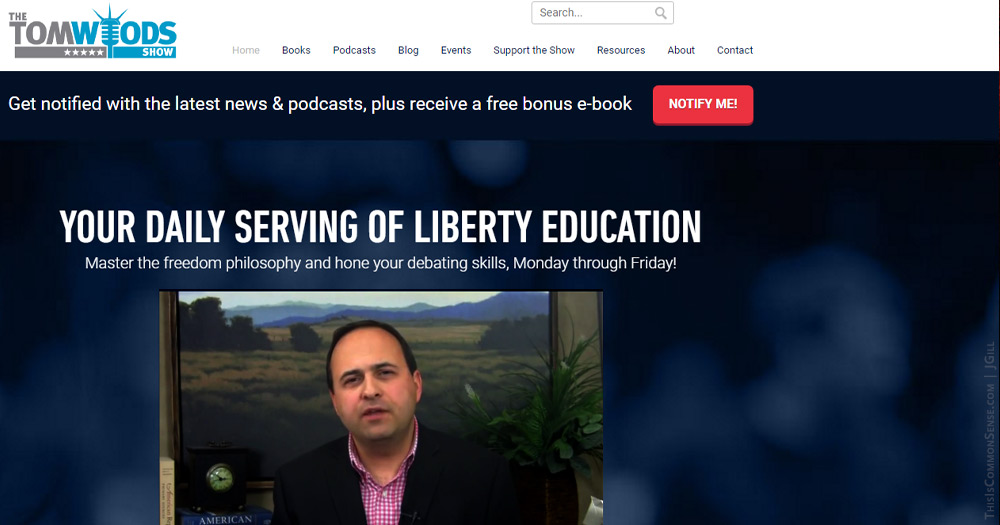
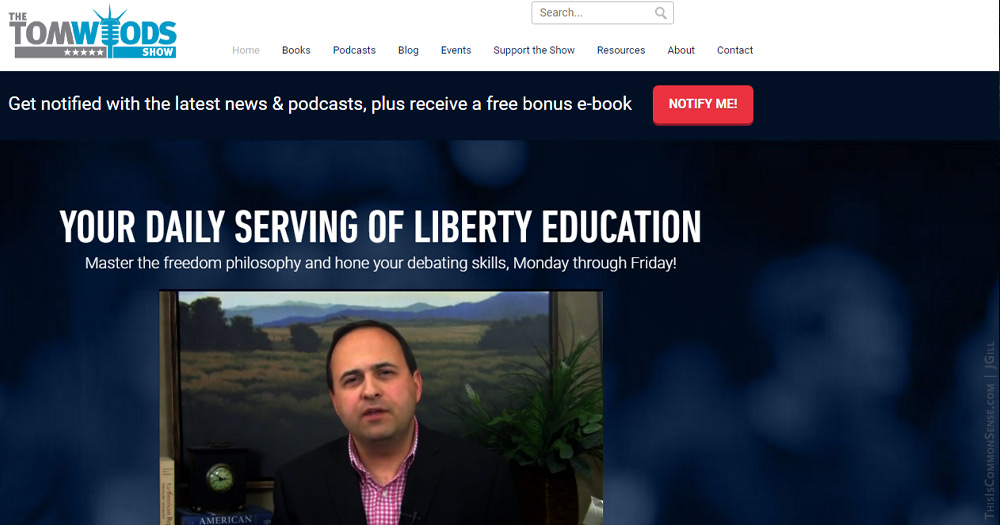
“Everywhere you look, economics is despised,” writes Tom Woods in his Tuesday email letter.

You know what isn’t despised? A daily email letter.*

But I digress; back to economics.

“The gimme-free-stuff people hate it because they don’t like being told that there might be undesirable side effects from seizing other people’s things.”

Well, true enough. But turn it around: many people demand free stuff at least in part because they do not understand the bigger picture . . . which Mr. Woods ably provides in his daily podcast and on his weekly Contra Krugman podcast with economist Bob Murphy.

“Politicians hate it, because it imposes logical constraints on what political activity can accomplish.”

True, but, like many in the general public (from whence they come), politicians’ prior lack of economic knowledge also leads, in part, to their hubris.

“Even some folks in the business world hate it, because (1) they’d rather agitate for special privileges than hear the case for free markets, and (2) they’d rather have low interest rates than be warned about the causes of the business cycle.”

Yes, too true. But, again, business people are generally just people, most of whom haven’t even been exposed to something beyond boring and misleading textbook econ, if that. Mr. Woods knows that, since that’s what his mission is, exposing more folks to ideas beyond what he calls “the index card of allowable opinion.”

Well, I’m all about allowing the unallowable — if it’s right!

This is Common Sense. I’m Paul Jacob.


* Historian Woods is now doing what I’ve been doing since 1999, providing a daily common-sense thought that is short and easy-to-read and dropped into your email box every weekday. Mine goes up online at ThisIsCommonSense.com; I don’t see his on his website . . . but I do see a lot of books and podcasts!


Printable PDF


Categories
Accountability folly general freedom ideological culture moral hazard nannyism national politics & policies property rights responsibility too much government

The Worst Is the Enemy of the Cure

You’ve heard the adage: “the perfect is the enemy of the good.” This can be true in politics, where opposing an ameliorating reform because it is not ideal means, sometimes, getting stuck with unmitigated policy disasters.

But there’s a corollary: in politics the worst is likely to emerge . . . when practiced compromisers succumb to fearing the best, because unpalatable, or perhaps not in line with political interests.* Trying to avoid the “best is the enemy of the good,” we’re left with the outrageously awful.

Cures worse than the disease are not uncommon. The Democrats’ “Affordable Care Act” (ObamaCare) was a clumsy, badly drafted hodgepodge designed to fix problems by doing the opposite of what made sense.

And it immediately started having ill effects, pushing up costs for many, many health-care and medical insurance consumers.

No wonder Republicans ran year after year promising repeal.

But now that Republicans have the chance for a real cure, they’re chickening out. The Senate just debuted their ObamaCare replacement. And Senator Rand Paul (R-Ky) calls it “worse than ObamaCare.”

Why worse?

Because Republican politicians are better at promising than delivering. Fearing how those who directly benefited from ObamaCare might squawk, and how badly the GOP would be treated in the media because of this, moderates went with what they know: snake oil.

Fortunately, Rand Paul’s opposition may kill the bill. If one other senator joins Dr. Paul — and Sen. Susan Collins (R-Maine) who announced her opposition for other reasons — in not voting for the monster, it will not pass.

Which is great, because going for a cure worse than the previous cure leaves us all with the worst possible outcome.

This is Common Sense. I’m Paul Jacob.


* Like many cures. Politicians these days no longer have the knack for the necessary “spoonful of sugar” to help medicine go down. They prefer distributing just sugar pills.


Printable PDF


Categories
Accountability folly free trade & free markets ideological culture media and media people national politics & policies

Next Bubble to Pop?

There was a great and wondrous moment, a decade and a half ago, when economist Paul Krugman, Nobel Laureate and New York Times’s unregistered shill for the Democratic Party, suggested that what the economy really needed was another housing bubble.

What he wrote, specifically, was this: “To fight this recession, the Fed needs more than a snapback; it needs soaring household spending to offset moribund business investment. And to do that, as Paul McCulley of Pimco put it, Alan Greenspan needs to create a housing bubble to replace the Nasdaq bubble.”

Krugman later reinterpreted that statement in a clever (if not convincingly honest) way. After the subprime loan industry collapsed in 2008, he attributed that bust to financial market malfeasance, not the Fed-inflated bubble we got . . . and that he had previously called for.

Now we are looking at several ready-to-burst bubbles:

  • The student loan debt problem seems scary.
  • The sovereign debt problem is undoubtedly more dangerous and far larger, but is perhaps still able to take on more fake money — all the world’s 1s and 0s have to go somewhere!
  • So the current bets seem to be on a huge auto loan industry bubble, about to pop.

Loan terms have increased in duration, and the average amount new car buyers are financing has jumped over 17 percent in five years. The idea has been “to continually lower monthly payments,” says David Stockman, “so people can get behind the wheels of vehicles they can’t really afford.”*

Which bubble does Krugman favor? I don’t have the stomach to check.

But, be certain, as we play pop goes the bubble, he’ll play pop goes the weasel.

This is Common Sense. I’m Paul Jacob.


* Stockman seems to be echoing warnings made by Eric Peters, of Eric Peters Autos.


Printable PDF


Categories
folly ideological culture media and media people meme national politics & policies

CNN, You’ve Been Trolled

The Cable News Network, known popularly and un- as CNN — and satirically as the “Clinton News Network” and “Fake News” — so hysterically hates the president that it has become completely unhinged.

Well, unhinged from decency and journalistic standards, anyway.

The latest slips downward?

First, some pseudonymous guy* on Reddit created a little gif** that placed a CNN-logo on the head of a wrestler whom Donald Trump “took down” in some weird bit of nonsense publicity the entertainer-entrepreneur was prone to, pre-presidency. Trump then retweeted a version of the gif, calling CNN (once again) “fake news.” This made CNN look silly,*** so CNN tracked the originator down and pressured him to make a humiliating apology — for it and other, more tasteless contributions. He deleted most of what he had done on Reddit.

CNN looks petty: a bully. And clueless about the free-for-all that is the Internet.

The Twitterverse erupted against the news outfit.

This went super-viral on July 4, the same day that CNN tried to humiliate Mr. Trump by tweeting a quote from Abraham Lincoln: “Let the people know the facts, and the country will be safe.”

How apt!

And yet . . . Lincoln did not say it. Not exactly. The “fake news” network faked a presidential quote.

CNN apparently doesn’t understand that responding to trolls feeds the trolls and makes you look bad, to boot.

I suppose you could blame Trump for all this. His ridiculous tweets and whoppers have so corrupted the culture that his enemies (CNN being the obvious media leader) have adopted his methods.

But I won’t. Not this time.

Just blame the people at CNN.

This is Common Sense. I’m Paul Jacob.


* He referred to himself as a “shitposter,” which is what satirists and trolls on the Web are called.

** A “gif” is an image file, and has been around since the beginning of the World Wide Web. Nowadays, when we talk about “gifs” we usually are referring to brief animated gifs.

*** Frankly, it made the president look silly, too.


PDF for printing

CNN, Trump, meme


Categories
Accountability folly general freedom ideological culture moral hazard nannyism national politics & policies privacy responsibility too much government

UK Death Panel

Six days ago, the European Court of Human Rights sided against the parents of Charlie Gard, a severely ill boy, refusing to allow them to take their infant son to America where he could receive full (and privately funded) experimental treatment. The court ruled that removing the child from the hospital would cause him “significant harm” — and authorized the termination of life support.

Yesterday, this site quoted Ben Shapiro on the case. Shapiro sees this sad story as a grand demonstration of what is wrong with government-funded and -managed health care:

Bernie Sanders tweets about how nobody should be denied care because they can’t afford it? But that’s what happens all the time under socialized medicine — the difference being, it’s not about you not being able to afford it, it is about the government not being able to afford it.

Economists tell us that, in a world of scarcity, there will be rationing, willy nilly: either by price (according to consumer and producer choices) or else by government diktat.

Last week, the European Court of Human Rights did its due diligence to ration resources — serving as a Death Panel.

The scheduled to pull the plug on Charlie last Friday, but there’s been a last-minute reprieve — no doubt a result of pressure from America and the Vatican.

Though the doctor who testified before the court insisted that any American medical institution would have provided the treatment he offers, the best the Gards can apparently hope for, now, is to be allowed to take Charlie home to die.

Think of it as socialized medicine in action.

This is Common Sense. I’m Paul Jacob.


Printable PDF


Categories
folly free trade & free markets general freedom ideological culture moral hazard nannyism national politics & policies property rights responsibility too much government

Minimally Mugged By Reality

It should shock no one: forcing businesses to pay steep minimum wages ends up pushing some businesses out . . . of business. Yesterday I looked at what minimum wage laws can do to low-skilled workers. Today, consider the employers. When we make it harder to turn a profit, it becomes harder to profit. Businesses that can’t at least break even close their doors.

Many business owners are inclined to promote, politically, politicians who in turn support minimum wage hikes. Do they change their minds when mugged by reality? Alas, the trauma alone won’t convert a person to principled allegiance to free markets.

I was reminded of this fact by a story about business owners in Minneapolis who stress their Sandernista credentials.  

“I’m a bleeding-heart liberal and I’m a big Bernie Sanders supporter,” says businesswoman Jane Elias, an art store owner. “But this whole flat-out, $15, one-size-fits all is just wrong.” Another victim, restaurant owner Heather Bray, says she’s a “proud, proud progressive.” But: “The arithmetic doesn’t work. People will not continue to go to budget-conscious restaurants when they’re no longer budget-conscious.”

So . . . arbitrary minimum-wage demands don’t add up in light of the demands of running their businesses under their particular circumstances. Well, no disagreement here. But take it further, please. Keep doing the math. The bottom line is that everybody, not just you — and always, not just sometimes — has the right to make his own decisions about his own life and property.

And profit by it.

This is Common Sense. I’m Paul Jacob.


Printable PDF


Categories
Accountability ideological culture local leaders moral hazard nannyism national politics & policies responsibility too much government

Minimum Wage Laboratory

Not every popular idea about government policy is good. Or bad. How do we tell the difference?

One way is evidence.

The modern administrative state was promoted heavily by social scientists who thought that piecemeal social engineering should be tested. A few even thought that the older experiment in limited-government federal republicanism gave Americans a near-ideal testing ground: “the laboratory of democracy.”*

Activists and politicians have been pushing big increases in the minimum wage in cities around the country. Seattle, Washington, has been one of those, establishing an $11.00/hour legal minimum in April of 2015, then raising that limit by two dollars in 2016. Now the results are in.

The City of Seattle commissioned a study of “the wage, employment, and hours effects of the first and second phase-in of the Seattle Minimum Wage Ordinance,” and it shows clear results:

  1. The first hike led to “modest reductions in unemployment” but scant change in over-all low-wage employment.
  2. The second hike led to a 9 percent reduction in hours worked at wages below $19/hour;
  3. a reduction of over $100 million per year in total payroll for low-wage jobs; and
  4. total payroll losses average about $125 per job per month.

Jonathan Meer, an economist teaching at Texas A&M University, calls this an “unmitigated disaster.” But he notices that a backlash against it was immediate.

To those who object: do you object to the method or the conclusions?

The only halfway plausible rationale for social engineering of this kind — top-down interventions into markets — has been “social science.” Rejecting evidence is to reject science, which is to reject . . . the minimum wage idea itself.

This is Common Sense. I’m Paul Jacob.


* The idea is to test policy tried in one location against its goals. What works should be mimicked, but only after the evidence is in and results accepted as good. And dropped in cases where not.


Printable PDF