Categories
Accountability folly general freedom moral hazard national politics & policies

An Inconvenient Empire

“Don’t look to the United States for hope. Our values make us sympathetic to your plight, and, when it’s convenient, we might officially express that sympathy. But we make policy to serve our interests, which are not related to our values. So, if you happen to be in the way of our forging relationships with your oppressors that could serve our security and economic interests . . . You’re on your own.”

That’s Senator John McCain’s New York Times op-ed mockery of Secretary of State Rex Tillerson, who recently told State Department employees that conditioning our foreign policy “on someone adopting our values . . . creates obstacles to our ability to advance our national security interests, our economic interests.”

In his op-ed, entitled “Why We Must Support Human Rights,” McCain recounted the hope it gave him to know America would not abandon him as a prisoner of war during Vietnam. But, of course, Tillerson wasn’t suggesting the U.S. abandon POWs.  

McCain highlighted dissidents throughout the world, urging the U.S. to speak out for them, to provide “hope . . . a powerful defense against oppression.”

No fan of President Trump*, the senator is playing up the praise Trump has awkwardly offered despots, including Russia’s Vladimir Putin, the Chinese leaders behind the Tiananmen Square massacre and recently North Korea’s Kim Jong-un. Still, recent successes in freeing Americans and others from the grasp of tyrants in Egypt, Iran and China suggest some degree of caring by Tillerson, Trump and Co.

The inconvenient truth? American foreign policy has long pursued certain political and economic interests at the expense of extolling human rights. As Glenn Greenwald wrote in The Intercept: “The list of U.S.-supported tyrants is too long to count. . . .”

Hypocrisy alone won’t change that.

This is Common Sense. I’m Paul Jacob.


* Very early in the presidential campaign, Trump needled the senator and reacted to McCain being called a war hero, by echoing a four-lettered Chris Rock routine: “He’s not a war hero. He was a war hero because he was captured. I like people who weren’t captured, okay. I hate to tell you.”

In 1967, McCain was shot down over Hanoi, North Vietnam, on his 23rd bombing mission of the war. He broke both arms and one leg and nearly drowned after parachuting into a lake. Denied medical treatment by the North Vietnamese, McCain spent the next five and a half years as a POW, some of it at the infamous “Hanoi Hilton” prison, where he was tortured.


Printable PDF


Categories
Accountability folly general freedom moral hazard porkbarrel politics property rights responsibility tax policy too much government

No Rich No More

Connecticut has a budget problem. There’s not enough money to spend.

WTNH-TV in New Haven paraphrased the situation along with the response of Connecticut’s very progressive governor: “Income tax revenue collapses; Malloy says taxing the rich doesn’t work.”

The news story explains, “Connecticut’s state budget woes are compounding with collections from the state income tax collapsing, despite two high-end tax hikes in the past six years.”

Hmmm. Despite the tax increases? Or . . . “because the state of Connecticut depends too much on its wealthy residents,” as the report continued, “and wealthy residents are leaving . . .”

A Yankee Institute report notes that “the exodus of wealth from the state as top earners and businesses relocate to more tax-friendly states” is a major problem. Institute President Carol Platt Liebau calls it a “terrible cycle of tax increases followed by deficits followed by even more tax increases.”

Yet, state legislative Democrats are back pushing more tax hikes on “the rich.” Senate legislation would jack up the tax rate — retroactively — on those with income of $500,000 or more. House legislation would slap a 19 percent surcharge on some hedge fund earnings. In response, the head of the Connecticut Hedge Fund Association testified that his “industry is populated by exactly that type of person that will move based on tax policy.”*

A song by Ten Years After comes to mind:  

Tax the rich, feed the poor
Till there are no rich no more

Doesn’t sound like a good idea even in song.

This is Common Sense. I’m Paul Jacob.


* It’s worth noting that Gov. Malloy is now “against raising taxes again to fill the deficits and is instead focusing on spending cuts . . .”


Printable PDF


Categories
Accountability folly general freedom ideological culture media and media people moral hazard nannyism political challengers responsibility too much government

French Beacon

“Since the French Revolution,” the New York Times pontificated online, “the nation has often been viewed as a beacon of democratic ideals.”

Really? Can a nation of constitutional turnovers — kings and republics and revolutions and foreign occupation — be a beacon? Most often we in America compare our Revolution to France’s, focusing on The Terror: mob rule and proto-totalitarianism.

On Friday, “the staff of the centrist candidate Emmanuel Macron said… that the campaign had been targeted by a ‘massive and coordinated’ hacking operation, one with the potential to destabilize the nation’s democracy before voters go to the polls on Sunday.” A few minutes later, the campaigns fell under the country’s election gag rule, unable to debate immediately prior to the voting. The government told the media not to look at what was dug up in the “hack” (which everybody said was by Russians). Though Macron’s putative Islamization plan is worth looking at, surely.

Much talk (at the Times and elsewhere) of how the hack destabilized democracy. No talk, for some reason, about how the election regulation gag rule did.

The idea that information might destabilize democracy? Awkward.

Still, we can see how an info-dump’s timing might destabilize an election.

But since Macron won by a large margin, the Late Exposure Strategy may have backfired, Russians or no.

The most obvious oddity in reportage? The continued reference to former Socialist Party hack Macron as “centrist” while Le Pen is called “far right” ad nauseam. Macron is pro-EU; Le Pen is nationalist. Neither are reliably for freedom. The fact that Macron packaged his En Marche ! Party as centrist doesn’t make it so.

This is Common Sense. I’m Paul Jacob.


Printable PDF


Categories
Accountability general freedom insider corruption local leaders moral hazard national politics & policies too much government U.S. Constitution

Separation of Senators

The separation of powers doctrine has been a bedrock principle of small-r republican government. Each branch — legislative, executive, judicial — should be independent, and check the power of the other branches.

This requires that no person hold positions simultaneously in more than one branch of government.

Which brings us to Nevada State Senator Heidi Gansert. In addition to being a legislator, she’s currently employed by the University of Nevada-Reno as executive director for external relations . . . an executive branch position.

One can certainly understand why she wants to keep her prestigious legislative perch, while maintaining her annual $203,000 from the university. But those pesky folks at the Nevada Policy Research Institute’s Center for Justice and Constitutional Litigation insist Gansert adhere to the constitution.

They’ve filed a lawsuit.

As if to dramatize why “separation of powers” matters, consider Senate Bill 358, which sought to reform civil asset forfeiture in Nevada. The legislation couldn’t get out of the Senate Judiciary Committee, where State Senator Nicole Cannizzaro is vice-chair. She also holds a $99,000 position as a Clark County deputy district attorney.

Senator Cannizzaro’s presence on the Senate Judiciary Committee, as it pertains to forfeiture legislation, begs for a lesson on separation of powers,” the Nevada Policy Research Institute’s Daniel Honchariw wrote in the Las Vegas Review-Journal.

“Reform would’ve meant less money for district attorneys,” Honchariw explained, “which, in addition to police departments, directly profit from forfeitures.”

Nevada’s legal precedent on separation of powers is less clear-cut regarding Cannizzaro’s conflicting role in local government, than for Gansert’s state position. But the potential for mischief is the same — and obvious.

This is Common Sense. I’m Paul Jacob.


Printable PDF


Categories
Accountability crime and punishment folly general freedom moral hazard nannyism Regulating Protest too much government

The Oregon Fail

My children used to play “The Oregon Trail,” an early computer game where one navigated the amazingly dangerous wagon trip out west — often dying of dysentery or drowning while crossing a river.

Oregon remains treacherous.

Yesterday, we bemoaned the cancellation of a parade because a Republican Party group’s participation elicited threats of violence. Now, we find that writing a thoughtful letter to public officials about problematic traffic lights garners a $500 fine.

Mats Järlström, a Swedish electronics engineer, made the mistake of moving to Beaverton, Oregon, and then compounded his error by sending an email to Oregon’s engineering board alerting them to a traffic light problem that put “the public at risk.”

The Oregon State Board of Examiners for Engineering and Land Surveying responded by informing him that statute “672.020(1) prohibits the practice of engineering in Oregon without registration . . . at a minimum, your use of the title ‘electronics engineer’ and the statement ‘I’m an engineer’ . . . create violations.”

Mr. Järlström expressed shock at the bizarre response. “I’m not practicing engineering, I’m just using basic mathematics and physics, Newtonian laws of motion, to make calculations and talk about what I found.”

After a red-light camera ticketed his wife, Järlström investigated and discovered that the yellow light didn’t give drivers slowing down to turn at the intersection enough time.

He wasn’t disputing the ticket, just attempting to right a wrong. Which is apparently against the law, when bureaucrats are committing the wrong.

The Institute for Justice accuses the licensing board of “trying to suppress speech.” Thankfully, they’re helping Järlström sue in federal court.

This is Common Sense. I’m Paul Jacob.


Printable PDF


Photograph by Tom Godber on Flickr


Categories
crime and punishment First Amendment rights general freedom ideological culture moral hazard national politics & policies Regulating Protest U.S. Constitution

Thorns in the Parade

Portland, Oregon, styles itself as “The City of Roses.” For over a century, this Pacific Northwest city has held an annual Rose Festival, complete with multiple parades.

This year, there will be at least one parade less.

“The annual 82nd Avenue Rose Parade and Carnival scheduled for Saturday have been canceled because of threats against the Multnomah County Republican Party, a longtime participant in the parade,” we learn from the Portland Tribune. “In a Tuesday afternoon email, the 82 Avenue Business Association, which sponsors the Rose Festival-sanctioned event, said it canceled the entire event because [it] could not guarantee the safety of the community.”

KOIN-6 News reported that the threats came from the Direct Action Alliance, an “antifa”-styled group that “created a Facebook event called ‘Defend Portland from Fascists at the Avenue of Roses Parade.’ The group wanted to disrupt the march because of ‘Nazis and fascists’ participating.”

Now, what you regard as “white supremacist” and what young pseudo-antifascists think of as “white supremacy” are probably very different. I doubt that many real Nazis and fascists would have marched on Saturday.

But the identification issue is irrelevant. If fascists want to peacefully parade, let them.

What is objectionable? Those who engage in violence to suppress views of which they disapprove.

Also objectionable? The organizers and the City of Roses police, who, by caving in, let free speech and assembly be squelched.

Spontaneous marches did occur on parade day, corralled to the left and right sides of the street. Literally and figuratively. Three violent activists were arrested but not identified by affiliation.

Portlanders used to worry that the clouds would rain on their parades. Now, it is ideological violence casting a dark shadow.

This is Common Sense. I’m Paul Jacob.


Printable PDF


Categories
Accountability free trade & free markets general freedom national politics & policies tax policy

Death and . . .

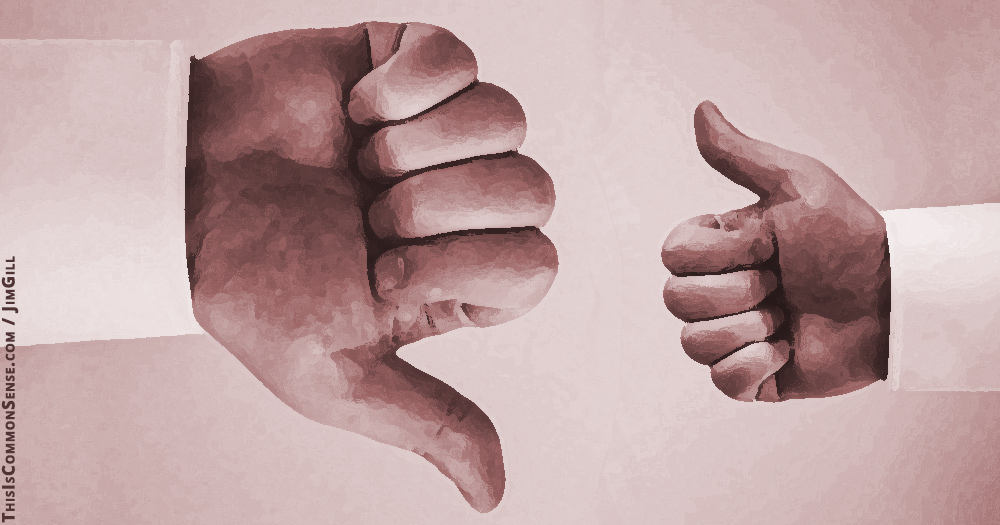
It’s a sure thing — that most folks will like President Trump’s tax cuts. Though we don’t yet know all the details.

When it comes to taxes, less is more

That is, if you’re paying taxes. It is no great mystery that people like it when their own taxes are reduced.

But what about reducing other people’s taxes?

“The core economic case for tax cuts is that they reduce the obstacles to creative and productive activities,” economist Don Boudreaux explained yesterday at the Café Hayek blog.

Cutting the corporate tax rate — which even former President Bill Clinton supported during last year’s campaign — won’t immediately appear in people’s paychecks, but can stimulate economic growth helping everyone. Recent experiences in both Britain and Canada bear this out.

Cutting taxes, of which “the rich” pay more, can also spur growth.

Yet, these ideas do not dominate popular discussions of tax cuts. Boudreaux lamented media reporting that treats any tax reduction as simply a “‘gift’ to high-income earners,” dubbing the coverage: “Biased. Benighted. Blind.”

“Suppose that freedom of the press were reported in the same way as . . . a ‘giveaway to the press’?” he asked. “Most people, of course, do not own newspapers or other media outlets.”

Boudreaux concluded, “When the press is free, the chief beneficiaries are the general public.”

Freedom — of both the press and to keep more of the fruits of our labors — helps the common man. As well as the uncommon man. A tax cut for me helps me directly, and you indirectly. And vice versa. Just as a free press is great for those in journalism as well as those of us not in journalism.

That is not blind, but eyes open; not benighted, but enlightened; not biased, but . . .

. . . Common Sense. I’m Paul Jacob. 


Printable PDF


Categories
folly general freedom ideological culture responsibility too much government U.S. Constitution

UN-appealing

Like E.F. Hutton, when the United Nations’ Office of the High Commissioner for Human Rights “Special Rapporteur on the right of everyone to the enjoyment of the highest attainable standard of physical and mental health” talks, people listen.

In disbelief, perhaps. Or amusement. But they listen. Well, at least Washington Post columnist Dana Milbank does, anyway.

Unfortunately, Milbank couldn’t get Dainius Puras — the Lithuanian doctor serving as the U.N.’s Special Rapporteur on the right of everyone to blah, blah, blah — to talk. Milbank did, however, uncover an “urgent appeal” sent by Puras to the U.S. State Department, with instructions to pass it along to congressional leaders.

Puras won’t discuss his confidential February letter until June, when “it becomes public at the next session of the Human Rights Council.” But the “leaked” letter announces the U.N. has launched an investigation to determine whether repealing the Affordable Care Act (Obamacare) violates international law.*

“The letter urges that ‘all necessary interim measures be taken to prevent the alleged violations’” Milbank further explains, “and asks that, if the ‘allegations’ proved correct, there be ‘adequate measure . . . to guarantee the accountability of any person responsible.’”

Should Congress repeal Obamacare, will U.N. troops occupy Washington, arresting congressmen for voting against its mandate?

The international body has no way “to impose its will,” Milbank acknowledges, seeming to wish it did and complaining that folks just “scoff at lectures from U.N. bureaucrats.”**

Taking solace, Milbank declares: “[T]he U.N. letter is at least a bit of moral support for those defending Obamacare.”

Moral support? From the U.N.? Now, you’re pulling my leg.

This is Common Sense. I’m Paul Jacob.


* Along with other U.N. gobbledygook, the letter cites Article 25 of the Universal Declaration of Human Rights, which proclaims, “Everyone has the right to a standard of living adequate for the health and well-being of himself and of his family” etc. etc. Standard U.N. speak: flowery, vague and unenforceable.

** People throughout the world and across the political spectrum — from the UK’s Daniel Hannan to Chelsea Clinton — scoff at the U.N. for being incompetent and corrupt. Not to mention thoroughly socialist.


Printable PDF


Categories
general freedom media and media people responsibility

Less Innocent Times?

Many years ago, waiting for coffee at a vendor in front of the Washington Post building and across the street from my U.S. Term Limits office, I often exchanged friendly banter with the Posts Dan Balz.

Coffee in hand last Sunday, I read Balz’s column, “A scholar asks, ‘Can democracy survive the Internet?’”

In more innocent times, the rise of the Internet was seen by many people as a boon to democracy,” Balz began, adding that “the Web broadened the flow of information, introduced new voices into the political debates, empowered citizens and even provided a powerful fundraising tool for some lesser-known candidates such as Barack Obama and Bernie Sanders.”

Obama, Sanders . . . all to the good!

“Now, in what are clearly less innocent times, the Internet is viewed as a far less benign force,” he continues, next to a picture of President Donald Trump’s Twitter feed.  “It can be a haven for spreading fake news and rewarding the harshest and most divisive of political rhetoric.”

Mr. Balz’s time continuum is faulty. The “innocent times” when Bernie Sanders used the Internet to raise money were the same “clearly less innocent” times when voters elected President Trump.

“Neither the legacy media nor the established political parties,” Balz bemoans, “exercise the power they once had as referees.”

Nathaniel Persily, the scholar cited by our legacy-media columnist, shares Balz’s anti-Trump bias. But he makes an important point, writing that the Trump campaign “could only be successful because established institutions — especially the mainstream media and political party organizations — had already lost most of their power.”

People voted against the less-than-innocent political (and media) establishment.

This is Common Sense. I’m Paul Jacob.


Printable PDF


Illustration based on original artwork by PRO With Associates


Categories
general freedom local leaders national politics & policies political challengers U.S. Constitution

Wag that Tail, Dog

Last November, Maine voters passed a ballot measure, Question 5, to begin electing their federal representatives to Congress, and their governor and state legislators, using Ranked Choice Voting. This selection mechanism allows voters to rank their choices, thereby removing the “spoiler effect” that often pushes citizens to support the lesser of two popular evils.*

Last month, Maine’s State Senate submitted advisory questions to the Maine Supreme Court about the new law’s constitutionality.

It is indeed constitutional. “Those who argue that ranked-choice voting conflicts with the Constitution,” explained Marshall Tinkle** in the Bangor News, “seem to be reading things into it that simply are not in the text.”

Last week, the Maine Supreme Court heard oral arguments. Justices Donald Alexander and Joseph Jabar seemed concerned about ranked-choice voting making it easier to vote for the person and not the party.

That’s not unconstitutional. But is it somehow bad?

“We are going to have a lot of people abandoning the political parties if ranked-choice voting remains,” argued Alexander. Or perhaps the parties might better serve voters?

The attorney representing the Committee for Ranked Choice Voting, James Kilbreth, reminded the justices that the voters have spoken, and as to the resistance by legislators in implementing their will, he remarked, “This is the tail-wagging-the-dog kind of problem.”

The courtroom broke out in laughter when Chief Justice Leigh Saufley responded, “Mr. Kilbreth, it’s a fairly large tail.”

I’m a big fan of ranked choice voting***, but the court’s decision is not about the policy. It’s about whether the dog (the people) will wag the tail (the legislators) or vice-versa.

This is Common Sense. I’m Paul Jacob.


* Portland, the state’s largest city, has used ranked choice voting since 2011.

** And Tinkle should know, since he “wrote the book” on the subject — the reference book, The Maine Constitution.

*** I serve on the Board of Directors of FairVote, an organization that promotes ranked choice voting and other methods to make every person’s vote count.


Printable PDF