Nobel Laureate economist explaining why drug prohibition makes no sense:
Category: general freedom
Times too tough for much thanksgiving? Some of my readers, surely, are feeling the bracing effects (to put it mildly) of a severe economic slump — a so-called “recession” that I’ve been calling, more simply (and I think more honestly) a “depression” — and all I can say is I have some glimmering of such troubles. Things could definitely be better.
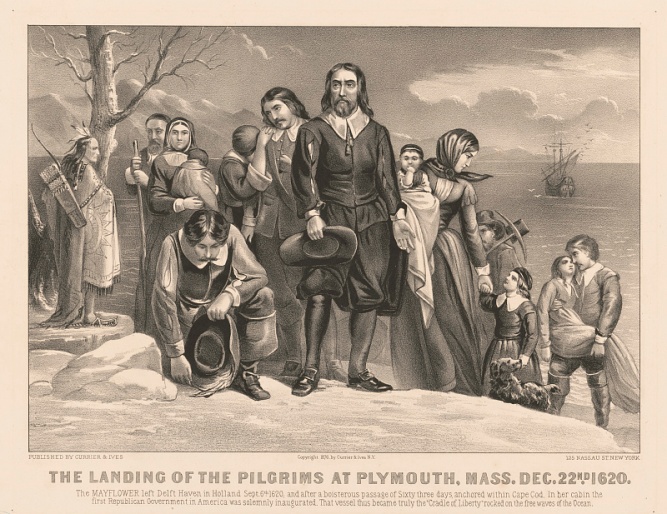
But at Thanksgiving, it might do us good to consult William Bradford’s account of the History of “Plimoth Plantation,” a document that recounts how his fellow Pilgrim settlers established, endured, barely survived, recovered, and eventually thrived in Massachusetts.
By the spring of 1623 — a little over three years after first settlement in Plymouth — things were going badly. Bradford writes of the tragic situation:
[M]any sould away their cloathes and bed coverings; others (so base were they) became servants to [the] Indeans, and would cutt them woode & fetch them water, for a cap full of corne; others fell to plaine stealing, both night & day, from [the] Indeans, of which they greevosly complained. In [the] end, they came to that misery, that some starved & dyed with could & hunger.
The problem? The colony had been engaging in something very like communism.
The experience that was had in this comone course and condition, tried sundrie years, and that amongst godly and sober men, may well evince the vanitie of that conceite of Platos & other ancients, applauded by some of later times; — that [the] taking away of propertie, and bringing in comunitie into a comone wealth, would make them happy and florishing; as if they were wiser then God.
Bradford relates the consequences of common property:
For this comunitie (so farr as it was) was found to breed much confusion & discontent, and retard much imploymet that would have been to their benefite and comforte. For [the] yong-men that were most able and fitte for labour & service did repine that they should spend their time & streingth to worke for other mens wives and children, with out any recompence. The strong, or man of parts, had no more in devission of victails & cloaths, then he that was weake and not able to doe a quarter [the] other could; this was thought injuestice. The aged and graver men to be ranked and equalised in labours, and victails, cloaths, &c., with [the] meaner & yonger sorte, thought it some indignite & disrespect unto them. And for mens wives to be commanded to doe servise for other men, as dresing their meate, washing their cloaths, &c., they deemd it a kind of slaverie, neither could many husbands well brooke it.
Yes, the s‑word: Slavery. Common property was mutual slavery.
The solution? The plan for society that Bradford attributed to God. He brooked no pleading that common property didn’t work because of corruption, sin. As he put it, “seeing all men have this corruption in them, God in his wisdome saw another course fiter for them.” The course? I’ll use a word of coined by Robert Poole, one of the founders of Reason magazine: Privatization.
Basically, what the Pilgrims privatized was land, and the fruits thereof, assigning to
every family a parcell of land, according to the proportion of their number for that end, only for present use (but made no devission for inheritance), and ranged all boys & youth under some familie. This had very good success; for it made all hands very industrious, so as much more corne was planted then other waise would have bene by any means [the] Govror any other could use, and saved him a great deall of trouble, and gave farr better contente. The women now wente willingly into [the] feild, and tooke their litle-ons with them to set corne, which before would aledg weaknes, and inabilitie; whom to have compelled would have bene thought great tiranie and oppression.
Thus began the years of bounty in Massachusetts. There’s much more in Bradford’s account worth reading, including the increasingly tragic relations with the native Americans. And, indeed, one learns from reading such first-hand accounts how imperfect a creature is man.
But it is obvious that some systems of property and governance work better than others, and, on the day that our government has set forth as a day of Thanksgiving, it is worth being thankful for living in a land that has upheld — to at least some degree — the system of private property that America’s Pilgrim’s learned to see as God’s “fitter course” for corruptible man.
Times may be tough today. On the bright side, they’ve been tougher. One reason for the progress we have seen — even as we endure a major setback, and perhaps a bigger one to come, as the international financial system implodes — is the system of private property that underlies our personal and economic liberties.
Let’s hope we can recover the best in this tradition.
This is Common Sense. I’m Paul Jacob.
I Gave at the IRS
A friend of mine shared something Desire Street Ministries had posted to Facebook:
We think sometimes that poverty is only being hungry, naked and homeless. The poverty of being unwanted, unloved and uncared for is the greatest poverty. We must start in our own homes to remedy this kind of poverty.
Mother Teresa said that. It’s not something you’re likely to hear from the “Occupy Wall Street” protestors. From what I’ve heard, they tend to say that people are in poverty because of big, greedy corporations … or government not taking care of them. Mother Teresa was closer to a better explanation. After all, those of us eating and sleeping well weren’t handed bread and a front door key by the government or a corporation.
A deeper poverty lurks behind persistent financial poverty. Sometimes the problem is neglect or abuse, drug addiction or alcoholism. Love can conquer all, but the Department of Social Services and the DEA don’t dispense love very effectively.
My Facebook friend commented, “Non-profits do so much better of a job of helping the poor than big government can/will do.”
Why is that? It isn’t because social workers don’t care. It’s that government bureaucracies are ill-equipped to address individual needs, which go far beyond a bowl of soup and a bed or even a monthly check.
More training, regulations and new laws are hardly the solution.
We are the solution. But we won’t be if we hand the task to government and declare “I gave at the IRS.”
This is Common Sense. I’m Paul Jacob.
Politics is dominated by pious, politic lies and half-truths. Every nation has them, and Turkey’s are most impressive.
Turkey has been a vanguard, in the Muslim world, of “Westernizing” and “modernizing” tendencies. But it still has one foot in the deep past. One of its great pious half-truths is that Turkey is “99 percent Muslim” yet possesses a “secular state” where “all religions are equal.”
With some religions more equal than others.
An Alevi spokesman, Izzettin Dogan, charges that the country “is actually a Sunni Islamic state.” There are 30 million Alevis in Turkey, according to the New York Times, and they are not alone in getting the short end of the stick in “secular Turkey”:
“The state collects taxes from all of us and spends billions on Sunni Islam alone, while millions of Alevis as well as Christians, Jews and other faiths don’t receive a penny,” Mr. Dogan said, referring to the $1.5 billion budget of the Religious Affairs Department. “What kind of secularism is that?”
Good question.
And it gets to the heart of one of the reasons I’m so happy to live in America. Our government may be a mess, but we still have some basic freedoms. We’ve long gotten over the ancient fixation on the union of religion and state.
In ancient empires, kings styled themselves as gods.
We know better.
And we know better than to subsidize religion — or use it as a branch of the government.
This is Common Sense. I’m Paul Jacob.
Widespread unemployment, fear, and consternation: Why now?
Three answers:
- Imperial over-reach. No nation can police the world forever. Empires once existed for loot. But on net the U.S. doesn’t take wealth from others. Instead, we spend our own wealth “protecting” others, often confusing our “national interest” for the interests of well-connected businesses. Hardly sustainable. Flag-waving about how good the U.S. is won’t stop the decline.
- Churning. We pretend to live in a “welfare state,” but wealth does not consistently go from rich to poor, to compensate for disadvantages. Wealth churns from one group to another, with each power shift. Trying to live at the expense of everyone else is not just a game for the poor. Government, without constitutional limits, inevitably shifts wealth haphazardly from the politically powerless (the least organized) to the politically powerful (the best organized) — with always a cut for the bureaucracy and political insiders. Of course such a system must decline, at some point.
- Sub-standard standards. In too many domains of life, we’ve almost given up. Certainly folks in high places act quite low. And the people who control our money, for example, don’t even pretend to keep a stable supply, a “standard”; instead, they pride themselves on “keeping bubbles going” … making unsustainability our standard policy.
But Americans do have an advantage over our Old World friends and foes. We have a history of dedication to better principles. Our best bet for recovery? Return to them.
This is Common Sense. I’m Paul Jacob.
This episode was written immediately after the events of 9/11/01.
This is war. And on our shores. Thousands of American citizens murdered in cold blood. But despite our pain and suffering as a people, we are still strong. Not only militarily, but also in our love of freedom and our commitment to defend it come what may.
Some have argued that America will never be the same. In a sense that’s true: we’ll certainly never forget this savage and senseless attack. And we have much work to do to make certain it doesn’t happen again. But it’s important to be careful how we go about it.
In the wake of this unprecedented brutality, two out of three Americans say they would be willing to trade some civil liberties to get more security. But this is isn’t our real choice. Nothing about increasing our security requires abridging our civil rights. We don’t have to let the terrorists win, not in any respect. For these terrorists would like nothing better than to knock America off our foundation, our principles, the things that make us truly the greatest country the world has ever known. They hate our freedom. Let’s sustain that freedom. Let’s show the whole world: we are the same America.
The same America whose rifle shot for freedom was heard ’round the world in 1776, and is still being heard today. The same America that freed Europe from the Nazis and Asia from imperial Japan. Let it be known in the face of this terror today that we are indeed the same America, the land of the free and the home of the brave.
This is Common Sense. I’m Paul Jacob.
Publication of this and previous Common Sense commentaries is only possible through the generous financial support of readers like you. Please contribute today.
In The Addams Family, young Wednesday sets up a sidewalk lemonade stand. A Girl Scout comes by and asks her if there are real lemons in her lemonade. After double assurances, the girl says she’ll buy Wednesday’s lemonade if Wednesday buys her cookies. Then comes the kicker: “Are they made from real Girl Scouts?”
The line works, in part, because of the historical setting. There is nothing more “American” than a kid selling lemonade by her home on a sunny day.
And yet, somehow, this traditional right of American life — a rite of passage — is under attack across the nation. Selling lemonade is a “business,” you see, which requires a license, and one may only engage in commercial enterprise in areas zoned for that, and … well, you get the idea.
Bureaucrats and over-policers feel it’s their duty to instruct the kiddies that they may only engage in nasty things like business with special permission.
Children must never see it as a right.
I know, there are problems (even in common law) about setting up a business in your home and stinking up the neighborhood or bringing in dangerous traffic. But, well, come on. Get real.
We’re talking lemonade stands!
So, a shout-out to Dave and Jenifer Roland and their Freedom Center of Missouri, for defending lemonade stands in their neck of the woods.
The issue may be more important than the size of the industry would suggest.
This is Common Sense. I’m Paul Jacob.
We parents worry when we send our kids off to college. But do we worry they’ll become terrorists?
No.
But a funny and slightly disturbing article by Colin Lidell in Taki’s Magazine takes notice of the deep connection between college life and terrorism. Indeed, “every major Islamist terrorist attack in Britain has been led by university students or recent graduates.”
Lidell makes a broader point, too, even with his title: “The Persistence of Bourgeois Radicalism.” Universities and colleges have long served as hotbeds of extremism:
Becoming “radicalized” — whether your bearded prophet happens to be Marx or Muhammad — is essentially code for having too much time on your hands and a sense of smug entitlement. This is the essence of university life. With three years of sleeping late, anything seems possible.
The author concludes that the best cure for such radicalism is the requirement of work. He leaves that thought to linger in the readers’ minds, letting us extrapolate upon government subsidies to increase the rolls of college student bodies.
A related fact, uncovered by previous scholars of Islamic radicalism, is that the main subsidizer of Muslim radicals in the West have been the welfare states of those countries. It seems that the safety nets of British and European states (as well as Canadian and Australian governments) have funded quite a number of terrorist cells.
Perhaps one reason America has nurtured fewer home-grown terrorists is our tougher-to-obtain “welfare.”
This is Common Sense. I’m Paul Jacob.
Are today’s problems caused by the sheer quantity of people?
No.
A week ago or so, the Los Angeles Times wasted space arguing the wrong side, “The world’s biggest problem? Too many people.” Laura Huggins responded with an able rejoinder, showing that such doomspeak is old hat, falsified by experience.
She mentions Paul Erlich’s The Population Bomb, in particular, 1968’s classic in the hysterically overblown prophecy genre. Not mentioned, however, is Julian Simons’s brilliant 1981 rejoinder to Ehrlich, The Ultimate Resource. Simons marshals economic argument and a vast array of factual evidence to demonstrate that human ingenuity and the market order provide amazing solutions to problems of scarcity and limited resources. The more people you have, the more solutions can be found. With greater prosperity comes the best possible amelioration to the resource scarcity that so worries and befuddles environmentalists of the Ehrlich stripe.
But really, this is much older hat than that.
The Rev. Thomas Robert Malthus wrote the first book on the subject, back in 1798, and, even in the course of his life had to expand his tract — and radically tone down his thesis — to make himself look less of a fool. Later, writers such as Nassau Senior and Herbert Spencer demonstrated why Malthus was wrong. Population growth does not necessarily outstrip agricultural productivity. Human co-operation through markets more than makes up for our physical limitations.
We have the history of the past 200 years to prove it.
This is Common Sense. I’m Paul Jacob.
Some people are creeps.
On Independence Day, someone — or a group of someones — broke into Fox News’s Twitter account for politics and put out false notices about the death of the United States President. Apparently, they meant this to smear Fox News, which, though calling itself “fair and balanced,” is in truth a conservative counter to the vaguely-to-staunchly leftward bias of ABC/CBS/NBC/CNN/MSNBC. The popularity of Fox really bugs many folks; some become unhinged on the subject.
And they forget that they should obey the law. And principles of decency.
Now, I don’t know what law in particular was broken. I can’t name it. But, just as I need no city council ordinance number to tell a stranger to get out of my house, after he entered without permission (finding the key, perhaps, in its secret spot in the garden — and hey: what was he doing in the garden anyway?), just so no one needs a special law to know that logging in to Twitter and trying a bunch of obvious and not-so-obvious passwords to gain access to someone else’s account is wrong.
We know this by common law and common sense and simple, everyday morality.
I have a simple bit of advice for all political activists. Say you are angry and you want to really hurt your “enemy.”
First ask yourself: Is what I want to do unjust?
Lastly, you might want to consider: Is it tasteless?
This is Common Sense. I’m Paul Jacob.