Categories
Accountability First Amendment rights general freedom ideological culture media and media people moral hazard nannyism national politics & policies Regulating Protest too much government

Dbl Standard Destruction Co.

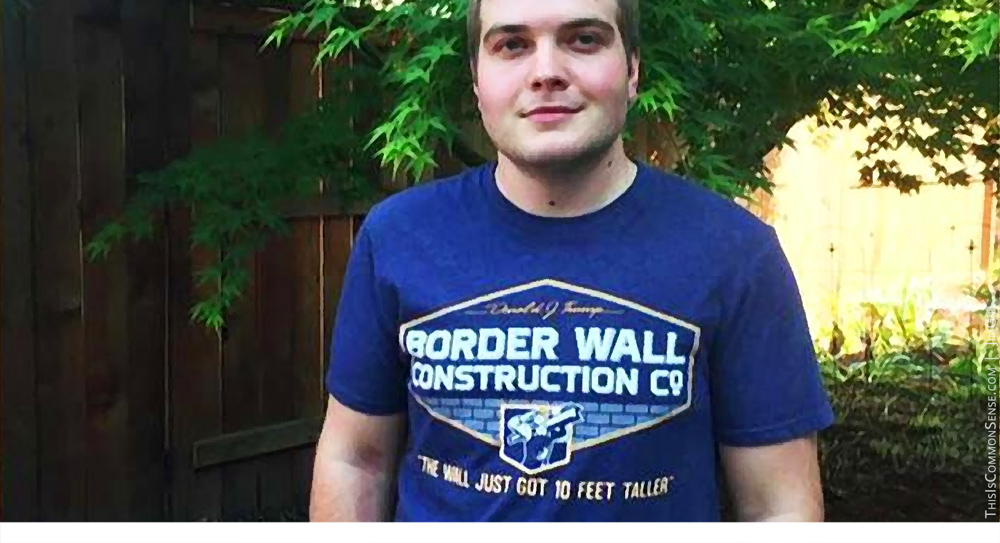
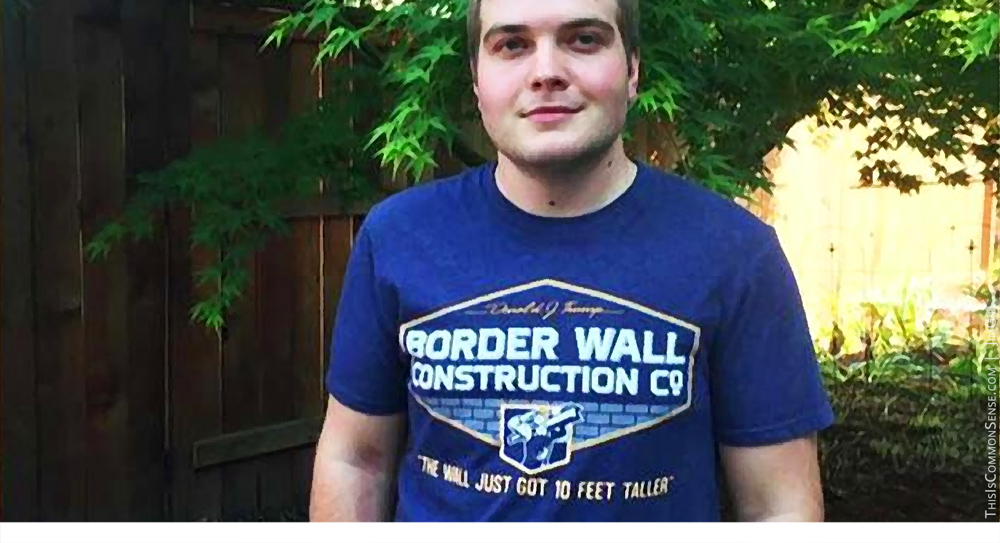
Addison Barnes has just won a court case against Liberty High School of Hillsboro, Oregon. The court ruled that the school acted wrongfully when, early this year, it suspended him for wearing a “disruptive” T-shirt heralding a “Donald J. Trump Border Wall Construction Co.” 

Addison was awarded $25,000 for legal expenses, and the school has apologized to him, sort of, for the suspension.

“I brought this case to stand up for myself and other students who might be afraid to express their right-of-center views,” Addison says. “Everyone knows that if a student wears an anti-Trump shirt to school, the teachers won’t think twice about it. But when I wore a pro-Trump shirt, I got suspended. That’s not right.”

No, it’s not.

The outcome is imperfect. The apology offered by Liberty High does not acknowledge the glaring injustice of the suspension. It simply asserts that the school got the “balancing act” wrong between making students feel welcome and making them feel safe. (Because it is “unsafe” per se for kids to peacefully express political disagreements?) Nor was the teacher who imposed the suspension obliged to apologize personally.

Ideally, all schools would be privately owned, privately run. Then they could openly promulgate whatever silly policies they wished about what students may display on T-shirts, if anything. Market pressures would tend to discourage indefensible rules. 

But today’s schooling system is not ideal.

Have you noticed?

Meantime, let’s hope that the court’s decision will discourage other schools from imposing similar double standards.

This is Common Sense. I’m Paul Jacob.


PDF for printing


Categories
Accountability First Amendment rights folly general freedom ideological culture media and media people moral hazard nannyism national politics & policies Regulating Protest too much government U.S. Constitution

Freedom “Weaponized”

Justice Elena Kagan has a way with words. The conservative majority on the court, she said after two recent rulings, is “weaponizing the First Amendment.”

What a phrase! But what does it mean?

“Conservative groups, borrowing and building on arguments developed by liberals,” explains The New York Times, “have used the First Amendment to justify unlimited campaign spending, discrimination against gay couples and attacks on the regulation of tobacco, pharmaceuticals and guns.”

First: if “liberals” now find themselves not supporting the idea of particular freedoms, or freedom in general, are they really “liberal”?

Second: “borrowing arguments” is what we expect to happen. Logic isn’t partisan.

Third: the point of the Bill of Rights is to “weaponize” the defense of freedom.

Remember, it is freedom of speech; freedom of the press; freedom of association; freedom of exercising one’s religion. The First Amendment weaponizes their defense by disallowing Congress from legislating against them.

Now, it has long been a “problem” that these listed freedoms blend together. They all work together or don’t work at all. And each points to freedom more broadly.

Kagan wants to read freedoms narrowly — though liberals historically have, indeed, read them broadly.

She’s objecting to two recent rulings. The first prohibits states from requiring pregnancy centers to talk up abortion options to their clients. An obvious free speech issue. The second prohibits governments from backing unions in their extraction of “agency fees” from non-members. An incontrovertible issue of freedom of association.

Kagan and The New York Times apparently think that “liberalism” means defending some freedoms in some contexts, but denying freedom in others.

This is Common Sense. I’m Paul Jacob.



Illustration by Newtown grafitti


Categories
Accountability crime and punishment First Amendment rights general freedom ideological culture national politics & policies political challengers Regulating Protest

Assaults Not Allowed

Have Americans forgotten that freedom makes getting along easier?

We do not all have to like each other. We do not even all have to be nice to each other. We just don’t have license to hit or hornswoggle our fellows. Hate speech may be bad, but it is hate assaults — not talk — that should be punished by law.

Yes, free people are at liberty to insult each other, call each other nasty names, even demean each other. And those insulted, besmirched, and dissed may return in kind or shrug the negatives off.

But we needn’t let it go at that.

Bill Ottman, founder and CEO of Minds.com, reminds us that there is more than one way to skin a hate. When coming across vile nonsense and worse, “the most important question is how we deal with these situations,” he writes.

We may be able to find the answer in the work of Daryl Davis, a famous blues musician with a hobby of  befriending members of the Ku Klux Klan. According to him: “Once the friendship blossoms, the klansmen realize that their hate may be misguided.” By having dinner with Klansmen, he has inspired over 200 members to give up their robes.

Ottman goes on to call for a concerted effort to reclaim a future for “internet freedom and human rights.” That’s a good idea.

Don’t accept the premise that, to get along, we must squelch speech. Instead, ignore disagreeable people trying to make us feel bad.

And look for ways to persuade those who hate us.

We can be adults about this. And keep freedom of speech.

This is Common Sense. I’m Paul Jacob.



PDF for printing


Categories
Accountability First Amendment rights general freedom local leaders media and media people

The Steps Beyond Argument

Rob Port’s job is to have an opinion. Opinions breed counter-opinions. Unfortunately, they sometimes conjure up concerted campaigns to pressure opinion-makers to shut up.

So, no surprise that his reporting — on his radio talk show and in print — on the doings and not-doings of North Dakota’s junior U.S. Senator, Heidi Heitkamp, a Democrat, has riled up nasty “feedback.”

Earlier this month, Mike McFeely, a “left of center” columnist at the Fargo Forum, where Port also writes, published a column calling Port’s “obsession” with Heitkamp “suffocatingly limited and boring” and acknowledging, “I have often voiced my concerns about the one-trick-pony nature of Port to my bosses.”

Port notes that McFeely’s criticisms are based on subject matter, not content, and suggests that journalism doesn’t spend too much time holding politicians accountable.

It gets nastier, though. Senator Heitkamp’s brother, Joel, is also in the radio business, managing a competing station and hosting one of its morning programs. Mr. Heitkamp got his mitts on Mr. Port’s divorce papers and tweeted out, “The #FargoForum is paying him 71K for part time work! What do the full-time employees get? #Wow #790KFGO #wishicould.”

Meanwhile, here comes the Senate Leadership Fund, associated with Senate Majority Leader Mitch McConnell (R-Ky.), to suggest the FCC remove Heitkamp’s station’s license due to his advocacy for his sister’s campaign.

Port, for his part, objects to the corrupt “help.”

“The FCC really has no grounds for getting involved,” he argues. “Free people should be allowed to speak freely.”

In the chaos of our current political battles, Rob Port stands on principle, offering equal freedom to his sleazy opponent.*

This is Common Sense. I’m Paul Jacob.


* For the complete story, check out this weekend’s Townhall column, and the links at the column’s splash page.

PDF for printing


Categories
Accountability First Amendment rights ideological culture media and media people moral hazard U.S. Constitution

Exit Strategy Advised

The First Amendment applies only against governments, but our free speech rights can be violated by nearly anyone.

These days, these rights are most notoriously and routinely violated by mobs of students . . . attending colleges and universities nearly all of which depend upon taxpayer subsidies.

David E. Bernstein, writing at the Volokh Conspiracy, in “USC Law Professor: Supporters of Campus Free Speech are ‘Preying on Vulnerable Teenagers,’” makes a number of points regarding a law professor’s published defense of nasty student reactions to a Federalist Society speaker . . . on a campus not his own.

Bernstein notes that “the article has to have the requisite references to the Emmanuel Goldsteins of the modern left, the Koch Brothers, who are mentioned four times for no discernable reason.” The reason, of course, is demonization. For a movement needs enemies.

The USC law professor argues that journalists should ignore campus speaking events that “goad” students into “tactical mistakes” by the “mean-spirited provocations” of “seasoned political operatives preying on vulnerable teenagers and inexperienced young adults.”* Bernstein shows that the “tactical mistakes” amount to peaceful and intellectual speakers being “harrassed, shouted down, and subject to or threatened with violence”; every reasonable person knows that disagreeing with the ideas someone communicates does not excuse violating that someone’s rights.

No matter how “provocative.”

Most chillingly, the speaker who incited student ire and accusations, etc., had been advised by “a security guard” before his “talk” to devise “an ‘exit strategy.’” This indicates that the American taxpayer needs an exit strategy from subsidizing anti-democratic mob activism.

And its professorial enablers.

This is Common Sense. I’m Paul Jacob.


* Don’t you find this language awfully coddling of people who should be treated as responsible for their actions, and who, by their attendance at an institution of higher learning, should be capable of listening to any point of view? I find it maddening.


PDF for printing


Categories
Accountability crime and punishment education and schooling First Amendment rights general freedom ideological culture moral hazard Regulating Protest

The Shallow State

Amidst all the talk of The Deep State, we are in danger of losing track of a parallel problem: the Shallow State — which, despite lack of depth, is very wide.

I am referring to government employees who increasingly abandon any pretense of impartiality. And the public institutions that protect them.  

Consider the case of the University of Illinois at Urbana-Champaign and its 39-year-old lecturer Tariq Khan, who is a member of an Antifa-affiliated group called the Black Rose Anarchist Federation. Mr. Khan had been angrily shouting and chanting at a campus anti-Trump rally when he was mildly challenged by a non-nut student journalist. Khan went on a rampage, screamed at and pushed the young journalist, and deliberately broke the smartphone of a fellow journalist who had been recording the fracas.

Khan was charged with destruction of property. But the story doesn’t stop there.

“I was told that if I wanted the ‘situation to improve,’” wrote a third journalist, “that I should stop writing about Khan.”

The university placed a restraining order on the three, to squelch news and dissent.

So the trio sued on First Amendment grounds.

Here we have a teacher willing to abridge free speech the old-fashioned way, by playing the bully. And a public institution ready and willing to defend him, to take his petty criminality and raise it to a conspiratorial, Big Brother level.

Not only does this rob Americans of rights, taxpayers are being forced to fund what they might justifiably regard as the destruction of the republican form of governance.

Root out the infamous Deep State?

Sure.

But limit and make transparent the Shallow State, too.

This is Common Sense. I’m Paul Jacob.

PDF for printing


Categories
education and schooling First Amendment rights folly ideological culture media and media people moral hazard national politics & policies

The Critique of Pure Intolerance

If you are older than 50, you probably remember when “liberal” meant free speech advocacy to the point of absolutism. “I may disagree with what you say,” stalwart liberals pledged back in the Sixties, “but I’ll defend to the death your right to say it.”

Nowadays, if you are under 30 and have gone to college, you may not even have encountered this saw.

Which has consequences.

Nine student groups protested, last week, the Federalist Society’s invitation of writer Christina Hoff Sommers to speak at Lewis & Clark Law School. The groups called it an “act of aggression and violence” and smeared the philosopher and Democrat as “a known fascist.”

Bari Weiss, writing in The New York Times, calls this “the moral flattening of the earth,” the “main effect is that these endless accusations of ‘fascism’ or ‘misogyny’ or ‘alt-right’ dull the effects of the words themselves. As they are stripped of meaning, they strip us of our sharpness — of our ability to react forcefully to real fascists and misogynists or members of the alt-right.”

While this “flattening” does prevent the flatteners (bullies) from even seeing any gradations of threat or error, let’s not pretend to be surprised. Their techniques do not merely echo, but replicate exactly, neo-Marxist postmodernist philosopher Herbert Marcuse’s proposal, in “Repressive Tolerance,”* to censor writing and speech “from the right.”

Ideas have consequences. Just as Marxian socialism led to Lenin, Stalin and Mao, these tyrants led to Marcuse, whose thinking set much of today’s Academia into full tyranny mode.

It’s time for liberals “on the left” to repudiate explicitly the methods of tyrants . . . to their left.

This is Common Sense. I’m Paul Jacob.
 

* See Herbert Marcuse and Robert Paul Woolf, A Critique of Pure Tolerance (1965). My college political theory professor, a proud communist, was a big fan of Marcuse.


PDF for printing


Categories
First Amendment rights general freedom media and media people moral hazard nannyism national politics & policies too much government

Why They Hate the First Amendment

Does banning Facebook in the weeks leading up to an election sound like freedom?

“The corrosive effect of social media on democratic life,” writes The New Republic’s Jeet Heer, “has led both French President Emmanuel Macron and Canadian Prime Minister Justin Trudeau to make the same threat to Facebook: self-regulate or be regulated.”

But Macron doesn’t go far enough. “If fake news truly poses a crisis for democracy, then it calls for a radical response,” Heer insists.

“Many countries have election silence laws, which limit or prohibit political campaigning for varying periods of time ranging from election day alone to as early as three days before the election.” And Heer sees little reason not to apply such regulations to social media.

“What if you weren’t allowed to post anything political on Facebook in the two weeks before an election?”

This exactly parallels the prohibition of political spending “by corporations” before an election, as in the McCain-Feingold campaign finance regulation. Except here we have it directly affecting normal citizens.

The current excuse, “fake news,” appears to be defined by partisans almost entirely as the errors and lies and spin of their opponents’ side(s).

But since lying about one’s political enemies is at least as old as the Election of 1800, why is this different now?

Because, I submit, Facebook is just another area the folks pushing such obvious breaches of the First Amendment — politicians and most of the media — do not yet control.

Competition mustn’t be tolerated.  

This is Common Sense. I’m Paul Jacob.

PDF for printing


Photo credit: by John Nakamura Remy


Categories
First Amendment rights free trade & free markets general freedom initiative, referendum, and recall nannyism national politics & policies privacy property rights Second Amendment rights Tenth Amendment federalism too much government U.S. Constitution

Winning Too Much?

“We’re Number 17!!!”

This lacks a certain triumphant note.

It is nothing like the “We’re Number 1!” the Swiss are now hollering as they pump their arms into the air, waving giant #1 foam fingers against the backdrop of snow-covered Alps.

Actually, knowing the Swiss, they are probably a bit more restrained. Still, you get the point.

Number 1 in what, you ask? Creamy, delicious chocolate, perhaps? Banking? Skiing?

Freedom.

The Human Freedom Index 2017, jointly published by the institutes Cato, Fraser, and Liberales, is hot off the presses. The report ranks the countries of the world on “personal, civil, and economic freedom.”

This year, Switzerland switched places with Hong Kong, which had come in first the year before. The U.S. moved up from 23rd place in 2016, but down from 2008, when we were challenging Top 10 status at Number 11.

“Weak areas [for the U.S.] include rule of law, size of government, the legal system and property rights,” according to a Cato video.

Let’s compare Switzerland to the United States. The 1848 Swiss Constitution creates 26 sovereign cantons (states), greatly influenced by our system of federalism. In the 20th century, Americans in 26 states and most localities borrowed from the Swiss, establishing a system of direct democratic checks on government — what we call ballot initiatives and referendums.

Both countries have constitutional limits on government, protecting individual rights — even from fully democratic tyranny. But in the freest nation in the world, Switzerland, citizens possess a powerful direct democratic check on their government at all levels . . . while we do not.

After all, we’re Number 17.

This is Common Sense. I’m Paul Jacob.

PDF for printing


Categories
crime and punishment First Amendment rights general freedom ideological culture media and media people moral hazard nannyism national politics & policies Regulating Protest too much government

Twitter’s Merkel Tactics or Merkel’s Twitter Tactics?

Is Twitter cooperating with Germany’s new crackdown on social-media speech because otherwise it risks steep penalties? Or is Twitter just doing what it would do anyway?

When Germany’s new law against unwelcome speech went into effect this year, many Germans protested. “Please spare us the thought police!” was the headline in one top-selling paper, Bild.

The law requires social-media sites to block unapproved content — which includes “hate speech” and “fake news” — within 24 hours or face exorbitant fines. (Of course, every piece of news, no matter how well or shabbily reported, gets decried as hateful “fake news” by somebody.) Under the new law, Twitter suspended the accounts of two officials of the political party Alternative for Germany who tweeted that Muslim men have violent proclivities. Hateful, fake, inexact, whatever, such tweets by themselves threaten nobody and violate nobody’s rights.

Did Twitter act only under duress here?

Well, in the U.S., the company is not ordered by our government to muzzle anybody except perhaps terrorists or persons directly instigating a crime. Yet Twitter regularly suspends or bans users whose speech it considers objectionable. Moreover, it has become notorious for especially targeting speech that can be regarded as on the right end of the political spectrum — while leaving intact the tweet-speech of left-wing micro-bloggers no matter how threatening or abusive.

I don’t say America’s government should become involved. It should certainly not compel Twitter to drop its double standard.

Instead, it is Twitter itself that should become involved . . . and drop its double standard.

This is Common Sense. I’m Paul Jacob.

PDF for printing