Categories
First Amendment rights ideological culture media and media people Regulating Protest

James Woods, Parody, and a Pillow

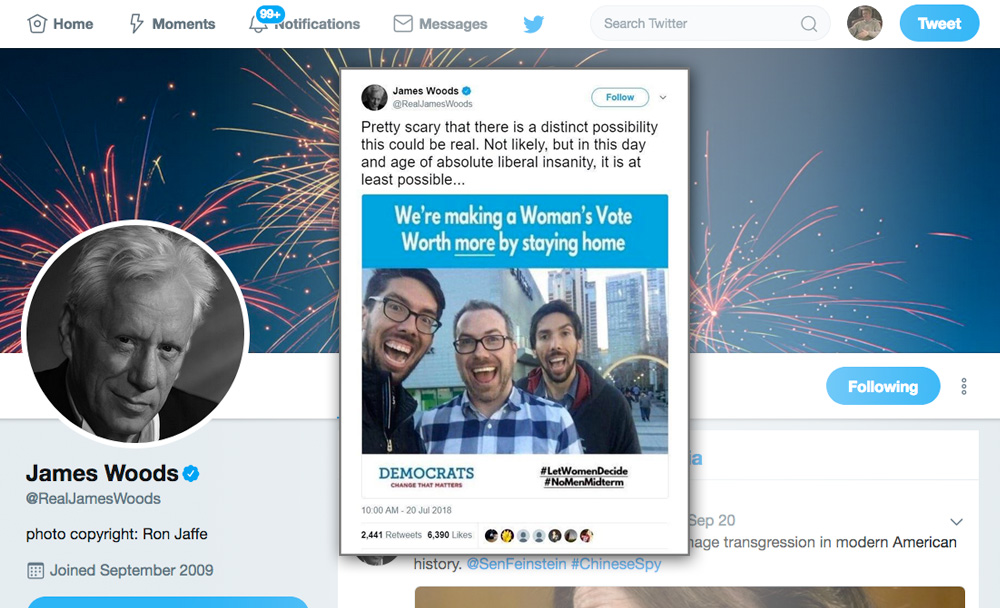
The beginning of the end of actor James Woods’s time on Twitter likely occurred on July 20, 2018.

Only recently discovering a tweet that he posted then, Twitter has locked Woods out of a forum where his right-leaning messages have been followed by 1,730,000 people.

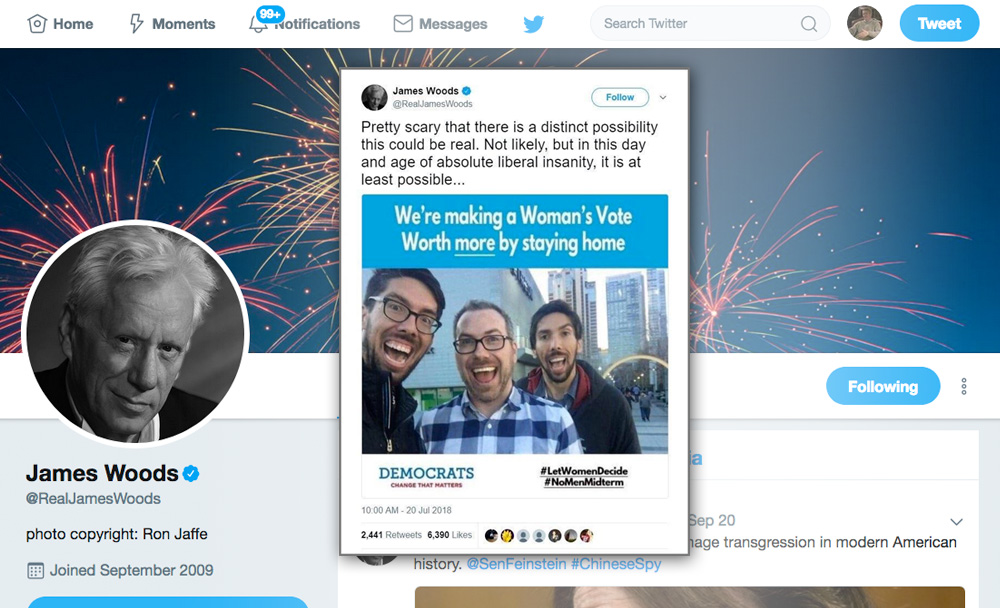
His delinquent tweet forwarded an image of giddily grinning guys promising to abstain from voting so that a woman’s vote would be “worth more.” Woods tweeted: “Pretty scary that there is a distinct possibility this could be real. Not likely, but in this day and age of absolute liberal insanity, it is at least possible.”

Twitter told the actor that if he agreed to the deletion of this fake-news tweet — simple enough — it would let him tweet once again.

Woods refuses.

“Free speech is free speech — it’s not [Twitter CEO] Jack Dorsey’s version of free speech,” Woods says. “The irony is, Twitter accused me of affecting the political process, when in fact their banning of me is the truly egregious interference. . . . If you want to kill my free speech, man up and slit my throat with a knife, don’t smother me with a pillow.”

There’s lots more where that came from, but you get the idea. I don’t, um, strictly agree with everything Woods says here. But I can only applaud the spirit of his refusal to submit to Twitter’s arbitrary standards of acceptable speech.

Oh, and one other thing: somebody tell Twitter that parodies are inherently fake.

This is Common Sense. I’m Paul Jacob.

 

PDF for printing


Categories
First Amendment rights general freedom ideological culture media and media people moral hazard privacy

Google Goes Bad

Good Google’s evil twin, Bad Google, is at it again.

In addition to doing bad things to advance its political agenda, Google is willing to work with bad governments do bad things. 

For example, the authoritarian Chinese government.

Google is working on a mobile version of its search engine, code-named Dragonfly, which would censor search results the way the Chinese government wants. The company is doing so even though it shut down its Chinese-mainland search engine back in 2010 because it “could no longer continue censoring our results” in China. At the time, I praised Google for moving in the right direction.

Now it’s regressing.

And more than regressing. The Intercept reports that Dragonfly goes beyond censorship. How? By linking a user’s search results to his phone number. Critics note that this would abet human rights violations, since users could easily be detained and even jailed for searching for the “wrong” terms.

At least five Google employees have resigned in protest. One, Jack Poulson, a research scientist, says that he regards “our intent to capitulate to censorship and surveillance demands in exchange for access to the Chinese market as a forfeiture of our values and governmental negotiating position across the globe.”

Google no longer promotes what used to be its motto and guide: “Don’t be evil.” 

To be sure, that motto did not put a very positive spin on the company’s moral stance. “Always be good” might be better. But I agree with both. 

Be good, not evil.

This is Common Sense. I’m Paul Jacob.


PDF for printing


Categories
First Amendment rights ideological culture too much government

Censorship for Unity

“Social media has given extremists a new tool with which to recruit and radicalise,” writes British Labour MP Lucy Powell in The Guardian. 

And just where are people “being exposed to extremist material”?

On Facebook!

“Instead of small meetings in pubs or obscure websites in the darkest corners of the internet,” she explains, “our favourite social media site is increasingly where hate is cultivated.”

Sharing ideas that she opposes is dangerous because they quickly spread. But her main ire is directed against private “Facebook groups,” an environment she argues “normalises these hateful views” because “critics are removed from the groups.”

Apparently, the problem with Facebook is that it is open — and that it is closed. Facebook is something new and dangerous because everybody uses it. Yet, because it allows closed groups, it is something very much like . . . “small meetings in pubs.”

Ms. Powell has, naturally enough, proposed a bill. “The responsibility to regulate these social media platforms falls on the government,” she asserts. “I believe we can force those who run these echo chambers to stamp out the evil that is currently so prominent.”

Like any politician, she talks up unity, of course. She demands the government prevent social media from “being hijacked by those who instead wish to divide.” 

But remember, she is a member of a political party that opposes other parties. She is trying to suppress divisions that exist. The implication of her agenda is a one-party state, where opposition is suppressed.*

By censorship.

A word she somehow neglects to use.

Online extremism, she writes, “is something we are frighteningly unequipped to deal with.”

I’d say she is frighteningly equipped.

This is Common Sense. I’m Paul Jacob.


* Social media critic Dave Cullen notices that MP Lucy Powell admits that there is a huge personal element here: she is a politician who doesn’t like criticism.

PDF for printing


Illustration by JG


Categories
First Amendment rights general freedom ideological culture meme moral hazard national politics & policies Popular

Re-Segregation

It is hard not to miss the ideological left’s inconsistency regarding “diversity”: demanding diversity of race and gender, they enforce a monoculture that somehow cannot tolerate intellectual and political competition.

We see this in 

  • higher education, dominated by left-of-center professors and administrators; 
  • in the news media, overwhelmingly filled with Democrats; and 
  • even in the corporate world, especially in HR Departments.

That some areas of life are filled with one type of person, and others with a different kind, should shock no one. But the intolerance of this? It has recently become extra extreme on the left: De-platforming, physical attacks on free speech, censuring and firing employees who dare offer facts inconvenient for progressivism. When a senior Facebook engineer attempted to bring in tolerance and diversity, what should have been a non-story received national attention.*

It amounts to a new segregationism. 

People are segregating more and more in their communities based on income and culture (see Bill Bishop’s The Big Sort) — despite many of these same self-segregators support for Martin Luther King’s civil rights agenda of de-segregation. 

Another current trend is shunning. When it was discovered, the other day, that the In-N-Out burger chain had contributed $25,000 to the California Republican Party, the Twitterverse cooked up something special: “#BoycotInNOut — let Trump and his cronies support these creeps” . . . well, that gem is from the chair of the California Democratic Party.

Apparently, this Democratic Party official is demanding separate eating establishments for progressives and conservatives.

But hey, where would I eat?

This is Common Sense. I’m Paul Jacob.


* Arguably, many of the stories we fret about should be non-stories — as in, “none of our business.” But when some people make others’ business theirs, the stories just will not stay local.

PDF for printing


Categories
First Amendment rights general freedom ideological culture national politics & policies

Snail-mail Your Contribution

In the dystopian world of the future, all financial transactions will be made by credit card. In this dark world, the people who run credit-card firms must be appeased. If they dislike what you’re doing, they will have the power to prevent you from receiving financial support for your work — however normal and legal that work may be.

And whom will such financial institutions be, in turn, appeasing?

Politicians.

The politicians won’t have to pass a law to get firms to do their bidding. They need merely grumble ominously.

Perhaps the politicians will cooperate with ideological organizations bearing ironically unrevealing names like Media Matters and Southern Poverty Law Center, dedicated to shutting down anybody they disagree with.

Is that future far away? No.

Here is the situation. Since cash and checks are still very legal, if you wish to support the work of the David Horowitz Freedom Center, you can mail a check. But as of this writing,* you can’t send the Center a payment online, because Visa and MasterCard have thwarted the Center’s ability to accept donations that way.

Why?

Because the SPLC has dubbed the Center a “hate group.”

David Horowitz told Breitbart News that regarding “Tech heads” as the main bad guys here is misguided: “They have been threatened by Senator Mark Warner and other Democrats if they don’t censor conservatives.”

When politicians start bullying, we are no longer talking about voluntary market transactions, or voluntarily abstaining from same. We are talking about a terrible future . . . that is already arriving.**

This is Common Sense. I’m Paul Jacob.


* After this installment of Common Sense was sent to our webmaster, it was reported on The Daily Wire that “Credit Card Companies Restore Donations To Conservative Group After Backlash” (August 27, 2018).

** And if it takes a protest campaign to reinstate every deplatformed individual or organization, it is obvious that no great victory of principle has been won in the current reversal. In David Horowitz’s words, the battle is “very much far from over.”

PDF for printing


Categories
First Amendment rights

Fake News; Real Assault

I don’t defend the way Twitter, Facebook, and others target users for expressing views that these firms dislike. I do defend the individual rights of all persons, including owners of companies. Our freedom to act includes the freedom to act in ways others consider to be wrong — if we do so while respecting the (actual) rights of others.

But something is extra-disturbing about the way Facebook, Google, Apple, Spotify, etc. (though not Twitter) ejected Alex Jones from their platforms. The firms apparently obeyed journalists and politicians demanding InfoWar’s ouster for purveying “hate speech.”

And now: “These companies must do more than take down one website,” intones incumbent U.S. Senator Chris Murphy.*

Such statements aren’t laws. But every company must worry about the arbitrary government power that incumbents like Murphy can deploy. And fellow U.S. Senator Mark Warner’s leaked paper on the dangers of technology-abetted fake news tells us we’re in for a more direct assault on free speech.

“The size and reach of these platforms demand that we ensure proper oversight, transparency and effective management of technologies that in large measure undergird our social lives . . . and our politics,” says the plan. The goal is to “ensure that this ecosystem no longer exists as the ‘Wild West’,” i.e., unfettered by government.

So . . . the idea is to rescind that wild First Amendment? 

I would sooner press for a new law penalizing politicians who threaten the liberty of firms on the basis of catering to the “wrong” customers.

But there is no crying need for this. Let’s stick with “Congress shall make no law . . .”

This is Common Sense. I’m Paul Jacob.


* These companies did not take down a website, by the way. Alex Jones’s InfoWars.com appears to be going gangbusters. Those companies ousted InfoWars from their Web services. This is a distinction with a difference.

PDF for printing


Categories
First Amendment rights general freedom ideological culture media and media people

The Opposite of Infowars

Yesterday’s big story? Several major social media platforms have de-platformed Alex Jones and his Infowars opinion (“information”?) show. 

Most commenters about this happening hasten to signal to their audiences that they do not approve of Alex Jones. Is this really necessary? When we consider a mass de-platforming event, do we need to belabor the obvious? 

I hazard that even most of Jones’s viewers and listeners agree with a small amount of what he says. Jones is more like Jon Stewart and Cenk Uygur, a performer whose rants entertain most of all. In his case, because he says things no one else will, Infowars makes for a bracing . . . alternative.

It should also go without saying that private platforms like Facebook, YouTube and Apple, who are the main players to kick Jones to the curb of the Information Super-Highway, have the right to include or exclude anyone they want. As Robby Soave at Reason put it, these “companies are under no obligation to provide a platform to Sandy Hook conspiracy theorizing, 9/11 trutherism, or any of the other insane ideas Jones has propagated.”

But Soave does worry about the goofy rationales provided for the exclusion.

As do I. And it is not just that the proffered reason, “hate speech,” is, as Soave explains, vague, unanchored to any offered specific offenses.

But it’s worse. This whole exclusionary move is not about hate speech. Everyone knows this.

It’s about suppressing ideas that are (a) popular and (b) despised by the dominant culture.

And these insiders seem at a loss to confront Jones’s farragoes with better ideas, failing to provide “counter info” in their war on Infowars. 

They strike below the belt.

This is Common Sense. I’m Paul Jacob.


PDF for printing


Categories
First Amendment rights general freedom ideological culture media and media people moral hazard

May Trigger Eye Rolling

The fashionable campus notion of “microaggressions” blurs the distinction between peaceful speech (offensive or not) and bashing somebody over the head with a club. 

If courts, police and/or university officials can rationalize regarding the perpetrator of a so-called “microaggression” as initiating force against an offended listener, they can also rationalize using actual physical force in retaliation. Which, to the extent implemented, would mean the end of freedom of speech. 

After all, nobody needs a First Amendment in order to utter banal pronouncements about the weather.

The allied campaign urging or requiring professors to issue “trigger warnings” before discussing anything that might provoke discomfort also dampens discourse. 

Who can object to letting viewers of TV news know that they are about to see a corpse? Or sending little kids out of the room when certain subjects are discussed? But is such common sense the point of “trigger warnings”?

At best, “trigger warnings” are a silly name for referring to what nobody seeks to keep secret. At worst, they help trigger distress themselves — or impede frank discussion of controversial subjects. The latter treats adults as if they were not adults; the former makes adults less adult. 

If and when “trigger warnings” are imposed by force, with penalties for omitting them, they also endanger freedom of speech.

Advocates of open discourse seem to be in an endless war with champions of a repressive political correctitude. The jabberwocky used to justify that repression keep evolving. The response must be constant: intellectual clarity and eternal vigilance.

This is Common Sense. I’m Paul Jacob.


PDF for printing


Categories
Common Sense First Amendment rights national politics & policies Second Amendment rights

Free Designs

The relationship between the First and Second Amendments is closer than commonly believed.

This is especially clear in the 3D gun printing story, the subject of yesterday’s Common Sense, “Progressive Designs.” As I finished the copy, a news story broke: U.S. District Judge Robert Lasnik “muzzled Defense Distributed with a court order,” as Declan McCullagh puts it. 

And then, as McCullagh goes on, a mirror site appeared. Though Cody Wilson, the man behind Defense Distributed, immediately took his plans offline, “the Calguns Foundation, the Firearms Policy Coalition, and other civil rights groups” published plans for “AR-15, AR-10, Ruger 10-22, Beretta 92FS, and other firearms” on their sites.

This made my footnote especially relevant, for it was there that I noted that “plans like this have been available on the not-exactly-easy-to-access Dark Web for some time.” And now Cody Wilson’s precise “freely downloadable computer-aided design (CAD) files,” though “dark” on his site, are bright elsewhere.

McCullagh admits that though it is certainly “possible that Defense Distributed may lose this legal skirmish and be prevented from returning its instructions to the DEFCAD site,” since such plans are now everywhere, and not easily stoppable, constitutionally, the “Second Amendment, it turns out, is protected by the First.”

Which is, of course, natural enough — for the Second Amendment’s protections of self-defense has held power-lusting politicians at bay, keeping Americans freer than citizens anywhere else. What other country has better free speech protections?

All freedoms help each other, reinforce each other.

This is Common Sense. I’m Paul Jacob.


PDF for printing


Categories
crime and punishment First Amendment rights general freedom Second Amendment rights too much government U.S. Constitution

Progressive Designs

In February 1979, Professor George Rathjens called the editors of The Progressive, urging them not to publish a story in the works, which included a journalistic best guess as to the design of a hydrogen bomb. The Progressive refused to squelch the story, and the professor of poli-sci (not nuclear physics) contacted the Department of Energy, which sued to suppress the article.

The Progressive defended itself on free speech grounds.

Fast forward to today, with progressives screaming to squelch the freedom of speech and press of Defense Distributed, an Austin, Texas, organization, which expressed its intention to publish easily downloadable plans* to print plastic guns using 3D printing technology.

This hit the news first as the result of a court decision early in the month,** but now Senator Edward Markey (D-Mass.) blames the Trump administration, not the court. “Donald Trump will be totally responsible for every downloadable, plastic AR-15 (gun) that will be roaming the streets of our country.”

Why blame the administration? Because the administration settled its lawsuit holding up the publication.

Amusingly, back in 1979, the government dropped its suit against The Progressive.

Progressives were definitely not for nuclear bombs 40 years ago, and The Progressive had its own agenda in publishing a version of the article that saw print in the magazine’s November 1979 issue. Now progressives express more alarm about private individuals having weapons, not about the government’s weaponry. 

But the biggest change? It has something to do with free speech.

This is Common Sense. I’m Paul Jacob.


* I say “easily downloadable” because plans like this have been available on the not-exactly-easy-to-access Dark Web for some time.

** The decision is clear: “Arguments for tighter restrictions on firearms are, in this case, directly opposed to arguments for the unfettered exchange of information on the internet.”

PDF for printing