Categories
Accountability media and media people national politics & policies political challengers

The Crooked News Network

A recent Gallup poll found Americans’ trust in their news media has fallen to the lowest level ever recorded. Only 32 percent expressed either “a great deal” or “a fair amount” of confidence in the press “to report the news fully, accurately and fairly.”

Trust among Republican is down to a mere 14 percent.

Sad statistics . . . but not surprising. Remember Rathergate in 2004?

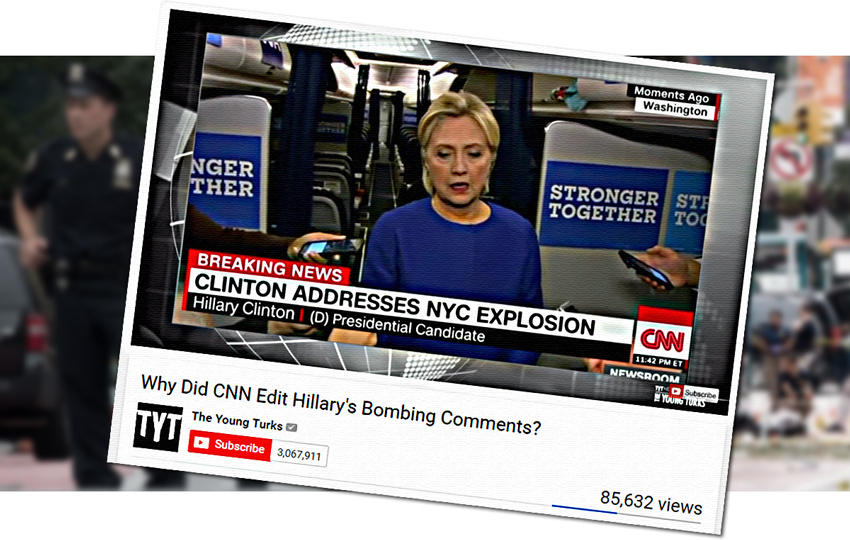
Over the weekend, CNN earned its “Clinton News Network” nickname by blatantly misreporting Hillary Clinton’s and Donald Trump’s responses to the terrorist bombings in New York and New Jersey.

Both candidates initially called these incidents “bombings” — even before government officials had definitively confirmed the obvious. But in its reports, CNN edited out Mrs. Clinton’s remarks to that effect and ran with the angle that Mr. Trump was irresponsible for saying . . . well, what she said.

“The press has since largely slammed Trump for referring to the explosion as a ‘bomb’ too soon,” reported The Hill, adding that major media outlets have somehow “also failed to mention Clinton in focusing on Trump.”

Some blame the public’s low esteem for the media on Mr. Trump’s scathing attacks. The Donald dubbed CNN, for example, “disgusting and disgraceful” over this latest controversy.

He’s right.

Enough. CNN’s desire to propagate stories favorable to one candidate and unfavorable to another has spiraled down to the withholding of relevant information, for no better reason than to mislead the public. As a news junkie with an itchy trigger finger on my TV remote, I’ve stopped clicking over to CNN.

Now, Anthony Bourdain’s Parts Unknown will be even more so.

This is Common Sense. I’m Paul Jacob.


Printable PDF

HIllary Clinton, CNN, bomb, bombing, bias, illustration


Categories
Accountability ballot access folly general freedom media and media people national politics & policies Regulating Protest too much government

The Two-Product Economic System

What if our economy worked like our political system?

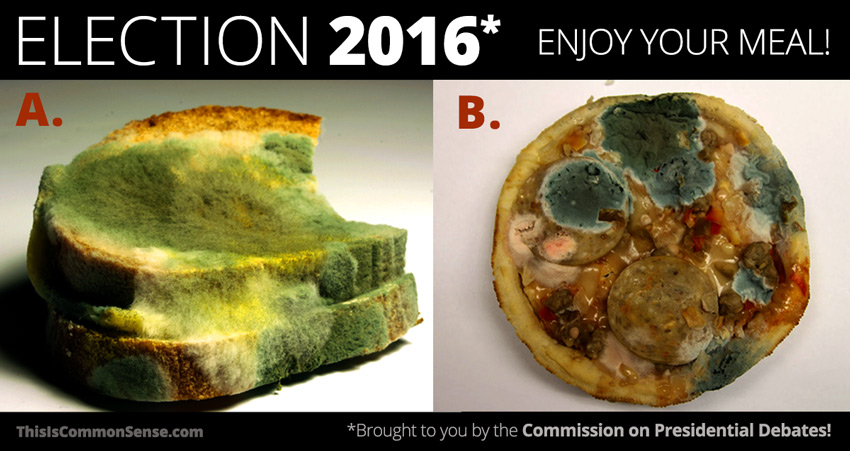
Only two major companies would provide any particular product for sale. But don’t worry — we’d still have a solid choice between “This Product Is Obnoxious” and “I Don’t Trust This Product.”

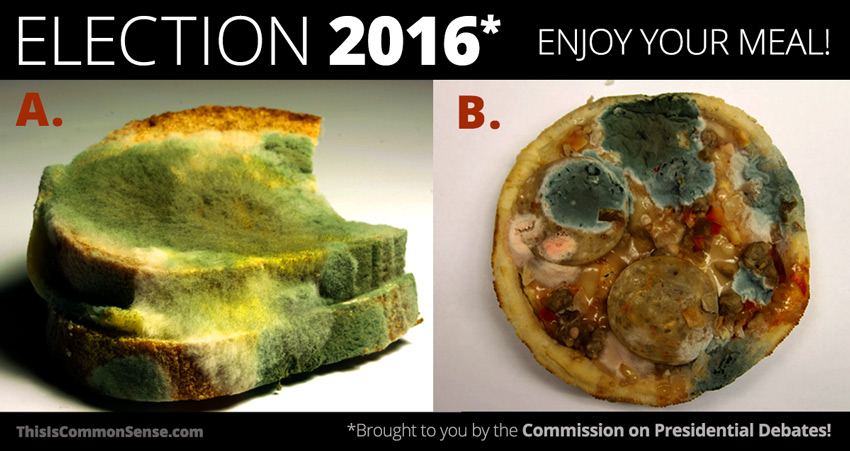
Those two companies would create a non-profit entity — a Commission on Product Debates — empowered to determine the rules under which any upstart company could present its “third-choice” product to consumers.

That Commission would prevent any third-choice product from standing on the marketplace stage where consumers could compare it face-to-face with the two established choices . . . until it captured 15 percent of the market.

Last week, in real life, the Commission on Presidential Debates announced that its upcoming September 26th debate would feature only Republican Donald Trump and Democrat Hillary Clinton.

Neither Libertarian Gary Johnson, averaging 8.4 percent in the five commission-approved polls, nor Dr. Jill Stein, the Green, at 3.2 percent, met the 15 percent threshold set by the Commission.

Forget that polls also show nearly two-thirds of consumers — er, voters, want Johnson and Stein in the debates. You can’t win ’em all.

Or any at all . . . if you can’t take your product to market. And the presidential debates are an essential space in today’s political marketplace.

No third-party or independent presidential candidate has been allowed on that debate stage since Ross Perot qualified in 1992, at the time polling at 8 percent — below Johnson’s current percentage.

That was before the Commission required a polling threshold. After those debates, one in five Americans voted for Perot on Election Day.

Duopolies do not serve us well. They cannot. That is not even their aim.

This is Common Sense. I’m Paul Jacob.


Printable PDF

election, duopoly, rotten choices, Hillary Clinton, Donald Trumpk


Categories
Accountability incumbents initiative, referendum, and recall nannyism national politics & policies

Colorado’s Problematic Solution

There’s a problem in Colorado, or so we’re told. And a solution. But the one doesn’t seem to match the other.

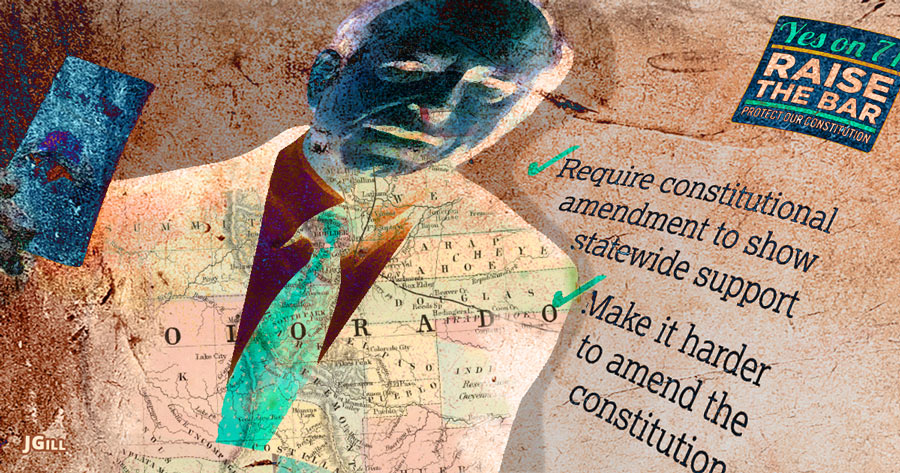
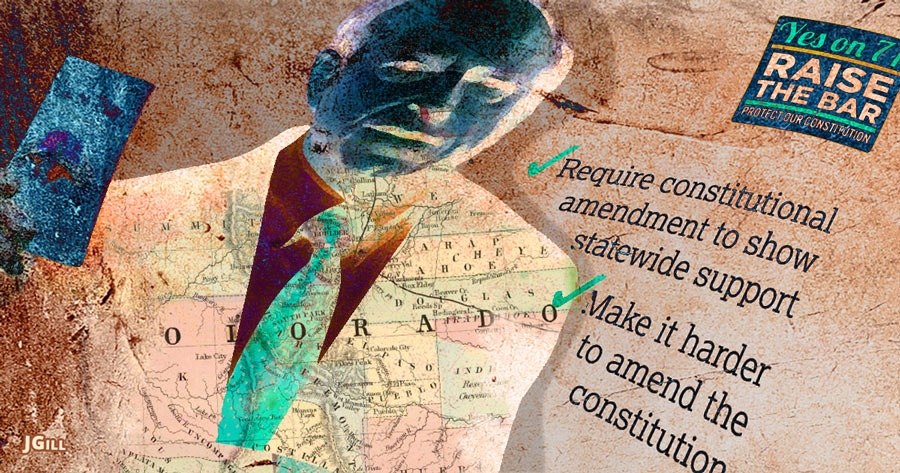
The problem, according to the supporters of Amendment 71, is too many constitutional amendments.

Their solution? Pass another constitutional amendment.

Moreover, even though two-thirds of constitutional changes have been proposed by legislators, not by citizen initiative, Amendment 71 makes it much tougher for citizens to propose amendments, while not altering the legislature’s power.

Maybe that’s because their committee, Rig the Bar . . . er, Raise the Bar, is a bipartisan group of politicians and political insiders. Their amendment would (1) increase the vote required to pass a constitutional amendment to a 55 percent supermajority, and (2) mandate that citizens qualify petitions statewide, as currently required, but also in each of the 35 state senate districts.

This means that to get an issue on the ballot citizens must successfully run 36 petition drives, not just one. And falling short in any single senate district would doom an entire effort. In short, future citizen initiatives would be much more expensive and likely to fail.

Meanwhile, the supermajority vote threshold provides well-heeled special interests with an ability to win even when they lose. Expect the powers-that-be to beat up reform measures with negative ads, knowing that simply by holding YES votes down to 54.9 percent, the establishment wins.

In a recent debate, Elena Nunez with Common Cause explained, “The problem with Amendment 71 is it’s designed to allow the wealthiest special interests in the state to act as a gate-keeper, because the cost of initiatives will go up dramatically.”

This Special Interest Protection Act sure is a problematic solution.

This is Common Sense. I’m Paul Jacob.


Printable PDF

Colorado, initiative, amendment, 71, incumbents, illustration


Categories
Accountability nannyism national politics & policies tax policy

The Year of Translucency

Barack Obama promised transparency in government. He didn’t deliver.

But others stepped up to the plate.

It’s now possible to see through a lot of political, elitist, and bureaucratic bunk courtesy of fugitives like Snowden, convicts like Manning, and citizens using FOIA (Freedom of Information Act) procedures.

And we are learning more about Hillary Clinton with each info dump from Julian Assange’s Wikileaks and every court-ordered disclosure thanks to lawsuits to enforce FOIA by organizations like Judicial Watch.

Some folks demand that Donald Trump release his tax returns. On the one hand, hooray for public demands for more information about candidates. But on the other hand, the richer you are, the longer and stranger your tax returns become. One shifts income around to avoid taxes — indeed, you take every “loophole” the law allows. As Justice Brandeis advised. Some folks may be shocked by Trump’s creative-but-legal accounting.

To avoid future confusion, we should demand simple tax returns from the rich. That would require jettisoning most of the tax code, simplifying the system. But ask your congressional representative why he or she will not support such a reform.

The reason we have an opaque and complicated tax code is . . . well, transparent. Under a simple tax system, there would be fewer favors to “trade” . . . and thus less power to accumulate, less oomph to parlay into pomp and splendor.

Which is why politicians rarely provide much transparency, and why it must often be wrested from them.

Merely by being merchants of opacity, our pols reveal, if inadvertently, the nature of our Too Big Government.

This is Common Sense. I’m Paul Jacob.


Printable PDF

tax code, power, politicians, transparency, illustration


Categories
Accountability general freedom ideological culture media and media people moral hazard nannyism national politics & policies too much government U.S. Constitution

Blame the Kids?

Why is it when some politicians or pundits get a brilliant idea about how to make the country better, involving (of course) making people do as the government dictates, it only applies to other people?

Sunday, on NBC’s “Meet the Press,” New York Times columnist and Times-styled conservative David Brooks bemoaned the electorate’s disunity due to the unprecedented unpopularity of Mr. Trump and Mrs. Clinton: “We could have a winner at 42 percent. Look at those poll numbers. . . . And so, that’s almost like a minority government. I think we’ve just got to do something about it.”

Do something? What?

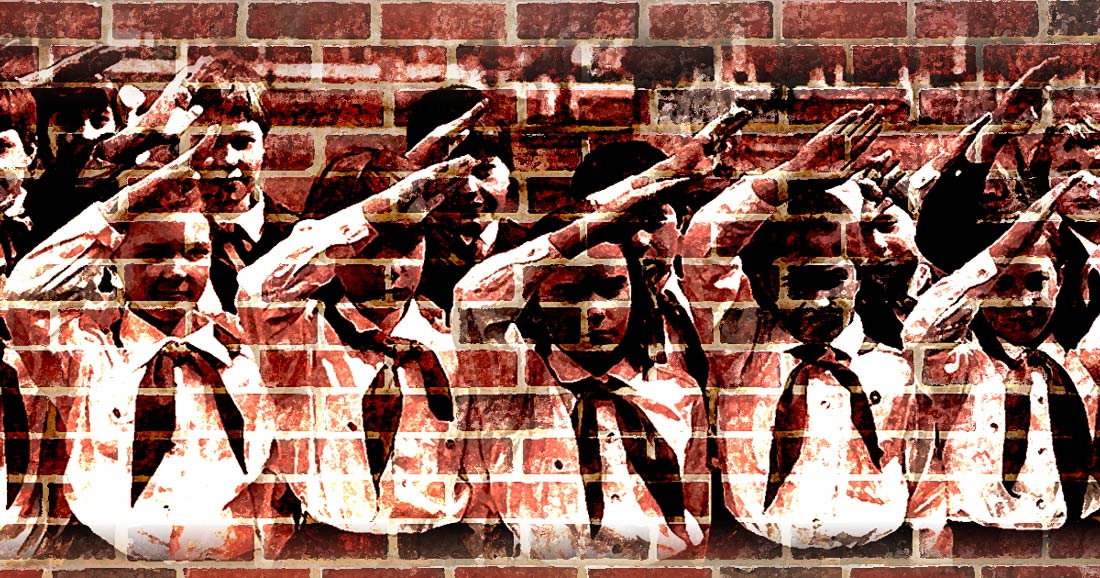
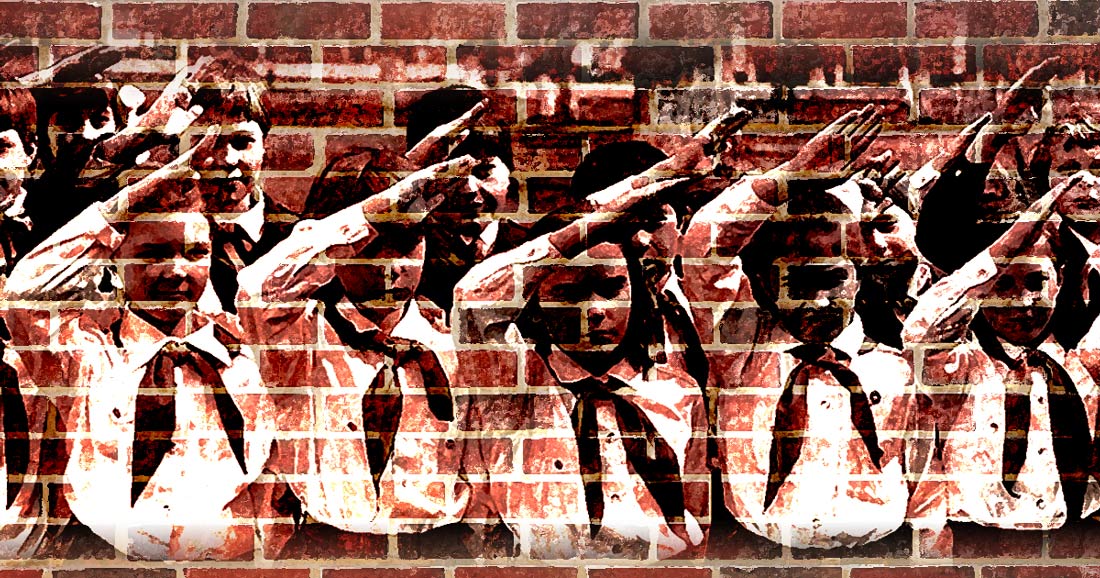
Brooks explained, “Mayor Rahm Emanuel of Chicago has an idea that every kid who graduates from high school spends the next three months in some sort of national service. So a kid from Martha’s Vineyard or Marin County is with a kid from Mobile, Alabama, and just three months, it would make a difference.”

Chicagoans will warn against emulating Mayor Emanuel.*

“I thought national service was going to be a given,” host Chuck Todd then offered. “I mean, my God, we’ve been talking about national service my whole adult life and I can’t believe we’re not there.”

News Flash: The problem with our politics is not the fault of teenagers. Nor would forcing young people to put their dreams on hold the better to toil in some social engineering scheme solve anything.

Want national service? Begin with politicians and TV talking heads.

This is Common Sense. I’m Paul Jacob.


* A whopping 62 percent of Chicagoans disapprove of their mayor and fully 40 percent want ole Rahm Never-Let-a-Crisis-Go-to-Waste Emanuel to immediately resign. The mayor’s delay in releasing an incriminating police video, until after his re-election, has been the most incendiary issue. But also consider some ugly facts about systemic breakdown in city governance: the number of murders this year is already higher than last year, four out of ten freshman in Chicago high schools fail to graduate and 91 percent of graduates going on to college require remedial courses.


Printable PDF

National Service, David Brooks , Mayor Rahm Emanuel , illustration, children, brick wall, illustration


Categories
Accountability ballot access general freedom media and media people national politics & policies political challengers

Serving the Voters

Who will choose the next president of these United States?

Voters? A private non-profit organization? The media? The Electoral College? The U.S. House of Representatives?

Russian hackers?

No joke, that last. Beyond the suspected Russian hack of the Democratic National Committee, the FBI warned last week that hackers, likely Russian, had broken into the online election systems of Arizona and Illinois.

Earlier this week, and months ago, I floated the possibility that Libertarian Gary Johnson could win New Mexico, where he served two terms as governor. Currently polling at 25 percent, a New Mexico win might prevent any candidate from obtaining an electoral majority, throwing the election into the House of Representatives.

Not likely. But possible. After all, by the Constitution, what actually determines who will be president is the Electoral College. Its elected electors vote in December. And, as attorneys David Rivkin and Andrew Grossman remind us in a Wall Street Journal op-ed, those electors can vote their conscience.

But first, voters must decide. Vote their consciences, based on good information not predigested by the press and the insider class.*

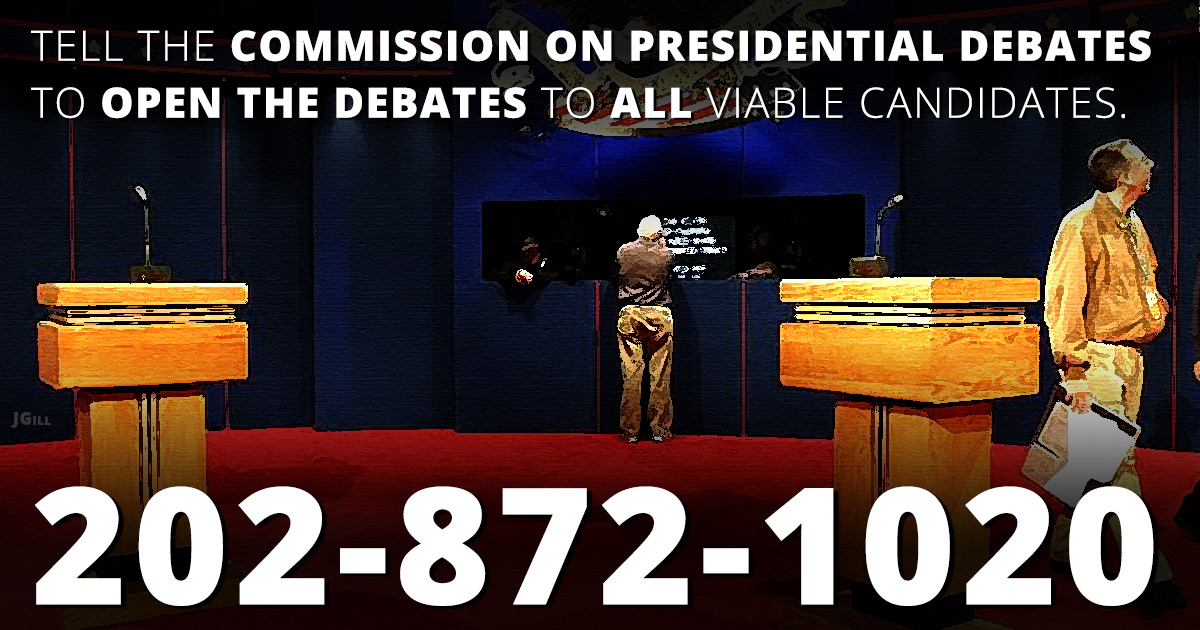
Which means people need to hear from each candidate who can be elected president. The partisan Commission on Presidential Debates (CPD) has no right to narrow our choices by holding a closed debate.

A series of polls before voters have even evaluated their choices ought not pre-determine the election.

Tell the Commission on Presidential Debates (202-872-1020) to open the debates to all viable candidates.

This is Common Sense. I’m Paul Jacob.


*The media made a mountain out of Gov. Johnson’s gaffe yesterday morning, not knowing immediately what MSNBC’s Mike Barnicle was asking concerning “Aleppo.” Johnson seemed to think it an acronym for some government agency, instead of a besieged Syrian metropolis. But consider it a sign the media is paying attention. Meanwhile, Green Party nominee Jill Stein became the first candidate charged with a crime — vandalism — for spray painting “I approve this message” on a bulldozer used to build a pipeline.


Printable PDF

debates, presidential, Gary Johnson, phone number, Commission on Presidential Debates, illustration


Categories
Accountability moral hazard national politics & policies responsibility too much government

Did We Pay for That?

It takes a treasure trove of love for government to demand that taxpayers fund politicians and political parties, in addition to basic government services — and “handouts for everybody.”

Most of us have enough horse sense to seek to reduce the scope of subsidy in society. Especially subsidies to politicians and activists. Who wants their tax money going directly to their ideological opponents?

Well, at least there is one area in recent times that has been defunded: the major parties’ national conventions.

The quadrennial indoor parades and awards shows that constitute the modern presidential nominating conventions don’t have the same function that they used to. Because of the primary system, and a number of other factors as well, the conventions aren’t so much selection mechanisms as “four-day infomercials.”

That’s Anthony L. Fisher’s term for the spectacles.

Fisher, in “Who Paid for the Conventions” — which appears in the October 2016 issue of Reason magazine — informs us that “this year, for the first time since 1972, the parties and their host cities’ host committees were on the hook to raise all the money” to pay for these festivals of folly.

Specifically, the directive was 2014’s Gabriella Miller Kids First Research Act, which diverted the convention subsidy funds to pediatric health care research.

It sounds like a good cause. But it is worth noting, once again, that Congress, when it defunds one thing, rarely just neglects to “spend the money.”

It’s the Spending, Stupid. Or stupid spending.

In any case, one small step for Congress, one giant leap for getting taxpayers out of politics.

This is Common Sense. I’m Paul Jacob.


Printable PDF

convention, politician, money, spending, taxes, illustration


Artwork based on original cc photo by Purple Slog on Flickr

Categories
Accountability folly national politics & policies responsibility

Greedy Union Bosses

Since the Service Employees International Union (SEIU) is a union, you might assume it holds that workers should be unionized.

Or, at the very least, that workers should have a right to unionize, if they so choose.

But you would be mistaken.

Similarly, many unions, most notably the SEIU, have been quite vocal in urging — demanding — that cities and states and the federal government require businesses to pay their employees a minimum wage of $15 an hour. The “Fight for 15” is their fight, no?

No.

Well, yes and no. It may be a fight they’ve picked, but unions such as the SEIU are on both sides of it. They’re fighting mighty hard to make other employers pay at least $15 an hour to employees, sure, but they’ve apparently not got an ounce of fight left to muster up the $15 an hour in pay for their own employees.

Last month, the pro-labor In These Times covered the struggle between the SEIU and those working for the SEIU’s “Fight for $15” campaign to form their own union as well as to receive an hourly wage of $15.

“We don’t have the right to join a union that we’re fighting for other workers to have,” one worker explained. “When we’re fighting for everyone to have $15 an hour, we should have it ourselves.”

“It is true that over the labor movement’s long history,” confirmed David Moberg, senior editor at In These Times, “many unions have fought with their staff over whether staff could or should organize.”

“Practice what you preach,” Moberg admonished the unions.

And if that’s so difficult for the SEIU, maybe what it preaches is the problem.

This is Common Sense. I’m Paul Jacob.


Printable PDF

union, labor, hypocrites, SEIU, Service Employees International Union, illustration


Categories
Accountability ideological culture media and media people national politics & policies political challengers Regulating Protest

The Media’s Job

Do nearly two-thirds of Americans want Libertarian Party presidential nominee and former two-term Republican governor of New Mexico Gary Johnson in the presidential debates?

Snopes.com, the hoax-busting website, investigated the truthiness of a widespread Internet meme making just that claim.

The verdict?

It’s true.

An August 25th Quinnipiac University poll showed 62 percent of likely voters saying yes, “Gary Johnson, the Libertarian candidate for president, should be included in the presidential debates.” Among 18-to-34-year-olds, a whopping 82 percent felt Johnson deserved a podium.

Or perhaps more accurately, these voters want an opportunity to hear about all their choices, not just Donald Trump and Hillary Clinton —deliciously dubbed “the unloved presidential candidates” in the Quinnipiac news release. Which leads to the most important number in the survey: 68 percent felt they “haven’t heard enough” about Gov. Johnson to even form an opinion.

He still garnered 10 percent support overall and was the only candidate with a higher favorable* than unfavorable rating.

Voters are dissatisfied with the major party choices, so why limit the debate to just Trump and Clinton? Because the Commission on Presidential Debates is a crony organization, a wholly owned subsidiary of the DNC and the RNC. With 68 percent of the public totally uninformed about Johnson, he’d have to win nearly a majority of everyone else to hit the 15 percent support required to get in the debates.

Where’s the Fourth Estate? Doesn’t the American voter deserve enough information about Johnson and Stein to form an opinion?

Or will they be broadcasting rigged debates?

This is Common Sense. I’m Paul Jacob.


* By the way, once again, the contest was closer when the polling included Libertarian Johnson and Green Party candidate Jill Stein. While head-to-head Mrs. Clinton bested Mr. Trump by a full 10 percentage points, 51-41, with Johnson and Stein included, Clinton’s advantage shrank to 45-38 percent, a seven point lead.


Printable PDF

debate, debates, candidates, media, illustration


Categories
Accountability crime and punishment general freedom moral hazard nannyism national politics & policies

A Practical Vote Against Racism

“Marijuana is only legal for white people, in California,” explains Lynne Lyman of the Drug Policy Alliance. Talking with Zach Weissmueller, on reason.tv, she clarifies the situation regarding California’s currently legal medical marijuana, and why Prop. 64, a ballot measure sponsored by Californians for Responsible Marijuana Reform, is so necessary.

Marijuana prohibition — which has been severely curtailed in the states of Alaska, Colorado, Oregon and Washington, all of which allow not only doctor-prescribed “medical marijuana,” but also recreational use — is still in play in California, despite legal medicinal use.

But the weight of the state’s heavy hand falls mainly upon the poor, especially on racial minorities. “If you are white and over 21 in California,” Ms. Lyman insists, “you can pretty much use marijuana without any sort of criminal justice involvement.”

So here is where the old canard that pushing for legalization and the right to self-medicate is “just about you smoking dope,” which is what I often hear. Californians’ best reason to vote for Prop. 64 is that it establishes something very much like a right to self-medicate, and — get this! — it altruistically applies to more than the white population.

The truth is, drug prohibition in America has been, mostly, racist.

Sure, alcohol prohibition transcended racial bias and bigotry. But the earliest federal laws against opium, heroin, and cocaine were directed at despised minorities, first the Chinese and even, many years later (after alcohol prohibition failed) when marijuana was made illegal, against blacks, “ne’er-do-well” jazz musicians, and Latinos.

So, one reason for white Californians to vote for legal marijuana is not so they can imbibe, but so that others aren’t unjustly persecuted.

This is Common Sense. I’m Paul Jacob.    


Printable PDF

marijuana, drug, war, racism, illustration


Original cc photo by ashton on Flickr