Categories
Accountability folly national politics & policies responsibility

Greedy Union Bosses

Since the Service Employees International Union (SEIU) is a union, you might assume it holds that workers should be unionized.

Or, at the very least, that workers should have a right to unionize, if they so choose.

But you would be mistaken.

Similarly, many unions, most notably the SEIU, have been quite vocal in urging — demanding — that cities and states and the federal government require businesses to pay their employees a minimum wage of $15 an hour. The “Fight for 15” is their fight, no?

No.

Well, yes and no. It may be a fight they’ve picked, but unions such as the SEIU are on both sides of it. They’re fighting mighty hard to make other employers pay at least $15 an hour to employees, sure, but they’ve apparently not got an ounce of fight left to muster up the $15 an hour in pay for their own employees.

Last month, the pro-labor In These Times covered the struggle between the SEIU and those working for the SEIU’s “Fight for $15” campaign to form their own union as well as to receive an hourly wage of $15.

“We don’t have the right to join a union that we’re fighting for other workers to have,” one worker explained. “When we’re fighting for everyone to have $15 an hour, we should have it ourselves.”

“It is true that over the labor movement’s long history,” confirmed David Moberg, senior editor at In These Times, “many unions have fought with their staff over whether staff could or should organize.”

“Practice what you preach,” Moberg admonished the unions.

And if that’s so difficult for the SEIU, maybe what it preaches is the problem.

This is Common Sense. I’m Paul Jacob.


Printable PDF

union, labor, hypocrites, SEIU, Service Employees International Union, illustration


Categories
Accountability ideological culture media and media people national politics & policies political challengers Regulating Protest

The Media’s Job

Do nearly two-thirds of Americans want Libertarian Party presidential nominee and former two-term Republican governor of New Mexico Gary Johnson in the presidential debates?

Snopes.com, the hoax-busting website, investigated the truthiness of a widespread Internet meme making just that claim.

The verdict?

It’s true.

An August 25th Quinnipiac University poll showed 62 percent of likely voters saying yes, “Gary Johnson, the Libertarian candidate for president, should be included in the presidential debates.” Among 18-to-34-year-olds, a whopping 82 percent felt Johnson deserved a podium.

Or perhaps more accurately, these voters want an opportunity to hear about all their choices, not just Donald Trump and Hillary Clinton —deliciously dubbed “the unloved presidential candidates” in the Quinnipiac news release. Which leads to the most important number in the survey: 68 percent felt they “haven’t heard enough” about Gov. Johnson to even form an opinion.

He still garnered 10 percent support overall and was the only candidate with a higher favorable* than unfavorable rating.

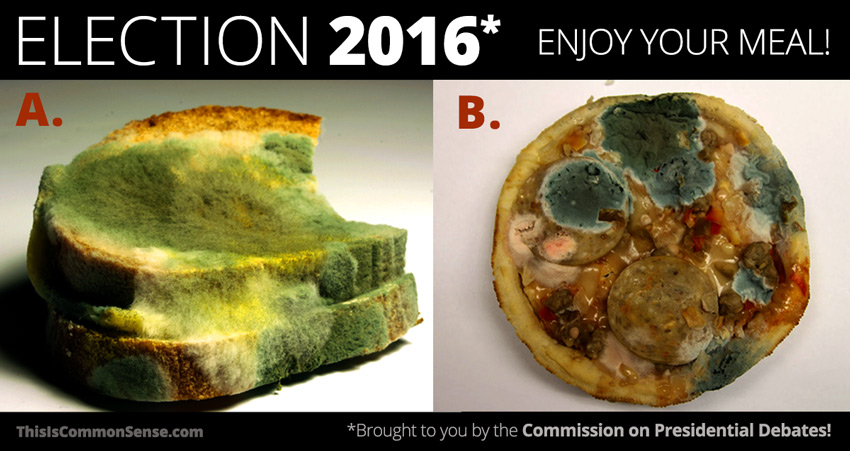
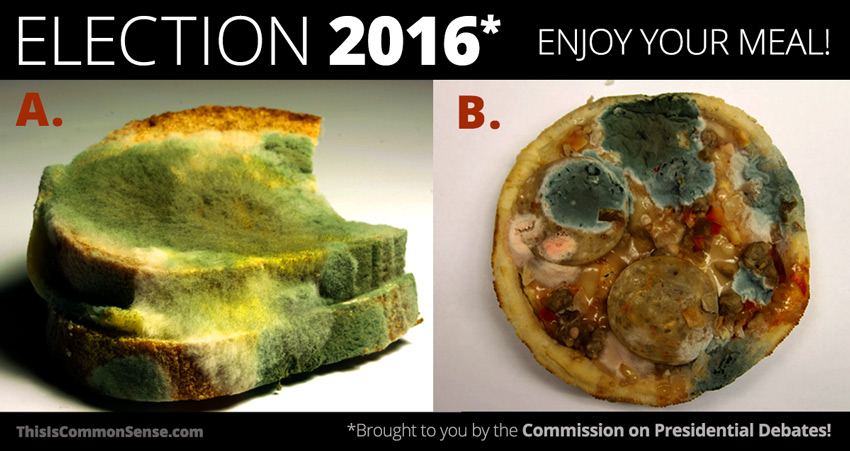
Voters are dissatisfied with the major party choices, so why limit the debate to just Trump and Clinton? Because the Commission on Presidential Debates is a crony organization, a wholly owned subsidiary of the DNC and the RNC. With 68 percent of the public totally uninformed about Johnson, he’d have to win nearly a majority of everyone else to hit the 15 percent support required to get in the debates.

Where’s the Fourth Estate? Doesn’t the American voter deserve enough information about Johnson and Stein to form an opinion?

Or will they be broadcasting rigged debates?

This is Common Sense. I’m Paul Jacob.


* By the way, once again, the contest was closer when the polling included Libertarian Johnson and Green Party candidate Jill Stein. While head-to-head Mrs. Clinton bested Mr. Trump by a full 10 percentage points, 51-41, with Johnson and Stein included, Clinton’s advantage shrank to 45-38 percent, a seven point lead.


Printable PDF

debate, debates, candidates, media, illustration


Categories
Accountability crime and punishment general freedom moral hazard nannyism national politics & policies

A Practical Vote Against Racism

“Marijuana is only legal for white people, in California,” explains Lynne Lyman of the Drug Policy Alliance. Talking with Zach Weissmueller, on reason.tv, she clarifies the situation regarding California’s currently legal medical marijuana, and why Prop. 64, a ballot measure sponsored by Californians for Responsible Marijuana Reform, is so necessary.

Marijuana prohibition — which has been severely curtailed in the states of Alaska, Colorado, Oregon and Washington, all of which allow not only doctor-prescribed “medical marijuana,” but also recreational use — is still in play in California, despite legal medicinal use.

But the weight of the state’s heavy hand falls mainly upon the poor, especially on racial minorities. “If you are white and over 21 in California,” Ms. Lyman insists, “you can pretty much use marijuana without any sort of criminal justice involvement.”

So here is where the old canard that pushing for legalization and the right to self-medicate is “just about you smoking dope,” which is what I often hear. Californians’ best reason to vote for Prop. 64 is that it establishes something very much like a right to self-medicate, and — get this! — it altruistically applies to more than the white population.

The truth is, drug prohibition in America has been, mostly, racist.

Sure, alcohol prohibition transcended racial bias and bigotry. But the earliest federal laws against opium, heroin, and cocaine were directed at despised minorities, first the Chinese and even, many years later (after alcohol prohibition failed) when marijuana was made illegal, against blacks, “ne’er-do-well” jazz musicians, and Latinos.

So, one reason for white Californians to vote for legal marijuana is not so they can imbibe, but so that others aren’t unjustly persecuted.

This is Common Sense. I’m Paul Jacob.    


Printable PDF

marijuana, drug, war, racism, illustration


Original cc photo by ashton on Flickr


Categories
Accountability free trade & free markets general freedom moral hazard nannyism responsibility too much government

States of the Unions

As Americans contemplate the intellectual breakdown of our two major parties, Brits and Europeans are trying to figure out what the state of their union is.

Does Brexit spell disaster for Europe?

Germany’s vice-chancellor is just the latest European bigwig to preach gloom and doom. According to the BBC, “Sigmar Gabriel said the EU would go ‘down the drain’ if other states followed Britain’s lead and that the UK could not keep the ‘nice things’ about Europe while taking no responsibility.”

What that “responsibility” is, I do not know.

But look: it is not as if an international order is all that difficult. In the 19th century, freedom of movement was accepted as the civilized standard — except in Russia.

In the 1800s, Britain and France agreed to bilateral free trade, and then Britain went unilateral with free trade. Prosperity ensued in Britain. Even in Europe proper, the century-long trend of wealth was upward.

And now a number of economists are advising the new British government to follow that old path — “a unilateral free trade deal would allow the UK to import cheaper goods and gain access to new markets, delivering greater prosperity,” The Guardian summarized.

Maybe the EU should go under. For the key to the union was subsidies along with EU-regulated trade. European states could adopt free trade without bullying from Brussels. And forget subsidies as a way of life.

America could do likewise, but not if Hillary or The Donald gets elected.

This is Common Sense. I’m Paul Jacob.


Note:  In most browsers, hovering your mouse over the bolded, silver text will give you “footnotes” of explanation.


Printable PDF

Brexit, Europe, hysteria, trade, economics, illustration


Categories
Accountability folly ideological culture nannyism responsibility

Venezuela’s New Firing Squad

We’ve watched Venezuela’s big-daddy socialism descend into dystopia:

  • Arbitrary arrests of political opponents;
  • An economy managed by government decree, in which inflation “may top 700 percent this year” and toilet paper, food and medicine are in terribly short supply;
  • The once oil-rich country has become “the worst performing economy in the world,” with hundreds of thousands of Venezuelans clogging border crossings with Colombia;
  • Meanwhile government workers “enjoy” a two-day work-week to save electricity, avoiding the wasted hours caused by daily blackouts;
  • And President Maduro has decreed that citizens can be conscripted — drafted into service — for 60 days, forced to pick crops.

“Venezuela brings back fedual [sic] serfdom to try to alleviate food shortages,” read one online headline. (Don’t laugh, that may be how we spell “feudal” someday.)

Still believing in magic . . . “Maduro ordered a 50 percent increase in the minimum wage last month,” informed the National Post, “but the latest studies show that salaries still fall far short of the amount needed to obtain basic household goods and food.”

Socialism has failed, again, and in doing so demonstrates something more than economic shortcomings. As the late President Ford warned, “A government big enough to give you everything you want is a government big enough to take everything you have.”

The Venezuelan people have the right to recall the president enshrined in their constitution, a particularly popular right at present . . . but the Maduro dictatorship refuses to take prompt, lawful action to facilitate the recall.

Not to mention unjustly arresting citizens circulating the recall petition or telling high government ministers to fire any government worker who signs.

So much for the socialist revolution . . . now tyrannically blocking a real revolution.

This is Common Sense. I’m Paul Jacob.     


Printable PDF

Maduro, Venezuela, socialism, collapse, illustration


Categories
Accountability media and media people moral hazard nannyism national politics & policies responsibility too much government U.S. Constitution

Too Dangerous x 2

“If he governs consistent with some of the things he’s said as a candidate, I would be very frightened,” former CIA Director Michael Hayden says about Donald Trump.

These are the words that begin an ominous television spot from Hillary Clinton’s presidential campaign. The advertisement concludes that Mr. Trump is “too dangerous.”

Hayden was director of the National Security Administration under President George W. Bush, before becoming the Principal Deputy Director of National Intelligence, and then moving to head the Central Intelligence Agency. He served at the CIA for only a few weeks into President Obama’s first term, but obviously Mrs. Clinton wouldn’t broadcast his negative view of Trump before millions of us in TV Land if she didn’t respect Mr. Hayden’s opinion.

Funny, yesterday on John Catsimatidis’s New York City radio program, Hayden declared, “I’m uncomfortable with the nominee of both of the major political parties.”

“John, a lot of my friends are saying that’s nice, Hayden, but you have to vote for one of them,” the former top spy offered, “but I’m not so sure I do.”

He doesn’t. Libertarian Party nominee Gary Johnson will be on all 50 state ballots and Green Party standard-bearer Jill Stein will be on most. And there are others.

“Somebody is going to win, but . . . I’m hoping they don’t think they’re sweeping into office with some powerful mandate,” Hayden continued. “And for people like me . . . to vote for some other choice, might deny them that sense of mandate, which would make, I think, things even worse.”

I’m no fan of Mr. Hayden, but regarding this? I agree.

This is Common Sense. I’m Paul Jacob.


Printable PDF

CIA, Director, Michael Hayden, Donald Trump, danger, Libertarian, Gary Johnson, illustration


Photo of Michael Hayden Credit: TechCrunch on Flickr (CC License)


Categories
Accountability general freedom initiative, referendum, and recall term limits

The Big Phony

In 2014, Bruce Rauner won the top job in Illinois politics leading a term limits ballot initiative. The initiative garnered 600,000 voter signatures, more than enough to go to voters.

But House Speaker Michael Madigan, the one man running Illinois (into the ground), recruited a henchman to file suit. After an appellate court struck the issue from the ballot, a cowardly state supreme court refused to even hear the case.

That didn’t stop Rauner. As governor, he tried to force a compromise that would get legislators to put term limits on the ballot for voters. But legislators are not going to budge until they, including Mr. Madigan, feel threatened by voters.

So, what’s Mr. Rauner on to now? He’s working with Turnaround Illinois to blanket the state with television spots about term limits. The ad buy is already over $1 million, much of which may be coming from Rauner, says Capitol Fax’s Rich Miller.

Miller complains that the legislature won’t ever pass term limits and that, even if legislators did miraculously propose a vote, the limits don’t kick in until “House Speaker Madigan will be 86 years old, and he could still run for a state Senate seat.”

True. Madigan, already the longest serving speaker in state history, would get to serve the newly enacted limit, which is prospective, not retroactive. Still, that’s hardly an argument against term limits.

Writing in Joliet’s Herald-News, Miller dubbed the effort “pretty much solely political and more than a bit phony.”

Political? Sure. What part of politics isn’t?

Phony? Come on. It’s not Gov. Rauner holding legislators accountable that’s phony — it’s our so-called representatives who crookedly ignore the people.

This is Common Sense. I’m Paul Jacob.


Printable PDF

term limits, Illinois, Bill Rauner, illustration


Categories
Accountability initiative, referendum, and recall nannyism national politics & policies responsibility too much government

Governments Against the People

Is it odd to see government employees and politicians — public servants — hold onto particular laws with a death grip?

Maybe not. In Texas, municipal government employees have been working mightily to prevent citizens from repealing local ordinances. According to a report by WOAI News Radio, the Texas “State Senate Intergovernmental Relations Committee on Monday heard horror story after horror story from citizen groups which have tried to circulate petitions calling for repeal of local ordinances.”

It’s not shocking, I suppose, since those laws may give politicians and bureaucrats more power. And perhaps there’s pride of authorship.

But, despite any merit (or demerit) these laws may possess, public servants are still public servants, which means: serve the public.

Which means: uphold democratic processes.

Government is all about processes, really. This shouldn’t be too hard.

Which is why there’s no excuse for what has been going on:

  • “municipal governments . . . employ ‘tricks’ and intimidation in an attempt to halt citizen petition drives”;
  • they cite “bogus city ‘statutes’ which invalidate signatures”; and
  • “will claim that more signatures are required than the citizens group has managed to collect.”

Basically, these government bodies are setting unreasonably high and arbitrary hurdles for petitions to get on the ballot — such as requiring “birth dates and Social Security numbers” of signers.

That often does the trick. One would have to be very careless to put one’s Social Security number onto a public document — one that anyone could see. And photograph.

For later nefarious use.

The fact that these government tactics are all illegal justifies the Senate committee probe into the malfeasance — and demands action.

This is Common Sense. I’m Paul Jacob.


PDF for printing

deathgrip, death grip, democracy, bureaucracy, change, politics, illustration


Categories
Accountability ideological culture media and media people moral hazard national politics & policies political challengers Popular

Smash the Duopoly

When Donald Trump called our country’s electoral process a “rigged system,” he was not wrong. The system is a legally secured duopoly.

I’ve discussed a number of the elements of this system previously. But one I may not have explored enough is the Commission on Presidential Debates (CPD).

The League of Women Voters sponsored the first televised presidential debates in 1952, and from 1976 till 1988 ran a “tight ship,” as How Things Work puts it. After the League refused to cooperate with the bullying major parties, the CPD was established by former R and D bigwigs aiming to fully accommodate the major party candidates.

And no one else.

The CPD calls itself “non-partisan,” but that’s a misnomer. It is a bipartisan commission, as everyone who knows its history knows. The commission raised the bar on minor party candidates to polling 15 percent in a number of polls.

Recently, we’ve been hearing that the commission is preparing a third place on stage, for Libertarian candidate Gov. Gary Johnson. But he still hasn’t quite yet hit the prescribed percentage, though he has met the most important qualification: he is the only minor party candidate likely to be on all state ballots.

And now there’s a kicker. According to Brian Doherty, historian extraordinaire of Reason, “The Socially Liberal and Fiscally Conservative PAC (Solifico) [yesterday] morning sent a letter to Janet Brown, executive director of the [CPD], threatening to send the IRS after them over their policy of not allowing all legitimate candidates for president in their debates.”

The case looks solid.

And could secure for Johnson a podium at the debates.

This is Common Sense. I’m Paul Jacob.   


Printable PDF

presidential, debates, duopoly, two party, illustration


Categories
Accountability ideological culture media and media people national politics & policies

The False Fairness of Bias

“If the disgusting and corrupt media covered me honestly,” Donald Trump tweeted on Saturday, “I would be beating Hillary by 20%.”

Argue the percentage, sure, but acknowledge the obvious bias.

Asked by MediaBuzz host, Howard Kurtz, about a “tilt against Donald Trump,” Larry Sabato, the director of the Center for Politics at the University of Virginia, replied, “I don’t think there’s any question about that.”

“But look,” continued Sabato, “there was a media tilt against Mitt Romney. There was a media tilt against John McCain. There was a media tilt against George W. Bush. It has more to do with party and personal characteristics of journalists than anything else.”

The bias is as old as it is obvious, “but of course I’ve never seen anything like this level of vitriol,” Kurtz clarified.

Kurtz noted a front-page New York Times column by Jim Rutenberg, which argued that reporters who believe Trump is “potentially dangerous” must “throw out the textbook American journalism has been using” and become “oppositional” — regardless of the fact that the stance “threatens to throw the advantage to his news conference-averse opponent . . . who should draw plenty more tough-minded coverage herself.”

According to Rutenberg, an unbalanced approach during the campaign’s homestretch would help remedy the $2 billion in free coverage the media gave Trump during the primaries.

Notice that the anti-Trump bias now helps the Democrat, whereas the pro-Trump bias previously helped the GOP nominate a candidate likely to lose to the Democrat.

Perhaps there’s a method to such media madness.

This is Common Sense. I’m Paul Jacob.


Printable PDF

media bias, Donald Trump, illustration, collage