
Categories
free trade & free markets too much government

The Exceptions Disprove the Rules

“I’ve instructed my prosecutors not to charge certain low-level nonviolent offenses to avoid people being held in jail unnecessarily,” Maryland’s Attorney General Marilyn Mosby informed the state’s Republican governor. She also urged the governor “to release all inmates in state prisons who are over 60,” explains The Washington Times, “approved for parole or scheduled to complete their sentences within the next year.”

This is all to avoid a prison pandemic. Meanwhile, the “Food and Drug Administration (FDA) announced Monday that it would permit states to create laboratories for designing COVID-19 tests,” Reason magazine tells us, adding that the FDA “has also decided to permit pharmacists to make their own alcohol-based hand sanitizers.”

Reason’s Robby Soave asks the obvious question: “Why do the people who are working hardest to fight the coronavirus have to ask a slow federal bureaucracy for permission to save lives?”

The New York Times reports that Dr. Helen Y. Chu, an infectious disease expert in Seattle, tried mightily to perform tests on subjects, early in the epidemic, to track how the virus was spreading. She was stymied every which way.

By bureaucracies.

The kludge of bad regulations and laws merely adds cost and annoyance during normal times; during emergencies they present major stumbling blocks to public health.

So, when our leaders make special exceptions, they demonstrate that the regulations were always bad — now just worse.

Real leadership would nix these rules, permanently.

And, for that matter, end the war on drugs — and prostitution and other victimless crimes.

One of the infractions Maryland’s AG decided to go lax on, however, is public urination. That crime has victims and ought to remain a public health violation.

Though perhaps not worth imprisonment.

This is Common Sense. I’m Paul Jacob.


PDF for printing

freedom, prohibition, rules, regulations, red tape, bureaucracy,

See all recent commentary
(simplified and organized)
See recent popular posts
Categories
general freedom too much government

Are We Graduating from Plastic?

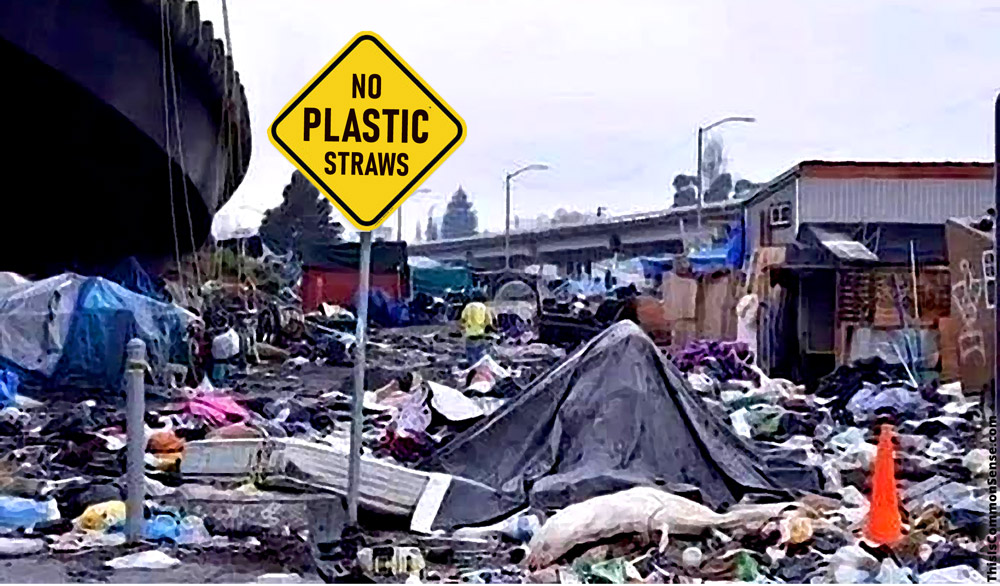
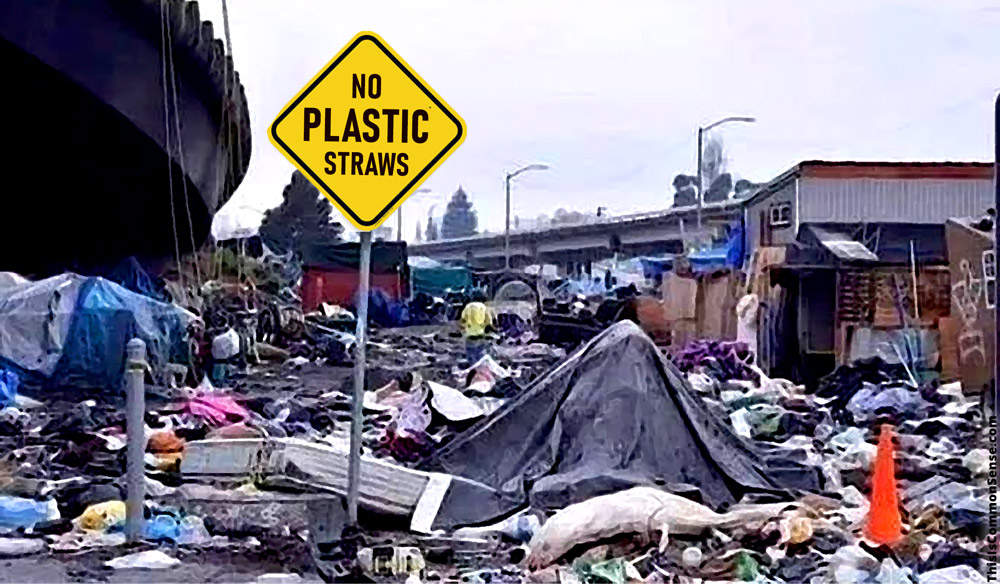
In The Graduate (1967), the young man played by Dustin Hoffman gets advice from an elder. “Just one word: plastics.” “Exactly how do you mean, sir?” “There’s a great future in plastics.”

When the world bans all plastic in 2021, that will be the end of that market opportunity. Other components of civilization will be discontinued in 2022.

Maybe I’m being too pessimistic. After all, there’s always the black market.

A plastic-bag ban is underway in New York City. Four states and five territories have already banned disposable plastic bags, as have countries around the world. New Yorkers are reportedly two-to-one in favor. A friend who lives there confirms this widespread resignation.

“I’m not happy about what it [plastic] does to the environment,” says one New Yorker. “But . . . what it does to my environment if I don’t have them is a nightmare.”

“This is a good thing because it’s helping the environment,” says another.

The problem of trash disposal has been solved. We use garbage cans, pickups, landfills. It’s a problem that must be continuously re-solved. Like many other problems . . . such as how to carry groceries.

We adopted plastic bags because they are much more convenient than paper. Convenience, efficiency, effectiveness: many man-made components of civilization serve these goals.

Reduction to absurdity can persuade only if the listener rejects the absurd. In 1967, the idea of banning plastic bags and plastic straws seemed, to most, absurd. Today, maybe two thirds of New Yorkers lament the inconvenience but add whaddyagonnado . . . when you gotta protect the environment?

That this measure will not protect much of anything, but merely allow activists to think well of themselves is, itself, absurd.

This is Common Sense. I’m Paul Jacob.


PDF for printing

plastic, environmentalism, California, law, prohibitions, bans,

See all recent commentary
(simplified and organized)
See recent popular posts
Categories
insider corruption too much government

Engineering Government Limits

Lord Acton’s Law of Power states the chief problem of government: “Power tends to corrupt and absolute power corrupts absolutely.”

It has broad application.

Take traffic lights. They are there to prevent accidents and make navigating roads a better experience for all. The basic idea is to establish and enforce a few basic rules and then let civilization proceed at the pace set by the people themselves. It won’t be perfect, but it won’t be tyranny, either.

But controlling traffic lights is a kind of power. 

And thus open to corruption.

Just ask Mats Järlström. After his wife got a “running a red light ticket” in Beaverton, Oregon — a town characterized on the show Veronica Mars as completely wholesome and innocent of guile — Mr. Järlström researched the yellow light timing system.

Using a sophisticated “extended kinematic equation,” obtained from his work background in Sweden, he sought to right the wrong that led to his wife’s ticket and found himself mired in government overreach.

You see, the Oregon Board of Examiners for Engineering and Land Surveying objected to his practicing engineering without a license.

The board sought to bury his findings about how yellow lights have been calibrated in Oregon — which he had shown encouraged behavior that would allow governments to maximize revenue . . . not safety.

That’s corruption. The intersection lights’ setup turned a safety measure into a means to fleece motorists — and the engineering board corruptly twisted its mission to suppress the truth. 

Thankfully, the Institute for Justice stepped in, and Järlström won in court.

Oregon now has new intersection lighting standards, and the power of the government professional board has been curbed.

A win for limited government!

And Common Sense, which This Is. I’m Paul Jacob.


PDF for printing

Oregon, licensing, Mat, traffic,

See all recent commentary
(simplified and organized)
See recent popular posts


Categories
property rights too much government

Zoned Out

There are ways of cultivating community standards without resorting to zoning and similar regulatory regimens by state and local governments. They have been studied, written about, and they can be found here and there around the country, though most famously in Houston, Texas.

But zoning’s the norm in urban and suburban communities.

Ask Marietta Grundlehner.

She had been running an online clothing boutique from her home in Fairfax County, Virginia, and has been forced to shut it down.

Well, a court has ruled that she must remove all her inventory from her home. You can have a home business in Fairfax, but not inventory of goods for sale.

Ms. Grundlehner had been earning, she said, about $30,000 a year as a “LulaRoe Fashion Retailer” in an industry billed by its online organizer as “social retail.” The ecommerce hub, lularoe.com, makes an enticing pitch for its business model: “Find your joy and fulfillment by creating a positive impact in your community.”

But it was a neighbor who turned her in and sicced the local government on her.

That Fairfax resident sure did not think she was having a “positive impact” in their community.

Grundlehner hopes for a regulatory change to save her business, but Christian Britschgi of Reason has a word for that battle: “uphill.”

Still, online businesses are on the ascendency. Too many run afoul of zoning laws. And online entrepreneurship being the wave of the future, local governments might want to forget their old gentrification utopianism and meet the real world, the place where people actually live. 

This is Common Sense. I’m Paul Jacob.


PDF for printing

zoning, regulations,

See all recent commentary
(simplified and organized)
See recent popular posts


Categories
ideological culture international affairs too much government

All the Tyranny in China

Are you going to make a big fuss?

I mean, about China — dominated by the ruling Chinese Communist Party (CCP). Because some people get all bent out of shape over their totalitarian government placing a million or two Muslim Uighurs into re-education camps surrounded by high walls and razor wire in order to browbeat, brainwash and torture away their ethnic heritage, language, and religious beliefs. 

Folks also complain about the insidious social credit system and the massive surveillance state, both of which would make Orwell blush; the ugly history of Chinese repression in Tibet; threats to invade peaceful neighboring Taiwan and snuff out their budding democratic experiment; not to mention Tiananmen Square. 

Some cannot get over the estimated 400 million babies murdered by the CCP against the will and amidst the anguished cries of their loving parents. Of course, that old “One Child Policy” has been “liberalized” . . . now permitting two children.  

Moreover, the CCP’s assault on free inquiry and public dialogue is no longer limited to just silencing their own citizens — as infamous attempts to squelch criticism from universities in Australia and here in America, as well as basketball players, show.

Presidential candidate and former New York City Mayor Michael Bloomberg said months ago that Chinese President Xi Jinping was “not a dictator” and “has a constituency to answer to.” At Wednesday night’s debate, he was asked about those remarks.

“In terms of whether he’s a dictator,” Bloomberg explained, “he does serve at the behest of the Politburo, of their group of people, but there’s no question he has an enormous amount of power.”

“But he does play to his constituency,” he reiterated. Sure, all 25 unelected communist insiders (ruling over 1.4 billion disenfranchised Chinese).

Acknowledging that their human rights record is “abominable,” Bloomberg agreed that “we should make a fuss, which we have been doing, I suppose.” 

But . . . “make no mistake about it, we have to deal with China if we’re ever going to solve the climate crisis. We have to deal with them because our economies are inextricably linked.”

Yes, indeed . . . with eyes wide open to the totalitarian brutality of the CCP’s Xi Jinping-led, 25-person dictatorship. 

We need a lot bigger fuss.

This is Common Sense. I’m Paul Jacob.


PDF for printing

See all recent commentary
(simplified and organized)
See recent popular posts


Categories
ideological culture political challengers too much government

The C-Word Emerges

“We’re not going to throw out capitalism,” declared Michael Bloomberg, the billionaire former New York City mayor now seeking the Democratic Party’s nomination for president. 

“Other countries tried that. It was called communism and it just didn’t work.”

Bloomberg was responding to a question by MSNBC’s Hallie Jackson at Wednesday night’s Las Vegas debate regarding his thoughts on Sen. Bernie Sanders’ proposal to “require all large companies to turn over up to 20 percent of their ownership to employees over time.”

“Let’s talk about democratic socialism, Mr. Bloomberg,” countered Sanders. “Not communism — that’s a cheap shot!”

But is it? 

The Vermont Senator has a long history of offering effusive praise for repressive socialist and communist regimes, including the Soviet Union, Cuba, and Nicaragua. After lauding the late Fidel Castro for providing healthcare and education and “totally transform[ing] the society” — while ignoring Castro’s complete disregard for human rights — Bernie judiciously added, “Not to say that Fidel Castro or Cuba are perfect, they are certainly not.”

Sanders has also called for “public ownership of the major means of production.” Unlike Karl Marx, I guess Bernie doesn’t sweat the small stuff.

“What a wonderful country we have. The best-known socialist in the country,” offered Bloomberg, referring to Sanders, “happens to be a millionaire with three houses! 

“What did I miss?”

Asserting a need for a second residence, the Vermont senator replied, “Well, you missed that I work in Washington.” 

“That’s the first problem,” Bloomberg interjected.

The first of many.

This is Common Sense. I’m Paul Jacob.


PDF for printing

Bernie Sanders, communism, socialism,

Photo by Gage Skidmore

See all recent commentary
(simplified and organized)
See recent popular posts


Categories
paternalism too much government

Save Me, Good and Hard

The problem with making my own decisions? I might make a mistake.

That’s not good for me, is it?

So what you government boys ought to do is make me scrape and bow and beg for permission. Make me fill out more forms, struggle with invasive new privacy-invading requirements. Make it super-hard to comply — so I give up before I do anything . . . ill-considered.

That way, you prevent me from taking actions that might just possibly go badly — like investing my own hard-earned money the way I want to.

The SEC is seriously considering meeting this demand. 

Give it to me good and hard, SEC! 

But let me clarify. By “me” I mean every small independent investor. By “give it to me” I mean “don’t give it to me.”

Don’t do what Securities and Exchange Commission Chairman Jay Clayton and other SEC commissioners are considering: imposing a regulation to “effectively ban many middle-class investors from buying mutual funds and exchange-traded funds.”

Don’t make it lots harder to use the Robinhood app to make certain low-fee or no-fee purchases. Don’t prevent investors from buying funds through discount brokerages and apps like Robinhood unless they first fill out an intrusive questionnaire about their personal finances and pray for permission.

Don’t make us beg to invest.

Don’t. 

Stop mulling whether to further harass Americans who want to be free to make their own choices and live their own lives. 

Don’t enslave. 

Liberate. Laissez nous faire, you condescending thugs.

This Common Sense. I’m Paul Jacob.


PDF for printing

SEC, Security and Exchange Commission,

See all recent commentary
(simplified and organized)
See recent popular posts


Categories
ideological culture political economy too much government

Ex-Californians

California, “the U.S. state most synonymous with all varieties of growth — vegetal, technological, and human — is at the precipice of its first-ever population decline,” writes Derek Thompson of The Atlantic. And folks in other states like Texas and Idaho are none too happy. 

You see, the Californians fleeing are finding new homes elsewhere. Especially in Texas and Idaho.

Oddly, Mr. Thompson breezes by the biggest source of anxiety: ideology. “Texas Governor Greg Abbott issued a warning on Twitter to Californians moving to his state: ‘Remember those high taxes, burdensome regulations, & socialistic agenda advanced in CA? We don’t believe in that.’ The sentiment was echoed in various warnings in Dallas newspapers about the awful ‘California-ing’ of North Texas.” Thompson quickly moves on to interrogate how real the general exodus from the Golden State is.

Which is interesting — but much more important is the main worry about all immigration: will these new citizens vote to overturn the order that attracted them in the first place?

There is certainly anecdotal evidence that this can be a real problem.

Also not mentioned in the The Atlantic squib is just how messed up California now is.

What can be done? The idea humorously floated by an Idaho politician — a “$26 billion wall to keep out people moving from the Golden State” — is just a joke.

And secession/expulsion of the 23rd state in the union is not realistic, either.

What is realistic is for non-California politicians to float in the U.S. Congress a willingness to break up the state into separate pieces, creating at least two new states. At least then, Jefferson State citizens could put up with West California émigrés. 

This is Common Sense. I’m Paul Jacob.


N.B. There are very serious political problems of representation in California that breaking up could help fix, by increasing the number of legislators and minimizing the ratio between representatives and the people they serve.

PDF for printing

Texas, California, democracy, migration, immigration,

See all recent commentary
(simplified and organized)
See recent popular posts

Categories
free trade & free markets too much government

The Anti-Worker Ism

Progressives who lean socialist used to hide their worst intentions. Now they are letting it all hang out.

There have always been overt socialists in the U.S., of course. They would sometimes protest the reluctance of fellow travelers to fully embrace socialism’s moniker. But the sentiment “Ah, screw it, let’s just admit we want to destroy everything currently in existence” seems on the ascendance. Even a few major Democratic candidates for president are on board.

Exhibit 112 is the new nationwide push to stomp the gig economy.

Especially freelancing.

This follows Exhibit 111, the recent and so far successful push to stop independent contractors from engaging in voluntary transactions in California. (Many lawsuits are underway.)

After scanning the coiled legalese of 111 — I mean AB5, California’s law — many companies decided that ending relationships with California-based freelancers was prudence with a capital P. And that rhymes with G, and that stands for Golden. Which the Golden State used to, uh, B.

Not every self-employed person has been thrown out onto the street. There are carve-outs. Actually, the only known victims are taxi drivers, cleaners, nurses, comedians, writers, editors, musicians, transcriptionists, citizen initiative petitioners, etc., etc.

The crackdown on non-9-to-5 work arrangements has also resulted in much gnashing of teeth by gig-seekers of all ideological stripes. 

Obviously, then, such massive destruction of economic freedom must be inflicted on the federal level too. So House Democrats put AB5’s gig-killing provisions into Exhibit 112, that is, into HR2474, pending legislation.

Democratic candidates for president Pete Buttigieg, Elizabeth Warren, and Bernie Sanders have endorsed the California statute, a national version, or both.

Ludwig von Mises had a word for this. He called socialism “destructionist.”

This is Common Sense. I’m Paul Jacob.


PDF for printing

California, socialism, labor, progressivism, Democrats

See all recent commentary
(simplified and organized)
See recent popular posts

Categories
too much government

Nixed Ski Trek App Flap

In Colorado, like other states, the people’s ingenuity often surprises. And in the Rocky Mountain State, like elsewhere, governments are known to worry about what free people do — and, unsurprisingly, often get in the way.

A popular new ride-sharing app, called TreadShare, hit the market last month, designed to alleviate traffic on I-70, the route from Denver to popular skiing destinations. The app makes the trip to the mountain slopes far cheaper than Uber of Lyft — not to mention easier on the environment.

So, of course, the State of Colorado has superciliously suppressed this innovation. Over safety worries, allegedly.

“The idea behind the app is for carpoolers to share the cost of gas and mileage, incentivizing the drivers to bring additional passengers and the passengers to get a cheap ride up to the mountains,” writes Taylor Sienkiewicz in Summit Daily. “Shortly following the launch, TreadShare received a ‘cease and desist’ letter from the Colorado Public Utilities Commission. This caused TreadShare to shut down operations and another similar app, Gondola, not to launch.”

Not receiving an apparently required $111,250 annual license, nor proof the company performs background checks on all drivers, the state government has “helpfully” squelched these two ride-sharing services.

What about safety? The Colorado State Patrol, whose job is ostensibly to maximize highway traffic safety, might wish to work with the app-makers to provide any useful security features.

But preventing organized carpooling through pricey up-front licensing requirements and ridiculous red tape doesn’t seem like promoting safety, but more like typical high-handed government regulatory overreach.

Thankfully, citizen activists have formed a group and are petitioning the legislature to join the rest of the Centennial State in the modern world. 

This is Common Sense. I’m Paul Jacob.


PDF for printing

Tread Share, regulations, Colorado, environmentalism,

See all recent commentary
(simplified and organized)
See recent popular posts