Categories
media and media people meme Popular responsibility too much government

Overkill . . . for Your Health

News stories about death- and illness-by-vaping keep hitting us. But in most of these stories it is what is left out that is most alarming.

From Washington State’s King County we learn of another case of severe lung disease “associated with vaping.” But the reportage doesn’t mention how the maladies relate to vaping. “KING-TV reports there have been 15 cases of severe lung disease associated with vaping in Washington state since April 2019. . . .” Interesting as far as that goes, but. . . .

In addition to no discussion of causality, the most obvious thing not mentioned in this and similar reports? The numbers diagnosed with severe lung disease caused by smoking — which is the relevant vaping alternative.

The U.S. Government’s agency devoted to diagnosing potentially widespread pathogens and practices is, thankfully, a bit more useful. In a recently published study, scientists have narrowed down the real culprit: “Vitamin E acetate was detected in all 29 patient” samples taken from those under study. 

Most had been vaping THC.

There are organizations worse than sloppy news outlets, however. In Massachusetts, the House of Representatives has passed a bill not merely to ban flavored e-cigarettes, but also to levy 75 percent tax on all e-liquids and vaping devices. 

Typical government overkill.

But not overkill enough, for the bill doesn’t stop there. Whopping fines against those caught with unlicensed vaping products are also in the bill, as is — aaargh! — civil asset forfeiture.

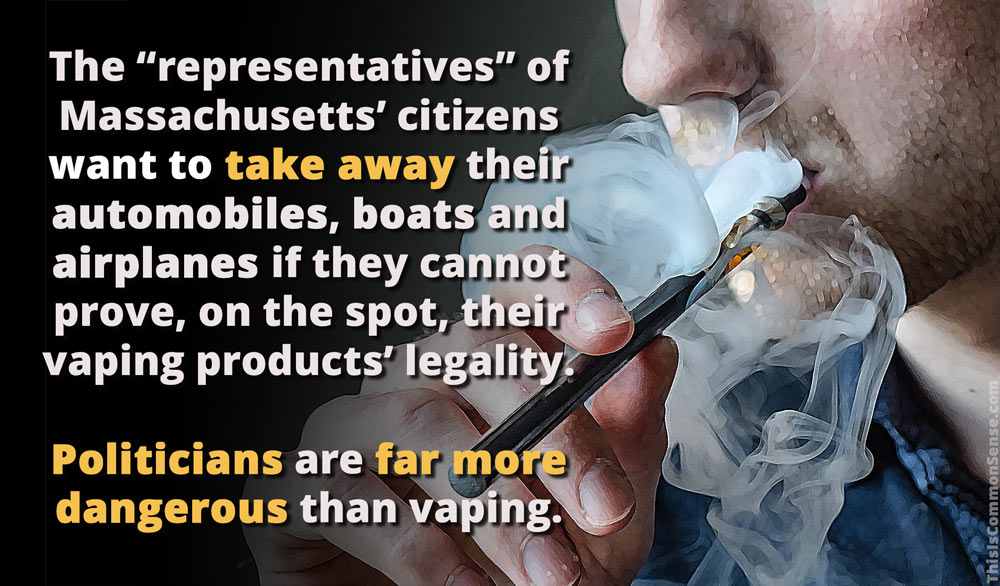
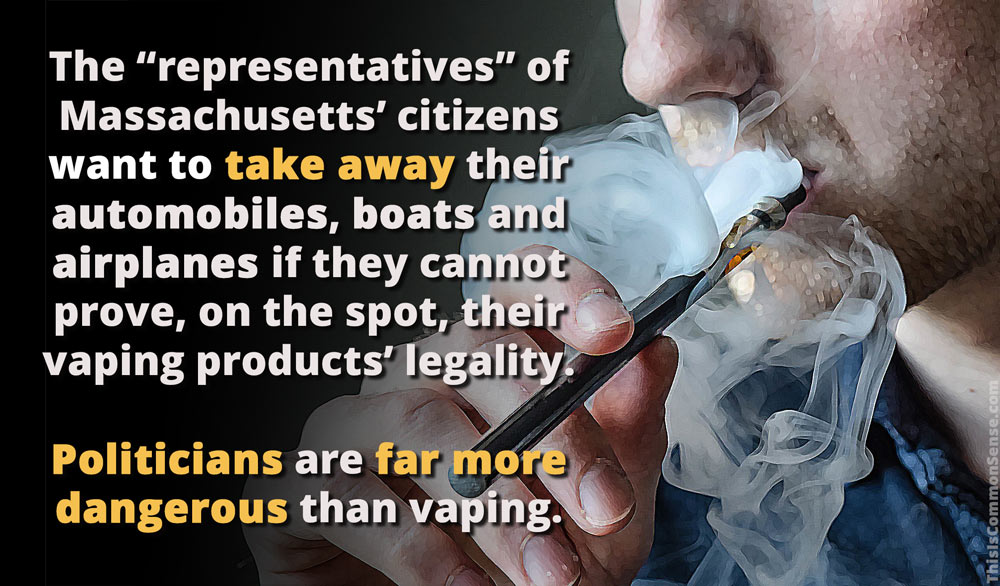
The “representatives” of Massachusetts’ citizens want to take away their automobiles, boats and airplanes if they cannot prove, on the spot, their vaping products’ legality.

Politicians are far more dangerous than vaping.

This is Common Sense. I’m Paul Jacob.


PDF for printing

vape, vaping, law, asset forfeiture, politicians,

Photo by Vaping360

See all recent commentary
(simplified and organized)
See recent popular posts


Categories
national politics & policies too much government

NowhereCare

Even people who get their information only from major network news know that, in their mad rush to promise free health care, Democratic presidential hopefuls would raise taxes for nearly everybody including the “hard-working middle class.”

How do they know?

Because at least one of the eager promisers won’t give a straight answer.

Her name is Senator Elizabeth Warren. 

Like Bernie Sanders (but not Amy Klobuchar and Joe Biden) she is offering “Medicare for All,” which Fox’s Tucker Carlson calls straight-up socialism.*

George Stephanopoulos, Chris Matthews, and “other strident Democratic partisans” have been pressing her on the tax hike issue, and at the recent, fourth national primary debate, Warren continued to evade. Even Sleepy Joe knows that universal single-payer health care spending would require more taxes than can be squeezed out of the very rich and the big corporations (which Warren, Sanders, and other Democrats incessantly push). But Warren just will not say the words: yes, your taxes will go up. She continually feints to her follow-up argument, that since overall health care costs would [according to plan] go down, we would all come out ahead.

Tucker Carlson, citing an Urban Institute study, gives the answer the democratic socialists won’t: their promise would require spending 3.4 trillion tax dollars per year — $10 grand per person per year, including every child, retiree, and prison inmate.** Warren expects us to repress our common sense and believe that cramming all health care spending through the federal government will increase efficiency.

U.S. Department of Health and Human Services Secretary Alex Azar has the right word for Medicare for All: utopian

Noting that Obamacare failed to live up to its promises, Azar predicts the ultimate result, “Medicare for None.”

This is Common Sense. I’m Paul Jacob.


* And not altogether implausibly, since medicine is a fifth of the American economy and (presumably) since socialism is an economy run by government.

** Tucker’s list.

PDF for printing

Elizabeth Warren, healthcare, taxes,

Illustration from a photo by Gage Skidmore

See all recent commentary
(simplified and organized)
See recent popular posts

Categories
insider corruption international affairs national politics & policies too much government

Mrs. Clinton’s Fevered Nightmare

Hillary Clinton’s recent statements linking Representative Tulsi Gabbard (D-Hawaii) to the Russians — Mrs. Clinton’s current favorite enemy — provided Rep. Gabbard with an opportunity for a return volley, dubbing Mrs. Clinton “the queen of warmongers, embodiment of corruption, and personification of the rot that has sickened the Democratic Party for so long.”

But what was shocking was Clinton’s confidence in making such a charge sans evidence

Or not, considering her long history of “vast rightwing conspiracy”-mongering.

Should we wonder about projection, here? Could Clinton see conspiracies everywhere because she is herself at base a conspirator?

Ask Julian Assange.

His Wikileaks site provided evidence of Clinton campaign malfeasance and sheer creepy weirdness before the 2016 election, and also, more famously, evidence of U.S. military war crimes. No wonder he earned the ire of Clinton and the superstate within which she has worked.

Assange is now in a British court, trying to resist extradition, a wounded man. “I can’t think,” he lamented. “I can’t research anything, I can’t access any of my writing. It’s very difficult where I am.”

What his barrister said is even more chill-inducing: “This is part of an avowed war on whistleblowers to include investigative journalists and publishers. The American state has been actively engaged in intruding on privileged discussions between Mr. Assange and his lawyer.”

Though we know little for certain, between a “sunlight” publisher and the dark, secretive Deep State, I trust the journalist at least a bit more. After all, the Deep State has Hillary Clinton on its side, along with known liars like James Clapper — who just had the temerity to call Trump’s lies “Orwellian”!

And no wonder Mrs. Clinton hates Rep. Gabbard, for the Hawaii congresswoman would halt the prosecution of Assange.

This is Common Sense. I’m Paul Jacob.


PDF for printing

Hillary Clinton, Tulsi Gabbard, Russia, conspiracy,

See all recent commentary
(simplified and organized)
See recent popular posts

Categories
free trade & free markets too much government

Location, Location, Dislocation

“While Lower Manhattan is desperately in need of affordable housing,” writes Yuh-Line Niou in an official statement of her re-election campaign for New York State Assembly, “we cannot pit the need for housing against the need for green space, especially when so many good alternatives are available. . . .”

Assemblywoman Niou (D-Lower Manhattan) is making the case against a housing project in her district. What she is really trying to do is save the Elizabeth Street Garden, a one-acre sculpture garden.

Uh, OK.

I have nothing against sculptures or gardens, but it seems like a strange sort of public space to exist in a high-demand real estate locale like Manhattan.

But you know what is stranger? 

Ms. Niou also supports the notion that “housing is a right.”

Christian Britschgi, of Reason, notes her pickle, drawing our attention to the similar predicament of a socialist city councilwoman on the other side of the continent, in Seattle. “Now, one can reasonably argue that open space is a precious commodity in a city, one that needs to be balanced against the need for shelter,” Britschgi writes. “But it’s hard to argue that while also asserting that housing is also a right that needs to be guaranteed by the government.”

Niou insists that “both need to be protected and expanded,” and somehow thinks the “best way to achieve this is by engaging the community from the start so decisions are made with a full knowledge of community sentiment and impact.” 

Not mentioned? Rent control.

It is almost as if pols have no idea that goals they promote might be exacerbated by existing policies they dare not criticize.

Or even bring up.

This is Common Sense. I’m Paul Jacob.


Yuh-Line Niou, housing, regulations,

See all recent commentary
(simplified and organized)
See recent popular posts


Categories
national politics & policies Popular too much government

E-Panic

One of the better arguments for government relies upon sobriety: we want rational, measured responses to threats, not panicky, hot-headed reactions. We have a rule of law to prevent revenge and vendetta, replacing them with justice and civil order.

But when we expand the concept of “threat” far beyond interpersonal violence and to dangers from our own foolish or merely misguided behavior, “sobriety” too often doesn’t even seem an option.

Take drugs. 

Specifically, take “vaping.” 

That is the innovative technology of “e-cigarettes” that can be used to replace the smoking of tobacco and other drugs with inhaling drug-laced water vapor.

Vaping is far less dangerous than tobacco, at least for emphysema and lung cancer, but it is not harmless. Several hundred people across several of these United States have become very ill and a few have died of a mysterious lung disease.

So of course the Surgeon General calls it an epidemic, and the White House and Congress take up the cause to regulate and even prohibit vaping. And India just “became the latest country to ban electronic cigarettes,” according to Bloomberg

Whoa, the subject has barely been studied, and what we know so far is that it was not major-brand nicotine e-liquid, but, instead, boutique product that has caused most of the casualties. 

The leap to legislation has been too quick for consumers to alter their own behavior with new information.

Besides, prohibition and regulation haven’t worked to prevent the current opiate overdose crisis.

The rush to “do something very, very strong,” as President Trump puts it, is the very opposite of why we say we want government.

Its lack of sobriety is . . . sobering.

This is Common Sense. I’m Paul Jacob.


PDF for printing

vape, vaping, law, ban, prohibition,

See all recent commentary
(simplified and organized)
See recent popular posts


Categories
education and schooling national politics & policies Popular too much government

Biden Under the Bed

Former Vice-President Joe Biden was put on the spot, again, about race. During last Thursday’s presidential candidates’ debate, ABC newscaster Lindsey Davis asked what responsibility Americans should “take to repair the legacy of slavery in our country?”

Triple, Biden said, “the amount of money we spend. . . .”

On “very poor schools, the Title I schools.”

From $15 to $45 billion a year.

Dodging the reparations question, he offered a four-part plan for educating poor children that was very . . . educational

Biden’s second solution is “make sure that we . . . help the teachers deal with the problems that come from home.” 

Send in more psychologists!

Step three is to “make sure that . . . 3-, 4-, and 5-year-olds go to school. School. Not daycare. School.”

Sounds like forcing every parent to put their 3-year-old into school. Or just “poor” 3-year-olds? Neither sounds good.

If my elementary school math still holds, next comes policy objective No. 4. 

And it’s a doozy. 

“We bring social workers in to homes and parents to help them deal with how to raise their children,” Sleepy Joe declared. Because as he explained “they”— wealth-challenged parents — “don’t know quite what to do.”

But Biden does. “Play the radio, make sure the television — excuse me, make sure you have the record player on at night, make sure that kids hear words.” 

The former VEEP explained that children from “a very poor background will hear four million words fewer spoken by the time they get [to school].”

Language skills matter. But do we really want the next president to station a social worker under every kid’s bed to make sure the record player isn’t skipping?

This is Common Sense. I’m Paul Jacob.


PDF for printing

Joe Biden, bed, monsters, record player, black child,

Illustration adapted from an image by Rusty Clark

See all recent commentary
(simplified and organized)
See recent popular posts

Categories
ideological culture Popular too much government

Slaves All?

A bizarre argument is gaining popularity: the United States of America not merely allowed slavery in its first hundred years, it depended upon it, grew rich by it . . .  and, “therefore,” not only the federal government but also its constitutional principles and even capitalism are all tainted . . . and . . . “therefore” . . . we must have socialism!

Why long-dead chattel slavery requires political slavery now is hard to figure.

And no, you should not need to read George Fitzhugh’s Cannibals All! or Sociology for the South to see that socialism is slavery.*

But these days it is more common to link slavery with . . . freedom (this is hard even to type) in the form of free markets. 

Leftists who make this linkage are helped by some popular historians who argue that since the   antebellum South (1) grew faster, economically, than the North, (2) slavery was profitable for slaveholders, and (3) slaves became more productive in picking cotton, the “peculiar institution” was key to American success. Vincent Geloso, a visiting assistant professor of economics at Bates College, writing for the American Institute for Economic Research, ably shows that not one of these three theses hold up to scrutiny.

Most importantly, though, Geloso demonstrates that the slavery system was like all other interventionist systems, with some people (slavers) benefiting at the expense of others (slaves, of course, but also free people . . . through a variety of subsidies).

Geloso uses the term “deadweight loss” to make his case that slavery made America poorer.

He is certainly not wrong. But once you understand why freedom and prosperity are linked, not much economic jargon is necessary.

This is Common Sense. I’m Paul Jacob.


* This pro-slavery southerner did argue against the very idea of liberty and free labor on the grounds that freedom is bad and socialism is good. Indeed, “Fitzhugh disliked ‘political economy’ (as economics was then called), which he saw as ‘the science of free society,’” economist Pierre Lemeiux explains, “as opposed to socialism, which is ‘the science of slavery.’” That forthright appraisal is about all that’s good in Fitzhugh.

PDF for printing

slave, ancient, Roman, Rome, chains,

Photo by Jun on flickr

See all recent commentary
(simplified and organized)
See recent popular posts


Categories
political challengers too much government

Recognizing a Problem

Democratic Presidential candidate Andrew Yang has at least one good policy preference: he opposes tough land use and zoning regimes.

And he is not alone. 

“Yang’s criticism of zoning is pretty close to what other Democratic primary candidates have said on the subject,” writes Chistian Britschgi at Reason. “Sens. Cory Booker (D–N.J.), Elizabeth Warren (D–Mass.), and Amy Klobuchar (D–Minn.), and former Housing and Urban Development Secretary Julian Castro have all targeted restrictive local land use regulations as a cause of high housing costs.”

Mr. Yang’s website clarifies the problem: “Those who already own homes have made it significantly harder for those who don’t to recognize that dream. Through NIMBY (not in my backyard) and zoning laws, the ability of new housing to be built in certain areas has been impeded to the point where the vast majority of Americans can’t afford to live in the largest cities.”

But while Yang recognizes that zoning is best dealt with on a local and state level, his more famous competitors offer fixes, Britschgi notes, that “require the federal government to either spend more money or attach more regulations to the money it already spends.”

Here’s the bottom line: Several Democrats competing for the highest office in the land recognize government interference as the leading cause of the housing crunch and its high prices.

Yet, instead of fighting bad policies at the state and local source, they advocate more federal spending. And they most decidedly do not apply their housing regulation realism to other problems we face.

This is Common Sense. I’m Paul Jacob.


Andrew Yang, zoning, land use, visionary, presidential, election,

Photo by Collision Conf

See all recent commentary
(simplified and organized)
See recent popular posts


Categories
national politics & policies too much government

The New New Dealer

Reason magazine’s Nick Gillespie finds “a lot” to like about Pete Buttigieg. He sees a candidate “who at his best represents a new generation in American politics and a principled unwillingness to go along with the most free-spending plans of his rivals for the Democratic presidential nomination.” 

I have so far resisted the charms of the Mayor of South Bend, Indiana.

He seems dangerous to me, in part because he cuts quite a figure while appearing so calm and reasonable.

But Mr. Gillespie is not making a case for Buttigieg. The Reason editor has noticed a growing set of downsides to the pol, writing that as Buttigieg “starts to unveil more and more plans — to pack the Supreme Court, say, and to call for national service — he becomes less appealing,” which, if anything, understates the situation.

You see, Buttigieg “wants to destroy the gig economy in order to save it.”

Gillespie provides that “takeaway” from the campaign’s proposal, “A New Rising Tide: Empowering Workers in a Changing Economy.” Gillespie explains that the plan’s “focus is to force more regulations on employers and increase unionization among workers, neither of which is likely to make it easier for the economy to grow or the workplace to ‘more easily adapt’ to the needs of suppliers, workers, or consumers.”

There is a lot about the current labor markets (at record all-time highs, says the President) that definitely would not be helped by a plan to “organize” labor using the old idea of the strike-threat system.

Like a lot of Buttigieg’s positions, they seem warmed-over yesteryear progressivism.

FDR, but modernly packaged.

Making Big Government even bigger.

This is Common Sense. I’m Paul Jacob.


PDF for printing

Pete Buttigieg, president, election, labor, gig economy, candidate,

Photo by Lorie Shaull

See all recent commentary
(simplified and organized)
See recent popular posts


Categories
national politics & policies too much government

Make Deficits Great Again?

Is Donald Trump really “draining the swamp”? 

It’s overflowing.

Stan Collender, writing last year in Forbes, noted just what a big spender the president really is. Now, an update: fiscal year 2019 sports a deficit of $1.09 trillion, up considerably from the $897 billion projected earlier this year; the next year is expected to nudge the deficit even higher, to $1.1 trillion.

The whys aren’t a mystery: it is politically difficult to cut an expected benefit to any constituency. It looks stingy — though it is the very opposite. Spending other people’s money — including taxpayers’ — is not generosity. For a politician, it is naked self-interest. Buying votes.

Worse than merely corrupt, it’s corrupting — since the People are increasingly tempted to look to government to supply special voting bloc advantages rather than the mutual, universal advantage of liberty and justice for all.

Collender speculated that a $2 trillion deficit is “definitely within view” because “Trump is demanding that federal spending and the government’s red ink be increased even further.”

Judd Gregg, writing yesterday for The Hill, summarizes current GOP fiscal policy as “now the most profligate and debt-driving party in the nation’s history.” 

He’s not wrong, but I question his next line: “Fiscal restraint is no longer part of the cloth the Republican Party wears.”

Careful wording. 

Republicans sometimes talk a good game, but are known to be big spenders when not opposing a Democratic president. The Class of 94 was effective against Bill Clinton. Under unified government in the aughts, though, under George W. Bush, they went on a spree.

Maybe Republicans just need a good enemy.

Bernie Sanders for President? 

Perhaps any socialist Democrat will do.

This is Common Sense. I’m Paul Jacob.


PDF for printing

money, case, window, floating, deficit, spending,

See all recent commentary
(simplified and organized)
See recent popular posts