Categories
initiative, referendum, and recall

Good News . . . For Now

For now.

One must always add that proviso — at least with respect to constitutional provisions like term limits and citizen initiative rights, which limit the power of lawmakers and expand that of citizens. For these, incumbents’ hostility never ends.

But for now? The news is good. 

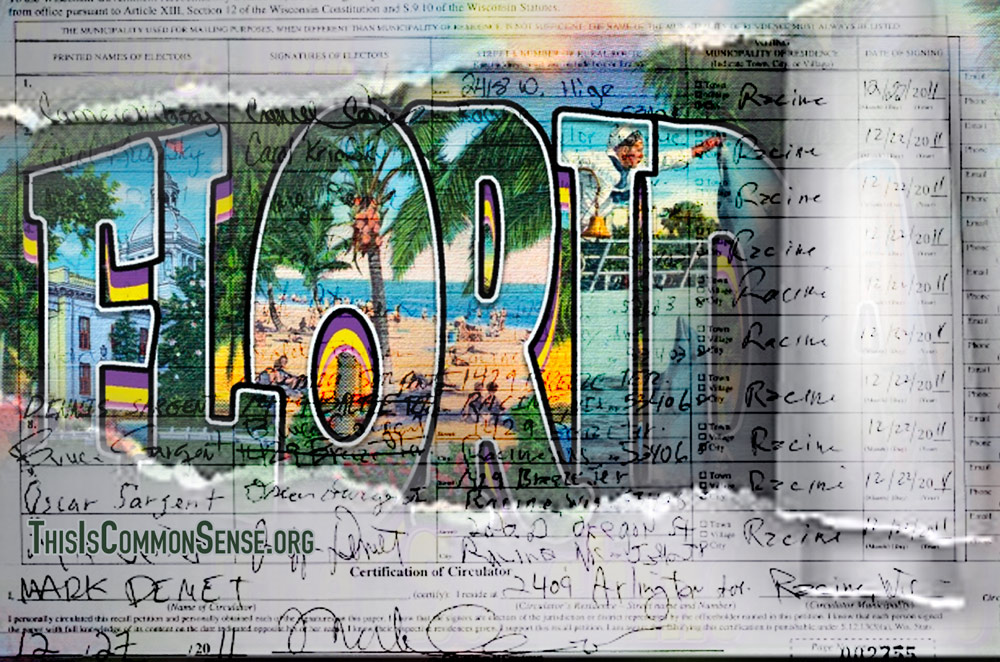
The Florida House of Representatives website reports that HJR 1127 “Died on Second Reading Calendar” in mid-March. The same fate is reported for the companion senate bill.

The measure would have amended the constitution to limit citizen-initiated amendments “to matters relating to procedural subjects or to structure of government or of State Constitution.”

Citizen initiatives would have been prohibited from dealing with policy matters, including legislatively enacted (or citizen-enacted) policy that voters seek to reverse.*

During the battle over the measure, Kara Gross of the ACLU observed that some lawmakers “continue to find new ways to make the already-stringent citizen initiative process even more challenging.”

One legislator who challenged the Republican-sponsored measure was Democratic Representative Andrew Learned.

“Is it really best that the legislature make decisions and not the citizens of Florida on the ballot?” he asked. “If the people of Florida at the ballot aren’t a check on the legislature, I don’t know what is.”

No matter how unpopular such a bill might be with mere constituents, many lawmakers would have had no problem imposing it. As a constitutional amendment, though, such a change must be approved by voters. 

And that proved a bridge too far.

This is Common Sense. I’m Paul Jacob.


 * Florida politicians cry crocodile tears over citizen initiatives amending the constitution instead of merely changing a statute. Those same legislators refuse to establish a path for citizens to petition statutory changes onto the ballot.

PDF for printing

See all recent commentary
(simplified and organized)
See recent popular posts
Categories
Today

Good Sailing

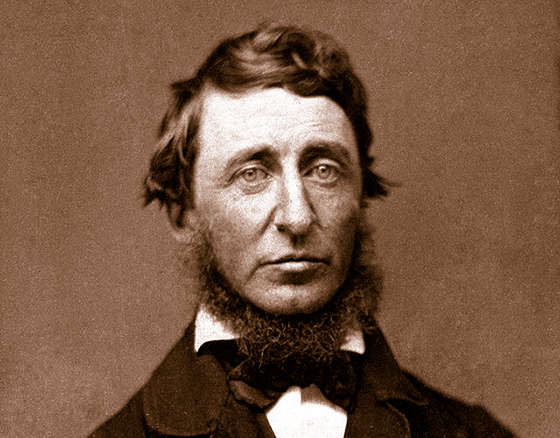
On May 6, 1862, American author, philosopher and abolitionist Henry David Thoreau died, after many years of tuberculosis. 

Aware he was dying, Thoreau’s last words were “Now comes good sailing,” followed by two lone words, “moose” and “Indian.” Bronson Alcott planned the service and read selections from Thoreau’s works, and Ralph Waldo Emerson wrote the eulogy spoken at his funeral. 

His remains, as well as those of members of his immediate family, were eventually moved to Sleepy Hollow Cemetery in Concord, Massachusetts.

His most famous works are An Essay on Civil Disobedience (1849) and Walden (1854).

Categories
Thought

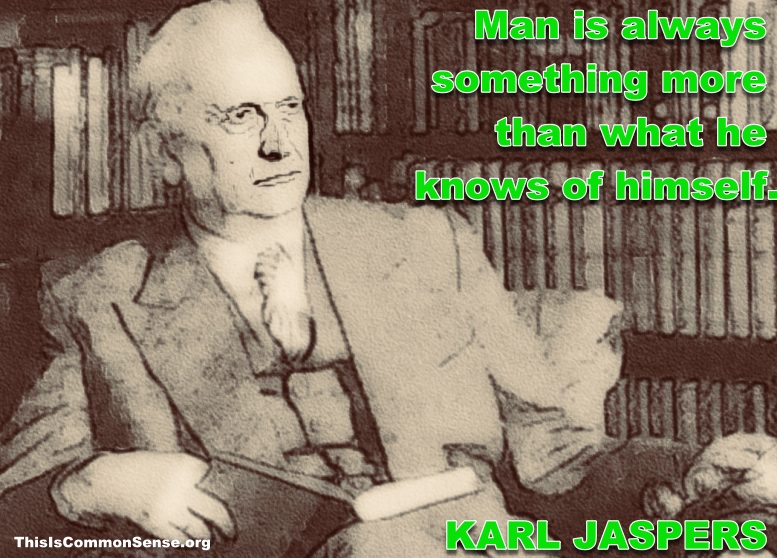
Karl Jaspers

Man is always something more than what he knows of himself. He is not what he is simply once and for all, but is a process…

Categories
Accountability general freedom local leaders term limits

Freedom in Granite

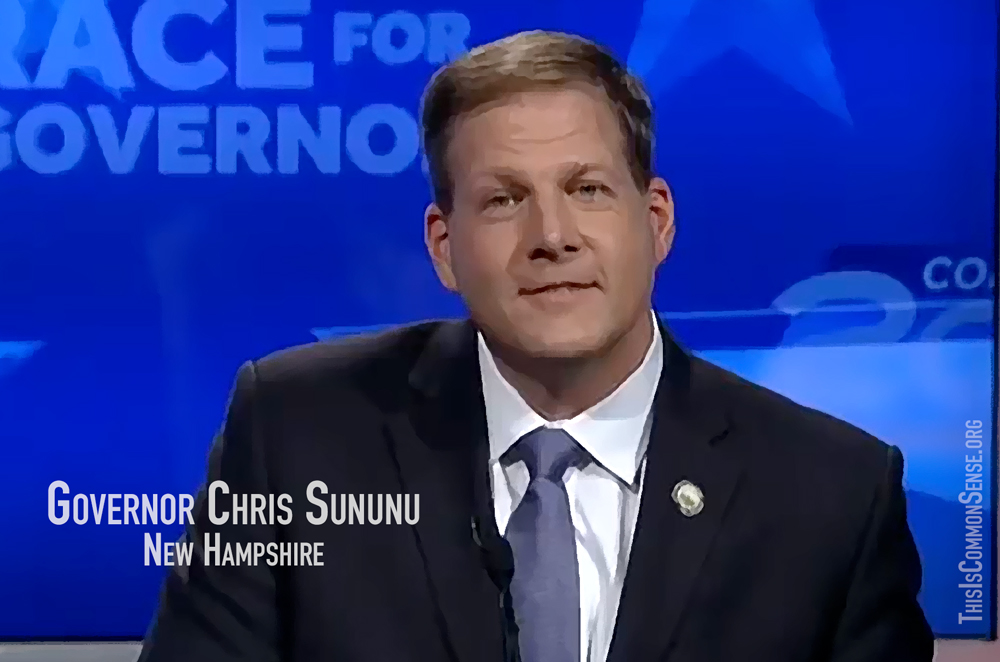
“In the past two years,” the Cato Institute announced last January, “Governor [Chris] Sununu and the State of New Hampshire have topped Cato’s rankings for both our Fiscal Policy Report Card on America’s Governors and our recently released Freedom in the 50 States report.”

How? Why? 

The governor points to “a long history of local control,” insisting that “town meetings matter.” 

He also cites the state’s executive council which, along with the governor, publicly debates “every contract over $10,000,” as well as a two-year gubernatorial term that “sucks” for him but gives citizens “all the say.”

Most of all, consider the sheer size of New Hampshire’s House of Representatives.

“When you have one of the largest parliamentary bodies in the free world with 400 members representing only 1.4 million people,” Gov. Sununu explains, “by definition” it has to be “one of the most representative bodies of government in the world.”

He elaborates that “they only get paid a hundred bucks a year. I mean, it’s like herding cats. Don’t get me wrong, it has its ups and downs. But that’s one state representative for about every 3,000 people. Like town selectmen, your representative in Concord is going to be somebody you know, somebody you see at the grocery store, somebody you can easily reach and who can hear you. It’s very different from other states where you have one person representing a district with tens or hundreds of thousands of people.

“Which means the control is really at the individual level,” Sununu adds, and “an individual citizen has much more say on how their taxes are spent or what’s going on in their schools or whether that pothole is going to get filled or not.” 

Sounds like citizens are more in charge.

This is Common Sense. I’m Paul Jacob.


PDF for printing

See all recent commentary
(simplified and organized)
See recent popular posts
Categories
Thought

William H. Prescott

The history of literature is the history of the human mind.

William H. Prescott, “Chateaubriand’s English Literature” in Biographical and Critical Miscellanies (1845), p. 245.

Categories
Today

Cinco de Mayo

In 1862, troops led by Ignacio Zaragoza stopped a French invasion in the Battle of Puebla in Mexico — an event leading to the popular “Cinco de Mayo” celebration.

No cause for celebration, however, is the anniversary of Karl Marx’s birth 204 years ago.

Categories
government transparency progress responsibility

UFOs and Other Foes

Frivolous federal spending: you don’t approve; I don’t approve. Which is why I’m usually on Reason magazine’s side when it comes to government prodigality. But complaining about the money spent by the Pentagon to make sense of the UFO phenomenon misses the bigger story.

In “The Feds Spent $22 Million Researching Invisibility Cloaks, UFOs, and a Tunnel Through the Moon,” Fiona Harrigan sets up the problem: “The 2008 Defense Supplemental Appropriation Act included $10 million for the AATIP [Advanced Aerospace Threat Identification Program] and the 2010 Defense Appropriations Act allotted $12 million, amounting to $22 million over five years. It is unclear how much of that money went toward researching UFOs and how much went toward invisibility cloaks, because how the money was used has been shrouded in secrecy.”

If when I’ve talked about these programs before I didn’t much discuss invisibility cloaks or spintronics and other ancillary aspects of UFO disclosure, it’s because I knew little about them . . . and neither, I gather, does Ms. Harrigan.

What they all show is the first teensy bit of transparency . . . on the apparently non-dismissible persistence of aerial phenomena that were dubbed UFOs* by Air Force Captain Edward J. Ruppelt in his 1956 study, The Report on Unidentified Flying Objects.

The military has apparently known about the puzzling reality of this phenomena for a long time. If we are to believe current reports, or past leaked documents like the Twining Memo, the objects observed by the military are (contrary to official statements) real objects intelligently controlled that do not behave according to the laws of physics that we were taught in school.

Ms. Harrigan warns us of a very different irregularity: how the research was contracted under the authorizing legislation.

That sure seems like the lesser story. 

The biggest story? Cover-up. Investigation into UFOs couldn’t be done in-house because of the layers of secrecy already in place. Non-disclosure agreements’ and top-level secrecy compartmentalization required outsourcing. We may have to accept some irregularities . . . the regular methods having led to secrecy of extreme sorts. 

The kind that makes the Deep State deep.

And as for invisibility cloaks: they are associated with UFOs, and would obviously be very useful for the military. Besides, cloaking technology is now in use, no longer a mere sci-fi dream.

This is Common Sense. I’m Paul Jacob.


* Ruppelt thought the initials should be pronounced as one word: YOU-foe!

PDF for printing

See all recent commentary
(simplified and organized)
See recent popular posts
Categories
Thought

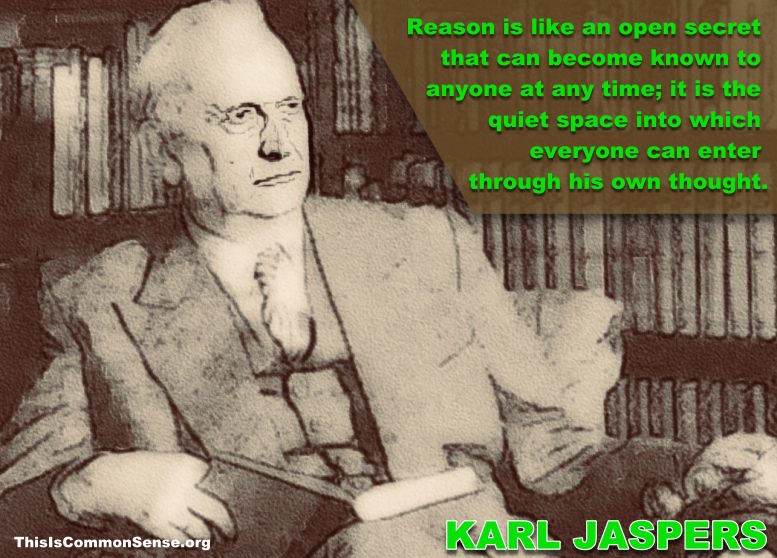
Karl Jaspers

Reason is like an open secret that can become known to anyone at any time; it is the quiet space into which everyone can enter through his own thought.

Categories
Today

Prescott, Tiananmen, and the Freedom Riders

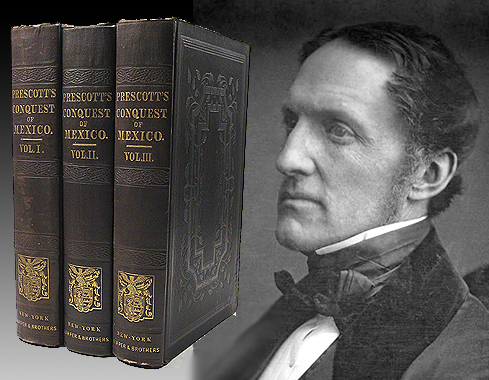
On May 4, 1796, American historian William H. Prescott was born. Prescott’s History of the Conquest of Mexico and his Conquest of Peru remain classic works of well-researched, “scientific history.” Prescott, Arizona, was named in his honor.

The May Fourth Movement began on May 4, in 1919: Student demonstrations took place in Tiananmen Square in Beijing, China, protesting the Treaty of Versailles, which transferred Chinese territory to Japan.

In 1961 on May 4, the “Freedom Riders” began a bus trip through the South.

Categories
education and schooling subsidy

Education Fraud

It’s a mess.

Families are often sold a bill of goods regarding higher education.

Unless a student pursues a subject like computer science, architecture, engineering, or medicine, it may take decades to pay off student loans.

Graduates who specialized in Advanced Basket Weaving, the Sociology of Postmodern Literary Stylings, and Marxist Techniques for Making White People Feel Guilty just might snag a high-paying job as an Ivy League professor or senior manager of a corporate “antiracism” task force. But beyond those few spots, opportunities are scant.

And, of course, many people who pursued legitimate studies in the liberal arts or technical subjects also don’t make enough to emerge from massive debt any decade soon. Nor does every STEM grad necessarily cash in. Individual results vary.

What to do?

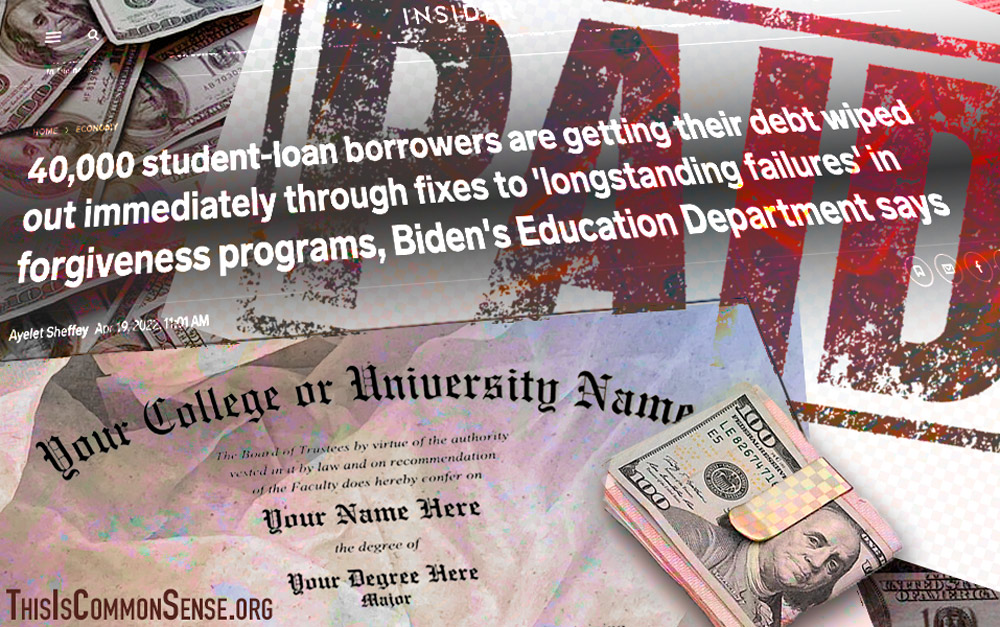
The Biden administration has decided to wipe out student debt en masse, expanding the Public Service Loan Forgiveness Program so that about 40,000 student-loan borrowers escape debt immediately and the debt of millions of others is slashed.

But is forcing others to pay this debt through their taxes — parents and children who perhaps carefully avoided taking out student loans — a just and practical answer to the problem?

The long-term solution is to get the government out of the business of subsidizing higher education in any manner, whether in the form of direct payments to schools or loans to students. Without the massive subsidies, tuition costs would decline.

The short-term solution? Launch an investigation into whether the U.S. Department of Education, colleges and universities — along with both Republican and Democratic administrations — have engaged in fraud against those who took out the loans. 

If students were defrauded, first seek redress from the perpetrators. Not the taxpayers.

This is Common Sense. I’m Paul Jacob.


PDF for printing

See all recent commentary
(simplified and organized)
See recent popular posts