
Categories
Accountability crime and punishment folly free trade & free markets general freedom ideological culture moral hazard nannyism national politics & policies privacy property rights responsibility too much government

Working to Boost Unemployment

Some government officials work overtime to throw people out of work.

What I’m referring to differs from losing your job or business because of slack performance or slackening sales. Instead, you lose the right to earn your living a certain way so that the government can benefit competitors at your expense.

Occupational licensing is great at dis-employing people. The regulations are especially galling when the work being regulated obviously requires no formal training in order to be done well and safely.

Hair braiding, for example.

The Institute for Justice — which has done incredible work over the years representing victims of destructive government mandates — just won a victory for hair braiders in Iowa. Thanks to IJ’s efforts, a new law there exempts braiders from having to waste time and money getting a cosmetology license in order to practice their craft.

Such battles are never won permanently, of course. Washington, D.C., recently started requiring day care providers to get a college degree or lose their job. (As I have argued in a Townhall column, the same “logic” would justify forcing people to get college degrees to become parents.) IJ is helping affected parties to challenge the absurd law.

It is time for a new licensing requirement. Nobody gets to become a local, state or federal lawmaker unless he first writes a million times in a row, “I will never help violate the rights of any man or woman to earn an honest living.”

This is Common Sense. I’m Paul Jacob.



PDF for printing


Categories
free trade & free markets general freedom national politics & policies responsibility

The Poverty Retirement Non-plan

A “conundrum” is “an intricate and difficult problem” or “a question or problem having only a conjectural answer.”*

In his June 8 article, “The Jobs Conundrum,” economist Gerald P. O’Driscoll focuses on a very big problem that we do not have sure answers to, yet.

Unemployment figures are down, but the number of non-working adults in the prime of their lives is up. O’Driscoll explains: “Unemployment” is a term of art and does not mean simply the number of people not working. It comprises the number of people not working and who are looking for a job.” Many aren’t “unemployed” for the simple reason that they are not trying to be employed.

They are, I suppose you could say, in early retirement, mostly a kind of poverty retirement.

Economists call it a drop in “labor force participation.” It used to be that men in the prime of life not looking for work constituted a mere 6 percent of the population. Now it’s 15 percent.

O’Driscoll, I notice, doesn’t engage in much conjecture to explain why. He merely insists, instead, that the trend is big, unemployment figures don’t track it, and that it has huge consequences.

I’ve heard some interesting (and puzzling) theories about the whys, of course. Blame feminism; blame the welfare state; blame the Chinese!

But even before we settle on a definitive answer, many movers and shakers now contemplate establishing — and are even experimenting with — a universal basic income as a way to alleviate this problem.

My conjecture? It would make the problem worse.

This is Common Sense. I’m Paul Jacob.

 

* The original, primary meaning of “conundrum” — “a riddle whose answer is or involves a pun” — is not relevant to this pun-free column.


Printable PDF


Categories
folly free trade & free markets general freedom meme national politics & policies

Robert Reich, Mythed Up

[mks_dropcap style=”letter” size=”62″ bg_color=”#ffffff” txt_color=”#000000″]C[/mks_dropcap]onsumer sovereignty is the idea that in markets consumers call the shots. In capitalism, most mass production is indeed for the masses, and the masses have a big say in what gets done. All profits and wages of successful businesses come from consumers.

But don’t take this too far.

Consumers don’t “create jobs,” for example.

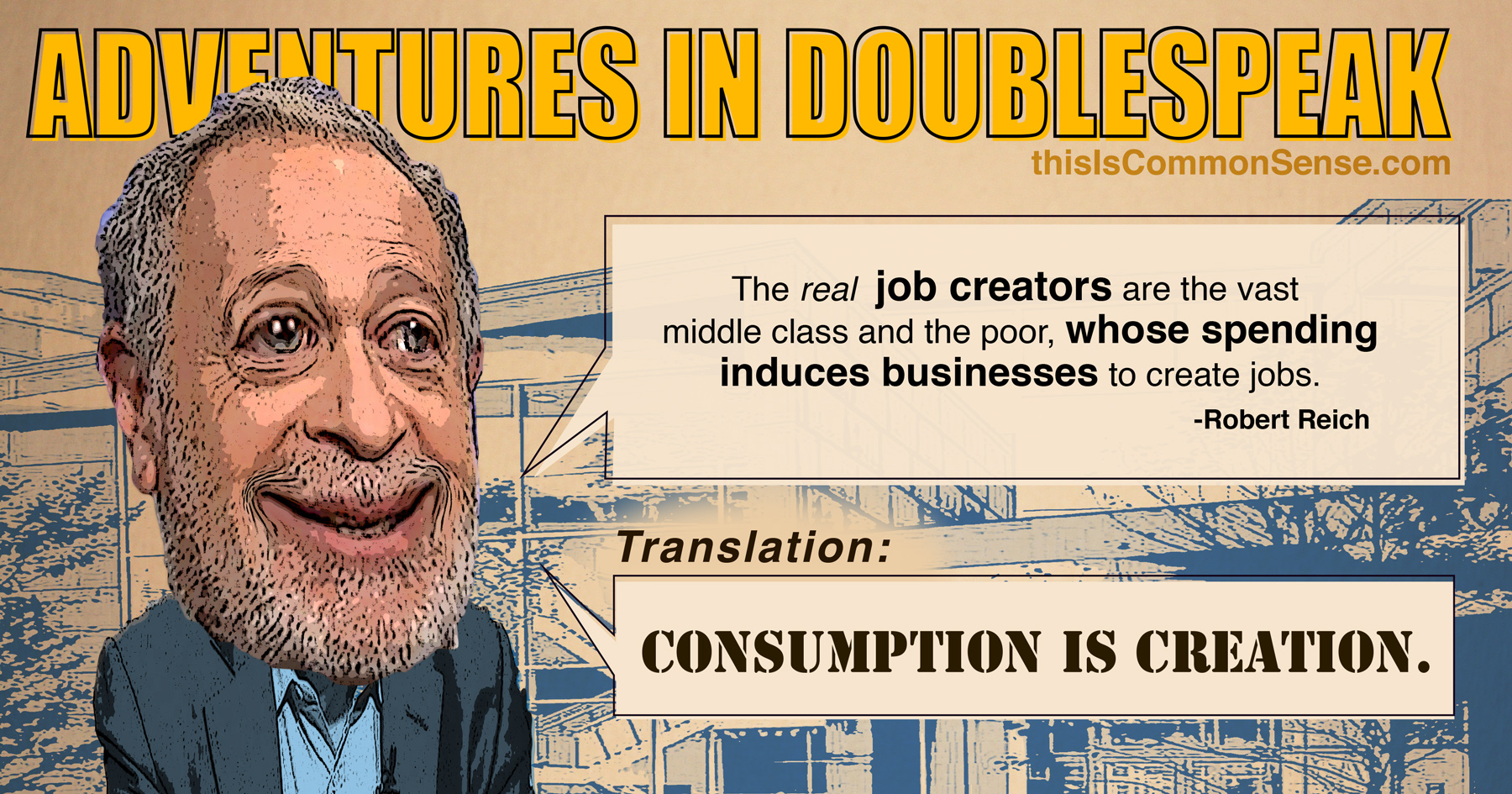
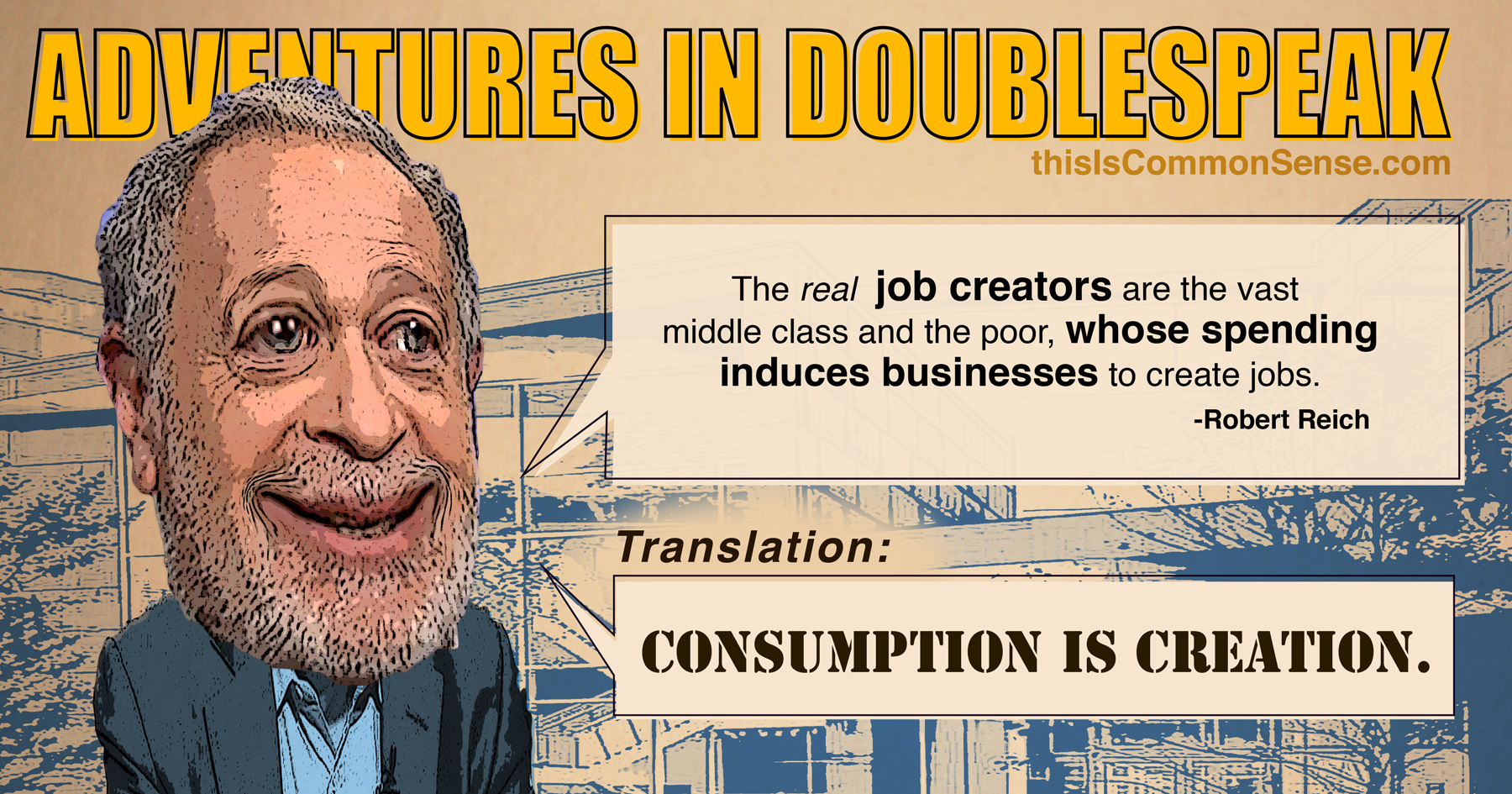
Recently, Clinton-era Labor Secretary Robert Reich has been floating this bizarre notion. To his Facebook audience, last month, he wrote that it is a myth that “the ‘job creators’ are CEOs, corporations, and the rich, whose taxes must be low in order to induce them to create more jobs.

Rubbish. The real job creators are the vast middle class and the poor, whose spending induces businesses to create jobs. That is why raising the minimum wage, extending overtime protection, enlarging the Earned Income Tax Credit, and reducing middle-class taxes are all necessary.”

So, we have people in roles of “producers” and “consumers,” and it is the consumers who “create jobs”? And they do this by “inducing” businesses to, wait, uh, “create jobs”?

Face it: businesses create jobs — out of capital from somebody’s invested savings. Entrepreneurs brace themselves to take big risks, fronting workers’ wages as well as hiring and purchasing capital goods and material.

Before a penny is spent by consumers.

Only when entrepreneurs guess right does the flow of money come full circle.

Reich repeated his quasi-Keynesian rap yesterday: it’s spending consumers who “get businesses to expand and hire.”

Truth is, Reich doesn’t “get” basic economics. But he does understand political equations, which is why folks on the Democratic left think he’s a genius.

This is Common Sense. I’m Paul Jacob.


For a high resolution version of today’s picture (perfect for use as a screensaver), click on the image below to open in new window. Also, please do feel free to share with your friends.

Robert Reich Doublespeak


Categories
free trade & free markets national politics & policies

Job Growth in 2014

President Barack Obama takes full credit for the job growth in 2014. Democrats on the Internet relentlessly push these growth rates with typically goofy superlatives like “highest ever” or “highest growth rate in decades.”

So, what did Obama and the Democrats do in 2013 and 2014 that led to the growth we saw last year?

Well, Obama refused to renegotiate with Republicans on any unemployment or budget reforms.

As 2013 ended, we heard Democrats complaining that stingy Republicans were letting federal government extensions of unemployment compensation (which had been re-extended many times) lapse altogether. Obama predicted disaster. The Keynesian economists who circle the Democratic Party like moths to a candle held to a simple prophecy:  because of a hit to “aggregate demand,” unemployment would increase.

Instead, in 2014 employment bounced back.

In a droll quasi-opinion piece, “President Costanza’s Jobs Boom,” the Wall Street Journal reports that “job growth in 2014 was roughly 25 percent higher than any post-2009 year. Joblessness plunged to 5.6 percent from 6.7 percent. Net job creation averaged 246,000 a month.”

Citing a National Bureau of Economic Research study by economists Marcus Hagedorn, Iourii Manovskii and Kurt Mitman, which treated the abrupt policy change as a “natural experiment,” the Journal reveled in the knowledge that the increase in incentives from lapsed benefits led unemployed workers to (gasp!) seek jobs.

And they found them. Granted, many of the new jobs are not as good as their pre-bust jobs. But they are jobs, which is better than nothing.

So when your big-government promoting friends attribute 2014’s job growth to Democratic policies, ask which policies, precisely. And ask why Obama’s predictions of 2013 for disaster in 2014 didn’t pan out.

This is Common Sense. I’m Paul Jacob.
Categories
free trade & free markets national politics & policies

Maximum Mixed Feelings

If a man with a gun claims he can get your boss to increase your pay, but that doing so might have the unfortunate result of killing your boss and/or ending your job altogether, what would you say?

“I have mixed feelings on it,” Rebecca Pentz-Jones told the Washington Post regarding legislation to increase Maryland’s minimum wage. It’s a case whereby a man with a gun (government) forces a pay raise, but accordingly risks her job and her employer’s business.

Mrs. Pentz-Jones works at Dollar Tree earning $7.95 an hour, but would rather make $10.10 an hour, the minimum being pushed by President Obama.

Polls show public support for upping wages, but Maryland Senate President Mike Miller argues, “We don’t just pass things because they’re popular.” Perhaps Miller has a larger perspective in mind. When pollsters ask people what they think of raising the minimum if the raise would increase unemployment, support for the hike flags.

Maryland Democrats haven’t downed enough of the president’s Kool-Aid. They fear the Congressional Budget Office analysis correctly predicts Obama’s higher minimum wage would cost 500,000 to a million people their jobs.

“I feel like I’m on a battleground,” explains Sen. Katherine Klausmeier of Baltimore County, “between trying to help a person make a living and trying to save my small businesses.”

Prince George’s County Del. Dereck Davis notes that a higher wage “will benefit some people, but at the expense of others” and “could result in the elimination of jobs.”

“It gets very confusing,” adds Sen. John Astle. “Sometimes it makes me wonder why we even have a minimum wage.”

Me, too, Senator.

This is Common Sense. I’m Paul Jacob.
Categories
free trade & free markets too much government

Equal Bailouts?

A new Pew Report tells us that Americans think that the rich got the biggest benefits — government handouts — after the collapse of financial markets in 2008. That’s my perception, too.

The banker class — including, perhaps focusing on, financial intermediaries on Wall Street — sure made out like the proverbial banditti, many of whom had their fortunes handed back to them after they lost billions and billions in 2008 and 2009.

Other programs bailed out Big Auto, to the advantage of stockholders and managers and union workers, but not to the discernible advantage of consumers or creditors or the bulk of non-union workers.

And yet, consider the extent to which government intervention in the labor market — including tax breaks, mortgage re-deals, and extended unemployment insurance — “helped” middle class and lower middle class workers and families. These programs had huge consequences, leading hordes to forego (hard-to-find) paid work for (comparatively easy-to-find) paid inactivity.

Americans are split on the lesson to be drawn from what they perceive as “scant signs of recovery” and government’s apparent lack of interest in “helping the poor”:

Although Americans were worried about the economic system, they remain starkly divided over federal regulations to control it. Nearly half thought that government regulation of markets did not go far enough, while almost as many said government regulation had already gone too far.

I’m in the latter camp. Government as Big Brother Bailout for businesses and families and individuals seems to just scuttle the necessary reshuffle our economy needs.

We don’t need more of the wrong response. We need less.

This is Common Sense. I’m Paul Jacob.
Categories
government transparency

Dum, Dum Datum

President Obama immediately ballyhooed the Bureau of Labor Statistics’ September unemployment rate of 7.8 percent as the logical outcome of the good work he has done.

But the BLS was promoting B.S. . . . according to many conservatives. 

NPR’s talking heads immediately pooh-poohed the idea that there was a conspiracy going on at the BLS. “That’s not how Washington works,” they informed us. And as if of one voice, Washington insiders rallied to the BLS.

Former GE CEO Jack Welch, one of the doubters, defended his skepticism in the Wall St. Journal. BLS data are decidedly not “handled like the gold in Fort Knox, with gun-carrying guards watching their every move, and highly trained, white-gloved super-agents counting and recounting hourly.” His basic take on the allegedly sacrosanct numbers? “Get real.” Welch provided more than a little reason to suspect “the possibility of subjectivity creeping into the process.” And he noted that skepticism is not just a right-wing trait:

I’m not the first person to question government numbers, and hopefully I won’t be the last. Take, for example, one of my chief critics in this go-round, Austan Goolsbee, former chairman of the Obama administration’s Council of Economic Advisers. Back in 2003, Mr. Goolsbee himself, commenting on a Bush-era unemployment figure, wrote in a New York Times op-ed: “the government has cooked the books.”

Truth is, unemployment figures are not tallies of surefire data, but statistical extrapolations based on surveys. They are more like Gallup Poll results — but perhaps less reliable.

And Welch is right to conclude that “the coming election is too important to be decided on a number,” especially that kind of number.

This is Common Sense. I’m Paul Jacob.

Categories
free trade & free markets national politics & policies

A Wealth of Joblessness

Did you know that the unemployment rate — as high as it is — is actually very much understated? It doesn’t include those who are out of work but have given up trying to find a job.

This puzzles me.

Oh, I see the rationale for not counting those who have abandoned their job searches (the information gets harder to collect and maintain, and you enter into the farther regions of statistics), but, nevertheless, they certainly do remain unemployed.

What puzzles me is the ability to remain permanently jobless. I don’t think my wife would let me make that choice. And even if she did, without income where would we get the money to pay the mortgage or buy food?

There’s unemployment insurance, which helps tide folks over when they lose a job. Yet, a condition for receiving unemployment benefits is continuing to actively seek a new job.

Like many, we could fall back on family and friends. But I’d feel bad enough about that if I was pounding the pavement every day in search of gainful employment. I can’t imagine doing so without any intention of landing a position and getting back on my own two feet.

So what can we conclude about folks who don’t have a job and aren’t looking for one? There are apparently a lot of rich folks out of work.

This yields the unwelcome-to-many conclusion that, in America, everyone is rich. Inequality notwithstanding.

This is Common Sense. I’m Paul Jacob.

Categories
free trade & free markets general freedom too much government

A Million Jobs, Gone

You’re fired! Now get a real job.

Does this sound mean?

It’s just what Cuba’s biggest employer plans to say between now and March — fire half a million workers and tell them to find other jobs, or (better yet) go to work for themselves.

After March, another half million will be given pink slips.

Or so say the Castro Bros., who are, in effect, the chief employers in Cuba.

Just like a despot, you might say. But hey: The country is broke, and the initial hiring of everybody by the government (which Fidel ran for scores of years, and his brother, Raul, now runs) was, itself, despotic. Thankfully, as more and more outlets of the “Cuban Communist Corp.” go under, the Cuban commissars say they will ease up on the regulations that now prohibit small, entrepreneurial businesses.

Of the many comments I’ve read about this, I was amused most by Tom Knapp’s. After drily noting that it is the Castros who will build down government, not Republicans in the U.S., he explained how the commies had kept their transportation going all these years: By maintaing old American cars from the ’40s and ’50s. Now that trade restrictions will likely be eased, those well-kept-up vintage cars could help “finance an explosion of economic prosperity just by tapping the U.S. classic car collectors’ market.”

Hope so.

And I hope the newly fired will transition to a slightly freer economy without too much trouble.

This is Common Sense. I’m Paul Jacob.