Categories
political economy property rights regulation too much government

Too Damn High?

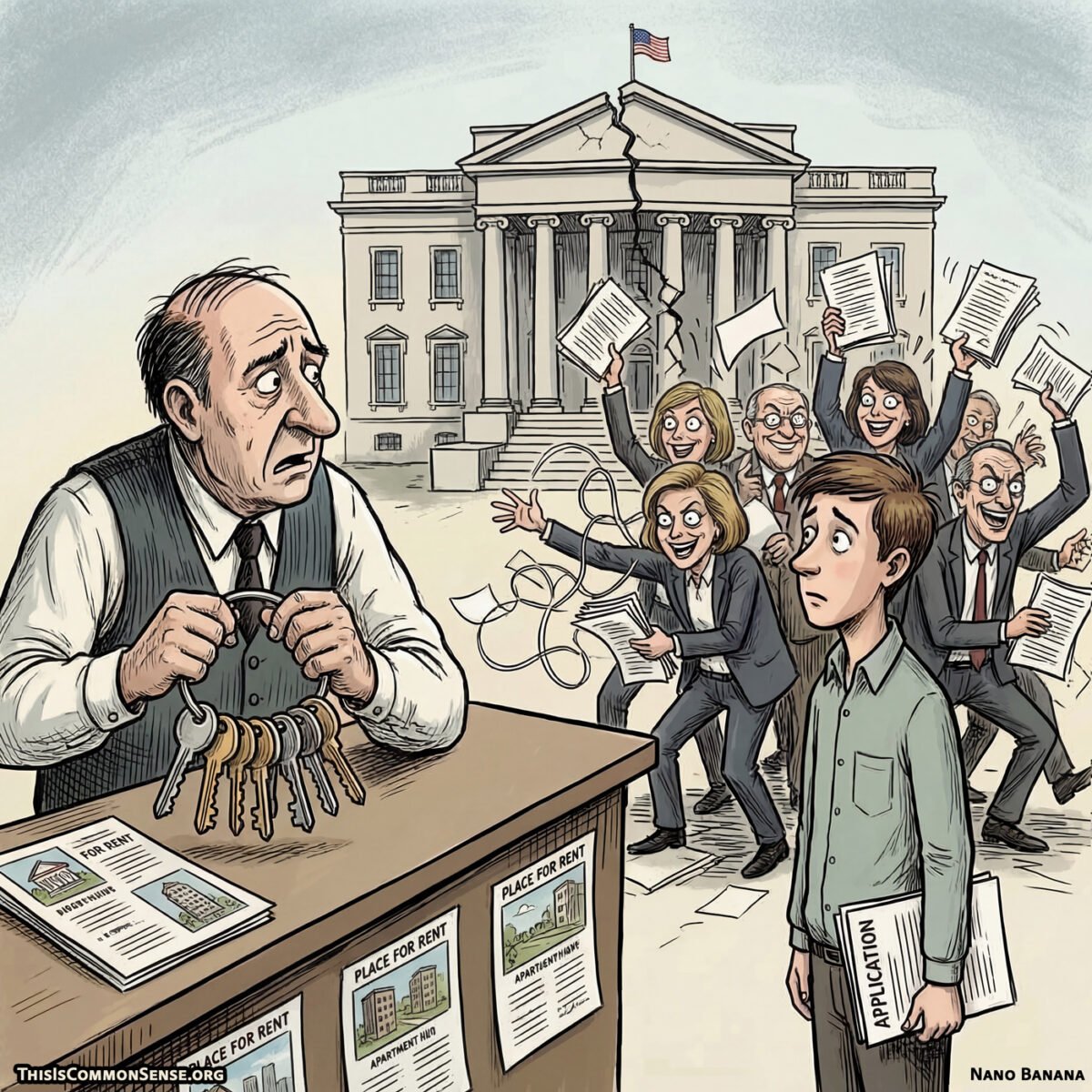
It’s getting tougher to rent a place to live.

Applications now often entail fearsomely intrusive scourings of financial history. And, writes Jeffrey Tucker, “if you are unbanked or missed a payment at some point, you can forget it.”

This is about more than digital intrusiveness or the end of privacy. It’s about aversion to risk. 

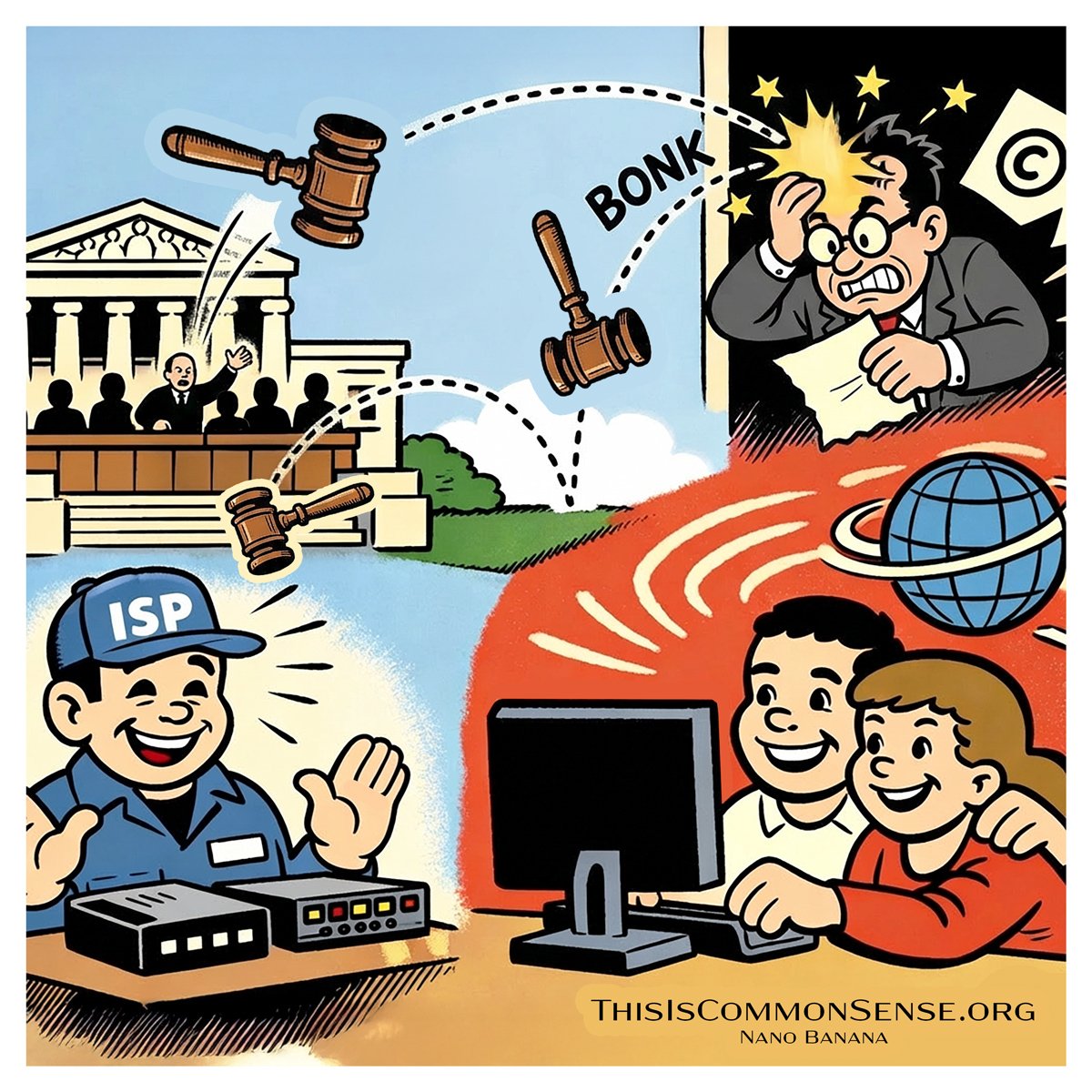
The aversion may have many causes. Tucker stresses a factor that’s pretty glaring once you think about it: the federal government’s assault on private property rights during the COVID-​19 pandemic. Some tenants eagerly exploited a federally imposed moratorium on rent payment — plus ban on evictions — only finally stopped by a 5 – 4 decision by the Supreme Court. 

At the state level, evictions continued to be outlawed until 2022.

So property owners assume that they cannot at all count on government to be in their corner. If a tenant fails to pay rent, folks in government (who include the ones with guns) protect the person who cannot or will not pay his or her bills. 

The concern must be even more intense if an owner’s property is located in a town with a track record of demonizing landlords and in the process of launching further assaults on property rights. (Example: New York City, where high rents are now officially called rip-​offs.)

Landlords want to avoid tenants who would use any law or bureaucratic tendency to rationalize skipping rent payment. Since owners can’t count on government to protect their property rights, they are becoming ultra-cautious. 

That is why conscientious prospective tenants who may have a blot or two in their financial history are paying the price.

This is Common Sense. I’m Paul Jacob.


PDF for printing

Illustration created with Nano Banana

See all recent commentary
(simplified and organized)
See recent popular posts
Categories
Fourth Amendment rights judiciary property rights

Against Government Invasion

Unconstitutional searches of private property by a renegade Tennessee government agency may be coming to an end.

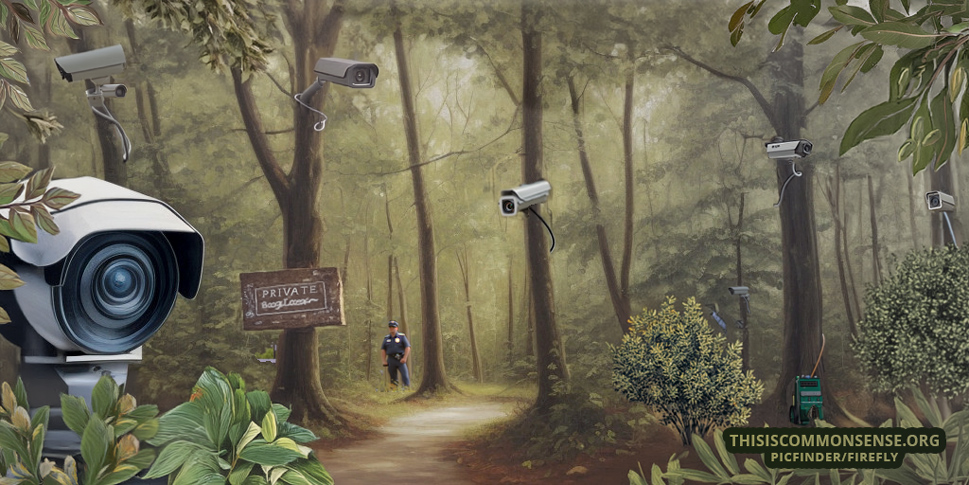
Unanimously upholding an earlier decision, a Tennessee Court of Appeals has ruled that no, Tennessee Wildlife Resources Agency employees have no right to ignore No Trespassing signs on private land — not even to enter it, let alone install cameras there in search of a crime.

The court ruled in a case brought by the Institute for Justice on behalf of Terry Rainwaters and Hunter Hollingsworth.

“TWRA claimed unfettered power to put on full camouflage, invade people’s land, roam around as it pleases, take photos, record videos, sift through ponds, spy on people … all without consent, a warrant, or any meaningful limits on their power,” says IJ attorney Joshua Windham.

“This decision confirms that granting state officials unfettered power to invade private land is anathema to Tennesseans’ most basic constitutional rights.”

The ruling cites the observation of legal scholar John Orth that “‘general warrants’ and ‘writs of assistance,’ authorizing officers to search anyone, anytime, for evidence of any crime” were among the abuses leading to adoption of the Fourth Amendment of the U.S. Constitution prohibiting “unreasonable searches and seizures.”

“The various state constitutions adopted after the Revolution almost invariably forbade the practices,” Orth notes.

According to the new ruling, Tennessee’s constitution does too. But we may not be quite done. The TWRA can appeal, which means that the case may end up in the Tennessee Supreme Court.

This is Common Sense. I’m Paul Jacob.


PDF for printing

Illustration created with PicFinder and Firefly

See all recent commentary
(simplified and organized)
See recent popular posts
Categories
crime and punishment ideological culture property rights

Shrink Shrank Shrunk

“Shrinkage.” A big problem.

I’m not talking about the delicate issue identified in the classic Seinfeld episode, “The Hamptons.” I refer, instead, to the business lingo for theft.

It’s rampant and taking a sad toll. 

Dick’s Sporting Goods is the first major retailer to blame declining profits on the “shrink” of its inventory because of mass theft. “The sporting goods and athletic clothing seller reported second-​quarter results Tuesday morning that included a 23% drop in profit, despite sales that rose 3.6% in the period,” CNN explains

But it’s not just a Dick’s problem. “Retailers large and small say they are struggling to contain an escalation in store crimes — from petty shoplifting to organized sprees of large-​scale theft that clear entire shelves of products. Target warned earlier this year that it was bracing to lose half a billion dollars because of rising theft.”

The cause?

No mystery.

Leftists have long been uncomfortable with private property. Their socialism seeks to replace private property with public property and private control over the means of production with governmental control. No wonder they often excuse private thievery as something like a revolutionary act.

When Pierre-​Joseph Proudhon put the idea boldly onto paper in 1840, that private property is itself theft, he really meant landed property, not personal property. Today’s leftists, unburdened by subtlety, keep coming back to opposing what is the core institution of civilization: respect for other people’s things.

Which allows for everything from privacy to progress.

Encouraging petty theft, as the left has knowingly, and organized theft, as the left has unwittingly (I hope) is not without consequences.

Our wealth, our liberties, our peace — they shrink.

This is Common Sense. I’m Paul Jacob.


PDF for printing

Illustration created with Midjourney

See all recent commentary
(simplified and organized)
See recent popular posts

Categories
Fifth Amendment rights national politics & policies subsidy

The Moratorium on Survival

If only Lincoln Eccles were a property owner in Franklin County, Ohio, instead of Kings County, New York. He’d have more of a chance.

Franklin County is defying the latest national moratorium on evictions. Early in August, caving to pressure from socialist Democrats, President Biden directed the CDC to outlaw the evicting of tenants for another 60 days.

A Franklin County court has announced that the county will not obey the ukase. The county cites a recent court of appeals ruling that disputes the authority of the CDC to impose the nationwide moratorium.

In June, the Supreme Court had narrowly refused to lift a previous moratorium in evictions, even though at least one justice in the majority acknowledged that the CDC had exceeded its authority. Justice Brett Kavanaugh’s exact words: “Yes, this is unconstitutional, but . . . well, okay.” (Fine, not his exact words.)

Property owners have bills too. (Not to mention rights.) The less money they get from a property, the less money they have to maintain it, let alone earn profit.

Lincoln Eccles owns a 14-​unit building in Crown Heights. Several tenants owe him rent. One owes $40,000. Which has put Eccles behind on utility bills and property taxes. The boiler must be fixed before winter. 

But Kings County is not defying the CDC.

“At this point they’re just abusing us,” Eccles says. “And it’s some version of slavery to me, forcing people to work and produce a product for free, and there’s no compensation.”

Were one to consult the Constitution, one might find a prohibition about public taking of private property “without just compensation,” but governments throughout the union haven’t been consulting that relevant document much lately.

This is Common Sense. I’m Paul Jacob.


PDF for printing

See all recent commentary
(simplified and organized)
See recent popular posts
Categories
national politics & policies property rights

Zoning by “Outsiders”

“In recent years, there’s been a push to move zoning decisions further from the local level,” writes Matt Ray for Mises Wire — engaging in no small understatement. 

“In 2019, Oregon passed House Bill 2001, making it the first statewide law to abolish single-​family zoning in many areas. By expanding the state government’s jurisdiction to include zoning decisions previously handled by local agencies, the law entails an alarming centralization of state power.”

This trend is old, going back at least to the Progressive Era. 

But the trend continues — “progresses” — and Oregon’s centralizing law has been “quickly followed by the introduction of similar bills in Virginia, Washington, Minnesota, and North Carolina,” Matt Ray explains. “Now President Biden is attempting to increase federal influence over local zoning.”

The problem should be obvious. Government land-​use regulation by “zoning” is an awesome expression of rights-abridging power, usually becoming nothing more than what most regulations are: special-​interest protection schemes, helping the in-​crowd at the expense of “outsiders” (you and me, actually).

Most savvy people understand this in specific instances, but not generally, so when they see zoning they don’t like, they might leap to the notion that bad local regulations should be replaced by good state or federal regulators.

Trouble is, we have less ability to ensure that regulators in distant political centers aren’t captured by special interests or malign ideologues. 

The only way out is a general rule-​of-​law approach, limiting all zoning powers. Barring that? Well, no matter how bad your city’s zoning, I wouldn’t trade it for zoning decisions from Washington.

This is Common Sense. I’m Paul Jacob.


PDF for printing

See all recent commentary
(simplified and organized)
See recent popular posts
Categories
crime and punishment ideological culture

Down Among the Non Sequiturs

There is a rule in respectable writing, particularly academic: don’t quote “down.”

This means that academics don’t cite newsletter writers as authorities, scientists don’t consult table-​rappers as purveyors of relevant data, politicians don’t quote tweets.

But of course that’s all changed now, thanks to Trump.

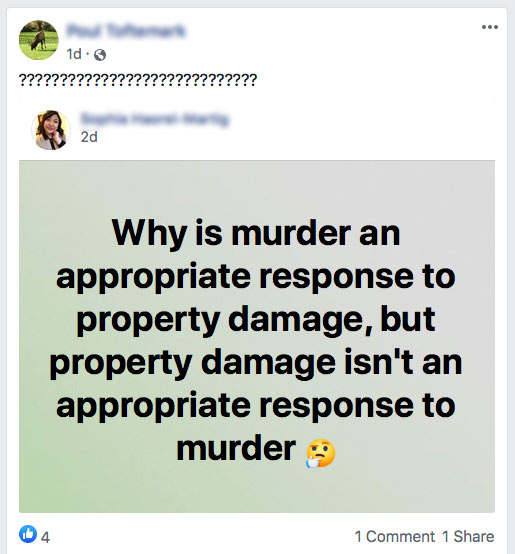
Which perhaps excuses me to deal with a simple Facebook “meme” that I’ve seen shared around among progressives. It’s a deceptively simple question; the point in criticizing it is not to castigate the person who first posed it.

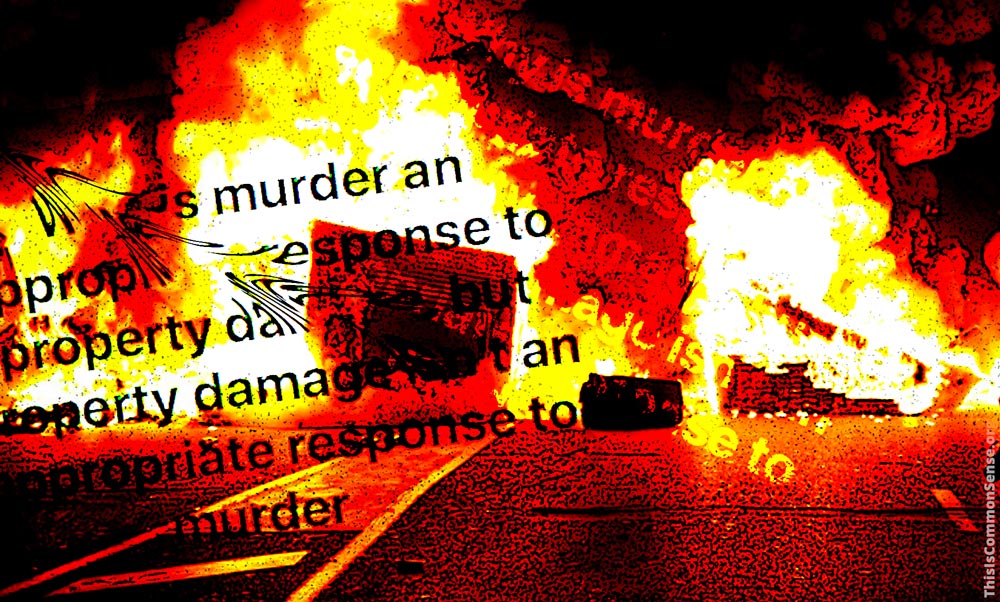
Here it is: “Why is murder an appropriate response to property damage, but property damage isn’t an appropriate response to murder?”

I confess: this really startled me. Not because it is hard to answer, but because what it says about discourse in our time. 

Note what is obviously wrong with it:

1. Murder is not an apt response to anything, for murder is unlawful and/​or immoral killing. The premise is absurd.

2. Some people do indeed kill rioters and others who are attacking them or their property. This can be justified because self-​defense is the basis of all our rights, and a violent attack doesn’t just fit into neat little “I’m only destroying your property” box. 

3. The proper response to murder, after the fact of some violent moment, is lawful arrest and trial, not killing. Self-​defense is for moments of conflict. Some time after an illegal act? Then we proceed by the rule of law.

Of course, this little thought experiment was designed to justify riots.

It does not.

It justifies, really, only this episode of

Common Sense. I’m Paul Jacob.


PDF for printing

See all recent commentary
(simplified and organized)
See recent popular posts
Categories
Accountability crime and punishment ideological culture

Theft by Spray Paint

Graffiti is theft.

That is how Heather Mac Donald puts it. “To a conservative,” she writes at City Journal, “graffiti is self-​evidently abhorrent, a spirit-​crushing blight on the public realm, and a theft of property by feckless individuals who avenge their mediocrity by destroying what others have built.”

But that is not how “liberals” or “progressives” see it, she goes on to explain, for they regard marking up buildings and subways and streets and sidewalks as a “political statement,” referencing the New York Times recent characterization of spray-​painting on property you don’t own as “a courageous strike against stultifying bourgeois values” representing “urban grit and resistance to corporate hegemony.” 

With each graffito, Ms. Mac Donald insists, progressives see an icon of “the city’s vibrant, anti-​capitalist soul.”

An interesting political divide. But this rumination  on the “taggers’” art is not random. Mac Donald is aghast that New York Mayor Bill de Blasio has cancelled a graffiti-​eradication program.

This, she insists, will lead to more crime, worse crime than mere trespass paintings. It’s the Broken Windows idea, and she’s probably right. Allowing small crimes to go unchecked demonstrates a lack of respect for persons and property, and that trains a city’s population to go on to do worse things.

But the program was cut for a reason. You see, de Blasio’s disastrous coronavirus response has put New York into the red. The city has to cut somewhere.

Mac Donald, however, calls the $3 million saved a “rounding error” on the city’s $88 billion budget. She imputes to de Blasio and others a preference for crime rather than fighting crime.

Maybe. And maybe we add law and order to health and commerce as casualties of the pandemic panic.

This is Common Sense. I’m Paul Jacob.


PDF for printing

See all recent commentary
(simplified and organized)
See recent popular posts
Categories
partisanship political challengers

Such Is Today’s Politics

“You do have a problem with a President demanding the federal government go ahead and seize private land and then promising to pardon those who seized the land,” challenged Joe Walsh, the former Illinois congressman running in the Republican Party primaries against Donald Trump. 

“Don’t you?”

Matt Welch, writing in the LA Times, quoted this Walsh tweet (three days after the Walsh2020 campaign announcement) to express alarm about where the GOP is heading. “We are accustomed to some ideological shape-​shifting when the White House changes teams,” writes Welch. “But what’s so striking about this week’s slate of immigration-​related controversies — including the one that supplanted the land-​grab pardon: the administration’s new rules governing potential citizenship for the children of U.S. service people abroad — is that none of it should come as a surprise.”

Because Trump is doing (sorta) what he promised to do. Which includes taking land by eminent domain. 

Before his election, Trump had proclaimed his support for the Kelo decision that signed off on governments nabbing land to give to private developers. At issue now is condemning land to build The Wall — at least an arguably public use. 

While “private property rights used to be foundational to the conservative movement,” Welch bemoans that Trump “didn’t care. And that Republicans cared a hell of a lot less than they claimed to.”

Again, unsurprising. Republican pols did little to nothing for property rights or limited government pre-​Trump. So these anti-​leftist voters went for someone — anyone? — who could deliver something.

I doubt that candidate Walsh will convince many that he can deliver much of anything.

This is Common Sense. I’m Paul Jacob.


PDF for printing

land grab, eminent domain, theft, property, border,

See all recent commentary
(simplified and organized)
See recent popular posts


Categories
general freedom ideological culture Popular

Slavery Is Not Free-​Market Capitalism

Tarring free-​market capitalism and limited government with the brush of slavery is old hat. What is new is that prominent journals and major media figures now shamelessly slop that brush around.

Indeed, the argument is so often made that addressing it from several angles, as I have — twice in the last few outings of Common Sense — is important. Today I make an additional point.

The fact that human beings were treated as property, to be sold and mortgaged and disposed of at will, does not make slavery “free market.” If we legalized and institutionalized the market in stolen goods, that might make those markets legally above board — but not morally

It is this moral argument against stolen goods that undergirds the case against slavery. 

Always has.

For slavery is stealing the rightful property of the people enslaved — their property in their own bodies. 

Richard Overton called this “self-​propriety” in 1646, and at about the same time John Locke, following Hugo Grotius, wrote of every man having “a property in his own Person.” This is the old liberal way to think about personal freedom when you are dealing with property: self-ownership. 

“Free market capitalism” rests on it just as slavery abridges it.

Unfortunately, there has been a successful campaign to muddy up this logic and its history. Teacher Lawrence Ludlow recently informed readers of American Thinker about the results of this indoctrination: today’s students have “somehow ‘learned’” that “slavery was isolated to the United States instead of practiced worldwide for ages” and that “Westerners were the most enthusiastic practitioners of slavery instead of being among the first to abandon it.”

Freedom is not slavery and the truth shall set us free.

This is Common Sense. I’m Paul Jacob.


See all recent commentary
(simplified and organized)
See recent popular posts


Categories
meme too much government

Twain on Congress and Liberty