Categories
judiciary responsibility

Caveat Tempter

If, like me, you expect people to bear the bulk of the brunt of their own decisions, big ticket court rulings often strike you as bizarre.

Case in point? “Drugmaker Johnson & Johnson must pay $572m (£468m) for its part in fuelling Oklahoma’s opioid addiction crisis, a judge in the US state has ruled,” reads a BBC report.

“During Oklahoma’s seven-week non-jury trial,” the BBC informs, “lawyers for the state argued that Johnson & Johnson carried out a years-long marketing campaign that minimised the addictive painkillers’ risks and promoted their benefits.”

A certain credulity boundary has been stretched, here:

  1. Don’t all ads stress selling points over . . . non-selling points?
  2. Doesn’t everyone know this, and, therefore,
  3. Shouldn’t they be expected to adjust — caveat emptor-wise — accordingly?
  4. And doesn’t everyone know painkillers are dangerous, and opiates notoriously so?

“The state’s lawyers had called Johnson & Johnson an opioid ‘kingpin,’” the report continues, “and argued that its marketing efforts created a public nuisance as doctors over-prescribed the drugs, leading to a surge in overdose deaths in Oklahoma.”

The public nuisance biz is idiotic, of course. If the company had been slipping its drugs to kids on a playground, something like this would have some plausibility. But the actual situation? Nope.*

Shifting responsibility from self to others, especially deeply pocketed others, has many bad consequences . . . not least of which is deflection of our attention away from why opioid use is up. Which is something we should be looking into for our friends’, families’, and neighbors’ sakes.

Lawyers are our tempters, in such cases. 

And monetary awards can sure be addicting. 

This is Common Sense. I’m Paul Jacob.


* Johnson & Johnson is appealing the decision, of course.

PDF for printing

apple, temptation, rotten,

Photo by Max Pixel

See all recent commentary
(simplified and organized)
See recent popular posts
Categories
judiciary partisanship U.S. Constitution

Heal or Heel?

Call it High Court chutzpah?

In a Second Amendment case seeking U.S. Supreme Court review, five U.S. Senators have filed an amicus curie or “friend of the court” brief . . . that wasn’t very friendly.

“The Supreme Court is not well,” argue Sens. Sheldon Whitehouse (D-R.I.), Richard Blumenthal (D-Conn.), Mazie Hirono (D-Hawaii), Richard Durbin (D-Ill.), and Kirsten Gillibrand (D-N.Y.) in their brief against the Court accepting the case. “Perhaps the Court can heal itself before the public demands it be ‘restructured in order to reduce the influence of politics.’”

A not-very-veiled threat.

Is their goal really to ‘reduce political influence’? Or to leverage influence against the Court should it not “heal itself” — or come to heel — by authoring judicial decisions more to Democrats’ liking? 

Seven Democratic presidential contenders, including Sens. Elizabeth Warren, Kamala Harris and Kristen Gillibrand, support court packing — having the next Democrat-controlled Congress increase the size of the SCOTUS beyond nine justices, to 12 or 15.

“[M]ost Americans recognize this tactic for what it is, which is a direct attack on the independence of the Supreme Court,” Sarah Turberville and Anthony Marcum write in The Hill. “It is no coincidence that court packing is employed by would be autocrats all over the world rather than by leaders of liberal democracies.”

To supposedly “depoliticize” the “partisan” Supreme Court, Mayor Pete Buttigieg wants to pick five justices to represent Democrats and five to represent Republicans, and then those ten would together choose five additional justices. 

Nothing like being overtly partisan to vanquish partisanship, eh?

This is Common Sense. I’m Paul Jacob.


Supreme Court, packing, packed, red, blue, Republican,Democrat, right, left, partisan,

See all recent commentary
(simplified and organized)
See recent popular posts

Categories
media and media people meme national politics & policies Popular

Courage and Wisdom?

President Donald Trump responded to the weekend’s two shooting atrocities by decrying hatred and making five substantive proposals. 

“They include tools to identify early warning signs in mass shooters, reducing the glorification of violence, reforming mental health laws, enacting ‘red flag’ laws to stop dangerous individuals from gaining access to firearms, and enacting the death penalty for mass murderers,” the Epoch Times summarizes.

But how useful are these?

  1. The “early warning signs” of a criminal are often identical to grumpiness and even righteous indignation in others — “tools to identify” could easily serve as excuses for unwarranted meddling and worse.
  2. Who would enforce lessening the “glorification of violence”? The federal government that is always at war?
  3. Is it mental health laws that should be reformed, or the practice of putting whole generations of boys on Ritalin and worse . . . made especially ominous by the percentage of shooters on such drugs?
  4. Denying “dangerous individuals . . . access to firearms” remains problematic under any semblance of due process and the ‘innocent until proven guilty’ principle.
  5. Since “death by cop” is often one of the apparent goals of many would-be shooters, how much of a deterrent could death by sterile procedure actually be?

But if you are looking for even worse reactions, look beyond Trump. The Democrats took the occasion to raise funds

And complain to the New York Times, which “changed a headline on its front page because it presented Trump in a neutral light,” reports independent journalist Tim Poole. “This was in response to far left activists and Democrats expressing shock and outrage and demanding everyone cancel their subscriptions to NYT over it.”

Ideological bias or old-fashioned market pressure?

If it is in tragedy that we find our greatest tests of courage and wisdom, the weekend’s shootings show a lot of political and media failure.

This is Common Sense. I’m Paul Jacob.


PDF for printing

gun violence, gun control, law, mass shooting, 2nd Amendment, Donald Trump,

See all recent commentary
(simplified and organized)
See recent popular posts


Categories
free trade & free markets general freedom too much government

Don’t Follow the Feds

“Federal agents never wear body cameras,” The Washington Post reports, “and they prohibit local officers from wearing them on their joint operations.”

That’s why a growing number of local law enforcement agencies are doing what Atlanta’s police chief and mayor “decided late last month,” pulling “out of joint task forces with the Drug Enforcement Administration, the FBI and the U.S. Marshals Service.”

The Justice Department supplies the usual excuses for their lack of transparency: they are “protecting sensitive or tactical methods” and “concerned about privacy interests of third parties.” But as Houston Police Chief Art Acevedo reminds, “if there’s a legitimate need to redact any [footage], there’s a process available for that through the courts.”

It is the height of hypocrisy, for the use of body cams has been “what they’ve been preaching,” St. Paul (Minn.) Police Chief Todd Axtell argues, referring to the Justice Department’s funding and training of local police forces in body-camera usage. “It’s ironic they aren’t complying with what they preach to be so important in policing.”

Ironic? Sure. 

Par for the course? Indeed.

The bad example federal police agencies set is hardly limited to body-camera use. In states where legislation has reduced or ended the outrageous practice of civil asset forfeiture — whereby police can take and keep cash and property from people never accused or convicted of any crime — the Feds are there again to facilitate the thievery known as “equitable sharing.”  

“Federal forfeiture policies are more permissive than many state policies,” a 2016 Post report explains, “allowing police to keep up to 80 percent of assets they seize.”

Make sure your local and state police don’t follow the Feds.

This is Common Sense. I’m Paul Jacob.


PDF for printing

body cam, camera, police, feds, federal, crime, law,

Photo credit: North Charleston

See all recent commentary
(simplified and organized)
See recent popular posts


Categories
crime and punishment

Guilty. Guilty! Guilty?

“No responsible prosecutor,” Alan Dershowitz writes in The Hill, “should ever suggest that the subject of his investigation might indeed be guilty even if there was insufficient evidence or other reasons not to indict.”

Don’t I know it.

The world-famous lawyer takes issue with the “statement by special counsel Robert Mueller in a Wednesday press conference that ‘if we had confidence that the president clearly did not commit a crime, we would have said that.’”* Dershowitz makes a good case that the ‘innocent until proven guilty’ principle requires the government not merely to refrain from imposing punishment before obtaining a lawful conviction, but also to hold back from punishing people by making loud public claims about their supposed guilt. 

Which brings to mind my own experience at U.S. Term Limits. In 1994, we ran radio ads and sent mail to citizens in two Oklahoma congressional districts and one in Kentucky. We did not urge a vote for or against anyone, but merely provided information on where the candidates stood. 

Yet, prompted by a complaint from the Democratic Congressional Campaign Committee, which prefers ignorant to knowledgeable voters, the Federal Election Commission (FEC) investigated.

As if to foreshadow current prosecutorial proclivities, the FEC abandoned its witch hunt after two long years. Relieved the agency’s harassment was finally over, I remember opening an Oklahoma newspaper and discovering a story headlined, “Term Limits Group Violated Law in State, U.S. Agency Charges.”

This problem goes well beyond Mr. Mueller and President Trump. Government agencies that cannot prosecute, should not persecute.

This is Common Sense. I’m Paul Jacob.


* Dershowitz calls Mueller’s comments “worse than the statement made by then-FBI Director James Comey regarding Hillary Clinton during the 2016 presidential campaign.”

PDF for printing

justice, law, Mueller, innocence,

See all recent commentary
(simplified and organized)
See recent popular posts

Categories
education and schooling general freedom

Top School Fails

Illiteracy, innumeracy, low standards, grade inflation — signs of a general failure of education, sure, and of public schooling in particular. But for the worst failing, look no further than Harvard University.

The Ivy League school just caved to a student mob. 

“Harvard said on Saturday that a law professor who has represented Harvey Weinstein would not continue as faculty dean of an undergraduate house after his term ends on June 30,” explains Kate Taylor at the New York Times, “bowing to months of pressure from students.”

The lawyer in question, Professor Ronald S. Sullivan, Jr., has served with his wife, law school lecturer Stephanie Robinson, at one of Harvard’s residential houses for undergraduate students. 

Now, the African-American couple has not been fired from faculty. Just as deans. No great tragedy, if the official Harvard statement be true — that there were multiple reasons for not renewing their contracts.

But the context: pressure from students who expressed horror — “trauma-inducing”! — at Sullivan’s legal defense of the former Mirimax mogul accused of numerous sex crimes.

We expect lawyers to defend even the worst criminals. Everyone is entitled to a legal defense. It’s sad that not only do some students fail to accept this but also that this crimson-colored college plays along with their uncivilized complaint. Harvard has, in effect, denied one legal foundation of a free society. 

Remember that the “common school movement” for government schools was started to inculcate republican values. Horace Mann’s great big excuse for government control and taxpayer funding of schools was to promote civilized American liberties.

Schools, generally, have failed. And Harvard has just accepted their worst failure as the new passing grade. 

This is Common Sense. I’m Paul Jacob.


PDF for printing

Common School, education, values, American, public school, law, lawyer,

See all recent commentary
(simplified and organized)
See recent popular posts


Categories
national politics & policies Popular term limits U.S. Constitution

The Court-Packers

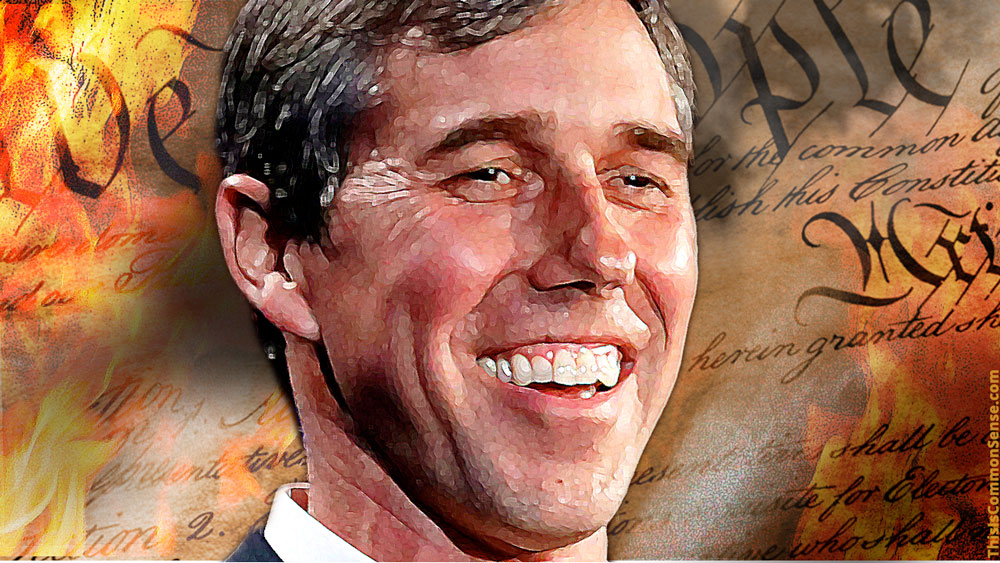
“What if there were five justices selected by Democrats,” presidential candidate Beto O’Rourke explored at an Iowa campaign stop, “five justices selected by Republicans, and those ten then pick five more justices independent of those who picked the first ten?”

Beto, meet FDR.

President Franklin Delano Roosevelt tried something similar with the Judicial Procedures Reform Bill of 1937, which would have added six new justices to the nine-justice U.S. Supreme Court. It failed in the Senate, even though FDR’s Democratic Party controlled the chamber.

This “court packing” gambit may have been the most unpopular action of FDR’s whopping three-plus terms. 

Despite the obvious self-interested power grab, “Sens. Kamala Harris, Elizabeth Warren and Kirsten Gillibrand . . . would not rule out expanding the Supreme Court if elected president,” Politico reported.

“It’s not just about expansion, it’s about depoliticizing the Supreme Court,” Sen. Warren explained . . . with a straight face. Yet Beto’s suggested reform would officially turn the nation’s highest court into a partisan, two-party political institution.

To the good, Democrats are also bantering about term limits for the nation’s High Court. Trouble is, term limits require a constitutional amendment, meaning a two-thirds vote of both chambers of Congress as well as 38-state ratification. 

Court packing, on the other hand, only requires simple majorities of both houses and the presidency. Which Democrats threaten in 2020.

“You need to gain power,” Washington Examiner columnist Philip Wegmann reminds, “before you can abuse it.”

So the abuse, for now, is merely promising.

This is Common Sense. I’m Paul Jacob. 


PDF for printing

Supreme Court, NPC, packing the court, FDR, law, justice, constitution

See all recent commentary
(simplified and organized)
See recent popular posts


Categories
First Amendment rights national politics & policies too much government

First Things First

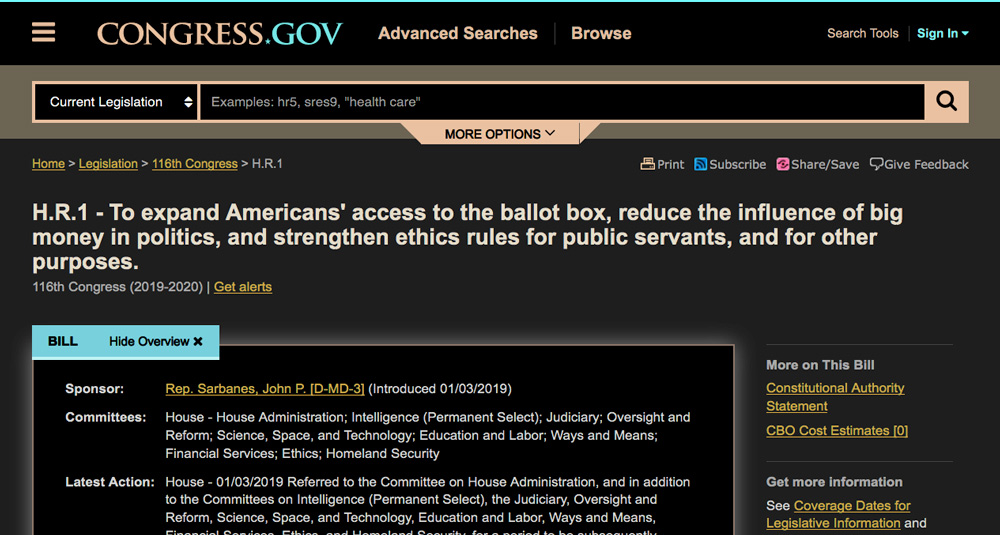
Surely there’s something good in the first legislation put forth by the brand-new Democratic House majority — though nothing jumps to mind. 

The 571-page smorgasbord bill “addresses voting rights, corruption, gerrymandering and campaign finance reform,” writes Thomas Edsall in The New York Times, “as well as the creation of a Select Committee on the Climate Crisis — a first step toward a ‘Green New Deal.’” 

H.R. 1 would mandate that states adopt automatic voter registration, a step too far. It establishes a system of public subsidies for candidates running for Congress, with taxpayers forking over a six-to-one match on donations of $200 or less. 

The legislation also empowers* the Federal Election Commission, including by ending its supposedly “neutral” composition, i.e. an equal number of Democrat and Republican commissioners. This would either allow the FEC to be more “decisive” or unleash the dogs of partisan political witch hunts . . . depending on the case and/or your politics.**

Speaker Nancy Pelosi (D-Calif.) and Rep. John Sarbanes (D-Md.), the lead sponsor of the legislation, bill it as the best way “to rescue our broken democracy.” 

“It should be called the Democrat Politician Protection Act,” argues Senate Majority Leader Mitch McConnell in the Washington Post

David Keating, president of the Institute for Free Speech, tells NPR, “A lot of [H.R.1] looks to be unconstitutional.”

No problem, for one provision calls for a constitutional amendment to partially repeal the First Amendment, so to authorize Congress to regulate campaign spending and speech.

Remember: the First Amendment is a single sentence, a mere 45 words.

Succinct and effective.

The former does not apply to this new bill, and the latter, I hope, does not apply to this new Congress.

This is Common Sense. I’m Paul Jacob.


* Let’s not give greater power to the FEC, which, according to a federal judge, “acted arbitrarily and capriciously and contrary to law” in the 2016 election.

** Of course, for Ross Perot in the 1990s or Libertarians, Greens and independents today, that “bipartisan” make-up isn’t neutral but stacked like a Star Chamber


PDF for printing

See all recent commentary
(simplified and organized)
See recent popular posts

Categories
meme moral hazard too much government

How to Know

Many people don’t seem to realize that a prohibition (banning something) is AUTHORITARIAN BY DEFINITION. Whether it’s drugs, guns, alcohol, offensive language, dangerous ideas, texting while walking(!), plastic straws(!)… authoritarians are perfectly happy to use government violence to force the rest of us behave as they wish. Because they think they know what’s right for everybody else. They are the authorities. They are the keepers of the truth. For the rest of us, the message is clear: obey or be punished.

The spectacle of people screaming about Trump’s “authoritarianism” while simultaneously demanding more regulations, more bans, more restrictions… would be funny if it weren’t so dangerous.


A “rule of law” is based on general principles, and makes room for — or, better yet, is based upon — the protection of individual rights.

It used to be common to say, “a rule of law, not of men”; it was even as common in political oratory as was spouted out over drinks at the Rotary. But as the modern Regulatory State has grown in scope and power, most folks seem to have lost track of the notion. It is now not even a cliché. Few even of our most educated folks can explain this idea. Vast swaths of the mis-educated public appear not to “get” the idea of limiting government to the enforcement of a few general principles; instead, they cry for more “regulations” (along with additional spending and maybe even a whole new division of the executive government) every time a crisis, tragedy or atrocity occurs.

So we are left with a political culture in which the words of Tacitus seem to a majority as implausible at best, evil at worst: “The more the laws, the more corrupt the State.” Contrary to today’s trendy prejudice, we do not need “more laws” — edicts legislated by representatives, or regulations concocted by bureaucracies — we need Law.

As in, “a rule of Law.”

regulations, rule of law, control, freedom

See all recent commentary
(simplified and organized)
See recent popular posts

Categories
free trade & free markets judiciary

The Cheese Stands “Unprotected”

Governments tempt us — with special privileges and advantages. 

You know what also tempts us?

Cheese.

Cheese? Yes. In the Netherlands, cheese is a big deal, as Baylen Linnekin relates in “Cheese Fight Ends With Court Declaring Producers Can’t Copyright Taste,” over at Reason — where I go for all my cheese-related coverage. (Don’t you?)

The tale is about two cheese companies and the European Union’s “Directive 2001/29/EC,” which tries to reconcile copyrights among member states. Specifically, it involves the legal fight between “two Dutch herbed cream cheese spread makers,” as Mr. Linnekin relates, “Heksenkaas (‘witches’ cheese’) and Witte Wievenkaas (‘wise women’s cheese’).” The former sued the latter for infringing on “its copyright on the taste of Heksenkaas.”

The case went from a Dutch court to the European Court of Justice, where the Court (Grand Chamber) ruled against Heksenkaas. There can be no copyright on “taste.”

This is of no great significance, I suppose, but in a world where the government gets involved in everything, it’s worth noticing when the government resists its temptation to tempt us.

The rationale for non-involvement, in this case, was not a move against intellectual property as such, but against the idea of property involved in subjective taste. “The taste of a food product cannot,” the Court determined, “be pinned down with precision and objectivity. . . .”

Well, sure. But what was really going on here was one company not wanting competition from another company. 

A temptation, for sure. But some temptations (like some cheeses?) must be resisted.

This is Common Sense. I’m Paul Jacob.


PDF for printing


» See popular posts from Common Sense with Paul Jacob HERE.