Categories
crime and punishment national politics & policies property rights

Dereliction of Duty

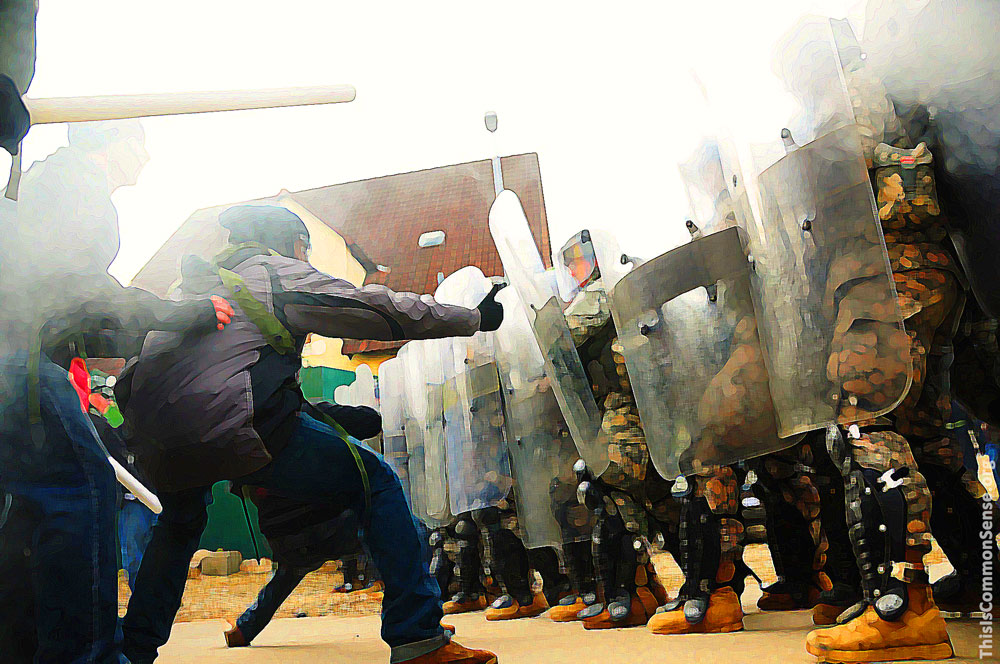
Must governments act to protect you when you or your property are attacked — for example, by rioters who vandalize and burn your store? 

Is the government liable if it willfully lets it happen?

Protection of life and property is the moral obligation of governments constituted for this purpose. But whether officials who ignore the obligation can be held to account is another question.

A Madison Avenue shop, Domus Design Center, is suing the mayor of New York City and the governor of New York State. In late May and early June, hundreds of businesses were damaged by rioters while Mayor de Blasio and Governor Cuomo refused to act to oppose them.

“Where are our tax dollars going?” asks the Center’s attorney, Sal Strazzullo. “Not protecting commercial properties is negligence of duty. Paying taxes that help pay the salary of the NYPD, we expect protection in return. Government is responsible to protect its citizens and businesses against criminals who want to do bad.”

Yes. 

But Strazzullo’s client faces the precedents of rulings in cases like Warren v. District of Columbia, Castle Rock v. Gonzales, and a lawsuit by Parkland, Florida students against the local sheriff’s office. In these cases, plaintiffs argued that law enforcers had a positive duty to protect the plaintiffs when they were being clearly threatened. 

The courts disagreed.

We must hope that there are limits to the willingness and ability of judges to avert their gaze. Otherwise, we are paying everyone in the system to look the other way when trouble comes.

This is Common Sense. I’m Paul Jacob.


PDF for printing

Photo by Georgia National Guard

See all recent commentary
(simplified and organized)
See recent popular posts

Categories
crime and punishment national politics & policies

Police Incentives Matter

“For every bullet the German police fired on duty in 2016, American police killed 10 people,” writes Jason Brennan for MarketWatch. “Even overwhelmingly white states like Wyoming and Montana imprison citizens at higher rates than authoritarian Cuba.”

What is going on here?

And by here I mean “these United States of America.”

Well, Brennan, who is the Robert J and Elizabeth Flanagan Family Professor of Strategy, Economics, Ethics, and Public Policy at Georgetown University’s McDonough School of Business, has an answer.

“What matters even more than black and white is green,” he writes, referencing the current protests and riots sparked by coverage of the George Floyd killing by Minneapolis police. “Fixing our criminal justice system means fixing the incentives.”

Professor Brennan points the finger at a number of federal programs:

  • The 1981 Military Cooperation with Law Enforcement Act “authorized and incentivized the U.S. armed forces to train police in military tactics” while the 1990 National Defense Authorization Act established a pipeline from the military industrial complex to local police forces.
  • The drug war set up police theft of private property via civil asset forfeiture, and encouraged federal drug warriors to share the loot with local police departments.
  • In many localities, direct election of prosecutors leads to campaign boasts about prosecution stats and long sentences, even when these policies make us less safe.

There’s a lot here to mull over, and you may not agree with everything Brennan argues, but the basic point is quite clear: “Even if we magically erased all racism overnight, the U.S. would still be harsh and violent” — and that because our politics has skewed incentives all wrong.

Getting rid of programs and laws that disincentivize good policing is a must.

This is Common Sense. I’m Paul Jacob.


PDF for printing

See all recent commentary
(simplified and organized)
See recent popular posts
Categories
national politics & policies too much government

The Ratchet Racket

Various models and curves and soothsayers predict that the coronavirus will lay off as the summer sun waxes. And then rush back in the autumn.

So we should not look at just near-term threats, but also look at cycles of contagion month-to-month, year-to-year. 

Yet, it is not just the dreaded coronavirus that must be seen over time. “Crisis measures are often ineffective,” writes Matthew Feeney, at Cato Institute, “and can survive the crisis they are implemented to counter.”

Because government power and interference tend to ratchet up with each crisis, there is a whole lot of reason to suspect that we will not go back to normal. Indeed, “the new normal” is now a catchphrase.

The quarantine shutdown has been, if not total, totalistic. Feeney acknowledges such extremist (he didn’t use that word) measures may sometimes be justifiable. But warns of that ratchet, of new powers given to government not devolving after the crisis.

Ted Galen Carpenter, also at Cato.org, draws a “fundamental lesson” from the panic: “Americans need to resist the casual expansion of arbitrary governmental power in response to the current coronavirus crisis.”

The extreme measures of the shutdown — called by economist Gene Epstein “The Great Suppression” — should have been widely discussed before the contagion hit. Instead, they were discussed in meetings behind closed doors.

But most of us were already up to our necks in the political muck fighting off the everyday kludge of the old normal level of too-much-government.

You know, from the previous turn of the ratchet.

This is Common Sense. I’m Paul Jacob.


PDF for printing

ratchet, coronavirus, Covid, pandemic, epidemic, law, regulations, government,

See all recent commentary
(simplified and organized)
See recent popular posts

Categories
general freedom too much government

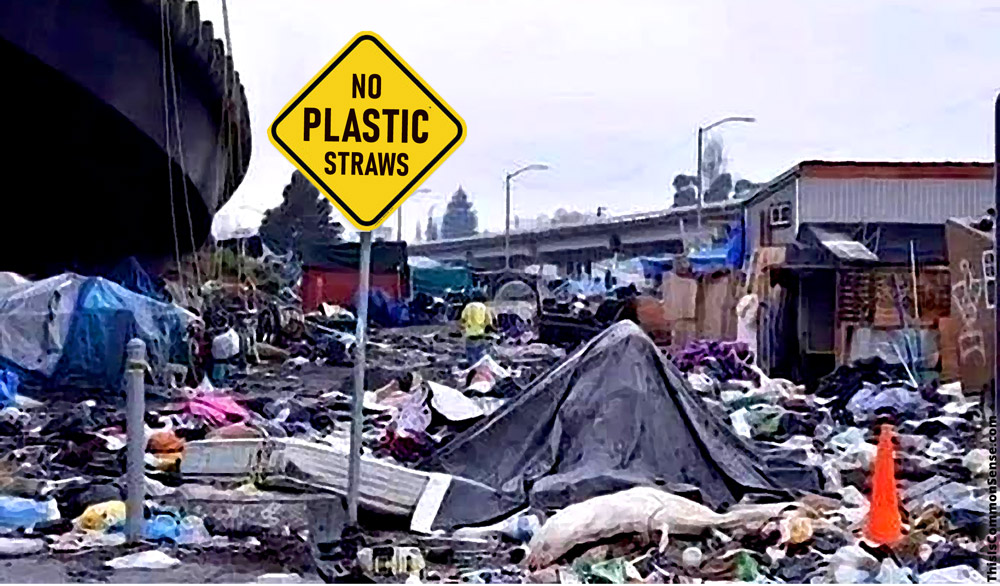
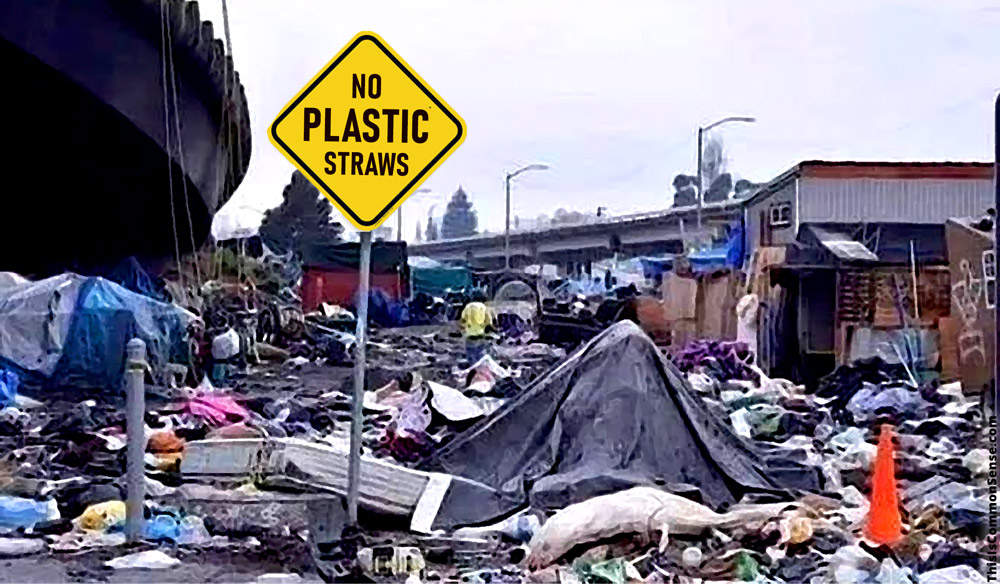
Are We Graduating from Plastic?

In The Graduate (1967), the young man played by Dustin Hoffman gets advice from an elder. “Just one word: plastics.” “Exactly how do you mean, sir?” “There’s a great future in plastics.”

When the world bans all plastic in 2021, that will be the end of that market opportunity. Other components of civilization will be discontinued in 2022.

Maybe I’m being too pessimistic. After all, there’s always the black market.

A plastic-bag ban is underway in New York City. Four states and five territories have already banned disposable plastic bags, as have countries around the world. New Yorkers are reportedly two-to-one in favor. A friend who lives there confirms this widespread resignation.

“I’m not happy about what it [plastic] does to the environment,” says one New Yorker. “But . . . what it does to my environment if I don’t have them is a nightmare.”

“This is a good thing because it’s helping the environment,” says another.

The problem of trash disposal has been solved. We use garbage cans, pickups, landfills. It’s a problem that must be continuously re-solved. Like many other problems . . . such as how to carry groceries.

We adopted plastic bags because they are much more convenient than paper. Convenience, efficiency, effectiveness: many man-made components of civilization serve these goals.

Reduction to absurdity can persuade only if the listener rejects the absurd. In 1967, the idea of banning plastic bags and plastic straws seemed, to most, absurd. Today, maybe two thirds of New Yorkers lament the inconvenience but add whaddyagonnado . . . when you gotta protect the environment?

That this measure will not protect much of anything, but merely allow activists to think well of themselves is, itself, absurd.

This is Common Sense. I’m Paul Jacob.


PDF for printing

plastic, environmentalism, California, law, prohibitions, bans,

See all recent commentary
(simplified and organized)
See recent popular posts

Categories
crime and punishment national politics & policies

Frisky Friends

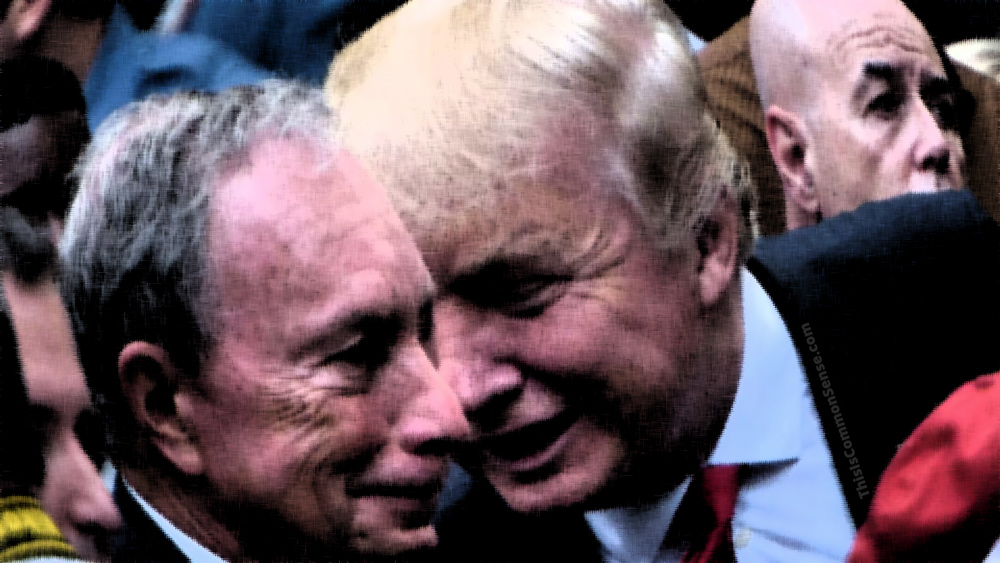
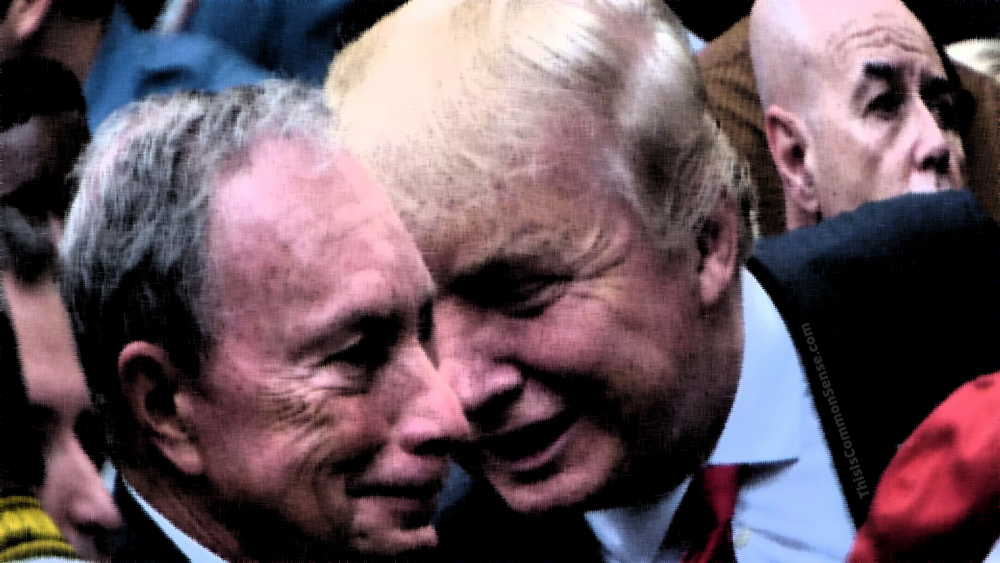
“WOW, BLOOMBERG IS A TOTAL RACIST!” tweeted President Donald J. Trump.

He was reacting to a recording, recently unearthed, of Democratic presidential aspirant Michael Bloomberg speaking to the Aspen Institute in 2015 about his controversial “stop-and-frisk” police policy while mayor of New York City.

“Ninety-five percent of your murders, murderers and murder victims fit one M.O.,” Bloomberg told his audience. “You can just take the description, Xerox it and pass it out to all the cops. They are male, minorities, 16 to 25. . . . that’s where the real crime is.”

“And the way you get the guns out of the kids’ hands,” explained Mayor Mike, “is to throw them up against the wall and frisk them.”

Bloomberg has since apologized for targeting young male minorities to be regularly detained, searched, harassed and thrown into walls by police on the basis of nothing more than being young male minorities. Ultimately, a federal court struck down Bloomberg’s program as an unconstitutional mass violation of Fourth Amendment rights. 

“We did it in New York, it worked incredibly well and you have to be proactive and, you know, you really help people sort of change their mind automatically,” Trump argued in 2016, floating a national roll-out and defending Bloomberg as “a very good mayor.” 

Back in 2009, Mr. Bloomberg and Mr. Trump were together on something else: Bloomberg disregarding a campaign promise and defying two clear citywide referendums to run for a third mayor term.

“Well, I’m not a believer in term limits,” Trump said then, adding, “Michael is a friend of mine.”

Funny, asked about then-Sen. Hillary Clinton, Trump offered, “I think she’s a wonderful women,” but “she’s a little bit misunderstood.”

Not long after posting the racist-baiting tweet noted above, the president deleted it.

We understand.

This is Common Sense. I’m Paul Jacob.


PDF for printing

Michael Bloomberg, Donald Trump, stop and frisk,

See all recent commentary
(simplified and organized)
See recent popular posts


Categories
initiative, referendum, and recall too much government

The Gig Is Up

Eventually, champions of government intervention, of all forms of thwarting independent judgment and killing dreams, find themselves under assault. From the public. 

And you don’t need an economics degree to grasp why. 

Initially, an intervention prevents other people from pursuing projects, getting jobs, earning a living. Then, finally, government meddling goes a step too far. Maybe lawmakers had “good intentions,” but hey! This is me now! 

Your legislation needs tweaking!

This is where we are in California’s attack on the so-called gig economy. Hatched to “protect” Uber drivers or some such nonsense, Assembly Bill 5 makes it massively harder for companies to classify freelancers as independent contractors. After it was signed into law, many companies—from blogs to transcription services—told California-based freelancers adios

Millions of people lost work and options.

What walks of life are affected? All

“California’s new gig worker law is . . . threatening all performing arts,” complains Brendan Rawson at CalMatters.org. California has “overreached.” Gotta nip-and-tuck that otherwise “worthy” bill! Use only the magic arbitrary intervention in our lives that works!

Not everybody now being hurt was previously okay with pushing other people around, of course. I’ve never been a fan. One of my missions is defending the right of citizen initiative. Well, AB5 makes it much harder and more expensive for petition campaigns to hire people for such gigs as collecting signatures for an initiative in California. 

AB5 attacks earning a living, speaking freely, associating freely, and petitioning one’s government freely. Maybe the law will be rescinded. But there’s more mischief where that came from. 

So let’s protect other people’s freedom . . . and stop the overreach before it reaches us.

This is Common Sense. I’m Paul Jacob.


PDF for printing

California, gig, freelance, law, control, interference, intervention, labor,

Photo by Dairo Cervantes

See all recent commentary
(simplified and organized)
See recent popular posts

Categories
nannyism too much government

Politicians & Pain

Whenever a new panic runs through corporate media and the grapevine — and especially when the lesson is supposed to be ‘we’ve gotta do something!’ — it is time to slow down. And look at the facts.

The opioid crisis is one of those panics.

The almost immediate reaction from politicians has been to point their quivering fingers at doctors and drug companies on the theory that doctors have been over-prescribing opiates, instigated by pharmaceutical companies.

Seems a ‘round up the usual suspects’ approach to public health.

Now there appears to be good research to back up our skepticism. According to Cato’s Jeffrey A. Singer, recent studies show “there is no correlation between opioid prescription volume and non-medical use or opioid use disorder among persons age 12 and over.” Nevertheless, Dr. Singer notes, “policymakers and law enforcement continue to pressure health care practitioners into undertreating patients in pain.” 

An under-treatment result is scarier, to me, than the desperate and dangerous self-medication problem that must lie at the core of the crisis we read about. Patients in too much pain because doctors are afraid of government harassment are pushed to unsupervised pain management . . . which looks an awful lot like a simple description of the opioid crisis itself.

Singer provides confirmation of an unintended effect: the fentanyl and heroin overdose rate “continues apace” even as the opioid prescription volume plummets.

“At a recent international breast cancer conference experts stated the under-prescribing of opioids to breast cancer patients in the U.S. is now comparable to treatment in third world countries,” warned Singer. 

One word: yikes.

I am tempted to define today’s politics itself as a kind of pain mismanagement.

This is Common Sense. I’m Paul Jacob.


PDF for printing

opioid, crisis, pain, drug, law, politician, ban, prohibition, control, medicine,

See all recent commentary
(simplified and organized)
See recent popular posts
Categories
media and media people meme Popular responsibility too much government

Overkill . . . for Your Health

News stories about death- and illness-by-vaping keep hitting us. But in most of these stories it is what is left out that is most alarming.

From Washington State’s King County we learn of another case of severe lung disease “associated with vaping.” But the reportage doesn’t mention how the maladies relate to vaping. “KING-TV reports there have been 15 cases of severe lung disease associated with vaping in Washington state since April 2019. . . .” Interesting as far as that goes, but. . . .

In addition to no discussion of causality, the most obvious thing not mentioned in this and similar reports? The numbers diagnosed with severe lung disease caused by smoking — which is the relevant vaping alternative.

The U.S. Government’s agency devoted to diagnosing potentially widespread pathogens and practices is, thankfully, a bit more useful. In a recently published study, scientists have narrowed down the real culprit: “Vitamin E acetate was detected in all 29 patient” samples taken from those under study. 

Most had been vaping THC.

There are organizations worse than sloppy news outlets, however. In Massachusetts, the House of Representatives has passed a bill not merely to ban flavored e-cigarettes, but also to levy 75 percent tax on all e-liquids and vaping devices. 

Typical government overkill.

But not overkill enough, for the bill doesn’t stop there. Whopping fines against those caught with unlicensed vaping products are also in the bill, as is — aaargh! — civil asset forfeiture.

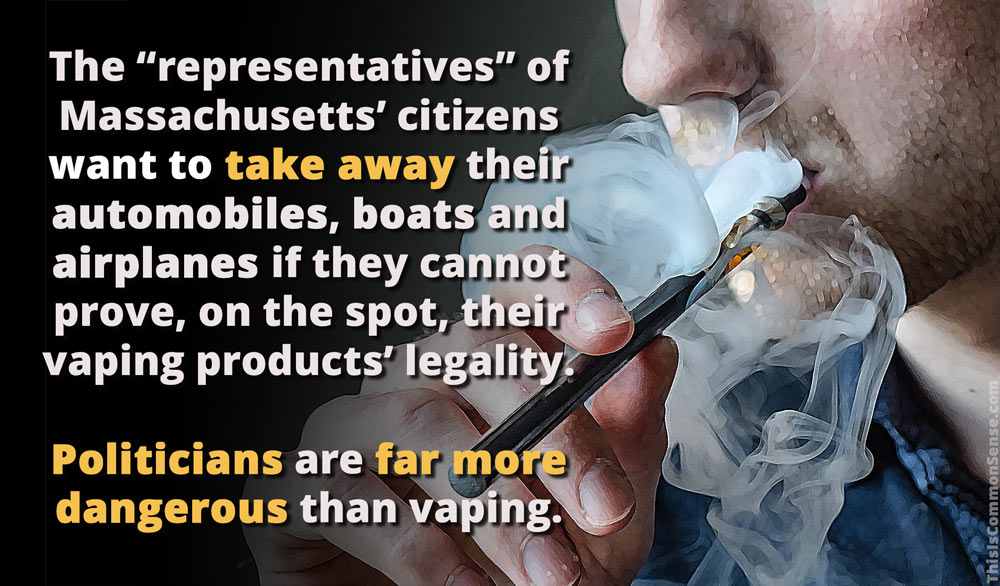
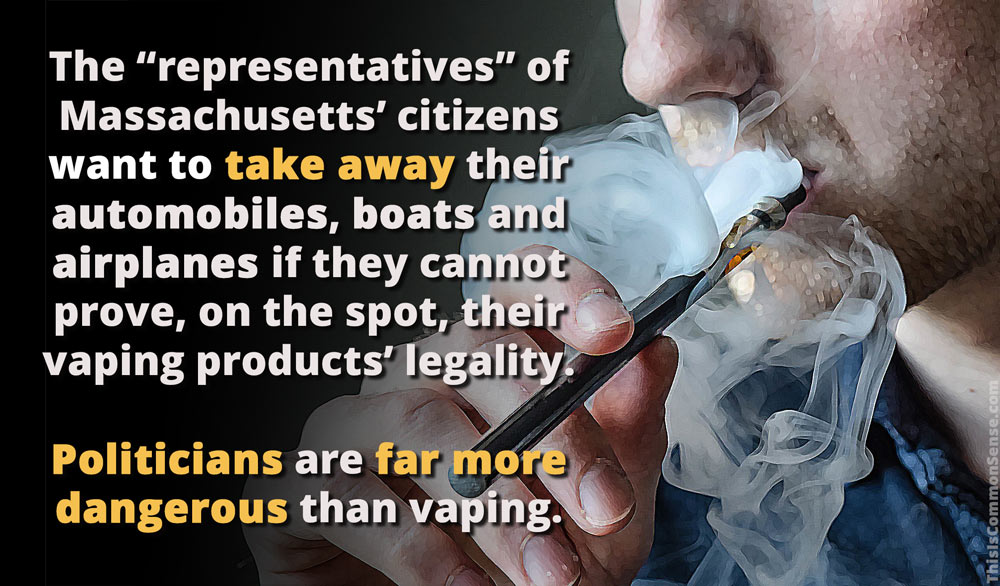
The “representatives” of Massachusetts’ citizens want to take away their automobiles, boats and airplanes if they cannot prove, on the spot, their vaping products’ legality.

Politicians are far more dangerous than vaping.

This is Common Sense. I’m Paul Jacob.


PDF for printing

vape, vaping, law, asset forfeiture, politicians,

Photo by Vaping360

See all recent commentary
(simplified and organized)
See recent popular posts

Categories
national politics & policies Popular too much government

E-Panic

One of the better arguments for government relies upon sobriety: we want rational, measured responses to threats, not panicky, hot-headed reactions. We have a rule of law to prevent revenge and vendetta, replacing them with justice and civil order.

But when we expand the concept of “threat” far beyond interpersonal violence and to dangers from our own foolish or merely misguided behavior, “sobriety” too often doesn’t even seem an option.

Take drugs. 

Specifically, take “vaping.” 

That is the innovative technology of “e-cigarettes” that can be used to replace the smoking of tobacco and other drugs with inhaling drug-laced water vapor.

Vaping is far less dangerous than tobacco, at least for emphysema and lung cancer, but it is not harmless. Several hundred people across several of these United States have become very ill and a few have died of a mysterious lung disease.

So of course the Surgeon General calls it an epidemic, and the White House and Congress take up the cause to regulate and even prohibit vaping. And India just “became the latest country to ban electronic cigarettes,” according to Bloomberg

Whoa, the subject has barely been studied, and what we know so far is that it was not major-brand nicotine e-liquid, but, instead, boutique product that has caused most of the casualties. 

The leap to legislation has been too quick for consumers to alter their own behavior with new information.

Besides, prohibition and regulation haven’t worked to prevent the current opiate overdose crisis.

The rush to “do something very, very strong,” as President Trump puts it, is the very opposite of why we say we want government.

Its lack of sobriety is . . . sobering.

This is Common Sense. I’m Paul Jacob.


PDF for printing

vape, vaping, law, ban, prohibition,

See all recent commentary
(simplified and organized)
See recent popular posts

Categories
judiciary national politics & policies Popular Second Amendment rights

Packing

“Are you proposing taking away their guns?” 

“I am,” replied former Texas Congressman Robert Francis “Beto” O’Rourke to ABC World News Tonight anchor David Muir’s question. If, anyway, “it’s a weapon that was designed to kill people on a battlefield.” 

“Hell, yes,” he added, later in last week’s Democratic presidential debate.

“We’re going to take your AR-15, your AK-47.”

Yesterday, I noted that U.S. Senator Kamala Harris seemed oblivious to any consideration of the constitutional rights of citizens to “bear arms.” Today, consider the constitutional work-around both Democrat presidential contenders support. You see, when they talk about confiscating your guns, they do not intend to go to all the hard work of changing the law of the land. They plan, instead, merely to change the High Court — something the president, with a majority of Congress, can do — and have the new justices re-visit the legal interpretation.

O’Rourke “spoke openly after launching his run,” informs Politico, “about expanding the high court to as many as 15 judges.” Fox News reported that he “is open to making drastic changes to fundamentally reshape the Supreme Court — essentially court-packing, with a twist.”

The “twist” is the scheme that I wrote about in March. In a bizarre nod to bipartisanship, O’Rourke would have Republicans select five justices, Democrats select five more, and then have those ten judges select yet another five. 

Only tradition and public opinion have kept the highest court in the land from previous hijackings.

Is Republican opposition all that stands in the way now?

Gives a whole new meaning to the question: Are you packing?

This is Common Sense. I’m Paul Jacob.


Beto

See all recent commentary
(simplified and organized)
See recent popular posts