Categories
international affairs

America Safe for Quagmires?

It happened: “The measure asking all foreign troops to leave . . . passed.”

We are talking about Iraq . . . and the U.S. military. 

So, not much else has happened.

After that parliamentary vote, Ron Paul explains, “when the Iraqi prime minister called up Secretary of State Mike Pompeo to request a timetable for a US withdrawal, Pompeo laughed in his face.”

I am with Dr. Paul on this one. The U.S. should take this opportunity to get out . . . “before more US troops die for nothing in Iraq.”

But is it for nothing?

Once upon a time, Americans were afraid of military “quagmires.” Now somehow we’ve come to accept permanent quagmire status in multiple theaters

Could it be that when President George Herbert Walker Bush said, following the First Persian Gulf War, that “By God, we’ve kicked the Vietnam Syndrome once and for all,” he was speaking of its psy-op effect on the American electorate?

Pushing us into World War I,  President Wilson claimed to be “making the world safe for democracy.” Perhaps Papa Bush made America safe for never-ending “regime-change wars.”

Before becoming vice president and then president, and going on to claim victory over  “Vietnam Syndrome,” Bush headed the Central Intelligence Agency, the original regime modification professionals. And certainly endless, pointless foreign warfare has been the health of . . . the Deep State.

“The pressure for the U.S. to leave Iraq has been building within the country,” argues former Rep. Paul, “but the U.S. government and mainstream media is completely — and dangerously — ignoring this sentiment.”

Put American soldiers — not some secret or not-so-secret Deep State agenda — first. Bring them home.

This is Common Sense. I’m Paul Jacob.


PDF for printing

quagmire, war, foreign policy, Iraq, Iran,

See all recent commentary
(simplified and organized)
See recent popular posts

Categories
international affairs national politics & policies too much government

The New Arms Race

We who grew up in the time of the Apollo missions are more than aware of the arms-race angle to the Soviet and American forays into Earth orbit and beyond. 

Now, we must recognize that the space race is no longer mere ornamentation over earthly military competition.

“The United States and China are rapidly building space warfare capabilities,” writes Bill Gertz in the Washington Examiner, “as part of a race to dominate the zone outside Earth’s atmosphere.”

Of course, much of this remains ground support. WHNT News 19 in Alabama quotes the Commander of the U.S. Space and Missile Defense Command at Redstone Arsenal — a Lieutenant General who “will soon become Deputy Commander of the U.S. Space Command in Colorado” — explaining that current space resources must be ever-ready in support of “the war fighter, the soldier on the ground.”

But the “satellites in space” he refers to, the ones with “very unique capabilities,” are not just about ground support. For when Donald Trump proposed a new Space Force military division last year, he wasn’t blowing smoke.

Billions of future dollars, maybe, but not smoke. 

In the works?

  • “AI for space war to stop anti-satellite weapons”;
  • Capabilities to treat “Space [a]s a warfighting domain similar to air, land and sea”;
  • Space planes, such as the in-dev X-37B;

and much more.

The Chinese are looking for “space superiority,” says American intelligence, and of course “you know what this means,” as Bugs Bunny liked to say.

War?

At least war profits.

Even France is talking about militarizing space.

Brave new world? Or more of the same, just higher up?

This is Common Sense. I’m Paul Jacob.


PDF for printing

Space Force, war, foreign policy,

See all recent commentary
(simplified and organized)
See recent popular posts


Categories
international affairs Popular

Beacon of Liberty

What part should we play in terror, torture, oppression?

Asking for a friend. 

Well, friends . . . some three-hundred-and-thirty million of them.

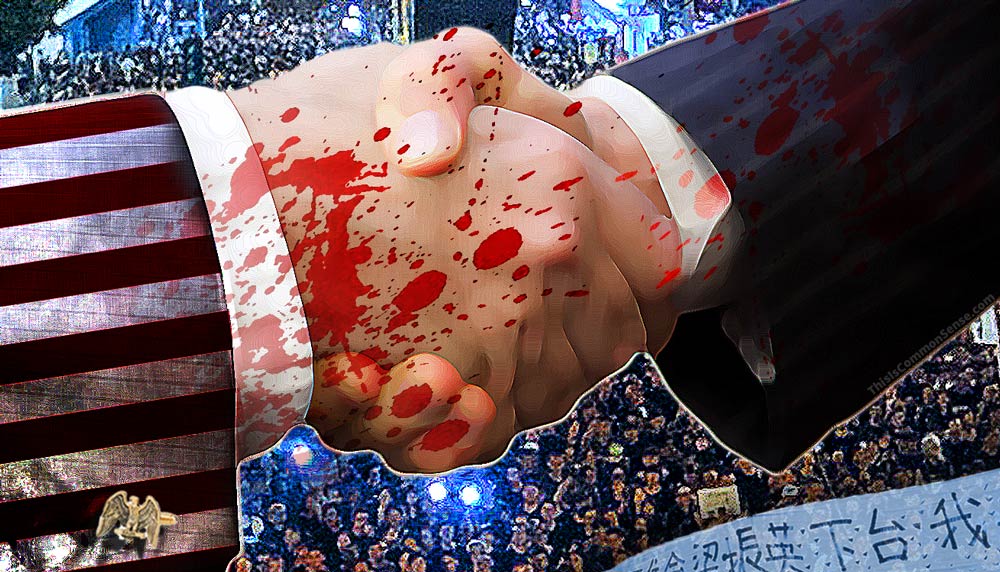
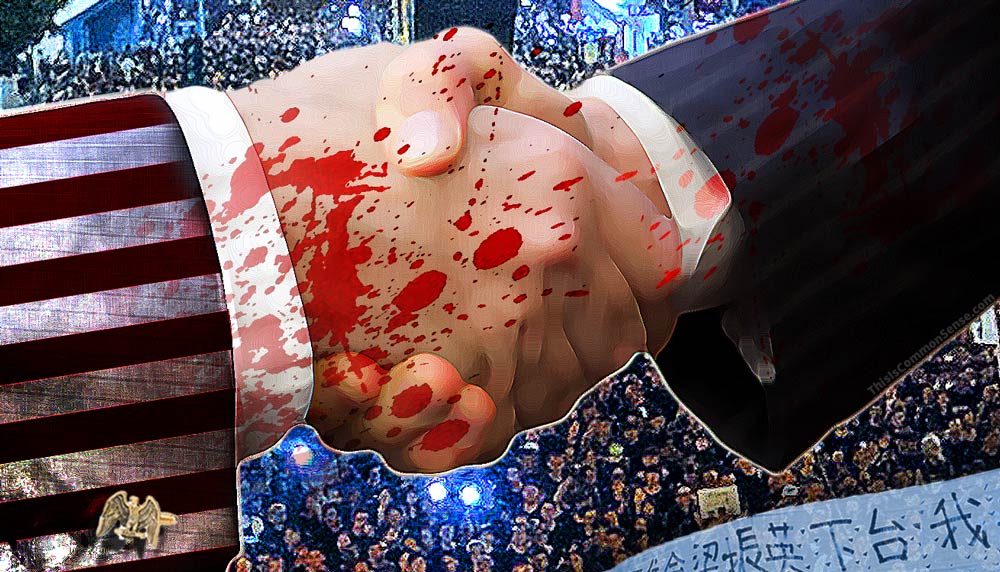
Egypt. The government of President Abdel Fattah el-Sisi just stormed the newsroom of one of Egypt’s few remaining independent media outlets, Mada Masr

“Mada has shown nothing but courage in reporting the news against all odds,” a representative of the Committee to Protect Journalists (CPJ) offered bitterly, “and in the face of brutal repression.” 

According to the CPJ, Egypt is the world’s top jailer of journalists. And that repression is not just well-documented, it is also well-funded. By . . . well . . . Sisi’s state receives roughly $1.5 billion in annual U.S. military and economic assistance, while Egyptians must “forgo democratic liberties” as “authorities” maintain “a constant crackdown . . . encompassing anyone criticizing the government,” informs a Congressional Research Service report updated last week. 

Iraq. Anti-government protests are in full swing, with Iraqis “demanding an end to corruption, more jobs and better public services,” the BBC informs. More than 300 people have been killed by the government the American military set up, and nearly 15,000 injured as Iraqi Security forces have used tear gas and live bullets against protesters.

Hong Kong. The smashing victory for pro-democracy candidates in the former British colony, who “won almost 90 percent of the seats” in local elections, was the weekend’s bright spot. Voters sent an unequivocal message.

Now on President Trump’s desk is the Hong Kong Human Rights and Democracy Act (H.R.3289), which puts the territory’s special trading status at risk should China impinge on its autonomy.

Will our president sign the legislation or exchange it with Chinese leader Xi Jinping for a better trade deal?

Funding, facilitating oppression is no way to serve as a beacon of liberty to the world.

This is Common Sense. I’m Paul Jacob.

PDF for printing

handshake, China, US, foreign policy, China, Hong Kong,

Photo: Studio Incendo / Photo: Flazingo Photos

See all recent commentary
(simplified and organized)

See recent popular posts


Categories
The Draft

Attendant Loss of Life

Is there an easy way to avoid the insanity of what author and decorated Marine vet Elliot Ackerman calls America’s “two-decade military quagmire”?

Yesterday, I took issue with Ackerman’s idea of a “reverse-engineered draft,” whereby each year about 65,000 young men and women — but only those with parents in the highest federal tax bracket* — would be forced into the military for two years of “service.” 

“A draft places militarism on a leash,” he argues. But in reality, select young people lose their freedom and politicians don’t relinquish any powers.

Still, Ackerman maintains that 

  1. “with a draft the barrier to entering new wars would be significantly higher” 
  2. placing these “kids” in jeopardy via military conscription would activate their wealthy and influential parents to lobby Congress and the White House 
  3. “could create greater accountability” 

ultimately resulting in a saner military posture around the globe, hopefully allowing us to “avoid . . . a major theater war, the continuance of our ‘terror wars,’ the attendant loss of life.”

Threatening to draft their kids would raise the eyebrows of parents. That’s why when Congress last voted on legislation mandating a draft, even the bill’s author voted NO.

But would having a small drafted force somehow actually save lives?

Let’s look at combat deaths when the United States used a military draft, post-World War II, and compare that to the time-period since 1973, when the draft ended and the All-Volunteer Force began. Those numbers are not close: 

  • Between 1946 and 1973, with the draft in place, nearly 100,000 American soldiers were killed overseas. 
  • Over the more than four decades since the draft ended, fatalities remain under 10,000.

That’s a heap-big correlation between the military draft and “attendant loss of life.”

This is Common Sense. I’m Paul Jacob.


* As I noted yesterday, targeting the draft to apply only to top income earners clearly violates the equal protection clause of the Constitution.

war, the draft, slavery, foreign policy, lottery

See all recent commentary
(simplified and organized)

See recent popular posts

Categories
First Amendment rights Popular

Against Spying on American Journalists

Does the Federal Bureau of Investigation have a file on you?

Does it — or some other agency — have an active file on you?

If so, does it have good reason for such an investigation?

Well, refine that last question a bit: does the FBI have a good reason under the principles of a democratic republic, abiding by the limits set by the rights listed (and not listed) in the Constitution?

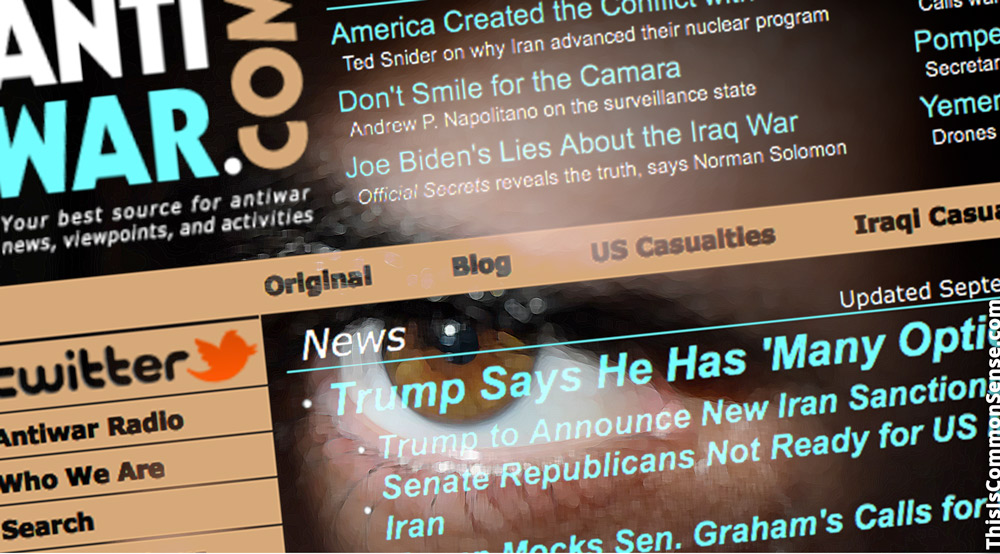
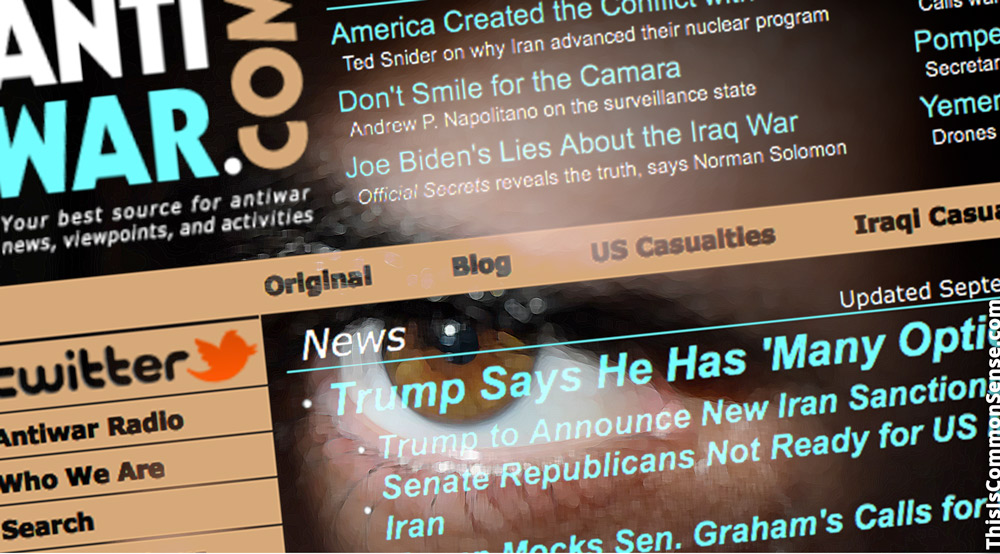
Eight years ago, the folks at AntiWar.com learned that they had been subject to FISA snooping and multiple “threat assessment” memos of the FBI. Eric Garris, founder, managing editor, and webmaster of the anti-war site sued, under the Freedom of Information Act, for discovery, and, under the 1974 Privacy Act, to have the memos expunged. On September 11, the court instructed the bureau to expunge one of them, mainly because no crime was under investigation.

You can read a good account of the story at The American Conservative, by Kelly Beaucar Vlahos. It is not a simple story. But the gist is that a journalistic enterprise was targeted for a spy operation because the American Deep State disagreed with — or just plain feared — the journalists’ policy of opposing never-ending war.

Never-ending war being, of course, the health of the ever-expanding state.

This may not unreasonably remind you of the Obama Era suppression of Tea Party activism via the Internal Revenue Service’s discriminatory doling out 501(c)3 statuses. But the FBI is even more ominous, as Angela Keaton, Director of Operations, acknowledged: “donors became scared.”

That is all the evidence we need to recognize how dangerous Deep State spying can be to the freedoms — political and personal — of Americans.

This is Common Sense. I’m Paul Jacob.


antiwar, anti war, Justin Raimondo,

See all recent commentary
(simplified and organized)
See recent popular posts


Categories
international affairs national politics & policies Popular

Who’ll Stop the Wars?

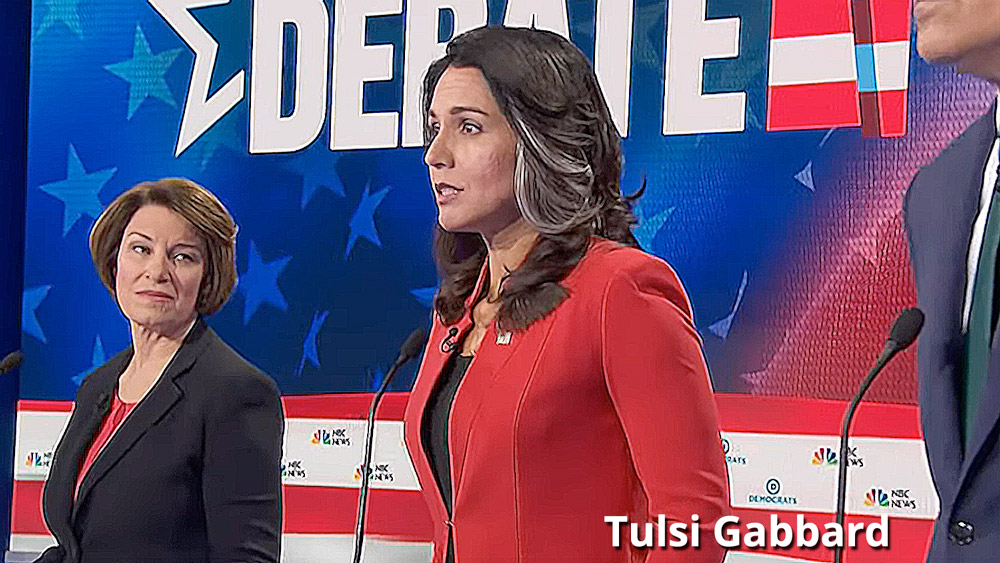
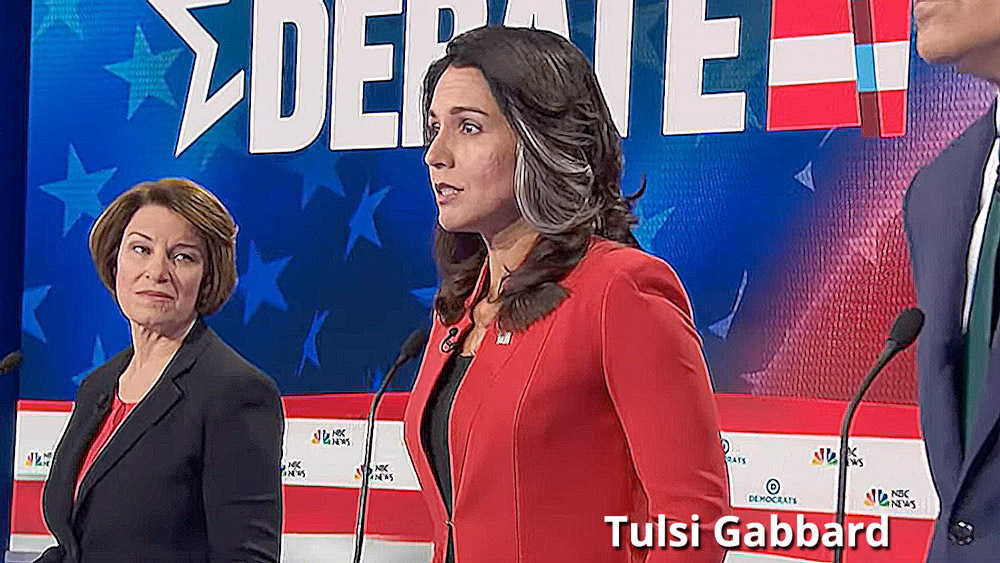
“Why were you the lone voice out there going after the neo-cons, going after the people who took us into these wars?” Chris Mathews, host of MSNBC’s Hardball, asked presidential candidate Rep. Tulsi Gabbard (D-Hawaii) after Wednesday night’s debate. 

Pro-peace candidates do well with voters, but still most politicians and the media remain hawkish. The only time “the mainstream media fawned” over President Trump was after airstrikes against Syria.  

“I deployed to Iraq in 2005 during the height of that war,” she told Mathews. “I served in a medical unit where every single day I saw that terribly high human cost.”

Contrasted with former Vice-President Joe Biden, who voted for the Iraq War as senator, Gabbard pledged not to “bend to the whims of the military-industrial complex or the foreign policy establishment.”

“Today the Taliban claimed responsibility for killing two American service members in Afghanistan,” MSNBC’s Rachel Maddow had posed during the debate. Noting that “leaders as disparate as President Obama and President Trump” have wanted “to end US involvement,” Maddow inquired of Rep. Tim Ryan (D-Ohio), how he might get us out?

Instead, he argued: “We must be engaged in this.” That led Gabbard to cut in, calling Ryan’s answer “unacceptable.” 

“We have to bring our troops home from Afghanistan,” she declared. “We are no better off in Afghanistan today than we were when this war began [nearly 18 years ago].”

Offered the opportunity, not one of the other eight candidates on the stage addressed the country’s longest war. 

This is a problem, since, as I’ve repeatedly posited in this space, there is no plan to defeat the Taliban, only to negotiate power-sharing with them.

Ceaseless intervention.

This is Common Sense. I’m Paul Jacob.


PDF for printing

Tulsi Gabbard, Democratic Presidential Debate, war, peace, foreign policy,

See all recent commentary
(simplified and organized)
See recent popular posts


Categories
folly ideological culture

War Lust Flags

A new poll shows that a narrow majority of Americans would support the President were he to pull troops out of Afghanistan. Less than a quarter of those polled said they would oppose it. 

“The survey also indicates Americans remain unconvinced that the United States has a clear purpose in Afghanistan,” explains the January 10 press release of the Charles Koch Institute, which commissioned the poll. “Almost half of respondents, 45 percent, said the United States has no strategic objective, while only 21 percent said it does. About one-third (34 percent) said they did not know.”

However you slice the public opinion data, the wars in the Mid-East are not gaining in popularity. A plurality of Americans polled want out of Syria, too — no matter “whether the conflict was framed around the Syrian civil war or to counter-ISIS.”

Lucy Steigerwald, writing at Reason, highlights the incoherence in the White House and Pentagon: “no one seems to know what the hell is going on.” Which just shows how far we have come, after all these years. “The long life of the Afghan war makes it hard to remember how popular it was when it began.”

But back then it all seemed so clear: get Osama bin Laden, destroy his training camps, and punish the Taliban for harboring him.

All that was accomplished long ago. Now our leaders fear pulling out because . . . we haven’t established a western democracy there?

That was never going to happen.

It is foolish — even immoral — to keep a war going with impossible and incoherent goals.

This is Common Sense. I’m Paul Jacob.


PDF for printing

soldiers, foreign policy, war, peace, Syria, Afghanistan
Categories
international affairs meme Popular too much government

What Kind of Ice Cream Cone?

When I wrote about the Donald’s change of troop positions abroad last week, it was less than completely clear that the US President aimed to withdraw troops from Afghanistan as well as Syria. But multiple reports on the day I posted “Strategic Disengagement” make it clearer: about half of America’s 14,000 troops stationed there are scheduled to exit.

Why not all?

Well, you can see how entrenched foreign intervention is for American leaders. While most of the GOP policy establishment howled at Donald Trump’s betrayal of the cause (whatever that cause is, exactly), so, too, did many of the Democrats. And they seem awfully earnest. More earnest than one has reason to expect from the objectors to “George W. Bush’s wars.”

Even Noam Chomsky came out saying that the U.S. should stay in Syria to save the Kurds, and Howard Dean tweeted that American troops must remain in Afghanistan for the sake of women’s rights.

What we are witnessing are eternal programs that do not ever — and cannot ever — fulfill their basic purpose. No amount of occupation of Syria or Afghanistan or Iraq is going to give us what the neoconservatives promised: freedom and democracy and jubilation in the streets.

Freedom and democracy do not work that way.

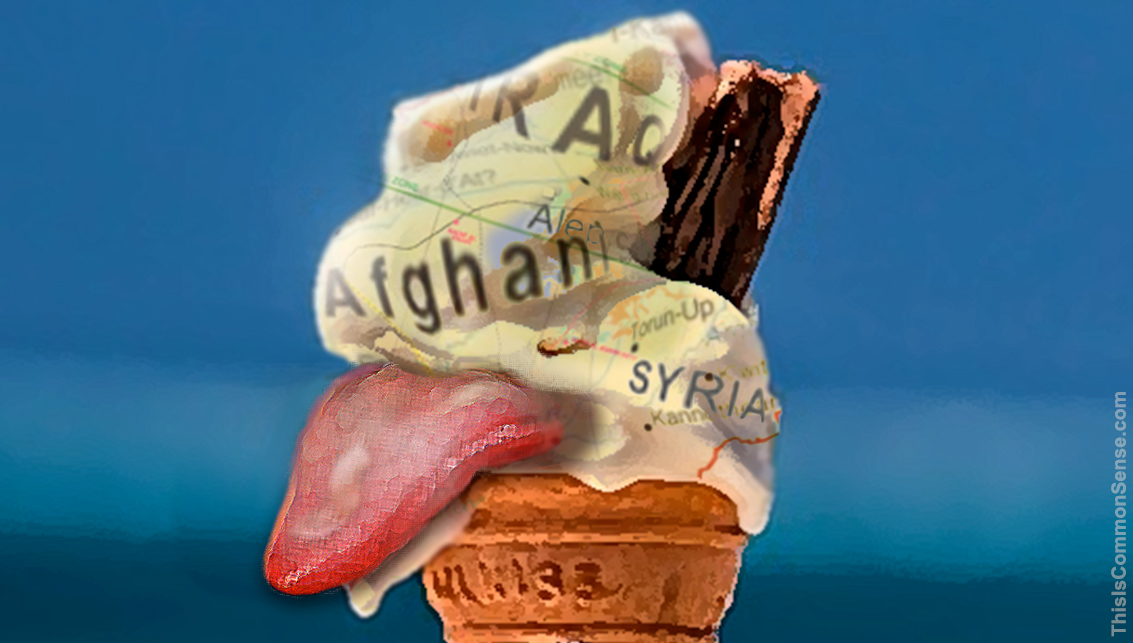
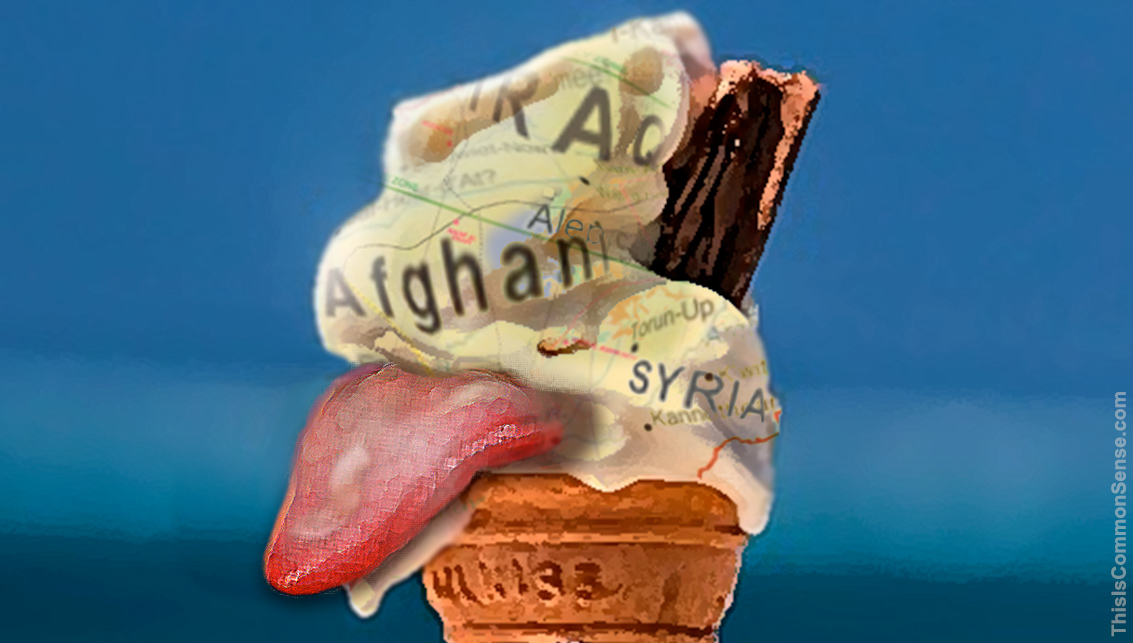
There is a term for such impossible-to-win/impossible-to-stop policy messes: “self-licking ice cream cones.”

The term means a “self-perpetuating system that has no purpose other than to sustain itself,” which is just standard operating procedure for domestic bureaucracies.

But in foreign military action?

Awfully cold imagery, and too comic . . . for tragedy.

This is Common Sense. I’m Paul Jacob.


PDF for printing

self licking ice cream, war, foreign policy, government

See all recent commentary
(simplified and organized)
See recent popular posts

Categories
international affairs Popular too much government

Strategic Disengagement

The policy was announced in a Tweet: President Trump said it was time to pull out of Syria. We won, he explained. “After historic victories against ISIS, it’s time to bring our great young people home!”

There is, of course, much outcry among Republicans, Sen. Lindsey Graham (R-SC) and pundit Ben Shapiro making the same point: this is, in the senator’s words, “a huge Obama-like mistake.”

But not a few are supportive. “U.S. forces should not be engaged in Syria — or any country,” explained Rep. Justin Amash (R-Mich), “without legitimate military justification AND proper congressional authorization.”

And there is no doubt that after pulling out of the region — and yes, it looks like Trump is readying forces for a pull-out of the expensive and ridiculous Afghanistan occupation — there will be outrageous horrors. But are they America’s? 

Should they be?

The problem with trying to solve every worldwide conflict is clear: by intervening, we make those conflicts ours.

The idea that the American military can successfully micromanage conflicts around the world seems implausible. And increasingly counter-factual. 

The same logic against intervening in the domestic economy to “wisely” promote some businesses and demote others also applies against most foreign military intervention: “unintended” consequences get conjured up, and even blowback.

Also, somehow, almost no one ever consults Just War theory to test various proposed interventions. Instead, military interventionism is all audacious hope and lofty language.

No realism, despite “Mad Dog” Mattis’s protests to the contrary.

Foreign policy scholar Earl Ravenel had the perfect term for what Trump may be and should be doing: strategic disengagement. We have much to gain from a more restrained — and constitutional — foreign policy.

This is Common Sense. I’m Paul Jacob.


PDF for printing

Donald Trump, Trump, Syria

See all recent commentary
(simplified and organized)
See recent popular posts


Categories
international affairs

The Grateful President

What are you thankful for?

Surely you were asked over Thanksgiving by friends or relatives — just as the president was by reporters. No doubt you had more social grace than to launch into a full-throated self-endorsement.

In his defense, President Trump first answered, “For having a great family,” before quickly pivoting to “and for having made a tremendous difference in this country. . . . This country is so much stronger now than it was when I took office that you wouldn’t believe it.”

Yes, hard to believe.

Thankful for Saudi Arabia? The Donald is. Oil prices are down.

Controversially, Trump also decided that Saudi Arabia has suffered enough for their grisly state murder of Washington Post contributor Jamaal Khashoggi. U.S. sanctions have indeed been firmly placed on 17 Saudis accused of involvement in the murder, but no action taken against Crown Prince Mohammed bin Salman, who the CIA “assesses” was “likely responsible.” 

“It’s a very complex situation,” the president told reporters. “It is what it is.

“We’re not going to give up hundreds of billions of dollars in orders and let Russia, China and everybody else have them,” Trump continued. “It’s America first.”

“Our relationship with Saudi Arabia has always been transactional,” explained the American Enterprise Institute’s Danielle Pletka on NBC’s Meet the Press. “Our relationship with Saudi Arabia has always been about our larger goals in the region, not out of admiration for Saudi Arabia’s rule of law, human rights record, or anything else.”

“Transactional” is a pretty word for this foreign policy, with pretense about human rights or without.

How thankful should we be for that?

This is Common Sense. I’m Paul Jacob.


PDF for printing


» See popular posts from Common Sense with Paul Jacob HERE.