Categories
Accountability media and media people national politics & policies

The Worshipful and the Incurious

Did the recent pandemic begin as a leak from a lab in Wuhan, China?

Who knows?

But in these United States there suddenly appears serious — even bipartisan — interest in finding out.

I’ve been curious for some time, but why wasn’t more of the media interested from the beginning? Why were questions about the Wuhan Institute of Virology as well as the questioners often attacked?  

“[T]he newspapers I read and the TV shows I watched had assured me on many occasions that the lab-leak theory wasn’t true,” Thomas Frank, the progressive historian and author, explains in The Guardian, “that it was a racist conspiracy theory, that only deluded Trumpists believed it, that it got infinite pants-on-fire ratings from the fact-checkers,” adding that he “always trusted the mainstream news media.”

Thank goodness Senator Rand Paul confronted Dr. Fauci, again, leading to Fauci acknowledging the need for further investigation into the Wuhan lab that performed research on bat coronaviruses, arguably including gain-of-function research, with indirect U.S. funding. 

“Renewed focus on Wuhan lab scrambles the politics of the pandemic,” was one of several recent explanatory Washington Post articles.

Politics

You don’t say!

“The shifting terrain highlights how much of the early debate on the virus’s origins was colored by America’s tribal politics,” the paper reported, “as Trump and his supporters insisted on China’s responsibility and many Democrats dismissed the idea out of hand . . .”

The Post should include itself when referring to Trump-blaming “Democrats.” 

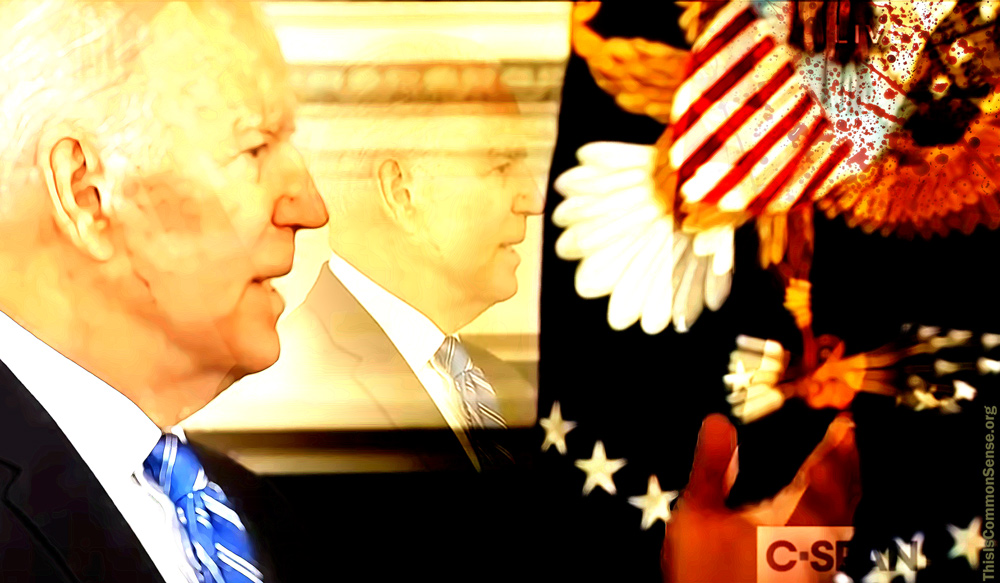
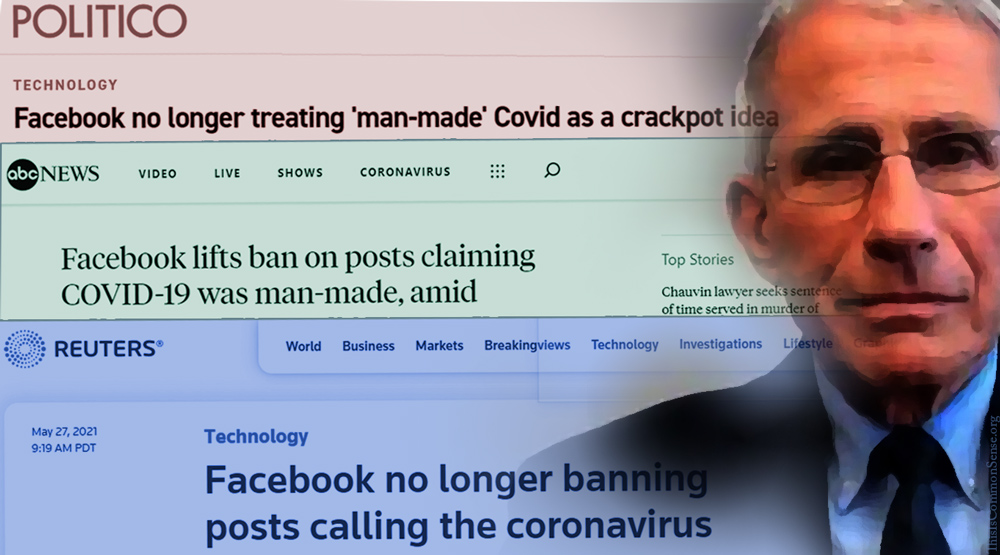
Another article The Post dangled before readers captures the moment — “Facebook: Posts saying virus man-made no longer banned.” 

In addition to the media and social media failure on this lab-leak story, let’s not forget the “expert fail.” Mr. Frank fears that if Big Science is found to be the cause of the pandemic, it “could obliterate the faith of millions” in “the expert-worshiping values of modern liberalism.”

We should be so lucky. 

What’s next: a release of Fauci’s emails?

This is Common Sense. I’m Paul Jacob.


PDF for printing

See all recent commentary
(simplified and organized)
See recent popular posts

Categories
social media

Threat/No Threat

Last week, I asked whether the social media companies that mine our data — which they obtain from our posts — might not expend a little more attention to allowing us to mine our own data with more ease and sophistication.

Today, let’s look at the biggest problem.

Politics.

Facebook and Twitter initially gloried in enabling users to easily communicate political ideas and activism. 

Then they realized that people don’t all agree, and that platform headmen Zuckerberg’s and Dorsey’s friends got upset when they lost, blaming Facebook and Twitter for allowing “democracy” to be compromised.

Now, that was overblown. Democracy wins when people use communication technology to convince others — just so long as they do not opt out of democracy’s integral respect for minority rights. 

Which is what Democrats accused Republicans — Trump was “obviously” authoritarian

Which is what Republicans also accused Democrats — and throwing people off a supposedly non-partisan platform for partisan reasons sure looks anti-democratic.

Robby Soave, arguing to the contrary at Reason, says that “Both the Left and the Right Are Exaggerating the Threat Posed by Facebook.” His article’s blurb boasts his thesis: “Facebook can’t kill, jail, or tax you. It can only stop you from posting on Facebook.”

True — but is it true enough? The political ramifications of Facebook’s de-platforming strike me as a great breach of contract — not just a matter of no physical threat. Plus, as mentioned Monday and previously, big tech is not immune to Washington’s political pressure and massive financial clout.

Meanwhile, Mr. Soave quotes Candace Owens, whose advice seems apt to me: “Twitter and Facebook are Fascist companies” that we should be “slowly migrating away from. . . .”

Soave is spot-on to highlight the limits to Facebook’s clout, reminding that we can stop feeding their data mining operations.

This is Common Sense. I’m Paul Jacob.


PDF for printing

See all recent commentary
(simplified and organized)
See recent popular posts

Categories
social media

Reddit Redacts the Internet

The watchdog group Judicial Watch has obtained evidence that the government of California and the Biden camp violated the First Amendment rights of Americans during the 2020 presidential campaign. 

In at least a couple dozen cases, social media companies complied with governmental requests to delete posts containing “misinformation,” the new code word for “stuff that I don’t want people to see or discuss.” 

But hey: were all materials containing “misinformation” deleted from the annals of humankind, historians would be left with maybe ten or twelve pages and scrolls of primary documents. Into the trash? Herodotus, Josephus, Gibbon!

On the other hand, the social-media giants often curtail online discourse without any apparent urging by government censors.

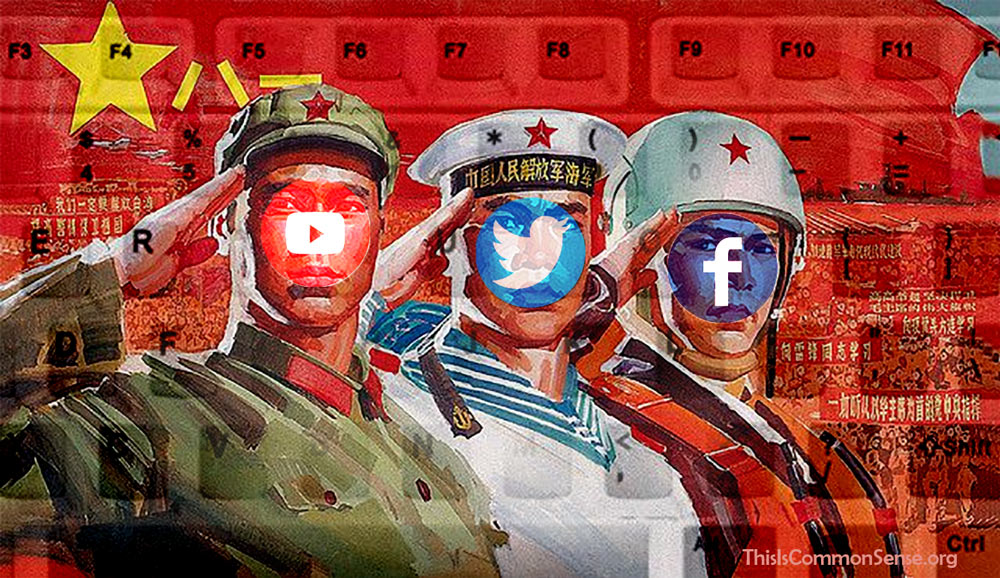
Example? The popular discussion group Reddit has taken upon itself to block users from viewing the videos hosted by certain popular alternatives to YouTube like Rumble and BitChute. Reddit has China-walled links to the videos regardless of content. The problem, it seems, is that Rumble and BitChute are too much in favor of free speech.

Now, it may be that Reddit does its redactions in eager pursuit of its own ideological agenda rather than in obedience to some politician(s), but questions remain. When it comes to suppressing voices that socialist social media moguls find politically uncongenial, how much is reluctant submission to government pressure and how much is spontaneous voluntary initiative?

I’d like to know. 

Barring any likelihood of a certain answer, we citizens must vigilantly watch governments — along with the tech firms receiving lucrative government contracts.

This is Common Sense. I’m Paul Jacob.


PDF for printing

See all recent commentary
(simplified and organized)
See recent popular posts

Categories
social media

The Cats’ Pajamas

In all the talk of “social media” — their psychological effects on us; their political power; their abusive treatment of our privacy and our loyalty — one thing does not get talked about enough: that social media’s chief utility for many of us is not social at all.

Facebook, YouTube, SoundCloud, Twitter, Gab, Instagram, Quora — these are personal databases. 

Databases on the Cloud, sure; databases open to the public and open to paying advertisers, surely (that’s how the media giants make money while providing us with a free service). 

But they remain databases. And, as such, they allow us to log our interactions with both online and physical worlds, storing our photos, videos, audios, links, thoughts, questions & answers, and more, so we may retrieve them later for whatever projects we may be engaged in.

This is no small thing if you are in a “business” like ThisIsCommonSense.org, where mining what I read two weeks ago can turn into something I need tomorrow. 

Trouble is, the search features of most social media services . . . well . . . don’t find much. It is often devilishly hard to find that article one linked to last April, or November, or . . . was it December? The search features to one’s own entries (as well as others’) should be much more robust. Inventive. Useful. 

It would be nice if the social media companies that mine our data for their pecuniary advantage would also allow us to mine our data . . . for our more humble purposes.

So, take this as advice to alternative social media developers, like the Flote app: if you are literally providing a database for clients (and not true P2P functionality), then give search features more serious attention.

So that we can quickly find and re-share our most sublime cat photos.

This is Common Sense. I’m Paul Jacob.


PDF for printing

Image from _DJ_

See all recent commentary
(simplified and organized)
See recent popular posts

Categories
First Amendment rights media and media people

Misinformed … or Worse?

“For the third time in less than five months,” journalist Glenn Greenwald writes at Substack, “the U.S. Congress has summoned the CEOs of social media companies to appear before them, with the explicit intent to pressure and coerce them to censor more content from their platforms. On March 25, the House Energy and Commerce Committee will interrogate Twitter’s Jack Dorsey, Facebooks’s Mark Zuckerberg and Google’s Sundar Pichai at a hearing . . .”

A joint statement by Democrat committee and subcommittee chairs declares: “This hearing will continue the Committee’s work of holding online platforms accountable for the growing rise of misinformation and disinformation.”

Wait — the constitutional authority of Congress does not stretch to holding social media “accountable” for political speech. The First Amendment clearly states that “Congress shall make no [such] law . . .”

And what Congress is forbidden to do, it cannot threaten and intimidate private companies into doing, instead.

“For the same reasons that the Constitution prohibits the government from dictating what information we can see and read . . . ,” Greenwald points out, “it also prohibits the government from using its immense authority to coerce private actors into censoring on its behalf.”

Consider longtime Hillary Clinton aide Jennifer Palmieri’s response to President Trump’s banning by Twitter and Facebook: “It has not escaped my attention that the day social media companies decided there actually IS more they could do to police Trump’s destructive behavior was the same day they learned Democrats would chair all the congressional committees that oversee them.”

Many on the left — and even some libertarians — continue to argue that Congress plays no role in the censorship being carried out by these private Tech Giants. 

They are mistaken — whether because misinformed or disinformed, we can leave to another day.

This is Common Sense. I’m Paul Jacob. 


PDF for printing

See all recent commentary
(simplified and organized)
See recent popular posts

Categories
First Amendment rights media and media people

Who’s Banned What?

Has dissent about pandemic policy been outlawed? 

I mean, “for the duration”?

Well, no. 

The Internet displays every possible view of policy and epidemiology, expressed with every possible degree of temperateness or intemperateness.

Yet we are indeed seeing signs of indifference to freedom of speech even when that speech cannot entail breathing a coronavirus on anybody.

According to CNN, Facebook told the network: “Anti-quarantine protests being organized through Facebook in California, New Jersey, and Nebraska are being removed from the platform on the instruction of governments in those three states because it violates stay-at-home orders.”

Online posts “violate stay-at-home orders”? 

Who knew? 

Obviously, a protest that violates social-distancing rules (if it does) is not the same thing as a communication about the protest.

Apparently, Facebook is a willing functionary of whichever state governments will instruct it to carry out their censorship. Tyler O’Neil opines that “it is disconcerting that Facebook would work with local governments to remove pages organizing protests against them.” 

Yes, indeed.

But such reports have been disputed. Facebook may be acting on its own. For example, a spokeswoman for New Jersey Governor Phil Murphy says that his office “did not ask Facebook to remove pages or posts for events promoting lifting the provisions of the Governor’s stay-at-home order.” Nebraska also denies making such a request. 

Which version of the story is true? 

Which is worse? 

Both are creepy.

I just hope that this muzzling-speech-just-to-help thing doesn’t start spreading like a virus.

This is Common Sense. I’m Paul Jacob


PDF for printing

Facebook, censorship, protests, corona virus, Covid, pandemic, epidemic,

See all recent commentary
(simplified and organized)
See recent popular posts

Categories
First Amendment rights media and media people political challengers

The Silence Option

“While internet advertising is incredibly powerful and very effective for commercial advertisers,” Twitter CEO Jack Dorsey said last month in announcing a complete ban on political advertising for candidates or issues, “that power brings significant risks to politics, where it can be used to influence votes to affect the lives of millions.”

But is it the risk to “the lives of millions” that is at issue here?

Really?

Pressure for social media companies to police “renegade” voices came mainly from the left . . . in Congress and major media. These are the groups with the most to lose by the free flow of political debate, as spurred by paid political advertising, which is what challengers often use to break through the incumbents’ natural advantage. 

Congress is filled with incumbents, by definition.

Major media sees itself as gatekeeper for political discourse, and feels threatened by an unregulated online culture.

Accordingly, Twitter’s ban received rave reviews from the political left. “Good call,” progressive Congresswoman Alexandria Ocasio-Cortez responded. A spokesperson for former Vice-President Joe Biden’s campaign called it “encouraging.”*

“Good,” tweeted Montana Gov. Steve Bullock (also sort of a presidential candidate). “Your turn, Facebook.”

But Facebook is thankfully not bending to pressure.

“[I]f Facebook were to cut off political ads, it could end up undercutting the scrappy, first-time candidates . . .,” reports The Washington Post. “Voters are more likely to see Facebook ads than television ads from challengers, according to the findings, published in a working paper whose first author is Erika Franklin Fowler of Wesleyan University.”

“Online advertising lowers the cost and the barriers to entry,” Fowler told The Washington Post.

Which is bad for the political establishment because it is good for challengers, the outsiders.

This is Common Sense. I’m Paul Jacob.


Perhaps the ban encourages top Democrats for the same reason the president’s campaign manager sounded the alarm: “This is yet another attempt to silence conservatives since Twitter knows President Trump has the most sophisticated online program ever known.”

PDF for printing

gatekeeper, Twitter, Facebook, censorship, political advertising,

See all recent commentary
(simplified and organized)
See recent popular posts

Categories
First Amendment rights general freedom ideological culture media and media people

The Opposite of Infowars

Yesterday’s big story? Several major social media platforms have de-platformed Alex Jones and his Infowars opinion (“information”?) show. 

Most commenters about this happening hasten to signal to their audiences that they do not approve of Alex Jones. Is this really necessary? When we consider a mass de-platforming event, do we need to belabor the obvious? 

I hazard that even most of Jones’s viewers and listeners agree with a small amount of what he says. Jones is more like Jon Stewart and Cenk Uygur, a performer whose rants entertain most of all. In his case, because he says things no one else will, Infowars makes for a bracing . . . alternative.

It should also go without saying that private platforms like Facebook, YouTube and Apple, who are the main players to kick Jones to the curb of the Information Super-Highway, have the right to include or exclude anyone they want. As Robby Soave at Reason put it, these “companies are under no obligation to provide a platform to Sandy Hook conspiracy theorizing, 9/11 trutherism, or any of the other insane ideas Jones has propagated.”

But Soave does worry about the goofy rationales provided for the exclusion.

As do I. And it is not just that the proffered reason, “hate speech,” is, as Soave explains, vague, unanchored to any offered specific offenses.

But it’s worse. This whole exclusionary move is not about hate speech. Everyone knows this.

It’s about suppressing ideas that are (a) popular and (b) despised by the dominant culture.

And these insiders seem at a loss to confront Jones’s farragoes with better ideas, failing to provide “counter info” in their war on Infowars. 

They strike below the belt.

This is Common Sense. I’m Paul Jacob.


PDF for printing


Categories
general freedom ideological culture insider corruption media and media people national politics & policies political challengers

Plantation Revolt

The #Walkaway movement started with Brendan Straka, who proclaimed that his tribe — the liberal Left — had become “intolerant, inflexible, illogical, hateful, misguided, ill-informed, un-American, hypocritical, menacing, callous, ignorant, narrow-minded, and, at times, blatantly fascistic.”

Mr. Straka’s beef — and the general tenor of the pile-on Twitterstorm — was not about Democratic Party policy, as Scott Adams noted. It was about the left-of-center movement’s rhetorical/propagandistic rut. Since the election of Donald Trump, Democrats had come to rely almost exclusively on the feeding of frenzy by psychological manipulation, by ginning up fear.

Straka’s appeal to “walk away” became a hit, especially amongst those “racial, sexual, and religious minorities in America” that he says the Democrats have treated as if they owned.

Yet the Washington Post pooh-poohs the trend as just a social media blip — over-hyped by the very nature of the medium itself.

Plausible?

David Catron says no. Before the #WalkAway movement, he writes in The American Spectator, African-American voters had already walked away from Hillary Clinton’s candidacy in enough numbers to allow Trump his victory. And this bodes badly for the Democratic Party, for, as Catron quotes YouTube sensation Candace Owens, “I’ve seen black liberals go conservative, but never seen a black conservative go liberal.”

It doesn’t take many defections, says Carton: “All that is needed is about 5 percent more African-Americans to vote Republican and another 5 to 10 percent to simply stay home.”

But be warned: wishful thinking and Straka’s litany of political vices — “groupthink, hypocrisy, division, stereotyping, resentment” — can overtake any movement pretty quickly.

Anti-leftists in general and Republicans in particular are not immune to mass mania and suicide-by-panic.

This is Common Sense. I’m Paul Jacob.


PDF for printing


Categories
Accountability crime and punishment folly free trade & free markets general freedom media and media people moral hazard nannyism national politics & policies property rights Regulating Protest too much government U.S. Constitution

That Something You Do

Congress grilled Facebook CEO Mark Zuckerberg, last week, and as usual ended up roasting itself.

“Zuckerberg has already experienced the worst punishment of all,” quipped comedian Trevor Noah on The Daily Show. “He had to spend four hours explaining Facebook to senior citizens.”

Utah Sen. Orrin Hatch, retiring after his 42nd consecutive year in Washington, asked, “How do you sustain a business model in which users don’t pay for your service?”

“Senator,” Zuckerberg incredulously replied, “we run ads.”

Inc. magazine reported the obvious: “several of our elected leaders asked questions that were highly uninformed, or in some cases just plain weird.”

Uninformed. Weird. That’s them, alright.*

Still, the Washington establishment seems to seriously think these same congressmen ought to be re-writing privacy rules.

“Elected officials know the public wants them to do something to protect their privacy,” announced Chuck Todd, host of NBC’s Meet the Press. “The question now turns to what is that something?”

“Americans are largely together on this issue,” Todd said, citing a recent poll where a similar “66 percent of Democrats and 68 percent of Republicans say they want more control over the information companies have about them.”

But Democrats and Republicans are together on something else: Only 21 percent of Democrats and a tiny 14 percent of Republicans “trust the federal government” to act on the issue.

The senators, though obviously “confused about basic topics,” Emily Stewart wrote at Vox,  “seem to agree they want to fix something about Facebook. They just have no idea what.”

Please Congress: DON’T “do something.” Don’t do that thing you do.

This is Common Sense. I’m Paul Jacob.


* Reason TV has a very funny video on the Zuckerberg hearing.


PDF for printing