Categories
education and schooling ideological culture moral hazard responsibility too much government

An Expert Explains Failure

The failures of the public high schools in the District of Columbia go on an on. It is quite a scandal, as I explained this weekend at Townhall.

And yet some “charter schools that serve large populations of children from low-income families,” notes the Washington Post, after providing much detail about the massive failures, “recorded big increases in scores.”

What hint about improving education does that fact give?

Well, Kevin Welner, a professor who heads the National Education Policy Center at the University of Colorado, has an interesting thought: “People want to read into these test scores lessons about what the schools are doing. But these scores, even the growth scores, depend a great deal on students’ opportunities to learn outside of school. If we address the poverty and racism, then we will see these test scores increase.”

Hmmm. Let’s review: (a) the problem is at home and (b) it cannot be overcome by the schools. Moreover, the esteemed professor perceives the cause of these detrimental home environments to be “racism and poverty.” 

Once upon a time, public education was proclaimed to be the great equalizer, allowing the disadvantaged to climb the economic ladder, and, if not wipe out poverty completely, to certainly dramatically reduce it. 

Now, we discover from a certified education expert that we had it backwards.

So maybe it is time to chuck the whole experiment and just try to educate kids.

Not “save” them, or society.

This is Common Sense. I’m Paul Jacob.



PDF for printing


Categories
Accountability education and schooling folly government transparency insider corruption local leaders moral hazard nannyism national politics & policies responsibility too much government

Reading, Writing & Racketeering

When I attended a public school — many decades ago, in a galaxy far, far away — teachers told students that cheating was unacceptable and would be punished.

Harshly.

Today, the idea has students laughing — all the way to graduation.

Last year, after DC Public Schools officials breathlessly announced massive improvements in graduation rates, several honest teachers broke ranks, and an investigation uncovered massive fraud: a whopping one of every three graduates across the city resulted from falsified records.

Many students played hooky for a third or even half the school year. Administrators also pressured teachers to improve grades to hike the graduation rate.

“The problem,” Washington Post columnist Colbert King concluded, “is systemic indeed.”*

You see, employment evaluations and cash bonuses for teachers and administrators were — and still are — tied in part to student graduation stats. It turns out that an incentive to good work can also serve as an incentive to cheat. Could it be that government employees grading their own work does not encourage honesty?

Just months after confirmation of the worst fears of public school corruption, new allegations against teachers and administrators at Roosevelt High School more than suggest fudging attendance records is ongoing.

“This growing environment of fear and mistrust,” asserts Elizabeth Davis, president of the Washington Teachers’ Union, “has never been addressed and continues to be a disservice to students and teachers.”

City officials have had plenty of time to address the issue. And of the common sense idea that the best way to avoid fear and mistrust is to follow the rules?

Crickets.

This is Common Sense. I’m Paul Jacob.


* Nor is the fraudulent behavior limited to dishonestly boosting graduation rates. Former DCPS Chancellor Antwan Wilson resigned back in February after it became public knowledge that his daughter jumped 600 other students on a waiting list for her school. A recent Post story about enrollment fraud, whereby non-residents grab spots at prestigious schools such as the Duke Ellington School of the Arts, without paying the non-resident fee, was entitled, “Stop enrollment fraud? D.C. school officials are often the ones committing it.” Two-thirds of pending cases involve a current or past DCPS employee.


PDF for printing


Categories
education and schooling general freedom ideological culture moral hazard nannyism national politics & policies too much government

Grading Democracy on the Curve

Voters, we are told, are amazingly ignorant. So, what to do?

“Ultimately, the ideal democracy is one in which as many citizens as possible vote,” writes Dambisa Moyo at The Guardian, “and the voters are armed with the most objective information. Yet today only a fraction of the electorate are voting, and many are armed with a diet of hyped-up statistics and social media propaganda.” Among her proposals is a voting booth access test: “why not give all voters a test of their knowledge?”

I can think of a whole bunch of reasons, as can Ilya Somin, over at Volokh Conspiracy, who considers just a few. One of the more interesting is this: whereas Moyo has no wish to shove poor people out of the voting booth, and so envisions public schools to teach to the test — “the knowledge needed should be part of the core curriculum” — Somin quotes John Stuart Mill about the very political dangers of the very idea of public schooling: “A general State education,” wrote Mill in On Liberty, would inevitably be devised to please and serve “the dominant power in the government, whether this be a monarch, an aristocracy, or a majority of the existing generation” and must constitute “a despotism over the mind.”

Though Moyo does observe incumbency and political careerism as big problems, she is innocent of the more fundamental issues.

Indeed, she does not consider the obvious: today’s voter ignorance of politics and government is in no small part the result of government schools.

For politicians, general ignorance is not a bug, it’s a feature.

Let’s look for solutions to political problems that do not give politicians more power.

This is Common Sense. I’m Paul Jacob.


PDF for printing


Categories
crime and punishment education and schooling ideological culture media and media people moral hazard national politics & policies

Bias and Blindness

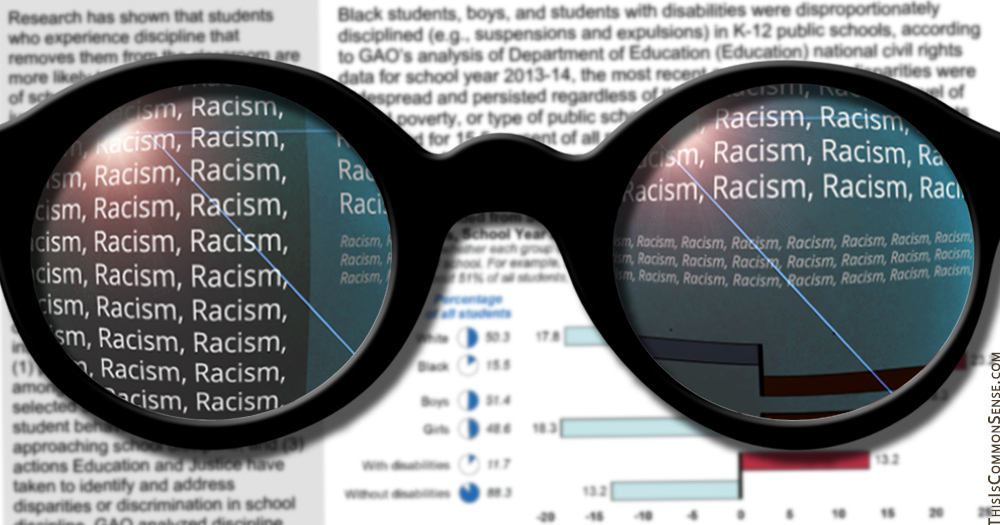
Neither stretching the truth nor ignoring it helps beat back implicit or explicit racism.  Yesterday, my Townhall.com column took the Washington Post to task for misstating the results of a recent GAO report.

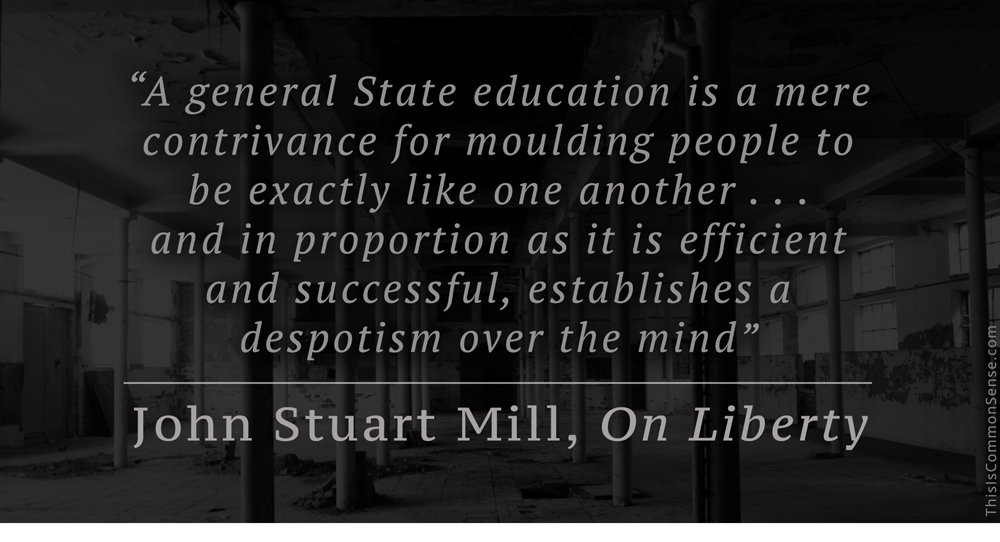
The GAO noted wide discrepancies between the percentage of students facing disciplinary actions who are black, male and disabled and the relative percentages of these groups in the overall student population. Yet, the report also specifically stated: “Our analyses of these data, taken alone, do not establish whether unlawful discrimination has occurred.”

Nonetheless, the Post headline told readers: “Implicit racial bias causes black boys to be disciplined at school more than whites, federal report finds.” The article claimed that “a government analysis of data . . . said implicit racial bias was the likely cause of these continuing disparities.”

The same discrepancies regarding boys of all races? And students with disabilities? Even the crickets had no comment.

In the Post’s Outlook section, yesterday, readers were treated to further edification on race — this time via C. Nicole Mason with the Center for Research and Policy in the Public Interest. “I feel alienated and slightly betrayed by the reboot” of the sitcom Roseanne,” she writes.

The title of her piece proclaims why: “‘Roseanne’ was about a white family, but it was for all working people. Not anymore.”

The “not anymore” refers to Roseanne’s support of (and Mason’s derangement syndrome over) President Trump. Interestingly, a more legitimate “not anymore” angle was completely missed — or ignored. The Connors now have a black granddaughter. The new show isn’t “about a white family,” but a racially mixed family.

When racism is finally extinguished from this planet, someone remember to tell the race-hustlers.

This is Common Sense. I’m Paul Jacob.

PDF for printing


Categories
Accountability crime and punishment education and schooling folly general freedom moral hazard nannyism national politics & policies too much government

Leave Them Kids Alone

This just in: oblivious little boys still play cops and robbers.

Just as in days of old.

Wait. Hold on. Breathe. Just breathe. This sociological fact doesn’t mean that we’re a nation of incipient international terrorists but for the galumphing grace of grumpy zero-tolerant schoolmasters.

Common sense says you don’t suspend toddlers from school for wiggling their fingers as if wielding a gun, or for sculpting a “gun” out of a slice of Wonder Bread or Freihofer’s. Yet evidence continues to mount that all too many teachers and administrators are immune to considerations of reasonableness when it comes to kids who misbehave. (Or “misbehave.”)

Such enemies of childhood innocence must be hindered. So let’s give two and a half cheers to Ohio lawmaker Peggy Lehner, who proposes to legislate an end in her state to suspending children in the third grade or younger who aren’t threatening anybody. (I’m not sure why kids in grades later than third can’t catch the same break.)

A new, probably imperfect government regulation is not the only way to counter blunderbuss government-school policies. The most fundamental alternative is the free market.

Ideally, no public-school monopoly plagued by mandatory insane rules would exist. Ideally, all K-12 (and university) educational offerings would be provided by an unregulated market economy, making it much easier for families to drop insane schools and patronize sane ones. The pressures of market competition would encourage school officials to become students of common sense.

We are not there yet.

This is Common Sense. I’m Paul Jacob.

PDF for printing


Categories
education and schooling folly general freedom ideological culture moral hazard nannyism responsibility

The Common School Agenda

The rise of campus radicalism, write Heather Heying and Bret Weinstein in the “Washington Examiner, appears to “validate every fantasy the Right ever had about the Left.”*

Heying and Weinstein, who have resigned their positions at Washington State’s public liberal arts college, Evergreen, detail what went wrong at the college they “loved.”

A sociologist was hired as college president, and he systematically bred an activist movement reminiscent of the Cultural Revolution. That’s how our two extremely popular professors found themselves defending free speech and non-compliance against angry crowds of students spurred on by college administrators and “equity” officers.

Heying and Weinstein plausibly assert that these protests arise directly from the “‘equity and inclusion’ movement, cloaked in words that sound benevolent and honorable” but serve as little more than “a bludgeon.” And definitely “not like protests many readers will remember from their own college days.”

But are they really that surprising?

Government-run and -funded education hit these United States in a big way with the 19th century’s Common School movement. And not primarily to ensure “proper education.” The rationale was political . . . to more-than-nudge immigrant children to assimilate to our republican way of life.

The political element from our schools never left — and became more Left with each and every “revolution” in educational methods, and each increase in government involvement.

So, does training students to become violent mob activists bent on suppressing ideas they don’t approve of seem out of place?

It certainly is expensive. In more than one way.

This is Common Sense. I’m Paul Jacob.
 

* And note that this piece did not appear in the left-of-center Washington Post — echoing the hesitance the mainstream and leftstream press have shown towards Bret Weinstein’s story in the first place.


PDF for printing


Categories
Accountability education and schooling folly general freedom moral hazard nannyism national politics & policies responsibility too much government

Eternally Postponing Responsibility

There is a common sense element to economics. We ignore it at our peril. So let’s take a cue from the Democratic Party’s current and de facto leader, Bernie Sanders.

Turn to Denmark for a model.

The Nordic state has what Bernie wants: higher education “free for all.” But there are . . . costs involved.

It turns out that “some Danes, especially older citizens already in the labor force,” explains Business Insider, “say the extra freedom can eliminate a crucial sense of urgency for 20-somethings to become adults. The country now deals with ‘eternity students’ — people who stick around at college for six years or more [not to mention advanced degree work] without any plans of graduating, solely because they don’t have any financial incentive to leave.”

Hardly a shock. Young Danes would not be the first to see in college life what satirist Tom Lehrer identified as the prolongation of “adolescence beyond all previous limits.”

Give young people an incentive to suck up resources year after year, and some will certainly take you up on that.

It’s hard to counter, too. The Danish “eternity student” problem remains even after taking policy steps to discourage it.

Business Insider ends its report by quoting an expert who insists that “motivation to succeed in your studies is in no way linked to whether you’re paying for your tuition or not.”

Yup, that’s what proponents of “free” education keep telling us. But there is more at play here.

Responsibility is on the line. Adulthood is about responsibility. Free tuition is about postponing responsibility.

Do we really want to go further in that direction?

This is Common Sense. I’m Paul Jacob.

PDF for printing


Categories
Accountability education and schooling free trade & free markets general freedom local leaders national politics & policies responsibility too much government

SEZ Ed

The great barrier to educational advance in our time is the federal government. The second great barrier? Your state government. The third great barrier? Your local government.

Proposals to break up government-subsidized and -enforced school monopolies have ranged from tax credit proposals and voucher programs to charter schools and (the biggest success so far) home schooling.

But it may be time to advance something a little . . . more daring. Break the stranglehold of government on dysfunctional schooling.

How?

Apply the “free trade zone” (FTZ) idea to education.

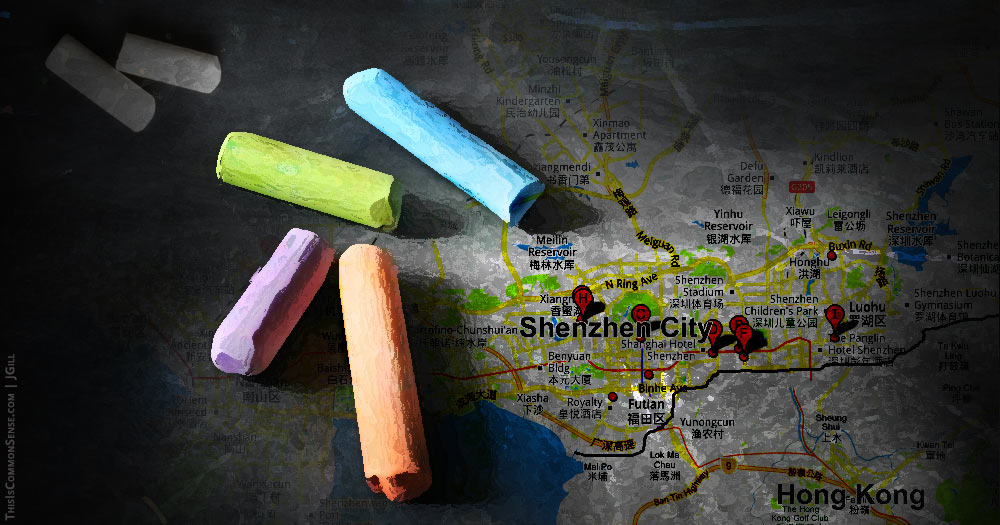
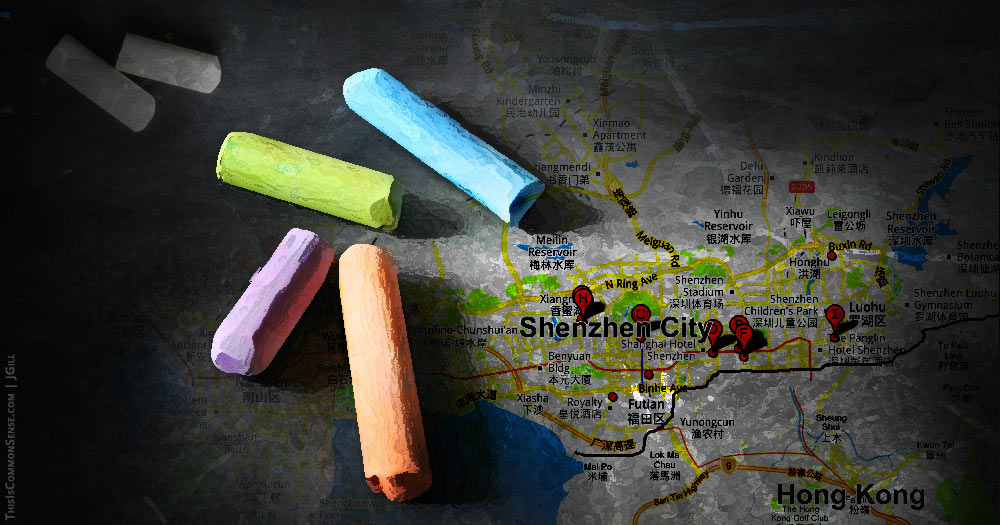
We remember the FTZ proposal because of its rise in popularity amongst academics and policy wonks in the 1980s and 1990s. But the notion is an old one. And in China, where they are called “special economic zones” (SEZs) — and it is this term that is catching on — they have been amazingly successful, the former fishing village of Shenzhen being the most obvious example.

What about America? Take a devastated region, like inner-city Chicago or Detroit,* and simply nullify the regulations and rules. (This probably would require federal enabling legislation on top of state leadership.) With the ensuing freedom and opportunity, entrepreneurs, established businesses and schools, teachers, community groups and activists could cook up new solutions to the oldest schooling problem there is:

actual education.

I’ve heard whispers of this Educational SEZ idea for some time now.

It is time for rational and quite public discussion.

And then the shouting.

This is Common Sense. I’m Paul Jacob.

 

* Of course, any area could work. The reason to focus on demonstrably failed educational regions is that such areas have lost hope, and thus the politically resistant are likely to give in and allow it.


Printable PDF


Categories
Accountability education and schooling folly responsibility

Only Make Believe

Problems can be solved. But for those lacking the merest clue how to solve a given problem . . . alternatives exist.

Books can be cooked to pretend the problem no longer exists. And perhaps to fool others.

A series of articles in the Washington Post highlights the effort to reduce the rate by which city schools suspend students for misbehavior. The good news? “D.C. Public Schools has reported a dramatic decline in suspensions at a time when school systems around the country have been under pressure to take a less punitive approach to discipline.”

Results? A whopping 40-percent decline.

The bad news?

A Post investigation found that “at least seven of the city’s 18 high schools have kicked students out of school for misbehaving without calling it a suspension and in some cases even marked them present.” In those schools, “most suspensions were not reported.”*

The Post further uncovered documentation showing that “DCPS officials knew students were being sent home without documentation at least as early as 2010.”

It brings to mind the recent scandal in Prince George’s County (Maryland) Public Schools, where a dramatic announcement that the county increased its student graduation rate faster than any other county . . . was followed by an investigation into grade tampering by school administration officials, which numerous teachers have alleged.

It is also reminscent of the systematic cheating on standardized tests in Atlanta — and across the nation.

Hiding the truth, cheating on tests, lying about results . . . not the actions of a system teaching kids a love of truth.

This is Common Sense. I’m Paul Jacob.

 

* Seven schools’ emails show that students spent a total of 406 days in suspension in January 2016. Officially recorded? Only 15 percent.


Printable PDF


Illustration based on a photo by Tod Baker

Categories
Accountability education and schooling folly local leaders moral hazard

Ugly Scrutiny

Prince George’s County Public Schools have increased their graduation rates faster than all other schools in Maryland. Measuring from 2013 to 2016, the graduation rate jumped from 74.1 percent to 81.4 percent.

Great! 

Well . . . a fly has stuck itself into the soothing salve of their success — what county principals called an “unfair, ugly scrutiny.” Said scrutiny came from the Old Line State’s Board of Education, which voted to pursue an investigation* into what the Washington Post described as “grade tampering” to “drive up graduation rates.”

Keith Maxwell, the county schools’ CEO, says he welcomes the investigation. 

Dozens of whistleblowers have reportedly come forward. Several spoke with the Post, anonymously, for fear of retaliation: 

  • “We knew that it wasn’t real,” said a teacher at a high graduation rate school. “It’s just common knowledge that they push kids through who shouldn’t be pushed through.”
  • “I’m not averse to helping a student pass,” one educator explained. “But when people are pressuring you to do it, when it happens behind your back, that’s when it’s problematic.”
  • “For a child not to come to class — maybe been in class three days in a whole quarter — and you’re going to change their grade?” questioned another teacher. “It’s not right. If they don’t come to school, and they don’t do the work, they deserve to fail.”

She added, “It doesn’t help them.”

Which is the point: the students are being cheated. If graduation doesn’t mean anything, then . . . their diplomas don’t mean anything.

This is Common Sense. I’m Paul Jacob.
 

*The investigation had been requested by Governor Larry Hogan.


Printable PDF