Categories
ideological culture political challengers

Madame Guillotine

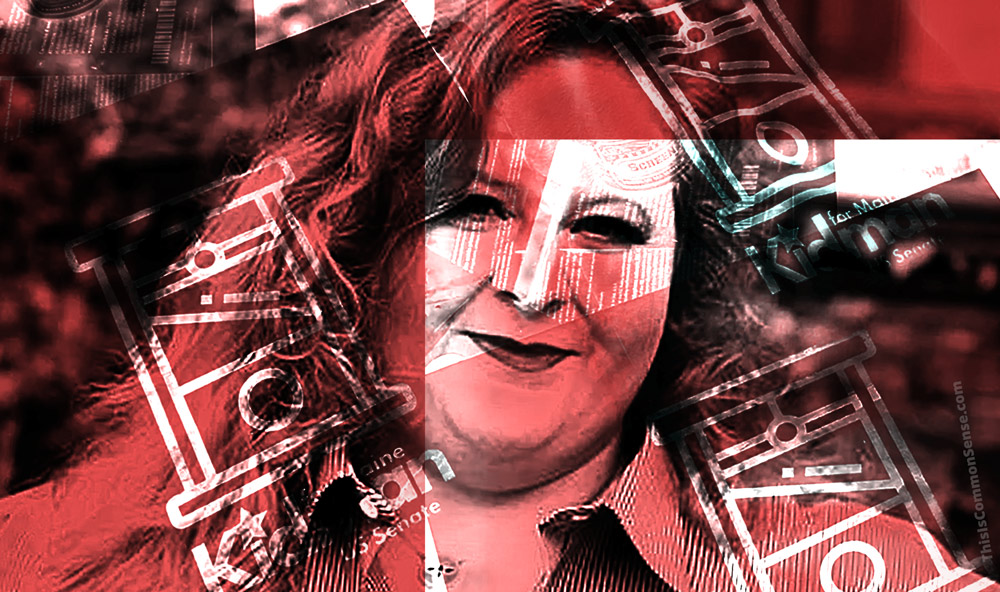
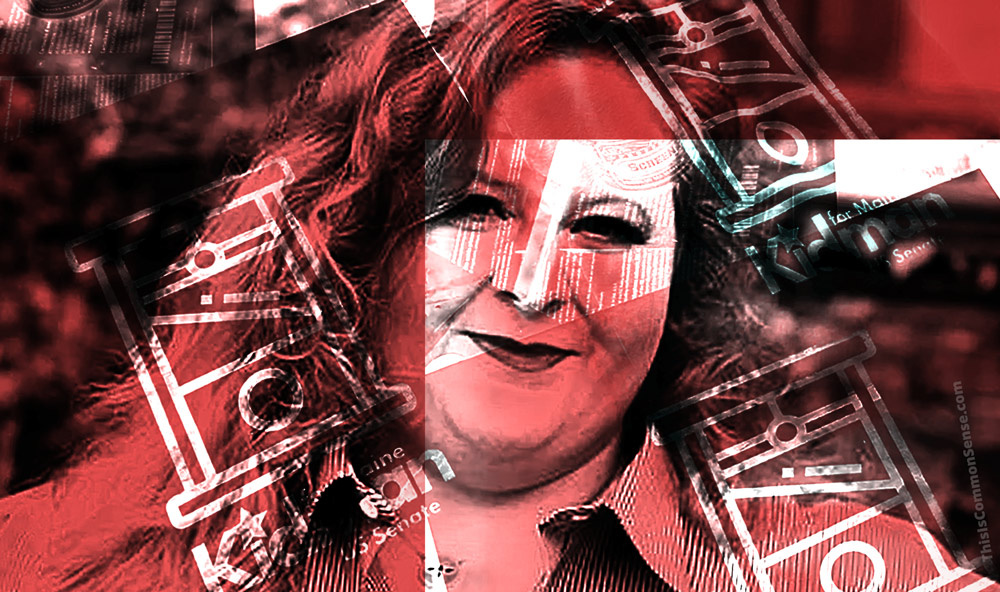
A Maine woman running for the U.S. Senate has chosen for her campaign logo the guillotine.

Yes, she calls herself a ‘democratic socialist.’ Well, on Twitter it is ‘DemSoc.’

Her name …

No, start again. On the campaign Twitter page the candidate’s “preferred pronouns” are listed as “they/​them.” So, their name is Bre, and they proudly promoted the new logo on February 5th: “I was gonna wait until tomorrow to show off these beauties, but Trump got acquitted and I feel like folks could use something to look forward to.”

But … why?

For my part, the blood running in the streets was my least favorite part of the French Revolution, and I would, uh, downplay it, no matter how murderous I might ever feel. 

You know, were I a DemSoc.

Upon being challenged with its most famous historical use, she had a … politic … response: “I’m aware of the French Revolution, and how the story ends. A guillotine t‑shirt reminds others about it in hopes that we’ll all be motivated to address the very serious problems with our government before a similarly violent uprising becomes inevitable.”

When asked who it was for, she replied, “More of a ‘what.’ The guillotine is for the plutocratic & kleptocratic norms that have undermined our democratic process. We have to develop ways to subvert the stranglehold of wealth on our government. There will not be a more convenient revolution. The symbol is a reminder.”

I wonder what she would say if her rivals chose as campaign logos the hangman’s noose and the electric chair.

But hey, her, er, their guillotine is attractive, and, because it lacks a drop of red, emphasizes the ‘democratic’ part of ‘democratic socialism’ … by hiding the blood.

This is Common Sense. I’m Paul Jacob.


PDF for printing

guillotine, Kidman, Senate,

See all recent commentary
(simplified and organized)
See recent popular posts


Categories
incumbents political challengers term limits

Knock Down the Incumbency

Over the weekend, I suffered through Knock Down the House … so you don’t have to. 

While the documentary heralding four inexperienced Democratic women running for Congress in 2018 cost Netflix $10 million, I did not have to spend a dime — beyond my regular monthly subscription.

The award-​winning film, directed by Rachel Lears, who wrote it along with her husband, Robin Blotnick, is expertly crafted. Unfortunately, it is geared to democratic socialists predisposed to adoring the subjects. 

The star is now Rep. Alexandria Ocasio-​Cortez (D‑N.Y.), who defeated then Rep. Joe Crowley, a ten-​term, 20-​year incumbent … the Number 4 Democrat in the House of Representatives.

In addition to Ocasio-​Cortez, the movie follows Amy Vilela, seeking to replace a retiring Nevada Democrat; Cori Bush, challenging the Clay Family’s hereditary congressional dynasty in Missouri’s 1st district*; and Paula Jean Swearengin, battling incumbent Sen. Joe Machin in West Virginia’s Democratic Party Primary. Of the four challengers chronicled, all of whom received extensive support from two progressive groups, Justice Democrats and Brand New Congress, AOC was the only winner.

“Let’s assume all the energy in this room can get you on the ballot and into office,” offers a fellow at one of Ocasio-Cortez’s early meetings. “How, then, do we overcome the drop in power?”

“I think we really need to have to look at what that power does now,” AOC responds. “When it matters, [Rep. Crowley] doesn’t stand up for us; when it matters, he doesn’t advocate for our interests.”

Whatever one thinks of AOC’s politics, her point here is not without merit: the idea that we citizens benefit from longtime incumbents who ‘bring home the bacon’ is … baloney. 

This is Common Sense. I’m Paul Jacob.


* At the completion of this term, Rep. Lacy Clay, Ms. Bush’s opponent, will have served 20 years. His father, Bill Clay, held the seat for 32 years before that. Together, over half a century. The film alludes to the fact that Clay Jr. gained the seat in 2000 only after the surprise retirement of Clay Sr. on the very last day to file for the office … with Jr. filing, instead.

PDF for printing

Knock Down the House, socialism, term limits,

See all recent commentary
(simplified and organized)
See recent popular posts


Categories
free trade & free markets ideological culture national politics & policies

Pick a Number

Is the number 15 “magical”?

The “democratic socialists” now dominating the Democratic Party first went for the $15 national minimum wage notion. Now it’s a cap on consumer credit interest rates, at 15 percent.

What’s next, 15 mph speed limits? Age 15 allowed to vote? 

Fifteen men on a dead man’s chest?

At Reason, Peter Suderman explains why “Bernie Sanders’ New Plan Will Make It Tougher for Poor People to Get Credit Cards.” The arguments proffered by Senator Sanders and his House co-​sponsor, Rep. Alexandria Ocasio-​Cortez, more than “suggest that people who choose to use payday loans don’t, and perhaps can’t, understand the choices they are making.… It is a form of benevolent condescension built on the belief that poor people can’t count.”

Now, it may be that, generally, poor people do not figure their finances as well as better-​off people. In fact, that’s demonstrated in the literature. But is that really the point?

The problem is, the methods they choose to help the poor make the poor less well-​off. Because they take away options: “What Sanders is actually bragging about is eliminating choices,” Suderman explains. “In essence, Sanders is proud of having eliminated useful financial tools for the poor.”

What’s really going on here is the magic of persuasion. Fifteen is a “sticky number.” It will be used again and again as self-​described socialists push for more and more unworkable government.

A bit of enchantment that just so happens to make one persuader a three-​house millionaire … and a bartender from the Bronx the talk of the nation.

This is Common Sense. I’m Paul Jacob.


PDF for printing

Bernie Sanders, 15, minimum wage, magic,

See all recent commentary
(simplified and organized)
See recent popular posts

Categories
ideological culture meme national politics & policies Popular too much government

More of the More

Alexandria Ocasio-Cortez’s triumphant entry into Washington, DC, as a United States Representative-​Elect, is quickly proving a cautionary tale for Democrats. She’s an enthusiastic socialist. Or “progressive,” to use the preferred euphemism. And thus Democrats see her as a fresh breeze to air out the stodgy, musty chambers of …

Nancy Pelosi’s office. 

Ocasio-​Cortez showed up in the House office building last week, along with other protestors “flooding,” as Politico put it, the Minority Leader’s work area. 

But what she is proving to be is not a breath of fresh air. And she is not merely “more of the same” in leftist agitation. 

She may be “more of the more.”

Progressives cannot seem to formulate an upper limit to their ideology. Dr. Jordan Peterson, trying to be “precise,” warns that this is the main problem of the left today: a lack of any sense of “going too far.” 

If government growth is always good, then … all the way to the socialism of Stalin, Mao and the Castros? The result of “always more” is “most.”

Real socialism is the  trap. “Democratic socialism” is the bait.

Their usual rebuttal? “We just want to be more like Scandinavian countries.” But these countries have less regulation on markets than America does currently. We should believe the “Scandinavian Limit” precisely when progressives earnestly push to repeal some regulations. 

Ideology aside, this may be mainly … politics. Ocasio-​Cortez proclaimed herself “looking forward” to “working together” with former and likely new Speaker Pelosi, and left the protest before the police began making arrests.

A statesperson in the making.

This is Common Sense. I’m Paul Jacob.


PDF for printing


» See popular posts from Common Sense with Paul Jacob HERE.

Categories
general freedom ideological culture Popular too much government

Socialism Is Anti-Democracy

Common sense politics must peer beneath the superficial attractions of “democratic socialism.”

In “Civil Liberties and Socialism Don’t Mix,” Matthew Harwood explains why those who call themselves democratic socialists may “say they believe in civil liberties” nevertheless “will always be hostile to individual freedom.”

In this short Reason piece, Mr. Harwood starts out by showing that socialism cannot merely be “a more generous welfare state along Nordic lines.” For “socialism” to remain distinct socialists must offer a Unique Selling Proposition. You cannot plausibly push a “new” philosophy and stick to pushing the old liberal stand-​bys of private property and markets.

Their own pretensions force them back to central planning, to economic planning for all by a few.

Which is not democratic, of course. It goes far further, to anti-​majoritarian.

Actual economic planning requires micromanagement. Harwood quotes socialist economist and luminary Robert Heilbroner, who expresses this requirement as “the necessity to intervene deeply, and probably ruthlessly, into the economy in order to establish the socialist order in the first place.”  

But it cannot stop there. Once established, a socialist state must feel a “need to continue a policy of painful intervention” to adjust to “the constricting limits of the environment.”

“Democratic socialism is not freedom,” Harwood concludes. “It is authority paternalistically dressed up in the language of liberation and wielded on behalf of that fuzzy abstraction, ‘the people,’ regardless of what flesh and blood individuals want.”

Sure, democratic socialists may hope that majorities will allow their elites to plan for everybody. 

But once that handoff is made, the power obtained, then the tyranny.

Inescapably.

This is Common Sense. I’m Paul Jacob


PDF for printing


Categories
ideological culture meme moral hazard nannyism national politics & policies Popular too much government U.S. Constitution

How Socialism Kills

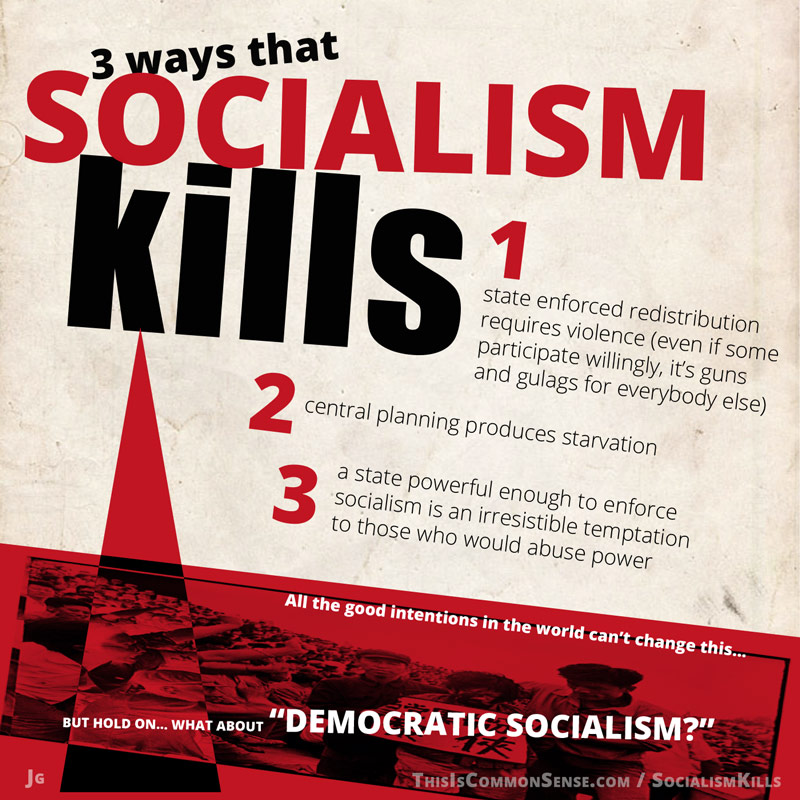
3 Ways That Socialism Kills:

  1. state enforced redistribution requires violence (even if some participate willingly, it’s guns and gulags for everybody else)
  2. central planning produces starvation
  3. a state powerful enough to enforce socialism is an irresistible temptation to those who would abuse power

All the good intentions in the world can’t change this…

but hold on… what about “democratic socialism?”


Categories
free trade & free markets general freedom meme moral hazard nannyism national politics & policies Popular too much government

Is Denmark Socialist?

First… some definitions:

Socialism advocates the public ownership (or control) of business and industry in service of a more equal distribution of wealth.

Bernie Sanders and his version of “democratic socialism” places emphasis on redistribution and downplays the public ownership and control part of the system.

However… Bernie seems never to have met a government monopoly he didn’t love, or a free market enterprise he didn’t distrust or despise.

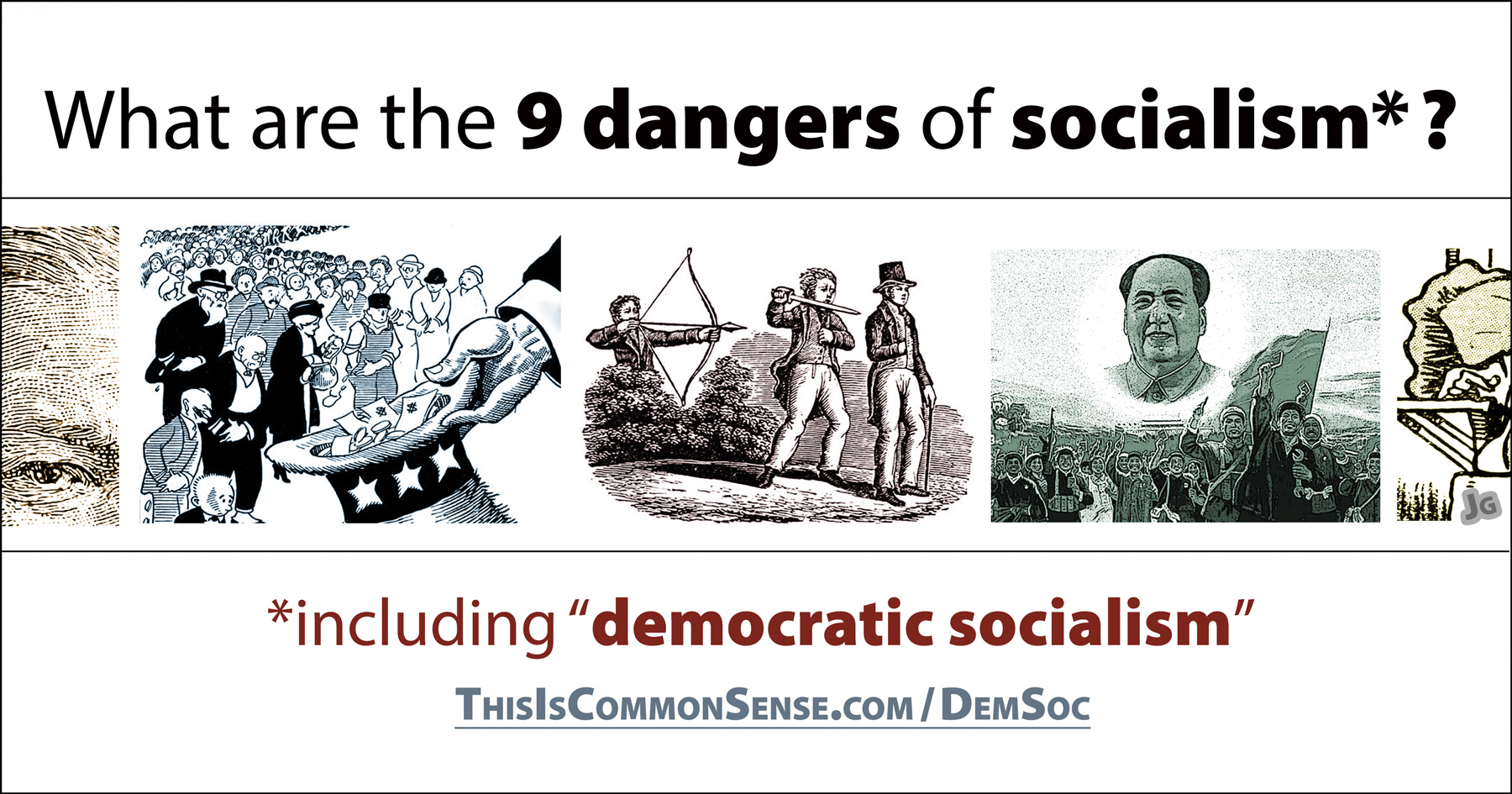
What are the problems (dangers) of socialism?


It idealizes envy.


It rationalizes theft.


It idealizes state power.


It penalizes accomplishment.


It rewards indolence.


It promotes obedience to the state.


It encourages dependence on the state by treating citizens as children.

It dismisses the protection of individual rights with a vague appeal to the “collective good” or “public good.”


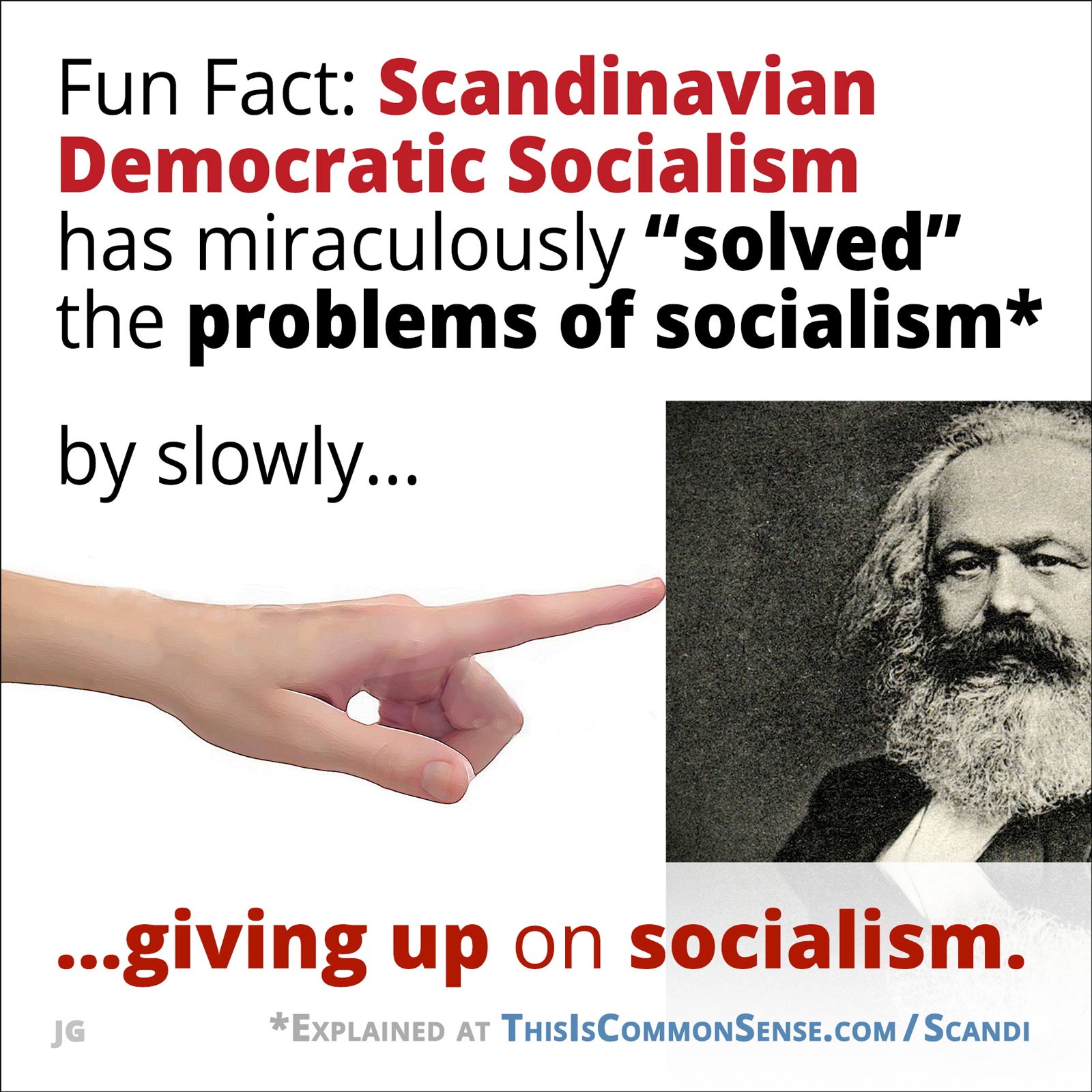
It has repeatedly led to economic collapse, oppression, poverty and starvation. So how have Scandinavian democratic socialists managed to overcome these problems?

Quote from the current Prime Minister of Denmark:

“I know that some people in the US associate the Nordic model with some sort of socialism. Therefore I would like to make one thing clear. Denmark is far from a socialist planned economy. Denmark is a market economy.”
Speech, Harvard Institute of Politics


From “Scandinavian Unexceptionalism” (from the Institute of Economic Affairs):

Today the Nordic economies are again growing, following a return to broadly free-​market policies that served them well before policies changed during the 1960s and 1970s.

The countries are changing in the face of serious long-​term problems that have developed over the last 30 years.

Finland, Sweden and Denmark have…introduced far-​reaching market reforms. These changes include greater openness to trade, clear reductions in the tax burden, private provision of welfare services, the introduction of personal retirement accounts and, in Denmark, even a shift towards a liberal labour market.

—Scandinavian Unexceptionalism (highly recommended!)

And the moral hazards?

The development of Scandinavian welfare states has led to a deterioration in social capital.

Nordic societies have for hundreds of years benefited from  strong Lutheran work ethic, a strong sense of individual responsibility and high levels of trust and civic participation.

In the early stages of their transition to “democratic socialism”, safety nets DID exist, but few used them. Over time, an increasing share of the population became dependent on government transfers. The welfare states moved from offering services to the broad public to transferring benefits to those who did not work.

The situation that exists in Nordic societies today is one in which ethics relating to work and responsibility are not strongly encouraged by the economic systems. Individuals with low skills and education have limited gains from working. This is particularly true of parents of large families, which gain extra support if on welfare.

It is true that welfare systems have reduced poverty. However, especially in the second generation, they have also created a form of social poverty of the same type that is apparent in the countries from which many of the admirers of the Scandinavian systems come. Detailed research clearly shows that welfare systems have formed a culture of dependency which is passed on from parents to children.

MUCH MORE HERE on the moral and economic capital that preceded the welfare state, and its gradual disintegration over time… 


Do you believe that socialism is a good idea that has simply been corrupted by ruthless dictators? Consider the story of the Chinese Cultural Revolution…  a mass movement of Chinese youth dedicated to eradicating capitalism and advancing socialism. Its bloody history tells us quite a lot about the logic of this flawed political philosophy… “Socialism’s Idealistic Youth”


 Useful References

Scandinavian Unexceptionalism (Institute of Economic Affairs)
This paper is especially valuable because it was written by someone who actually favors a large welfare state. His willingness to concede the problems inherent in such a state are refreshingly honest… and useful for anyone interested in the issues.

What Can the United States Learn from the Nordic Model? (CATO Institute)

Myth: The Scandinavian countries are proof socialism works (Being Classically Liberal)

The Myth of the Scandinavian Model

Economic Freedom of the World: 2013 Annual Report

International government spending (Wikipedia)

Index of Economic Freedom (Heritage Foundation)


A healthy democracy depends on the spreading of good ideas. If you found this article useful,  please share it with friends by clicking on any of the social media icons below.

Also, please consider showing your appreciation by dropping something in our tip jar  (this link will take you to the Citizens in Charge donation page… and your contribution will go to the support of the Common Sense website). Maintaining this site takes time and money. Your help in spreading the message of common sense and liberty is very much appreciated!

Categories
folly general freedom ideological culture nannyism privacy property rights too much government U.S. Constitution

Democratic Socialism…

Because BIG BROTHER is okay as long as enough people vote for him!


CLICK BELOW for a high resolution version of this image:

Democratic Socialism, Big Brother, socialism, vote, voting, egalitarian, meme, Jim Gill, Paul Jacob, Common Sense


Categories
folly general freedom ideological culture meme national politics & policies too much government

One-​Party Socialism?

As the President of the United States noodles around Cuba, opening up relations and trade for the first time in half a century, one obvious obstacle to progress sticks out: Fidel Castro is still alive, and his brother, Raoul, still runs a one-​party state.

It is worth reminding Americans how desperately socialism in Cuba requires repressive one-​party rule. Sometimes folks forget. As Bernie Sanders pushes a “democratic socialism,” we should wonder where he and his Sandernistas stand on Cuba’s brand of socialism, i.e. without the democratic part.

Months ago, an old 1985 video surfaced of Bernie Sanders, then mayor of Burlington, Vermont, back from trips to Nicaragua and Cuba. Frankly, I agreed with his opposition to U.S. intervention in Central America. But Bernie also praised the Cuban government, asserting that Cubans were not “against Fidel Castro” because “he educated their kids, gave their kids health care, totally transformed society.”

He did not mention what Fidel didn’t give, indeed, would not allow: opportunity, progress, autonomy, freedom, democracy … the list is long.

Cubans who speak out are arrested, imprisoned.

Bernie did add: “Not to say Fidel Castro and Cuba are perfect.” But failed to make any mention of the total political repression of democratic activity.

The necessity of violence to establish socialism should be obvious. Even Bernie’s so-​called “non-​violent” supporters engage in raucous, invasive protests against Trump, and litter Twitter with indecent talk of assassinating the Republican front-runner.

What would they do with official power?

Are they committed to democracy as a process, really? Or to their programs alone?

Programs that rely upon mass expropriation and strong-​arming governance. No matter what Sanders says about “love.”

This is Common Sense. I’m Paul Jacob.


Printable PDF

Bernie Sanders, Democratic Socialism, Che, democracy, meme, illustration, Common Sense


A healthy democracy depends on the spreading of good ideas. If you liked this post,  please share it with friends by clicking on any of the social media icons below.

Common Sense Needs Your Help!

Also, please consider showing your appreciation by dropping something in our tip jar  (this link will take you to the Citizens in Charge donation page… and your contribution will go to the support of the Common Sense website). Maintaining this site takes time and money. Your help in spreading the message of common sense and liberty is very much appreciated!


Categories
general freedom ideological culture meme moral hazard national politics & policies Popular responsibility too much government

9 Dangers of “Democratic Socialism”

First… some definitions:

Socialism advocates the public ownership and control of business and industry in service of a more equal distribution of wealth.

Democratic Socialist” Bernie Sanders places emphasis on redistribution and downplays the public ownership and control part of the system.

However… Bernie seems never to have met a government monopoly he didn’t love, or a private enterprise he didn’t distrust or despise. It’s the state for Bernie, and Bernie for the state.

What are the 9 dangers?

It normalizes envy.


It rationalizes theft.


It idealizes state power.


It penalizes accomplishment.
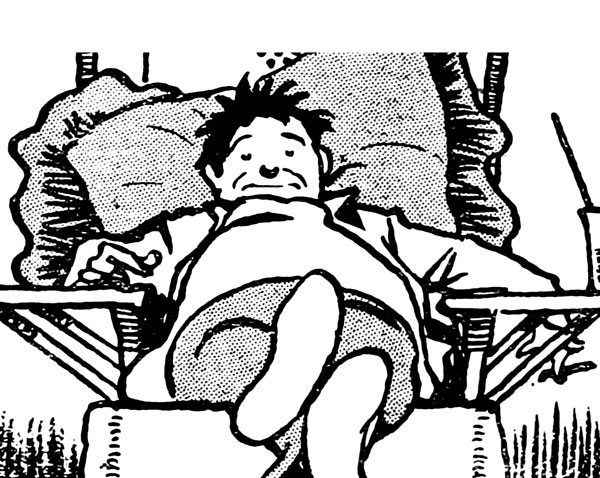

It rewards indolence.


It preaches obedience to the state.


It encourages dependence on the state by treating citizens as children.


It dismisses the protection of individual rights with a vague appeal to the “collective good” or “public good.”


It has repeatedly led to economic collapse, oppression, poverty and starvation.

So how have Scandinavian democratic socialists managed to avoid these dangers?

Quote from the current Prime Minister of Denmark:

“I know that some people in the US associate the Nordic model with some sort of socialism. Therefore I would like to make one thing clear. Denmark is far from a socialist planned economy. Denmark is a market economy.”
Speech, Harvard Institute of Politics


From “Scandinavian Unexceptionalism” (from the Institute of Economic Affairs):

Today the Nordic economies are again growing, following a return to broadly free-​market policies that served them well before policies changed during the 1960s and 1970s.

The countries are changing in the face of serious long-​term problems that have developed over the last 30 years.

Finland, Sweden and Denmark have…introduced far-​reaching market reforms. These changes include greater openness to trade, clear reductions in the tax burden, private provision of welfare services, the introduction of personal retirement accounts and, in Denmark, even a shift towards a liberal labour market.

—Scandinavian Unexceptionalism (highly recommended!)

And the moral hazards?

The development of Scandinavian welfare states has led to a deterioration in social capital.

Nordic societies have for hundreds of years benefited from strong Lutheran work ethic, a strong sense of individual responsibility and high levels of trust and civic participation.

In the early stages of their transition to “democratic socialism”, safety nets did exist, but few used them. Over time, an increasing share of the population became dependent on government transfers. The welfare states moved from offering services to the broad public to transferring benefits to those who did not work. 

The situation that exists in Nordic societies today is one in which ethics relating to work and responsibility are not strongly encouraged by the economic systems. Individuals with low skills and education have limited gains from working. This is particularly true of parents of large families, which gain extra support if on welfare.

It is true that welfare systems have reduced poverty. However, especially in the second generation, they have also created a form of social poverty of the same type that is apparent in the countries from which many of the admirers of the Scandinavian systems come. Detailed research clearly shows that welfare systems have formed a culture of dependency which is passed on from parents to children.

All of these problems are widely acknowledged by policy makers in the Nordic states. They are generally ignored by American enthusiasts for “democratic socialism.”

MUCH MORE HERE on the moral and economic capital that preceded the welfare state, and its gradual disintegration over time… 


Do you believe that socialism is a good idea that has simply been corrupted by ruthless dictators? Consider the story of the Great Cultural Revolution…  a mass movement of Chinese youth dedicated to eradicating capitalism and advancing socialism. Its bloody history tells us quite a lot about the logic of this flawed political philosophy… “Socialism’s Idealistic Youth”


 Useful References

Scandinavian Unexceptionalism (Institute of Economic Affairs)
This paper is especially valuable because it was written by someone who actually favors a large welfare state. His willingness to concede the problems inherent in such a state are refreshingly honest… and useful for anyone interested in the issues.

What Can the United States Learn from the Nordic Model? (CATO Institute)

Myth: The Scandinavian countries are proof socialism works (Being Classically Liberal)

The Myth of the Scandinavian Model

Economic Freedom of the World: 2013 Annual Report

International government spending (Wikipedia)

Index of Economic Freedom (Heritage Foundation)


A healthy democracy depends on the spreading of good ideas. If you found this article useful,  please share it with friends by clicking on any of the social media icons below.

Common Sense Needs Your Help!

Also, please consider showing your appreciation by dropping something in our tip jar  (this link will take you to the Citizens in Charge donation page… and your contribution will go to the support of the Common Sense website). Maintaining this site takes time and money. Your help in spreading the message of common sense and liberty is very much appreciated!