
Categories
First Amendment rights ideological culture international affairs

Elon Musk’s Right Answer

“By the rules of the complicated pretense which all those people played for one another’s benefit, they should have considered his stand as incomprehensible folly; there should have been rustles of astonishment and derision; there were none; they sat still; they understood.”

These words are from a scene in Atlas Shrugged in which beleaguered industrialist Hank Rearden rejects “this court’s right to try me” and refuses to put on a defense. Thereby giving the best defense of all.

Elon Musk didn’t give a speech.

Instead, when an EU muck-a-muck, Thierry Breton, sent him a letter on the eve of Musk’s Twitter interview with presidential candidate Donald Trump, a letter babbling about dire consequences for Twitter if it were to “amplify potentially harmful content [i.e., any deviation from current government dogma] in connection with events with major audience around the world,” Musk responded with a quote and a clip from the movie Tropic Thunder.

Other EU officials are now rushing to disavow Breton’s letter, widely castigated as an attempt to interfere with the U.S. election.

I can’t repeat the line Musk quoted, because we don’t use cuss words here. If you don’t like to hear such words, don’t click into the video clip. Just don’t go there.

Mega-magnate Elon Musk is often badly wrong about China. But when he’s right, he’s right. Even super right. 

And we need a million more CEOs to be thus willing to stand up to regulators foreign and domestic.

This is Common Sense. I’m Paul Jacob.


PDF for printing

Illustration created with PicFinder and Firefly

See all recent commentary
(simplified and organized)
See recent popular posts

Categories
election law general freedom Voting

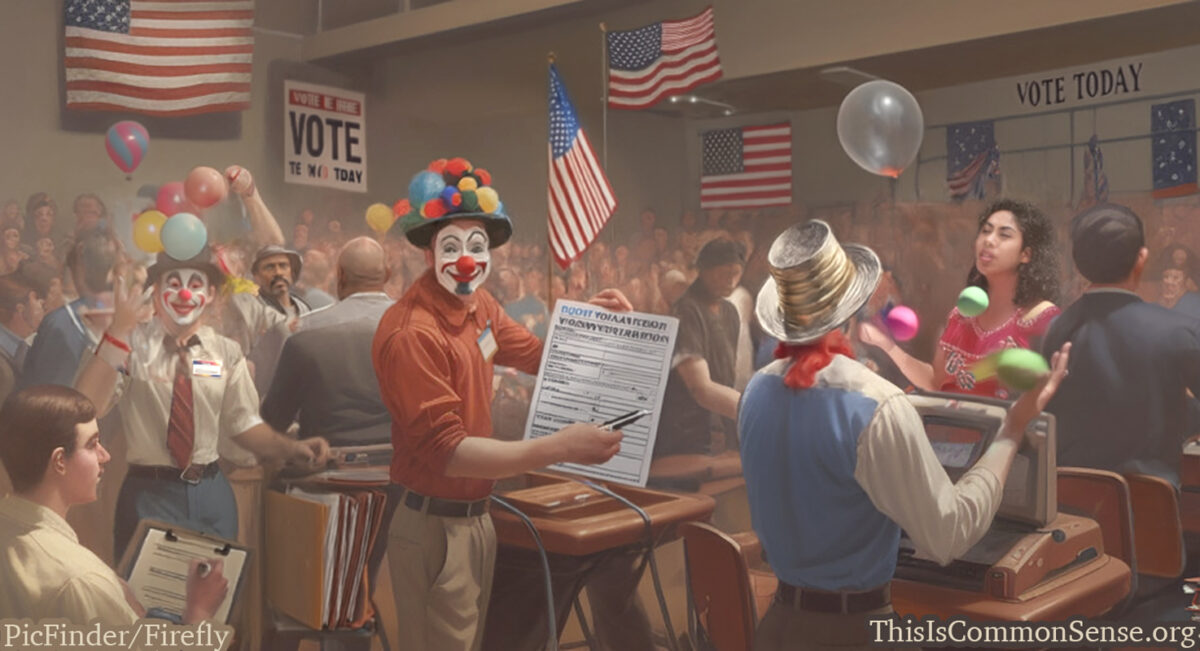
Jugglers & Clowns

“Shall the City of Santa Ana City Charter be amended to allow . . . noncitizen City residents, including those who are taxpayers and parents, to vote in all City of Santa Ana municipal elections?”

In November, this question about voting will be presented to voters. 

It is true that noncitizens in the city include both “taxpayers and parents,” of course. Still, by this same logic, why not change the ballot language to read “including the childless and the destitute”? Those noncitizens would also get to vote. 

Or get away from one’s tax status and childbirth proclivities altogether and change the wording to “including those who speak French and drink coffee.” Or maybe voters could be made aware that noncitizens will include “shopaholics and known thespians.”

All these statements are the truth and nothing but the truth. How could anyone object?

But object they did. Opponents of the measure filed suit, asking a California court to strike the “taxpayers and parents” wording from the ballot — as prejudicial in favor of the change.  

The court agreed, ordering the city to remove that language “sugarcoating” the proposition. 

But the city refuses (I didn’t know cities could tell courts No!*) and is keeping its current biased language to push a Yes vote on the proposition. 

Rule of law be damned.

My last suggestion to Santa Ana officials is to edit the wording after noncitizens to say, “including jugglers and clowns.” No, wait — that particular identification might be confusing, since it applies far less to noncitizens than to Santa Ana’s city council.

This is Common Sense. I’m Paul Jacob. 


* Unusual, indeed, for a local government to ignore a court order. It likely means the proposition, even if passed, will ultimately be blocked in court as improperly enacted. 

PDF for printing

Illustration created with PicFinder and Firefly

See all recent commentary
(simplified and organized)
See recent popular posts

Categories
initiative, referendum, and recall judiciary term limits

A Second Life for Limits

Will the Supreme Court let states impose limits on the representatives and senators they send to Washington, D.C.?

Thanks to events in North Dakota, there’s a good chance this question is about to asked again

And get a different answer.

The first time was thirty years ago. The case: U.S. Term Limits v. Thornton.

In May 1995, the U.S. Supreme Court held, in a 5-4 decision, that states cannot impose restrictions like term limits on their congressional delegations.

But: “Nothing in the Constitution deprives the people of each State of the power to prescribe eligibility requirements for the candidates who seek to represent them in Congress,” observed Justice Clarence Thomas in his dissent. “And where the Constitution is silent, it raises no bar to action by the States or the people.”

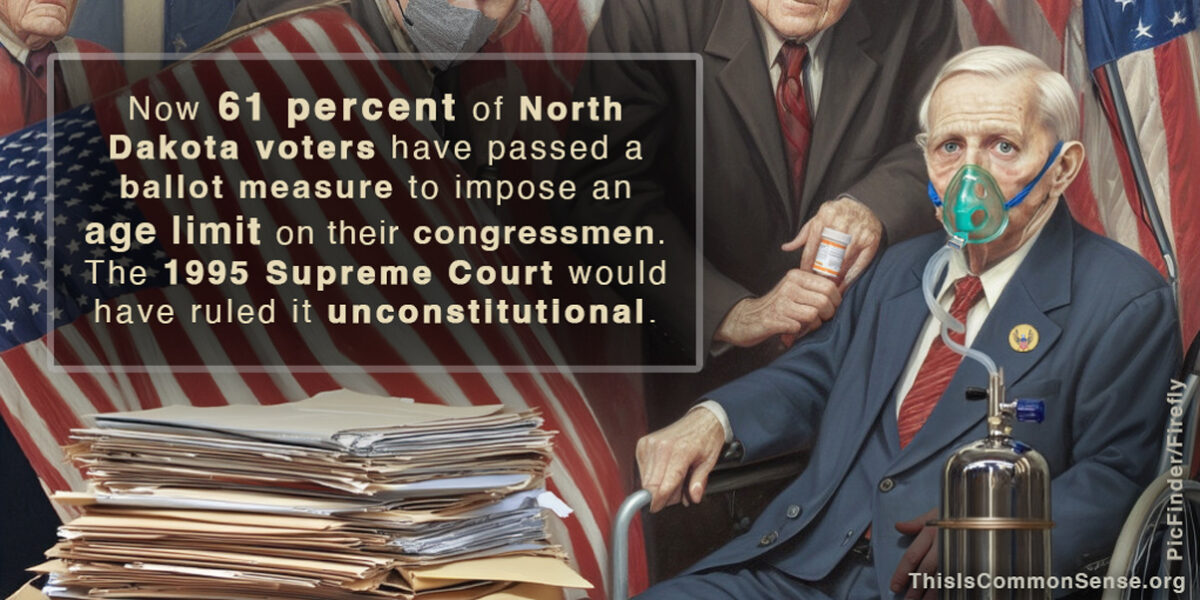
Now 61 percent of North Dakota voters have passed a ballot measure to impose an age limit on their congressmen. The 1995 Supreme Court would have ruled it unconstitutional. The only justice serving on the high court then who is still there is Thomas.

Everybody thinks that North Dakota’s outlawing of ancient candidates will be challenged in court. In a June 17 podcast for U.S. Term Limits, its president, Philip Blumel, says that USTL would welcome such a challenge.

“Surely, U.S. Term Limits versus Thornton would be the basis” for the challenge and would thus “provide an opportunity for the U.S. Supreme Court to revisit the issue.”

Moreover, a case brought in federal court won’t necessarily take years to decide, because “sometimes the [Supreme Court] expedites election-related cases.”

Fingers crossed, everybody.

This is Common Sense. I’m Paul Jacob.


NOTE: Paul Jacob is a former president of U.S. Term Limits and continues to serve on its board of directors. Paul is currently the president of Liberty Initiative Fund, which made significant contributions to North Dakota’s age limits initiative.

PDF for printing

Illustration created with PicFinder and Firefly

See all recent commentary
(simplified and organized)
See recent popular posts
Categories
ballot access election law judiciary

A Done Decision

We probably needn’t feel suspense about whether the Wisconsin Supreme Court will let certain sloppy voting practices continue.

The Wisconsin Institute for Law and Liberty and the chairman of the Racine County Republican Party filed a lawsuit alleging that Racine city officials illegally used a van to collect absentee ballots in 2022. A circuit court ruled that such mobile voting sites violate state law.

Now, “without allowing any lower appellate courts to rule first,” the state’s supreme court will decide whether the circuit court is right about that.

The high court voted 4 to 3 to accept the case. The three justices who opposed end-running the appellate courts are conservative (read: Republican); the other four are liberal (read: Democrat).

The Democrat justices voted to take the case at the request of the Democratic National Committee, which leads a political party known to be a proponent of slapdash voting procedures, slapdashery that observers tend to agree favors Democrats.

Chief Justice Annette Ziegler, who is part of the conservative bloc, has stated that the “liberal” justices proceeded in this way in order to help the Democrats politically. Ziegler knows her “liberal” colleagues, and I guess they must be the sort of progressives who don’t make conscientious adherence to the law in the service of election integrity a top priority.

So I think what’s about to happen is more of a foregone conclusion than it is a cliffhanger.

We know how the court will decide — but wouldn’t we love a surprise ending?

This is Common Sense. I’m Paul Jacob.


PDF for printing

Illustration created with Midjourney

See all recent commentary
(simplified and organized)
See recent popular posts
Categories
ballot access insider corruption partisanship

Words for Jersey Insiders

Effrontery. Chutzpah. Impudence.

I’m of course talking about partisan politics.

The case at hand is covered by Matthew Petti at Reason, “Are New Jersey Voters Too Dumb for Normal Ballots?” In this April 3rd report, Petti explains that a “federal judge has ordered Democrats in New Jersey to draw up ballots fairly instead of putting their favorite candidates at the front. But state Democratic bosses think that voters can’t be trusted to figure out how to think for themselves.”

This is a dispute about ballot design. Remember the notorious “butterfly” ballots that so confused Palm Beach County, Florida voters in 2000? You know, even Pat Buchanan acknowledged that thousands in the liberal county voted for him by mistake. 

Well, this is similar, though here the case is not so much a confusing ballot but a simple ballot with favored candidates getting the easiest-to-spot slots. “All but two of the state’s counties endorse candidates for the primary and then place their endorsed candidates all in one line,” explains NPR’s Nancy Solomon. “It’s called the ‘county line’ or ‘the party line’ and it includes candidates for various positions. . . . The other candidates for the same seat are placed in what’s known as ballot Siberia – way off to the right on the ballot and all alone.”

But when the party machine tried to replace the serially indicted Senator Bob Menendez with the governor’s wife, a challenger complained. And sued. And won.

County clerks are appealing the decision — but the court still requires them to design a new ballot.

“New” . . . meaning like ballots nearly everywhere.

This is Common Sense. I’m Paul Jacob.


PDF for printing

Illustration created with PicFinder and Firefly

See all recent commentary
(simplified and organized)
See recent popular posts

Categories
ballot access national politics & policies political challengers

The “We the People” Party Pooper

The only substantial challenger to the two parties, this presidential campaign season, has been Robert F. Kennedy, Jr. 

The son of a presidential primary frontrunner in 1968, and nephew of the 35th President of the United States — both assassinated — has been an environmental litigator and vaccine skeptic for years, and, unlike Presidents Biden and Trump, has publicly and fundamentally criticized the handling of the recent pandemic.

Though a Democrat for years, he was marginalized by the Democratic Party — an efficient machine for an astoundingly monolithic power center — and last October decided not to run as a Democrat. 

So he’s gathering signatures, creating parties, all sorts of schemes to make good on his promise of being on the ballot in every state of the union.

As Ron Paul’s last-minute ballot access coordinator in 1988, I know how difficult that is. The two parties have only continued to tighten their grip on American election “rules.” If you were wondering why Bobby Kennedy made his Veep choice so early and picked wealthy Silicon Valley lawyer Nicole Shanahan, the reason is that many states require a Vice Presidential running mate to be on the petition before signatures are gathered.

RFK, Jr., was forced to jump the gun. Plus, now a candidate, there are no campaign finance limitations on Shanahan putting her personal wealth into the effort. 

Interestingly, RFK has formed a “national” political party, the “We the People Party,” which has established footholds in California, Delaware, Hawaii, Mississippi, and North Carolina. He has also formed The Texas Independent Party and is on the ballot as an Independent in Hawaii, Nevada, New Hampshire, and Utah.

While in recent years there has been tremendous focus on how people vote, look at all the hurdles and walls still facing the who, if that candidate exists outside the major-party duopoly, a victim of all its silly, anti-democratic laws.

Maybe that’s one way Kennedy’s campaign can “do good,” by highlighting an issue neither party cares about: free and fair elections.

This is Common Sense. I’m Paul Jacob.


PDF for printing

Illustration created with PicFinder and Firefly

See all recent commentary
(simplified and organized)
See recent popular posts

Categories
ballot access election law

More Is Less

Jose Barrios was “quite happy to hear we’re going to have more democracy, not less in the District of Columbia.”

Barrios, the president of D.C. Latino Caucus, was reacting to a federal judge’s ruling to toss out the legal challenge, brought by several city voters, to the D.C. Noncitizen Voting Act.

That underlying law, passed by the DC City Council in 2022, certainly puts the “more” into democracy, allowing anyone residing in our nation’s capital for 30 days, even if in the country illegally, to legally vote for mayor, city council and local ballot measures. 

And I do mean “anyone.” China’s ambassador to the U.S. and other Chinese nationals working at their embassy are today eligible voters in Washington. Same for the FSB agents and other Russian nationals working out of their embassy. 

Federal Judge Amy Berman Jackson dismissed the lawsuit on the grounds that plaintiffs “were simply raising a generalized grievance.” She elaborated: “They may object as a matter of policy to the fact that immigrants get to vote at all, but their votes will not receive less weight or be treated differently than noncitizens’ votes.”

I object to her poor choice of terms. “Immigrants” have been voting in this country for the last century and hopefully always will: By becoming citizens. 

The judge’s ruling also highlights that who votes is a pretty fundamental constitutional question, one that voters should decide. 

Yesterday, Idaho’s legislature voted to place a Citizen Only Voting Amendment on this November’s ballot — joining Wisconsin, Iowa, and Kentucky, which have similar amendments on the ballot. 

Certainly, yes, bestowing the vote on foreign citizens residing in the city for 30 days is an expansion of democracy. But sometimes more is less.

So, let’s ask voters.

This is Common Sense. I’m Paul Jacob. 


PDF for printing

Illustration created with PicFinder and Firefly

See all recent commentary
(simplified and organized)
See recent popular posts

Categories
ballot access election law ideological culture

The Colorado Gambit Crushed

The Supreme Court unanimously nixed the clever scheme to keep Donald Trump off the Colorado ballot. The court explained its actions in the second paragraph of its anonymously written March 4th ruling: “Because the Constitution makes Congress, rather than the States, responsible for enforcing Section 3 against federal officeholders and candidates, we reverse.”

That’s it. The 14th Amendment, which the Colorado gambit relied upon, does make Congress the instrument for preventing “an insurrectionist” from serving in office.

So Colorado’s ploy to rig the 2024 election out in the open has been stopped. And good thing, too, since the political repercussions could have been . . . harrowing. 

A lot of commentary and reporting on the ruling has been devoted to pushing what was not covered. Take the CNN article by John Fritz and Marshall Cohen, “Trump’s on the ballot, but the Supreme Court left key constitutional questions unanswered.” It is hard not to interpret such headlines as providing excuses to partisan Democrats — in this case those at CNN — who had put so much hope in Colorado’s (and other states’) taking of the Trump matter into their own hands. 

“But while the unsigned, 13-page opinion the Supreme Court handed down Monday decisively resolved the uncertainty around Trump’s eligibility for a second term,” the article explains, “it left unsettled questions that could some day boomerang back to the justices.”

True enough, but so what? Take the first mentioned: “Could Democratic lawmakers, for instance, disqualify Trump next January when the electoral votes are counted if he wins the November election?”

Well, no. 

The 14th’s third section does not list presidents as barred by insurrection: “No person shall be a Senator or Representative in Congress, or elector of President and Vice-President,” it says. Electors of. But not the President and VP.

I’m sure the Supreme Court would be happy to expedite an opinion to that effect should the Democrats attempt anything that stupid.

This is Common Sense. I’m Paul Jacob.


PDF for printing

Illustration created with PicFinder and Firefly

See all recent commentary
(simplified and organized)
See recent popular posts

Categories
folly political challengers

Pied Pipers, Again

In 2015, the Hillary Clinton campaign exhibited the hubris for which politicians have been associated since the dawn of civilization. 

Instead of relying on a strategy of promoting Hillary herself, Clinton insiders plied what they called “Pied Piper candidates,” Republican hopefuls who, they theorized, would shift mainstream candidates further “right,” thus making the ultimate winners unpalatable to enough general election voters to win Hillary the election. There were three they identified: Ted Cruz, Ben Carson, and Donald Trump. 

We know how this worked out.

In California, Democrats are returning to hubristic form.

The serpentine Adam Schiff, who is running to fill the slot formerly occupied by Senator Diane Feinstein, has directed $11 million in the primary “to elevate a GOP candidate,” according to The Washington Post

“The ads argue that Republican Steve Garvey — a congenial former pro baseball player for the Los Angeles Dodgers and San Diego Padres who voted twice for Donald Trump but won’t say if he will do so again — is too conservative for California and highlight his recent surge, in an apparent effort to consolidate support for him on the right.”

The idea is to boost Garvey with Republican primary voters in hopes that Garvey takes the second of two spots available for the November election under California’s Top Two system, becauseSchiff’s people think Garveyis easier to defeat than liberal Democrat “Rep. Katie Porter, whom Schiff and his backers would prefer to avoid facing come November in this left-leaning state.”

But can this strategy really work in California? The ads portray Garvey as more Trumpian than he probably is, and recent polling suggests that Schiff and Garvey are now neck-and-neck.

A review of the Clinton metaphor, “Pied Piper,” shows how slippery the strategy can be. The “Pied Piper of Hamelin” is a cautionary tale

The Democrats’support may go the way of rats and children.

This is Common Sense. I’m Paul Jacob.


PDF for printing

Illustration created with PicFinder and Firefly

See all recent commentary
(simplified and organized)
See recent popular posts

Categories
ballot access election law partisanship political challengers

Parties Demoted

Though “[s]everal left-leaning groups have sued to block the former president from the state’s ballot on 14th Amendment grounds,” Tom Ozimek of The Epoch Times reported in November, “Trump Listed on Michigan Primary Ballot,” as the headline states.

The primary was yesterday. Trump won. As expected.

But he appeared on the primary ballot only with legal wrangling. Michigan Secretary of State Jocelyn Benson, a Democrat, was under a lot of pressure to keep Trump off the ballot. Which she resisted, explicitly stating that she thought the maneuver to allow state officials to prohibit Trump from appearing on ballots because of the 14th Amendment’s “insurrection” clause was a bad idea.

Michigan’s voting system is now quite complicated. First, it’s an open primary state, so there will always be strategic voting, where partisans will cross lines to sabotage opponent parties. Though in the case of Trump, there is some irony here, since Trump benefitted in 2016 from such voting by Democrats, thinking he was the candidate easiest to beat in the general election.

Michigan sports a hybrid system for selecting partisan candidates to appear on the general election ballot. “More of Michigan’s 55 delegates to the Republican National Convention (RNC) will be awarded,” explains Nathan Worcester, also of The Epoch Times, “through the caucus process than through the primary vote — 39 as opposed to just 16.” But there are dueling conventions for caucusing, and it’s quite a mess.*

Michigan also now offers early voting at special voting sites. Is it a sign of a healthy democracy that there are so many ways to vote?

It sure doesn’t seem healthy that national partisan politics almost kept a Republican candidate off a primary ballot. Could the solution be to take parties’ candidate selection entirely out of state balloting?

Demote major parties from their current favored position to paying their own way.

This is Common Sense. I’m Paul Jacob.


* In the Democratic Primary, President Biden won big against Dean Phillips, a largely unknown congressman from Minnesota, and author Marianne Williamson. But, with roughly half the vote counted, a not insignificant 14 percent of Democrats snubbed the president (and the field) by voting “Uncommitted.” Many were no doubt protesting the president’s policies concerning the Israel-Hamas War; in the county containing the University of Michigan, 20 percent voted uncommitted. Yet, even in rural counties across Michigan, more than 10 percent of Democrats opted for uncommitted.

PDF for printing

Illustration created with PicFinder and Firefly

See all recent commentary
(simplified and organized)
See recent popular posts