Categories
ideological culture media and media people Popular

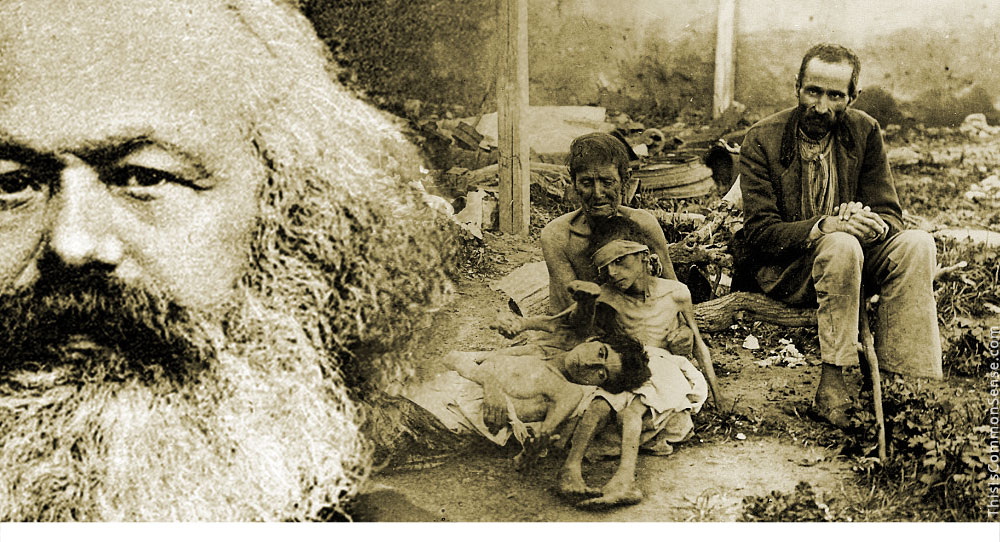
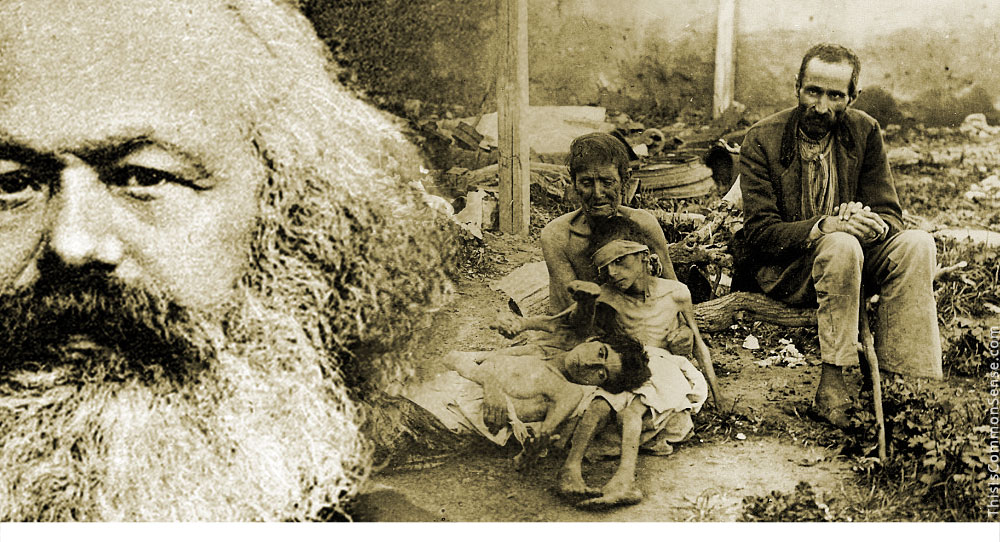
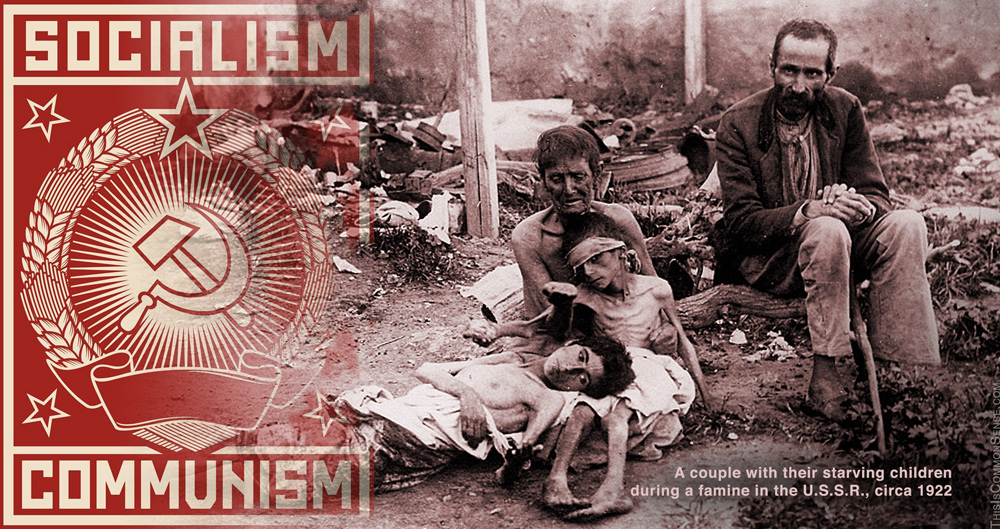
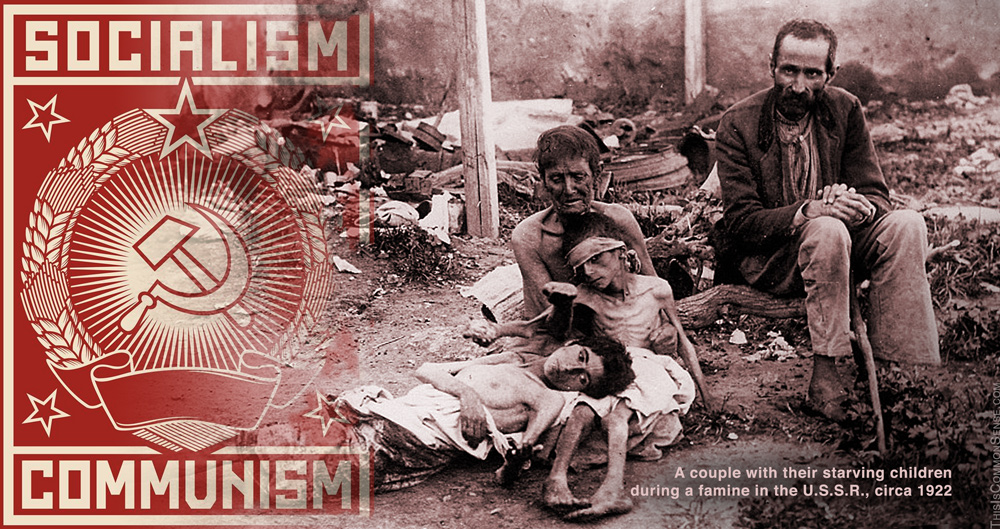
Gray Lady Commies

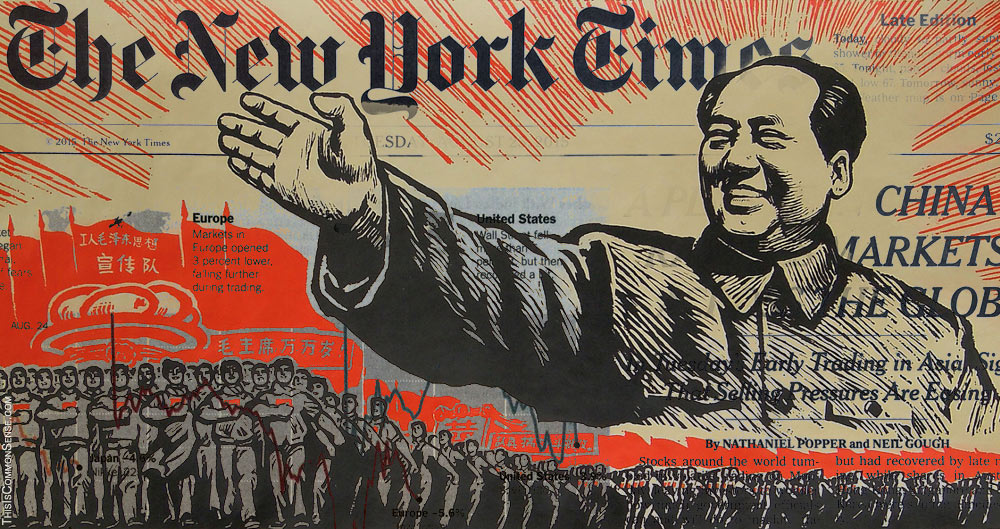
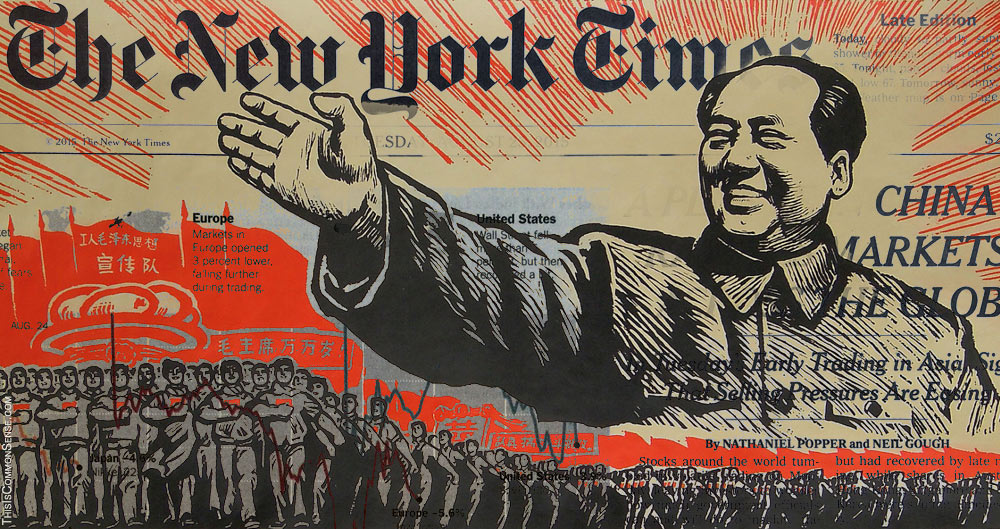
The New York Times has long leaned left. But is it really a stable Pisa-tower lean, at this point? It sure seems that, in recent years, the Gray Lady has gone extreme, abandoning its “respectable” center-left perch. 

The change, economist Alex Tabarrok writes for FEE, appears to have happened “around 2010-2014,” when we can see “an inflection point” where phrases and buzzwords like “social justice” and “diversity and inclusion” increased in number in Times editorials and news stories.

Forget, for a moment, the why — is it demand side, with the paper trying to court Millennial readers; or supply side, a result of new hires out of journalism programs and other indoctrination factories; or a mixture of both? — and concern ourselves with how far will the Gray Lady go?

Communism, apparently.

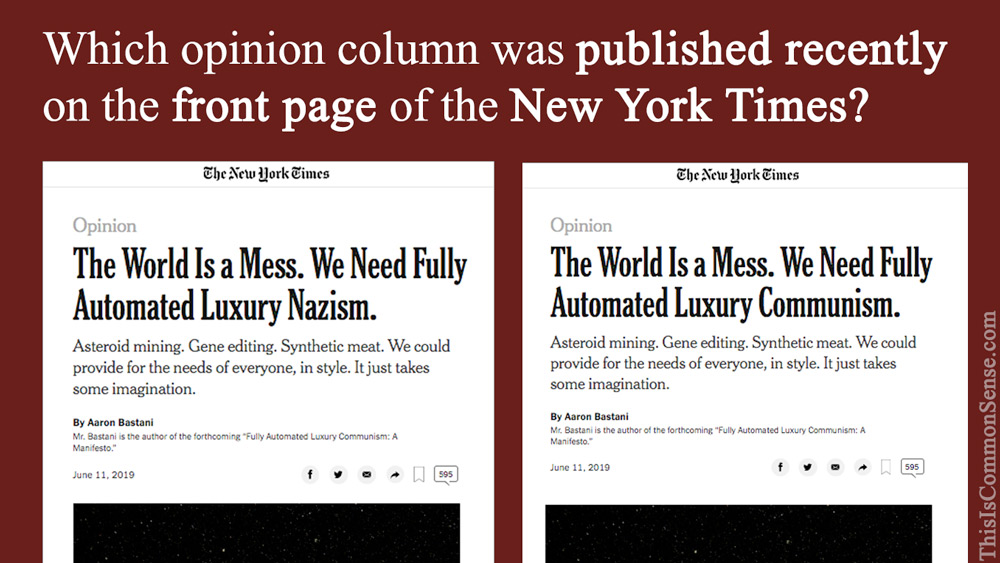
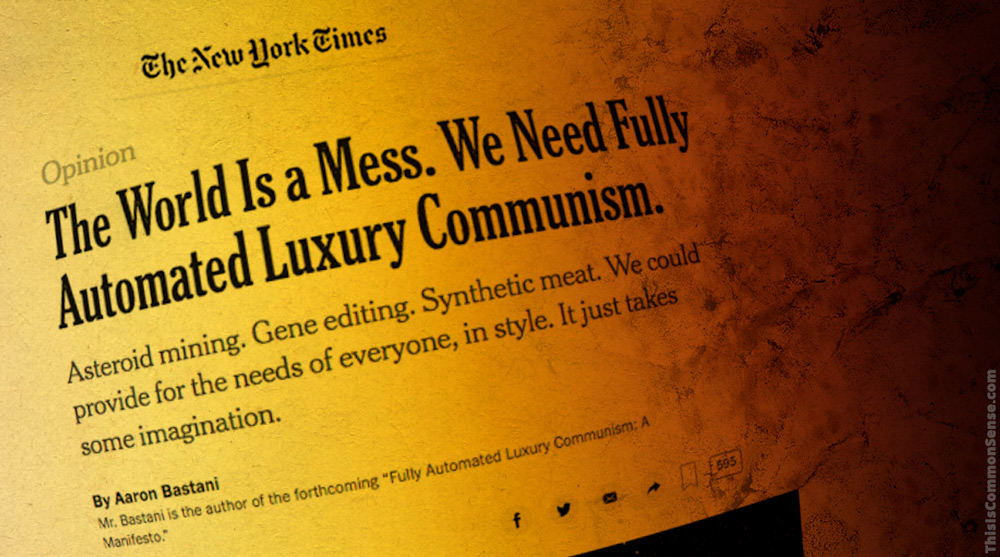
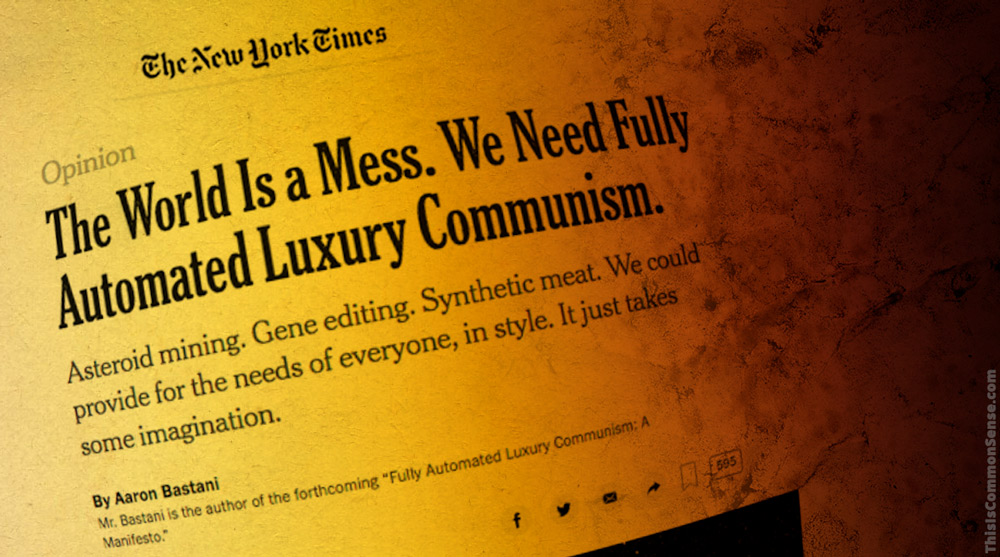
Or, at least, “Automated Luxury Communism,” as identified in what may be the stupidest article to appear in any newspaper in years.

“The plummeting cost of information and advances in technology are providing the ground for a collective future of freedom and luxury for all,” the author asserts, upon the evidence of innovations he has identified as arising . . . in our capitalist mixed economy, chiefly in the market sector: lab-grown burgers and “molecular whiskey.”

It all smacks of a loafer’s Marxism, with robots and AI as the proles. I could explain this better had the author bothered to do any real work on his vision, but, unfortunately (?), he offers nothing but a “wouldn’t it be neat if” blog post. 

That the Times’ placed on its front page.

I guess since Democratic pols are now calling themselves socialists, their lead thought organ must seize the advance guard position by going full commie.

This is Common Sense. I’m Paul Jacob.


PDF for printing

New York Times, communism, socialism, journalism, pandering, newspaper,

See all recent commentary
(simplified and organized)
See recent popular posts

Categories
folly ideological culture moral hazard

Mass Murderers Are Cool?

If you have a lick of sense, you wouldn’t emblazon images of Ché Guevara on your chest or your wall — and yet Ché t-shirts and posters have been a pop culture hit for decades now.

He is cool, we are told, because he was ¡Viva la Revolución! and all that.

But it could get worse. You could be emblazoning a hammer and sickle.

Walmart’s website is there to help. Under “men’s sleeveless,” for example, we see an artistic rendering of the old Communist symbol, frankly identified as a “Soviet Hammer and Sickle,” white on black for $14.97.* Walmart files it under “Pop culture.”

Aren’t men’s sleeveless shirts called “wife beaters”? Should we now call them Kulak Killers?

It’s hip to murder millions!

No wonder Lithuania and several other Baltic countries — who suffered greatly under Soviet rule — object. Indeed, many of these countries go too far in actually banning the symbols. Now, they have contacted Walmart requesting a cessation in hawking the offensive merchandise. “You wouldn’t buy Nazi-themed clothing, would you?” Lithuania’s foreign minister Linas Linkevicius tweeted. Or sell such items.

But a few people might. Certainly, a lot of people do buy stuff that others regard as “Nazi.” Sometimes to be “cool”; other times to make a controversial political point.

At the Uhuru Store, Gavin McInnes’s “ProudBoys Official” sells a “Pinochet Did Nothing Wrong” t-shirt for twice the price of Walmart’s Hammer and Sickle shirt — and that surely has annoyed leftists who have seen it.

I’m waiting for the death of cool.

This is Common Sense. I’m Paul Jacob.


* The shirts also come in Navy, Royal and Gray. I guess to get a red commie shirt you have to go for the sleeves.

PDF for printing


Categories
Accountability folly general freedom ideological culture moral hazard responsibility U.S. Constitution

China Marks Marx Anniversary

The Chinese government has sought to honor the birth of Karl Marx (1818-1883) by giving a giant bronze statue of the social philosopher and pseudo-economist to the German city of Trier, his birthplace.

Agreeing that Trier and Marx should be thus honored, local officials shamefully accepted the donation.

Marx was a bad guy. His willfully destructive anti-capitalist theorizing and polemics have been enlisted to enslave and murder many millions of people in the Soviet Union, China, Cambodia, Cuba and elsewhere. The story is told in works like Modern Times and The Black Book of Communism. One effective critique of Marxian ideas may be found in the second volume of Murray Rothbard’s History of Economic Thought.

We often hear that Communist implementation of Marxian theory poorly translates “real” communism/socialism/collectivism. No government unswervingly enacts all the ideas and prescriptions of a single intellectual founding father. But there is much in Marx’s volumes that openly demands the razing of the division of labor, profit-seeking, and other requirements of civilization.

In one article, Marx scribbled that “there is only one way in which the murderous death agonies of the old society and the bloody birth throes of the new society can be shortened, simplified and concentrated, and that way is revolutionary terror.” There’s plenty more where this came from.

When a major nation-state gives a town a statue, it’s hard to say no. But one needn’t accept it at face value. Install it on a base that lists the separate bouts of Marx-inspired mass murder. Or use it as a target in paintball tournaments.

Or just place it in the local cemetery. Where deadly ideologies should go.   

This is Common Sense. I’m Paul Jacob.


PDF for printing


Categories
general freedom ideological culture media and media people moral hazard

The Cuban Slavery-and-Freedom Sandwich

How easy is it to mix freedom with just the right amount of slavery?

New York Times reporter Azam Ahmed regards the attempt to mingle political opposites as noble or at least understandable. He doesn’t call Cuban Communism and its destructive effects “bad” — it’s a “unique tapestry.”

He wonders, instead, to what extent the Cuban government can fine-tune the contradiction.

According to the article, Cuba’s newest Dear Leader “will have to foster the growing private sector . . . while guarding against the income inequality it often brings. . . . Move too slowly and it risks economic collapse and widespread discontent. . . . Move too fast, and it risks unstitching the unique tapestry of Cuba’s social project.”

“Unique”? With or without cigars and salsa, the “social project” of repressing a hapless populace is as old as civilization. And as a “tapestry,” we’ve seen this warp and weft before.

Under freedom, inequalities are unavoidable.* On the other hand, nothing is wrong with inequality per se. Nature, human beings and economic outcomes are inherently unequal. Equality arrives only with the grave.

A government working to phase out slavery and phase in freedom may have legitimate problems in transition. But it is wrongheaded to seek just the right “balance” of both. How can any degree of freedom and markets fail to threaten a revolution, the purpose of which is a thoroughgoing assault on freedom and markets?

My advice to Cuban social engineers? Abandon Communism altogether and embrace prosperity and freedom instead.

This is Common Sense. I’m Paul Jacob.


* Speaking of inequality, Cuba’s head commies certainly have not lived like the masses they’ve kept down.


PDF for printing


Categories
Accountability general freedom ideological culture media and media people national politics & policies responsibility too much government

The Times Must Change

“Political leaders prefer to project a noble history, sometimes by turning complicity in atrocities into claims of victimhood,” the New York Times informed us last Sunday. “In Russia, Mr. Putin and many of his lieutenants came from the K.G.B. and resisted fully confronting its repressive history. And they, like many of their countrymen, prefer to portray Stalin not only as the architect of the Gulag but also as the leader who built Russia’s industrial might and led it to victory in the Great Patriotic War.”

The Gray Lady here marks the passing of Arseny Roginsky, an organizer and activist who kept alive the memory of state mass murder in his homeland. The Times quotes the late hero as insisting that common talk of “victims of repression” is nowhere near enough. The repression did not merely descend upon the people as “a plague.”

The victims were targets of “state terror.”

But there was something missing in this too-brief notice. Though the Nazis were mentioned, the Union of Soviet Socialist Republics wasn’t.

Communism was not.*

State terror did not infect its perpetrators biologically, like the world’s worst case of x-oplasmosis. It neither descended from the heavens nor ascended from the swamps. The infection was ideologicalthe result of Marxian socialism, of unworkable communism.

By not mentioning socialism or communism or even the USSR, the New York Times carries on its sad history of leftist apologetics. The case of the lying propagandist Walter Duranty — the Times’ award-winning foreign correspondent and author of Mission to Moscow — should have been the last of that.

It isn’t, apparently. The Times still protects its safe-space socialist readers.

This is Common Sense. I’m Paul Jacob.


* The omissions were also present in the Timesinitial obituary.


PDF for printing


Categories
Accountability general freedom ideological culture media and media people moral hazard national politics & policies

Not So Bad, Communism?

First the good news. The New York Times has repudiated Walter Duranty’s 1930s-era “journalism” for whitewashing — “underestimating” — the murderousness of Soviet Communism.

So that’s done, right?

Whatever its failings today, the paper will certainly no longer allow writers to use its august pages to discount blatant systematic evil.

Right?

But Helen Raleigh, a writer for The Federalist who is an immigrant from China, finds that the Times does indeed persist in glossing over the sins of Communism. In commemorating the centenary of the Bolshevik Revolution, the paper is “once again proving itself Communism’s greatest apologist” through articles variously arguing that “women had better sex under socialism to now claiming China’s Communist revolution taught Chinese women to ‘dream big’…”

As if, suggests Raleigh, Duranty’s ghost were still calling the shots.

In rebuttal, she recounts what so many people suffered under Communism, as exemplified by the fate of her Aunt San.

At age 15, her aunt was forced by Mao’s government to leave the city and work in the countryside, separately from her siblings, who were forced to do the same but in different villages. Cutting family ties was important “so people could devote themselves 100 percent to the Communist Party’s causes.”

Primitive farming, mandatory singing of gruesomely cheerful revolutionary songs, food rations, malnutrition, ritual humiliation, derailed education, derailed or extinguished lives.

Just a few of the standard ingredients of the totalitarianism that, according to the Times of 2017, taught women to “dream big.”

Which should remind us: despite only a few countries’ close ties to the doctrine — Cuba, Venezuela, North Korea — Communism’s threat to world peace, prosperity, and freedom remains big.

The Times must change.

This is Common Sense. I’m Paul Jacob.


PDF for printing


Categories
free trade & free markets general freedom ideological culture national politics & policies

Workers’ Days

Today is Labor Day. But it is worth remembering, “Labor Day” in most other countries is May 1 — also called “International Workers’ Day.”

One thing to be thankful for on our American Labor Day is that we can celebrate labor — perhaps, like me, you will celebrate it by working! — and not have it serve as a celebration of communism.

For yes, it was the socialists and communists who cooked up the original May Day labor celebration, in part to commemorate 1886’s workers’ protest gone horribly wrong, the Haymarket debacle. In the 19th century, much of the impetus for collectivism came from workers themselves, under the impression that they could do better if they rebelled and expropriated the capitalists’ holdings and “worked for themselves.”

For some reason these activists rarely struck out on their own, becoming entrepreneurs.

Nowadays, alas, many top-level entrepreneurs lean toward socialism, and it is the non-government working people who resist more government, and thereby the socialist program. Indeed, the most enthusiastic clade of socialists in America today seem to be in the ranks of the unemployed.*

Oregon was the first of these United States to make an early September celebration an official Labor holiday, in 1887. Seven years later, the federal government got on board. President Grover Cleveland signed it into law soon after the disastrous Pullman strike, to promote a more rule-of-law friendly celebration of workers, and avoid thinking about rioting and murder and police violence.

So, even folks like me, who labor in the vineyards of the people’s politics while still supporting private property and freedom of contract, can celebrate.

Or take a last summer nap.

Without any communists hiding under the hammock.

This is Common Sense. I’m Paul Jacob.


* In less than two centuries, socialism went from proletarian to Lumpenproletarian. Karl Marx? Rolling over in his grave.


PDF for printing


Categories
Accountability general freedom ideological culture media and media people nannyism Regulating Protest responsibility too much government

Tyranny’s Days Are Numbered

Fidel Castro, the Cuban dictator for half a century, died Friday night.

“Although Castro was beloved by a legion of followers,” The Washington Post acknowledged, “detractors saw him as a repressive leader who turned Cuba into a de facto gulag.”

Many on the American left — especially in Hollywood — have been surprisingly enamored of Castro, and the supposed “accomplishments” of better education and healthcare delivery in his socialist paradise.

I guess we must all weigh whatever policy advances were made against Mr. Castro’s faults.

As the New York Times detailed: “Foreign-born priests were exiled, and local clergy were harassed so much that many closed their churches. . . . a sinister system of local Committees for the Defense of the Revolution that set neighbors to informing on neighbors. Thousands of dissidents and homosexuals were rounded up and sentenced to either prison or forced labor. . . . jailing anyone who dared to call for free elections. . . . imprisoning or harassing Cuban reporters and editors.”

Fidel Castro’s death reminds me of Irving Berlin’s jazz tune about Adolf Hitler, When That Man is Dead and Gone:

What a day to wake up on

What a way to greet the dawn

Some fine day the news’ll flash

Satan with a small mustache

Is asleep beneath the lawn

When that man is dead and gone

Saturday morning, that news finally flashed for Cuban Americans in south Florida. Followed by jubilation. Horns honking. Smiles, cheers and songs. Jigs were danced.

Fidel Alejandro Castro Ruz — that dictator, the person who imprisoned and murdered many seeking freedom — is dead and gone.

For now, sadly, his brand of tyranny continues through brother, Raúl Castro. But its days, too, are numbered.

This is Common Sense. I’m Paul Jacob.


Printable PDF

Castro, death, Cuba, Communism, freedom, illustration


Categories
Accountability folly free trade & free markets general freedom moral hazard nannyism national politics & policies

Thanksgivings, 1623 AD

The Pilgrims we were taught about in school deserve a Paul Harveyesque “Rest of the Story” treatment. Most students were not told about how they tried communism before they wised up, though I actually had a teacher who made a point of it.

Yes, initially, the “community” owned everything, and all worked together for the greater good and the Glory of God.

Of course, it was a disaster.

The commune plan sparked sloth, shirking, family quarrels and resentment — with men regarding their wives’ work for others a “kind of slavery.”

And then near-starvation.

The solution? Privatize! They allotted land, setting “corne every man for his owne perticuler.”*

That worked well, but they still had to endure a late Spring drought, and things looked bleak. Then, after prayers and expressions of humility (as Governor William Bradford explained**), the rain returned:

It came, without either wind, or thunder, or any violence, and by degreese in yt abundance, as that ye earth was thorowly wete and soked therwith. Which did so apparently revive & quicken ye decayed corne & other fruits, as was wonderfull to see, and made ye Indeans astonished to behold; and afterwards the Lord sent them shuch seasonable showers, with enterchange of faire warme weather, as, through his blessing, caused a fruitfull & liberall harvest, to their no small comforte and rejoycing. For which mercie (in time conveniente) they also sett aparte a day of thanksgiveing.

So the most obvious political lesson to be drawn from the Pilgrim experience got lost in stories of rain and corn and Indians and such.

But it’s worth noting that Bradford wrote his discussions of communism — and how very wrong Plato and his ilk were — in his primary text, while his talk of the drought was an afterthought in his mss., and appears as a footnote in the edition I’ve consulted.

Both*** Plymouth stories deserve to be told.

This is Common Sense. I’m Paul Jacob.


*I wrote about this a few years ago, offering some of the juiciest quotations, in “Plymouth’s Great Reform.”

** Bradford’s History of Plimoth Plantation, available for free at Gutenberg.org.

***The traditional date for the first Thanksgiving is given a few years earlier, with Squanto showing up and helping them plant and all. However, Bradford’s memoirs do not use the term thanksgiving (or “thanks-giveing”) or even “thanks” in relation to the harvests of 1621 at Plymouth Colony. But there is talk of plenty of food, including that Thanksgiving specialty, the turkey:

And now begane to come in store of foule, as winter aproached, of which this place did abound when they came first (but afterward decreased by degrees). And besids water foule, ther was great store of wild Turkies, of which they tooke many, besids venison, &c. Besids they had aboute a peck a meale a weeke to a person, or now since harvest, Indean corne to yt proportion. Which made many afterwards write so largly of their plenty hear to their freinds in England, which were not fained, but true reports.


PDF for printing

pilgrims, socialism, communism, thanksgiving, sharing, shirking, illustration


Categories
folly general freedom ideological culture too much government

Discreditable Credit

Capitalism can be rigged a hundred different ways, apparently. China’s is run by its Communist Party, and even current innovations bear the stamp of the Party.

Take “social credit.”

Not the quaint decentralist economic reform movement that was a minor deal in politics on the West Coast of the U.S. and Canada 60 or more years ago.

What I’m referring to is the innovative credit scoring system devised by a gaming company in cooperation with China’s commie-run government.

But it’s not quite like the credit scoring systems set up by competing companies in the U.S., which cook up “credit scores” based on going into debt and paying off debt. If you pay your bills, you get a higher score. If you don’t, it plummets.

The new “Sesame” credit scoring system is less interested in the debts you pay off and more in what you buy and what you put up on social media. The company has concocted a secret algorithm, and gives higher scores to good citizens — obedient people — and lower scores to lazy people (inferred from, say, if you play a lot of video games) or to folks who are rebellious free thinkers (posting pictures of Tank Man in Tiananmen Square, for example).

That is what it seems like, so far.

It rewards those Chinese who are industrious (yay?) and who kowtow to Communist Party expectations (yikes!) — and makes me extra glad I live in the U.S., where government is too chaotic and stupid to cook up anything quite this insidious.

This is Common Sense. I’m Paul Jacob.


Printable PDF

China Credit System, Sesame, China, Credit Rating, Common Sense