
Categories
First Amendment rights

A Finn Reviled, and Worse

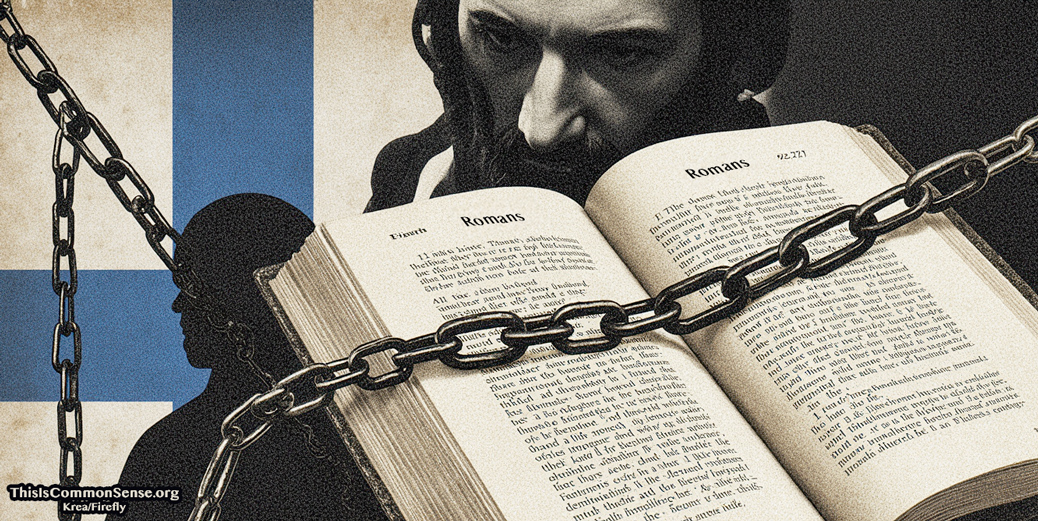
Päivi Räsänen cited the Bible’s characterization of homosexuality, about men inflamed by “shameful lusts” (Romans 1:24-27). That’s why Finland is prosecuting her.

The effort continues even though the former minister of interior has been acquitted, twice, by lower courts.

Originally, Räsänen’s prosecutors cited three proofs of heresy. A post that she published in 2019, comments made during a radio interview, and her 2004 pamphlet “Male and Female He Created Them: Homosexual relationships challenge the Christian concept of humanity.” The radio “evidence” has been dropped from the case.

You may wonder why Finland’s prosecutors are dredging up religious expression from 2004 in order to pursue its bogus prosecution for a 2019 speech-“crime.” The pamphlet’s publisher, also being prosecuted, probably also wonders. I’m not sure, but my theory is that the prosecutors are jackasses. (The preceding sentence isn’t hate speech, just reasonable-postulate speech.)

The U.S. Bureau of Democracy, Human Rights, and Labor, part of the State Department, has taken up her cause, saying that “no one should face trial for peacefully sharing their beliefs” and that the case against Räsänen “for simply posting a Bible verse is baseless.” Then the Bureau also quotes the Bible, Matthew 5:11: “Blessed are you when others revile you and persecute you and utter all kinds of evil against you falsely on my account.”

Räsänen has expressed her gratitude and the hope that “justice will prevail not only for me, but for the wider principle of free speech in Finland.”

Americans should be looking in alarm at governmental attacks on freedom across the globe. As well as here at home.

This is Common Sense. I’m Paul Jacob.


PDF for printing

Illustration created with Krea and Firefly

See all recent commentary
(simplified and organized)
See recent popular posts

Categories
election law

Over-Regulated or Regulations Over?

Critiques of campaign finance regulations (CFR) often focus on particularly egregious applications or expansions of the regulations.

That’s fine. When somebody who is hammering us on the head starts hammering even harder, it’s okay to object. 

We should make clear, though, that we object to being head-bashed at all, not just the latest intensification.

In an amicus brief submitted to the Supreme Court National Republican Senatorial Committee v. FEC, the Institute for Free Speech and the Manhattan Institute are tackling CFR-rationalized repression of speech (CFRRS) as such.

“By conflating election campaign speech with the mechanics of running elections,” IFS says, “the Supreme Court has allowed the government to trample the First Amendment through campaign finance laws.”

This has been going on at least since the Supreme Court’s 1976 ruling in Buckley v. Valeo.

The current case, NRSC v. FEC, pertains to federal limits on coordinated spending by political parties, which is allowed in many states. IFS punches holes in the excuses for this instance of CFRRS but also stresses the bottom line.

“The brief argues that the federal government lacks the power to regulate this type of speech in the first place. . . . The Constitution grants Congress the power to regulate the times, places, and manner of electing federal officials. But . . . speech about candidates is not the same thing as the election itself, and the Elections Clause does not give Congress authority to regulate core political speech.”

Obviously. May at least five out of nine justices grasp this also.

This is Common Sense. I’m Paul Jacob.


PDF for printing

Illustration created with Krea and Firefly

See all recent commentary
(simplified and organized)
See recent popular posts

Categories
First Amendment rights international affairs social media

Germany Versus X

The question is freedom of speech. Many German officials are opposed. Twitter-X, or X, is in favor.

As Reclaim the Net summarizes the case, “German prosecutors are testing whether the reach of their censorship laws can outstrip the guardrails of international treaties.”

These prosecutors have been going after three X managers for alleged “obstruction of justice.” This obstruction consisted of refusing to immediately give prosecutors data on users who utter government-disapproved speech.

The X managers have been adhering to the provisions of a bilateral treaty, the Mutual Legal Assistance Treaty, under which the German requests are to be reviewed in U.S. legal channels before X can be forced to comply. Which increases the chances that X will not be forced to comply.

The prosecutors regard the managers’ refusals as a form of criminal interference. The legal and constitutional issues are now being battled over in German courts.

This is the German government which has been in the news for raiding the homes of people who post sentiments online of which the government disapproves.

That X is not meekly obeying orders to violate the trust of account holders and turn over their private information has upset German advocates of censorship. One MP, Anna Lührmann of the Green Party, says that X’s resistance to censorship is a “scandal” that “goes against fair competition and puts our democracy at risk.”

I don’t think, though, that democracies fail to be robust as they become more like dictatorships. Germany has it all inverted.

This is Common Sense. I’m Paul Jacob.


PDF for printing

Illustration created with Krea and Firefly

See all recent commentary
(simplified and organized)
See recent popular posts

Categories
First Amendment rights international affairs Internet controversy privacy

Apple to Keep Encryption

Thanks, United Kingdom.

Following pressure on UK officials by the Trump administration and some congressmen, British censors have caved — the U.S. Director of National Intelligence confirmed that the UK was abandoning its demand that Apple burn a hole in its iPhone encryption.

So Apple may continue providing its flagship smartphone with robust encryption. Cyberhackers and autocratic regimes (including snoopy British officials) — who’d love a crashable gate into everyone’s private iPhone information — must now endure their extreme disappointment.

Director Tulsi Gabbard reported on X that the UK will “drop its mandate for Apple to provide a ‘back door’ that would have enabled access to the protected encrypted data of American citizens and encroached on our civil liberties.”

Such a back door would have rendered the encryption close to pointless, presenting a vulnerable target to all bad guys in addition to all “good” guys in the UK holding backdoor keys.

Under an agreement in effect since 2019, U.S. companies are obliged to comply with requests from UK officials for data relevant to criminal investigations.

The agreement prohibits surveillance of Americans. But this year British officials secretly demanded that Apple install a back door to enable the UK government to extract data from any iPhone. Yes, that’s any iPhone anywhere in the world. 

The British Government also planned to initiate these back-door intrusions without even needing to show relevance to a UK criminal investigation, let alone provide a warrant.

How long will the reprieve last? Maybe only until we get another U.S. administration as eager to censor everything as the last one was.

This is Common Sense. I’m Paul Jacob.


PDF for printing

Illustration created with Krea and Firefly

See all recent commentary
(simplified and organized)
See recent popular posts

Categories
First Amendment rights free trade & free markets national politics & policies regulation

Banks Not the Only Debankers

A recent executive order that President Trump issued to stop regulators from abetting and even compelling the “debanking” of bank customers for their political views is clear and on-target.  

On-target as far as debanking by banks goes.

But Reclaim the Net notes a glaring omission. The order’s identifies financial institutions willing to blacklist customers for possessing the “wrong” political opinions or missions. (“Wrong” here means not too pro-criminal or pro-terrorist but too constitutionalist, too much in favor of individual rights of the First or Second Amendment variety.)

The problem is that the order says nothing about major payment processors like Visa and PayPal.

Now, perhaps a penumbra of the new regulatory marching orders would influence the policies of the credit-card companies, whose cards are after all typically issued in cooperation with banks. But this is highly uncertain.

And Reclaim the Net thinks that Visa and Mastercard, “the twin tollbooth operators of the global payments highway,” are, like PayPal and Stripe, untouched by Trump’s order. Yet all of these payment processors have in recent years been blacklisting individuals and organizations that the processors happen to disagree with.

The practice goes back at least to the Obama administration, which instructed regulators that it could regard something called “negative public opinion” as a legitimate risk factor. 

This doctrine “quickly turned into a permission slip for politically driven account closures.” 

The government shouldn’t be issuing such “permission slips” — or implicit instructions — to banks, payment processors, or anybody.

This is Common Sense. I’m Paul Jacob.


PDF for printing

Illustration created with Krea and Firefly

See all recent commentary
(simplified and organized)
See recent popular posts

Categories
free trade & free markets regulation

Debanking Disallowed

President Trump has issued an executive order telling banking regulators to cut it out already.

The order, “Guaranteeing Fair Banking for All Americans,” takes aim at Biden-era regulations that pushed banks to “debank” clients who had the “wrong” political viewpoints: supporters of the First Amendment, the Second Amendment, or whatever aspect of individual rights and freedom the Biden administration was most insistently opposed to.

One key passage requires regulators to “remove the use of reputation risk or equivalent concepts that could result in politicized or unlawful debanking . . . from their guidance documents, manuals, and other materials . . . used to regulate or examine financial institutions over which they have jurisdiction. . . .”

The order also takes aim at banks. It requires regulators to identify financial institutions that have engaged or still engage in “politicized or unlawful” debanking practices and “to take appropriate remedial action” against the banks, including possibly “levying fines, issuing consent decrees, or imposing other disciplinary measures.”

Overall, the order represents a welcome 180 turnabout in very recent policy. The one problem I see, though, is that no clear attempt is made to distinguish between banks that were gung ho about clobbering politically unhip account holders and those that went no further than what they were pushed by Biden regulators to do.

Of course, one could always take a stand and do the right thing despite being threatened. Like the way the debanked individuals and institutions fought for what they believed in despite the risk of being debanked.

This is Common Sense. I’m Paul Jacob.


PDF for printing

Illustration created with Krea and Firefly

See all recent commentary
(simplified and organized)
See recent popular posts
Categories
First Amendment rights international affairs Internet controversy

UK Targets Wikipedia

It would be nice if Wikipedia were suing to challenge the United Kingdom’s entire Online Safety Act, not just the provision that most directly targets Wikipedia. 

Better something than nothing, however.

As Wikipedia describes it, the Act “creates a new duty of care for online platforms, requiring them to take action against illegal content, or legal content that could be ‘harmful’ to children where children are likely to access it. Platforms failing this duty would be liable to fines of up to £18 million or 10% of their annual turnover, whichever is higher.”

The Wikipedia Foundation objects to being classified as a category 1 service under the Act, a designation that imposes digital ID requirements on its contributors.

“Privacy is central to how we keep users safe and empowered,” says Phil Bradley-Schmieg, lead counsel for the Wikipedia Foundation. “Designed for social media, this is just one of several category 1 duties that could seriously harm Wikipedia.”

“Designed for social media” — in other words, do it to the other guys, not us.

“Volunteer communities working in more than 300 languages could be exposed to data breaches, stalking, vexatious lawsuits, or even imprisonment by authoritarian regimes,” Bradley-Schmieg adds.

True. But won’t those risks also be faced by those who surf in to say something on a social media platform and suddenly find themselves confronted with age-verification — ID — demands?

We need a tsunami of lawsuits against the UK’s global assault on privacy and freedom of speech.

This is Common Sense. I’m Paul Jacob.


PDF for printing

Illustration created with Krea and Firefly

See all recent commentary
(simplified and organized)
See recent popular posts
Categories
First Amendment rights social media

Website Suppression

Censors are on the march . . . seemingly everywhere. Strike them down one place, they pop up three others. 

Or, in the U.S., two: the House and the Senate. 

“Earlier this year, U.S. Rep. Zoe Lofgren introduced a new pirate site blocking bill, titled the Foreign Anti-Digital Piracy Act,” we read at Torrent Freak, which goes on to tell us that, in late July, “a similar proposal was introduced by Senators Tillis, Coons, Blackburn, and Schiff. The bipartisan bill, titled Block Bad Electronic Art and Recording Distributors (Block BEARD), aims to introduce a legal mechanism for rightsholders to request site blocking orders.”

Ostensibly, the Block BEARD Act targets websites accused of harboring pirated materials.

But Reclaim the Net observes that the legislation would establish “a formal, court-approved process that could be used to make entire websites vanish from the American internet.” ISPs would have to obey orders to take down websites.

Once government has this new means of torpedoing websites, what counts as prohibition-worthy content could easily expand. The bill doesn’t require transparency, so the public would not have to be told what sites are being blocked.

Or why. 

Or for how long.

Reclaim the Net points to how easily the “takedown notice” provision of the 1998 Digital Millennium Copyright Act has been weaponized to censor content in the name of protecting copyright. Everyone from artists to political activists have had content scrubbed because of DMCA notices for work “that clearly falls under fair use, commentary, or criticism.”

Platforms eager to avoid liability delete content even when a DMCA claim is clearly illegitimate. Then publishers must engage in a time-consuming legal process to maybe obtain permission to restore the censored material.

If the Block BEARD Act is enacted, suddenly whole websites, not just individual pages, could be unjustly disappeared so skittish ISPs can avoid liability. Can we trust the U.S. government — and various disgruntled people — to possess that power?

This is Common Sense. I’m Paul Jacob.


PDF for printing

Illustration created with Krea and Firefly

See all recent commentary
(simplified and organized)
See recent popular posts

Categories
First Amendment rights general freedom international affairs

UK as China’s Thumb Puppet

British police do some good things. In 2023, officers were credited with reducing the number of phone snatchings by punks on mopeds. Great.

Let’s have more of that, less of telling victims of totalitarian dictatorship to shut up for their own good.

The UK police wanted expatriate Hongkonger Carmen Lau, a pro-democracy activist and former Hong Kong politician who has been living in Britain since 2021, to stay out of trouble with China. So in March, London bobbies asked her to sign a “memorandum of understanding” obliging her to avoid public gatherings and “cease any activity likely to put you at risk.”

What activity? 

Not hang gliding.

The sickening effort to muzzle Lau came after neighbors got letters “offering a £100,000 bounty (US$131,947) for information on her movements” leading to her arrest by Hong Kong’s Chinese Communist Party authorities.

Hong Kong denies sending the letters. But in 2024, it placed bounties on the heads of six pro-democracy activists, including Lau, who had fled overseas in the wake of China’s repressive national security law of 2020, which targeted Hong Kong liberties.

Lau felt constrained to submit to the police request when they came to her door but has continued to speak out. “A truly democratic response should center on protecting the rights of those targeted, not advising them to retreat from public life,” she says.

Responding to the revelations, Thames Valley police say that they’d never “confirm or deny safeguarding tactics that we may or may not use. . . .”

Is this the free world? Not if under China’s thumb. 

This is Common Sense. I’m Paul Jacob.


PDF for printing

Illustration created with Krea and Firefly

See all recent commentary
(simplified and organized)
See recent popular posts
Categories
crime and punishment First Amendment rights

The Bobbies That Say NIII

In Great Britain, you can get police to show up at your door just by posting an unauthorized opinion on social media.

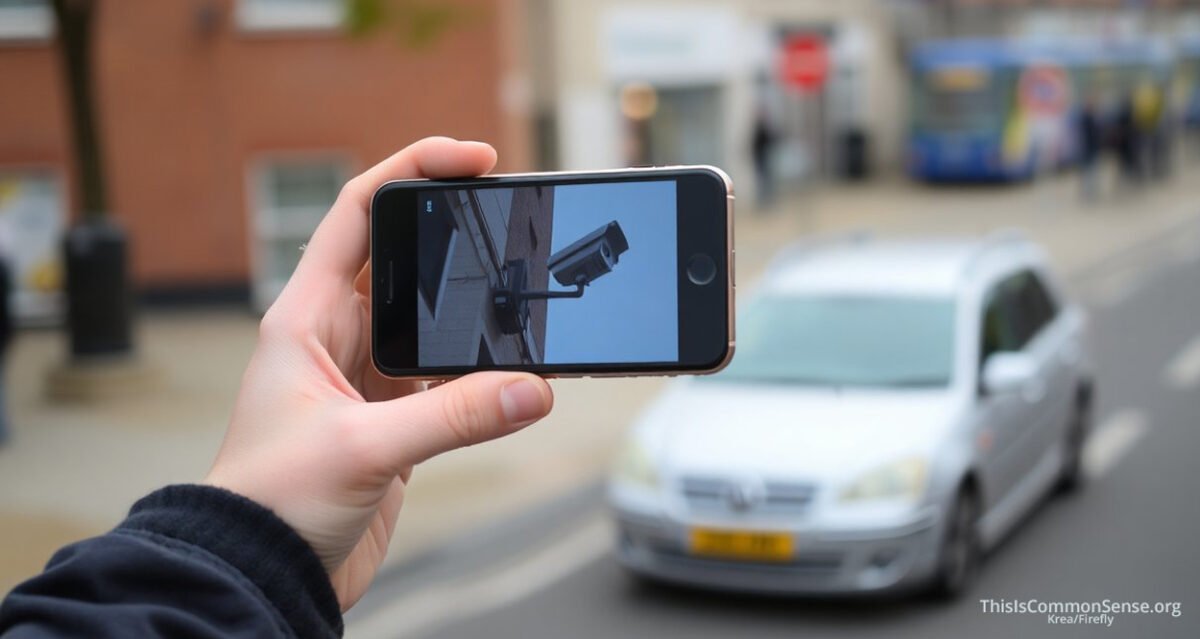
Things are about to get worse. By talking about it online, Britons who think that the country has an immigration problem could draw the attention of a new police unit, National Internet Intelligence Investigations.

Saying “we’ve got to protest about this” will probably cause the sirens to go off.

Chris Philp, the shadow home secretary, says the government is trying “to police what you post, what you share, what you think” because it “can’t police the streets. . . . Labour have stopped pretending to fix Britain and started trying to mute it.”

However, this kind of thing happened under the Tories too.

People still speak their minds in the UK. They aren’t yet used to regarding their political opinions as prenatal forms of criminal activity.

One could use social media to plan or boast about what everybody agrees is a crime. A thug might post video showing how he beat somebody up. Bank robbers might share bank-robbery plans on Facebook. Criminals tend not to do these things. But if they did, for real (that is, they’re not play-acting), who could object if the police inspect the incriminating posts and take appropriate action?

But what’s happening in the UK is not that. 

It’s an attempt to prevent social unrest by finding expressions of dissent and pretending to divine which speech-crime will lead to protest-crime.

It requires Big Brother Bobbies.

This is Common Sense. I’m Paul Jacob.


PDF for printing

Illustration created with Krea and Firefly

See all recent commentary
(simplified and organized)
See recent popular posts