
Categories
initiative, referendum, and recall

A Place Without Hope?

“Don’t lose hope.”

That’s what Bonnie Miller, president of the League of Women Voters of Arkansas, told her fellow Arkansans after the state’s highest court overturned a 74-​year precedent. The justices ruled that constitutional amendments passed by citizens’ initiative can be amended or repealed by legislators with a two-​thirds vote of both chambers. 

Without the issue ever going back to voters.

Sure, this might seem to follow from a constitutional provision: “No measure approved by a vote of the people shall be amended or repealed by the General Assembly … except upon a yea and nay vote on roll call of two-​thirds of all the members elected to each house of the General Assembly …”

But in 1951, the Arkansas Supreme Court declared it “inconceivable” that “the General Assembly could amend or repeal a constitutional amendment initiated by the people,” concluding that the term “measure” simply did not apply to a constitutional amendment. Today’s Supremes reversed this bedrock understanding, thereby empowering the legislature. (Note that the legislature is not seeking to overthrow their own constitutional amendments.)

For more than a decade, the Natural State’s solons have passed statute after statute — and even proposed several constitutional amendments — designed to destroy the citizen initiative process. Their attempts have been consistently defeated by voters at the polls. In addition, last month a federal judge finally struck down several burdensome restrictions that legislators had passed on petitioning.

Now there are also two ballot initiatives — one by Protect AR Rights and another by the League of Women Voters — petitioning for a vote next November to restore the state’s once fair and accessible ballot initiative process.

How long can politicians thwart the will of the people and get away with it? The people of Arkansas are finding out.

This is Common Sense. I’m Paul Jacob.


PDF for printing

Illustration created with Nano Banana

See all recent commentary
(simplified and organized)
See recent popular posts

Categories
election law general freedom initiative, referendum, and recall

Politicians Revolt Against Voters

“[C]urrently, in the state of Arkansas, out-​of-​state special interest groups that come to our state can try to change our laws and change our constitution,” Rep. Kendon Underwood, the Republican sponsor of House Bill 1419, testified “by just getting signatures from 15 counties.”

In the over 100-​year history of citizen-​initiated ballot measures in Arkansas, no initiative has ever qualified with signatures from only 15 counties. Zero. Moreover, to pass a statutory or constitutional initiative requires much more than merely gathering petition signatures; it mandates a majority vote of the people of Arkansas.

As for “out-​of-​state” special interests, the ballot issues referred by legislators last election received more such funding than the lone citizen-​initiated measure. 

There’s more to unpack. 

“Changing” the state constitution is too easy? Well, HB-​1419 hikes up the constitutional requirement that citizen petitions qualify in “at least 15 counties” to now 50 counties out of Arkansas’s 75 counties — a more than 300 percent increase. 

You read that correctly. Mr. Underwood’s proposes to amend the constitution with a simple statute. Textbook unconstitutionality. Yet, that statute has now passed both houses of the legislature and Governor Sarah Huckabee Sanders says she will sign it.

In both 2020 and 2022, legislators placed constitutional amendments on the ballot to entice Arkansans to vote away their initiative and referendum power. Both times Natural State voters said no. One of the provisions defeated in 2020 would have increased the number of counties in which petitions must reach a threshold to 45.

After voters rebuffed legislators on those amendments, the politicians now decide to weasel their way around the constitutional restraint. 

My, they’re real politicians now!

Legislators also declared “an emergency” so HB-​1419 will immediately go into effect, because there’s an urgent need “to enhance and protect Arkansans’ voice in the ballot initiative and referendum process.” 

Why not tell the Big Lie? They’ve told every other size.

This is Common Sense. I’m Paul Jacob.


PDF for printing

Illustration created with PicFinder​.ai

See all recent commentary
(simplified and organized)
See recent popular posts

Categories
initiative, referendum, and recall term limits

You’re Sued!

Firing politicians is what democracy’s all about.

But politicians don’t like being fired. Even when “You’re fired!” is a signature line. It definitely explains why incumbents tend to oppose term limits. 

As shown in the long history of term limits in my home state, Arkansas. 

In 1992, an all-​volunteer petition drive placed the initiative on the ballot and a grassroots campaign beat the Good Ole Boy network and their $500,000 in paid media warnings of “outsiders.” 

The victory sent shockwaves through the Arkansas political establishment; term limits received more YES votes than President-​Elect Bill Clinton had garnered in his home state.

Arkansas pols have been at war with term limits ever since. The latest assault came in April, when legislators passed an “emergency” measure now known as Act 951. 

The Act bans people found guilty of minor misdemeanors (trespassing, vandalism, any violation of drug laws) at any time in their lives — even many decades ago — from working as paid petitioners. The new law also limits the pool of petitioners to state residents, something not done for any other political job, or for those carrying Arkansas’s candidate petitions.*

That’s why Arkansas Term Limits, Liberty Initiative Fund, U.S. Term Limits, et al., filed a complaint in the federal Eastern District of Arkansas alleging constitutional rights violations under the legislature’s Act 951. 

“I was never a supporter of term limits until this bunch got in office,” offered Arkansas Times editor Max Brantley in response to our lawsuit, “and gave themselves essentially unlimited terms and set about running roughshod over human rights.”

Cries of “You’re fired!” are coming soon. But first, to pry back petition rights in Arkansas, the catchphrase is, “You’re sued!”

This is Common Sense. I’m Paul Jacob. 


* In recent years, similar residency requirements have been unanimously struck down in rulings of the 4th, 6th, 7th, 9th and 10th federal Circuit Courts of Appeal. Earlier this year, a federal judge enjoined enforcement of Maine’s similar law.

PDF for printing

meter /​ JG

See all recent commentary
(simplified and organized)
See recent popular posts

Categories
initiative, referendum, and recall term limits

Lifetime Politicians Ruin Christmas

Legislators, anxious to further weaken their own term limits, placed Issue 2 on the Arkansas ballot. 

The current limit is already a loiteringly long 16 years — thanks to a dishonestly worded, legislatively referred 2014 ballot amendment, which weakened the voter-​initiated limits.* 

Voters came back in 2018 to restore the original six-​year House and eight-​year Senate limits, placing a measure on the ballot that from various public reports received nearly 80 percent of the vote. But an Arkansas supreme court decision forbade counting those votes.

Still, politicians are back with another term limits attack. Issue 2 lowers the 16-​year limit to 12 years. Huh, lowers? Stay with me. Issue 2 grandfathers everyone elected this year or before. Current office holders get the full 16 years — plus no lifetime limit (that gets nixed), allowing politicians to return for another 12 years after a short break. 

No wonder the citizens’ group Arkansas Term Limits opposes Issue 2, calling it “The Lifetime Politician Amendment.”

Not unrelated, there is also Issue 3. Arkansas legislators have repeatedly attacked term limits and the only way for citizens to get a real term-​limit on the ballot: the citizen petition process. 

“Advocates acknowledged the amendment, [Issue 3], would make it harder to qualify proposals for the ballot,” the Arkansas Times’ Max Brantley explained, “but generally saw that as a good thing.”

One poison-​pill provision would slice six months from the petition process, moving the deadline from warm, sunny July to cold, dark January — and forcing campaigns to flood Christmas shopping with petitioners trying to gather signatures.

Call it “The Ruin Christmas Amendment.” 

Putting 2 and 3 together: The Lifetime Politicians Ruin Christmas Amendments.

This is Common Sense. I’m Paul Jacob.


* Want to holler at that politician author who hoodwinked voters? Go to a federal prison … where Senator Woods relocated after convictionson political corruption. 


PDF for printing

See all recent commentary
(simplified and organized)
See recent popular posts

Categories
Accountability scandal

Dispatched

The 911 call released last weekend is … hard to forget. It is the one where, as The New York Times reports, “The dispatcher, Donna Reneau, repeatedly told a sobbing Ms. [Debbie] Stevens to calm down.”

With a tone — condescending and worse.

As television station KATV informs, the 911 operator “was working her last shift after previously resigning,” when she “answered Stevens’ call for help” and “can be heard yelling at her.”

Delivering newspapers at 4 am in Fort Smith, Arkansas, Stevens was caught up in rapidly rising flood waters and washed off the road.

The water is “all the way up to my neck,” Stevens desperately told dispatcher Reneau. “I’m the only one in the vehicle with all of my papers floating around me. Please help me. I don’t want to die.”

“You’re not going to die,” the dispatcher replied. “I don’t know why you’re freaking out.”

“This will teach you next time,” she lectured, “don’t drive in the water.”

Indeed, Ms. Stevens will never again “drive in the water.” 

She died. 

In fact, she had not driven into the water, but drowned in the rising flood water that overtook her SUV nonetheless.

Following release of audio from the 911 call, the Ft. Smith police acknowledged that the dispatcher sounded “calloused and uncaring at times.”

Dispatcher Reneau’s behavior wasn’t criminal, however, says her supervisor. And having already quit, she cannot be fired. 

Perhaps there is a lesson: More often than we know it folks don’t so much need a tongue-​lashing or an eye-​roll or a dismissive tone as much as they need some help.

Especially important if you work for 911.

This is Common Sense. I’m Paul Jacob.


911, flood, call, recording,

See all recent commentary
(simplified and organized)
See recent popular posts


Categories
ballot access initiative, referendum, and recall

The Rest of the News

Reid Wilson’s very welcome reporting in The Hill, recently, was headlined, “GOP legislators clamping down on voter initiatives.” 

This disrespect for the people and their basic, democratic check on legislative power is far too common, and something about which people need to know. 

For instance, ballot measures in Florida already must garner a supermajority of 60 percent to win, but politicians are now proposing that threshold be hiked still higher to 67 percent. Not to mention bills to burden petitioners with unconstitutional restrictions.

Though most of the attacks are coming from Republican-​dominated legislatures, the article also made clear that Democratic Party legislators in several liberal states — California, Oregon, Washington — are also trying to “take power away from voters.”

But the article lacked some very pertinent information, allowing politicians to make some terribly misleading charges against direct democracy. 

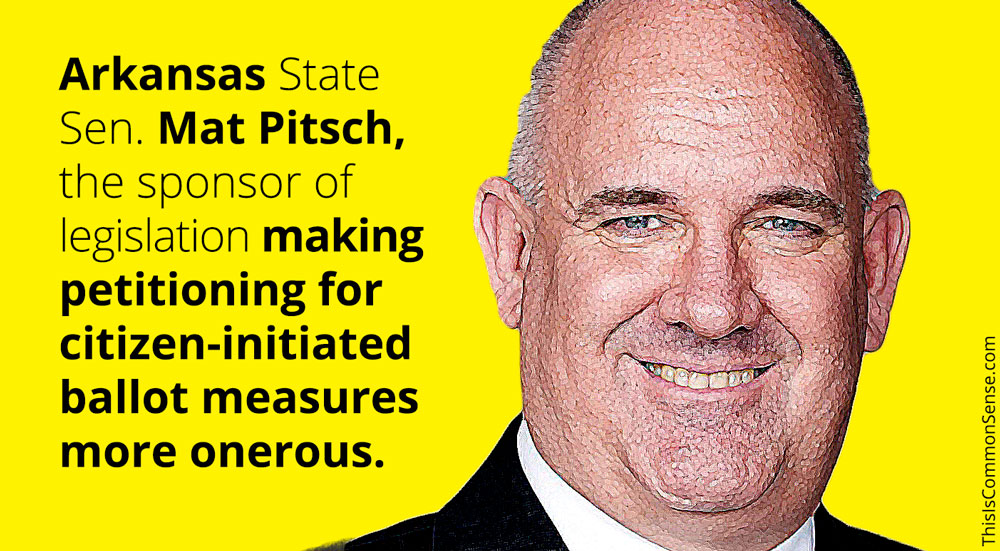
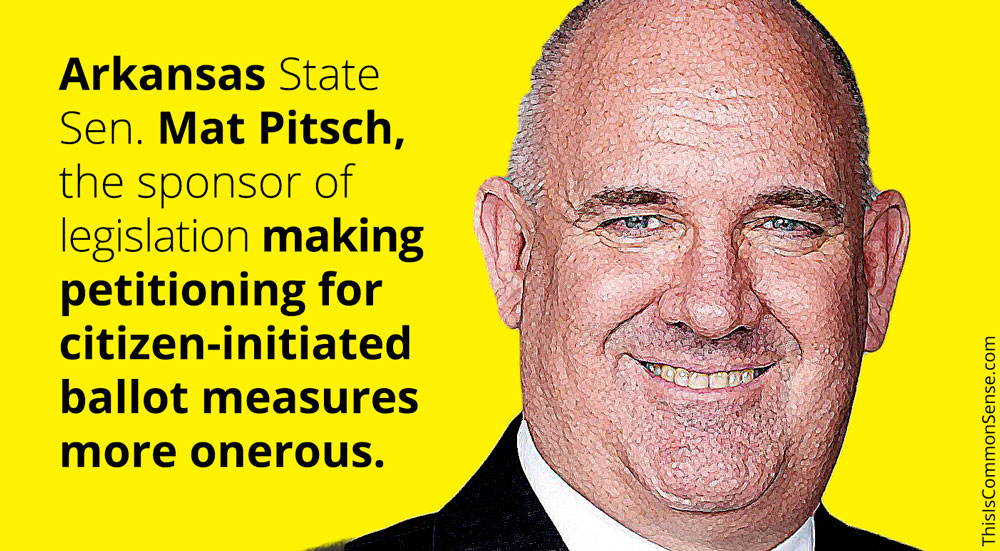
“In the last seven elections, we’ve actually changed our constitution 20 times,” complains Arkansas State Sen. Mat Pitsch, the sponsor of legislation making petitioning for citizen-​initiated ballot measures more onerous. “We’re averaging three changes every other year. Things that normally are voted on by elected representatives were making their way through constitutional ballot measures.”

Sen. Pitsch thinks legislators should make these decisions, instead of voters. How convenient. 

But the state’s motto is “The People Rule.”

Honest people can disagree about how often state constitutions should be amended, but 20 amendments in 14 years does not make Arkansas one of the more prolific states. Moreover, consider the genesis of those 20 amendments. Only three were citizen-​sponsored measures; the other 17, the vast majority, were placed on the ballot by … legislators! 

A fact the reader should have been told.

This is Common Sense. I’m Paul Jacob.


PDF for printing

Matt Pitsch, Arkansas, initiative, citizen, ballot,

See all recent commentary
(simplified and organized)
See recent popular posts
Categories
initiative, referendum, and recall term limits

Catnip for Arrogant Politicians

Arkansas Sen. Alan Clark pretends that his bill, Senate Joint Resolution 15, would toughen the term limits that apply to him.

Clark’s masterpiece, which sailed through the Senate 27 – 3 on Tuesday, most certainly does not. While it purports to toughen term limits from 16 years to 12 years, read the fine print.*

First, these legislators are grandfathering themselves in at 16 years. 

Second, Clark’s amendment removes the current lifetime limit, allowing politicians to return to office after just four years out.

For another 12 years.

And then perhaps an additional dozen years.**

What is going on here, you ask?

Well, in 2014, Arkansas legislators had tricked voters, referring a dishonestly worded measure onto the ballot. It claimed to establish term limits and ban gifts from lobbyists to legislators. The amendment accomplished neither; lobbyists continue to ply legislators with food and drink while existing term limits were weakened.

Last year, a citizens group turned in 135,000 voter signatures to place the strict limits citizens had originally enacted (1992) onto the ballot. But a lobbyist lawsuit with technical signature challenges won a 4 – 3 state supreme court decision blocking the initiative. 

Nonetheless, it was too late to remove the measure from the ballot. Votes were cast, just not counted. Fortunately, the Arkansas Times’ Max Brantley released vote totals in three large counties showing that the citizen-​sponsored term limits had won big.

Which scared Arkansas’ prima-​donna careerists, Clark especially, to create the current exercise in representing themselves, not the citizens of Arkansas.

This is Common Sense. I’m Paul Jacob.


* Clark’s constitutional amendment originally contained a provision taking term limits for state legislators out of voters’ hands by banning use of the initiative process to propose changes. Thereafter, only legislators could address the length of their own careers. That bit of self-​interested boss-​rule was jettisoned, apparently, as too obviously and arrogantly anti-voter.

** Those additional years — which, depending upon longevity, could extend past three decades — come with additional pension benefits, too.

PDF for printing

Alan Clark, Arkansas, term limits,

See all recent commentary
(simplified and organized)
See recent popular posts
Categories
initiative, referendum, and recall term limits

Suppressed Measure Woulda Won

Arkansas politicians and their cronies were terrified by Issue 3. So when this tough state legislative term limits measure was approved for the ballot, foes of citizen-​controlled government sued to kill it.

Agreeing that thousands of already-​approved signatures of bonafide registered voters must be tossed because of new, legislatively-​imposed, byzantine, legal technicalities, the Arkansas Supreme Court ruled that the measure was unsuited for ballot. Yet it was too late to pull it.

The vote simply wouldn’t count, that’s all.

So, why was Issue 3 proposed?

A few years earlier, in 2014, lawmakers had posted a deceptive ballot question consisting of a laundry list of “ethics reforms.” Carefully obscured in the measure was a massive increase in legislative tenure. Sadly, the scam succeeded and voters passed the measure, which allows legislators now to serve up to 16 years (or more) in one seat.

To fix this, Issue 3 sought to impose a maximum of three two-​year terms in the house, two four-​year terms in the senate, and ten years on overall legislative service. It would also have prohibited lawmakers from sending future term limits measures to the ballot. 

After November 6, votes on Issue 3 did get reported in at least some counties. Max Brantley of the Arkansas Times notes that in Pulaski, Washington, and Pope Counties, the Yes vote for 3 exceeds 75 percent. I’m sure these counties are representative.

“I think the term limits crowd should try again,” Brantley says, “if the state motto is to be Regnat Populus rather than Regnat Lobbyist.”

Agreed. 

Let the people rule.

This is Common Sense. I’m Paul Jacob.


PDF for printing


Categories
initiative, referendum, and recall insider corruption term limits

Corruption, Arkansas-​Style

On Friday, the Arkansas Supreme Court struck Issue 3, a citizen-​initiated measure to restore legislative term limits, from Arkansas’ November ballot. The Court declared, 4 – 3, that there weren’t enough “valid” signatures.

This, despite opponents never disputing that more than enough Arkansas voters had signed the petition.

In recent years, legislators have enacted a slew of convoluted laws, purposely designed to wreck the initiative and referendum process.* The regulations give insiders and partisans a myriad of hyper-​technical “gotchas” that can be used to disqualify whole sheets of bonafide voter signatures.

“The legislature,” explained former Governor Mike Huckabee recently, “sucker-​punched the people of Arkansas and expanded their terms. They did it, I think, very dishonestly — by calling it an ethics bill … that had nothing to do with ethics. It was all about giving themselves longer terms.”

Since getting away with that 2014 ballot con job, giving themselves a whopping 16 years in office, seven Arkansas state legislators have been indicted or convicted of corruption. The author of that tricky ballot measure, former Sen. Jon Woods, just began serving an 18-​year federal prison sentence for corruption.

Other corruption, that is.

“It’s one reason I think term limits are a very important part of our political system today,” said Huckabee. It is, he argued, “easier to get involved in things that are corrupt the longer you stay.”

Now, sadly, after 2014’s fraudulent ballot measure and two 4 – 3 state supreme court decisions neutering the entire ballot initiative process, political corruption can continue unabated in the Natural State. 

This is Common Sense. I’m Paul Jacob.


* The state supreme court has ignored the clear language in the state constitution regarding such petitions: “No legislation shall be enacted to restrict, hamper or impair the exercise of the rights herein reserved to the people.”

N.B. For relevant links, check yesterday’s splash page for this weekend’s Townhall column.

PDF for printing


Categories
Accountability incumbents initiative, referendum, and recall insider corruption local leaders political challengers term limits

Sneaky Lobbyists Prefer Sneakiness

The Arkansas Chamber of Commerce’s CEO and chief lobbyist, Randy Zook and Kenneth Wall, have formed Arkansans for Common-​Sense Term Limits. 

The Chamber has a burning hatred for term limits — Common-​Sense or otherwise — just like every other lobbyist and special interest. But Zook and Hall are fibbing in their name because they realize that voters love term limits. 

The ballot committee’s stated purpose? To “advocate for the disqualification or defeat” of the Arkansas Term Limits Amendment, which citizens just petitioned onto the ballot, collecting 129,000 signatures.

Defeating such a popular ballot measure isn’t likely. Instead, these politically-​experienced lobbyists are preparing to sue, hoping to disqualify valid voters’ signatures on some ginned-​up technicality, feigning confusion over the clear ballot language — anything that might keep democracy from coming this November.*

At issue? The difference between real term limits and ridiculous ones.

That is, between term limits set by citizens and those set by legislators themselves. 

Currently, legislators can serve for 16 years in a single seat under the state’s “limits.” And because two-​year Senate terms aren’t counted at all, senators can stay as long as 22 years. 

Legislators snuck this past voters in 2014 with a ballot title claiming only to “establish” term limits … amidst other lies. Politicians thereby turned Arkansas’s toughest-​in-​the-​nation term-​limit law into the nation’s very weakest — a significant 50 percent longer than limits in any other state.**

Unfazed by all the corruption in the Arkansas Legislature, Chamber lobbyists are focused on putting politicians in their pocket for as long as possible. 

But those pesky Arkansas voters are once again in the way.

This is Common Sense. I’m Paul Jacob.


* After recently threatening to challenge the signatures of another initiative petition, Zook had to admit that he was not aware of a single problem or deficiency in the petition. But he quickly added, “It’s a very complicated process.”

** Arkansas’s term limits were the same as Michigan’s until 2014, three terms, six years in the House and two-​terms, eight-​years in the Senate.

PDF for printing


Original photo by Jeff Kubina