Categories
Accountability media and media people national politics & policies

Lessons Not Yet Learned?

When will we learn to distrust big government?

While readers of this Common Sense have been tracking the Wuhan Lab Leak story for two years now, most people are still behind the curve. Fortunately, another government agency has weighed in on the Lab Leak side, as reported by Michael R. Gordon and Warren P. Strobel in the Wall Street Journal: “Lab Leak Most Likely Origin of Covid-19 Pandemic, Energy Department Now Says.

No wonder there’s disagreement and confusion, though: “The Energy Department made its judgment with ‘low confidence,’ according to people who have read the classified report,” Gordon and Strobel explain. 

There remains much we do not know, of course. But we should understand that is largely because China’s totalitarian regime has purposely hidden information from the world. With the full assistance of Dr. Anthony Fauci and Big Government Science in the U.S. . . . and evasive coverage by our media.

Then consult Brett Stephens’ “The Mask Mandates Did Nothing. Will Any Lessons Be Learned?” in The New York Times last week.

Now, many of us embraced masks early on, when little was known, bascally advising mask wearing as a signal of hope. We can do something. But soon the masks themselves masked something other than hope: the raw powerlust of the elites in their lockdown tyranny over the masses.

But for actual reduction in the contagion of a virus, Stephens reports, masks are useless. Citing an Oxford epidemiologist with the great name of “Tom Jefferson,” not even N-95 masks do the trick: “Makes no difference — none of it,” said Jefferson.

What about those studies we were informed proved the case? They were “nonrandomized,” “flawed observational studies.”

Yet lots of politicians and bureaucrats — including “the mindless” Centers for Disease Control — keep pushing masks.

It’s not that we cannot learn. It’s that they don’t want us to.

This is Common Sense. I’m Paul Jacob.


PDF for printing

Illustration created with PicFinder.ai

See all recent commentary
(simplified and organized)
See recent popular posts

Categories
general freedom government transparency media and media people national politics & policies

The 2021 Spike

The graph is startling. It shows VAERS reporting numbers in Florida from 2006 through 2022. 

VAERS is the Vaccine Adverse Event Reporting System. Little blips of data run along the bottom of the graph through 2020, a year in which there were 2466 reports of negative effects. 

And then came 2021, the year in which mRNA and viral vector vaccines were rolled out in the United States, pushed heavily by the federal government and All Responsible Opinion, subsidized per the dose to the drug companies, as well as by lifting the burden of liability for . . . adverse effects.

The number of Floridians reporting such adverse effects soon after taking the vaccines spiked to 41,473.

The next year it subsided a bit, but to an otherwise walloping high of 9,104.

“In Florida alone, there was a 1,700% increase in VAERS reports after the release of the COVID-19 vaccine, compared to an increase of 400% in overall vaccine administration for the same time period,” Florida Health tells us in the online “Health Alert on mRNA COVID-19 Vaccine Safety,” of February 15. “The reporting of life-threatening conditions increased over 4,400%. This is a novel increase and was not seen during the 2009 H1N1 vaccination campaign.”

“Just publish the data; give us the facts,” Dr. John Campbell stated in his online talk on the report. He’s appreciative of the Sunshine State’s newfound transparency: “Well done, State of Florida.”

But nearly all other governments have failed to acknowledge such data much less act on it “in meaningful ways”: “badly done, other 49 states. Badly done, the UK; badly done, Europe; badly done, Canada; badly done, New Zealand, Australia.”

Quite a spike in government “badly dones.”

This is Common Sense. I’m Paul Jacob.


PDF for printing

Illustration created with PicFinder.ai

See all recent commentary
(simplified and organized)
See recent popular posts

Categories
international affairs national politics & policies

Identified Floating Object?

It’s always something. 

Last week, it was a Chinese spy balloon floating over Alaska, Canada and then across the continental United States from Montana all the way to South Carolina — repeatedly loitering over strategic military installations — before being downed by a Sidewinder missile fired by a U.S. military jet over the Atlantic.

China claims it was a civilian balloon gathering meteorological data that had accidentally blown off course; the U.S. says its flight path was deliberate and “We know it is a surveillance balloon.”*

With growing controversy about why the Biden Administration allowed a spy balloon to traverse the country, the Pentagon shockingly stated that the Chinese had done this before — once earlier in Biden’s term and three times during the Trump Administration. 

So just normal stuff, eh? 

Well, no. As Byron York sorts out at The Washington Examiner, those Chinese spy balloons were “near” U.S. territory, just possibly crossing into our airspace — nothing like last week’s cross-country cruise.

So, just what are the Chinazis up to?

“[The Chinese] want it to be seen,” argues Professor Michael Clarke, a defense analyst for Australia’s Sky News. “They want it to be noticed. My view is that it is all about the Philippines.” 

Clarke points to the South China Sea where China has been illegally building militarized artificial islands in areas that rightfully belong to the Philippines. Last week, the Philippines agreed on opening four more bases to the U.S. military, sending a strong message that Chinese aggression will be met with force. This was the Chinese government bringing the conflict to people in North America. Us!

While we still lack important information, analysis of the wreckage may allow us to learn more.

On the other hand, don’t we already know everything we need to know about the CCP? 

This is Common Sense. I’m Paul Jacob. 


* I have nearly zero trust in ‘fog of war’ U.S. government pronouncements, but less than zero in the great gaslighting Chinazis.

PDF for printing

Illustration created with PicFinder.ai

See all recent commentary
(simplified and organized)
See recent popular posts

Categories
deficits and debt folly national politics & policies

Earmarked Nation

The big secret of the federal government’s budget is that there isn’t one.

Instead of proposing a rational budget, Congress spends money in huge omnibus bills, which sweep up most of the big items into a bucket which is then poured out into the economy. Since these buckets contain more money than can actually be found in federal coffers, the consequent deficits are covered by debt. 

Which accumulates. 

Looming larger and more ominous every year.

One way these omnibus bills are managed is that almost no one reads them. As former House Speaker Nancy Pelosi said of Obamacare, ya gotta pass it to find out what’s in it.

How to get congressmen to go along with this financial chaos? Bribery. Make the spending binge even bigger with earmarks.

That’s where members of Congress place local boondoggle projects into the omnibus bills and get them through without having to convince anyone but the leadership of the projects’ dubious merits.

I used to talk more about earmarks. But when the Tea Party Republicans entered in 2011, they nixed earmarking “the pork.”

When the Democrats came back into power, the aforementioned Mrs. Pelosi brought them back, which, in the last big omnibus bill, pushed spending up an extra $8 billion or so.

Though Democrats love earmarks as an institutional practice, Republican protests are often merely pro forma. Alabama’s Retiring Republican Senator Richard Shelby, for example, “got $666.4 million down there to Alabama,” explained Tom Temin recently. “Sounds like there’s going to be a lot of Richard Shelby bridges, Richard Shelby schoolhouses, Richard Shelby highways.”

Thankfully, one of the concessions Speaker of the House McCarthy made with the Freedom Caucus (whom the president calls “ultra-MAGA” and “semi-fascist”) was to attack the earmarking practice again — after a failure to decide against earmarks late last year.

We’ll see how that goes. But the real test will be the abandonment of omnibus spending packages.

This is Common Sense. I’m Paul Jacob.


PDF for printing

Illustration created with Midjourney and DALL-E 2

See all recent commentary
(simplified and organized)
See recent popular posts

Categories
general freedom media and media people national politics & policies

How Congress Works

“Who knew that our time-tested and powerful democracy could not survive a few days of debate and disagreement on our most important questions?” asked journalist Glenn Greenwald weeks ago during the House voting for Speaker.

“To hear establishment mavens all tell the story,” he pointed out, “the failure of Congress to smoothly and swiftly and immediately elect a speaker that’s been preordained — with little debate (as it usually does) — has put the U.S. Government on the verge of collapse.

“Apparently, a healthy democracy requires that everyone march in lockstep, follow orders from on high, and never question anything,” he added sarcastically. 

Greenwald is onto something.

“One of the dirty secrets of how Congress works in the modern era,” he explained, “has been that actual members of Congress, your representatives, have very little power — almost none. They’re more like little, tiny chess pieces moved around for a tiny coterie of party leaders.

“It’s a dynamic that has turned Congress into a profoundly anti-democratic institution,” noted Greenwald. “And it’s one of the main reasons why we get so little reform and so much corruption out of [Congress].

“Many Americans remain convinced that the two parties can’t agree on anything . . . can’t make anything happen, when in fact they’re making a lot happen.” Such as making “tens of trillions of dollars fly out the door.”

Mr. Greenwald blames “a small handful of omnipotent party leaders, from each party, who are willing to play the game, join hands and ensure that totally insulated from election outcomes and public debate, the Washington consensus churns on.”

What to do? Greenwald did not mention term limits. But I just did.

This is Common Sense. I’m Paul Jacob.


PDF for printing

Illustration created with DALL-E2

See all recent commentary
(simplified and organized)
See recent popular posts

Categories
national politics & policies term limits U.S. Constitution

The Demand for Term Limits

Lots of talk about term limits last week — in Washington. 

Of all places. 

What bizarre chain of events caused career congressmen to start jawboning and horse-trading about the popular reform that most of them viscerally oppose?

It was the work-product of a small number of hardcore conservative Republican legislators, a mere 20, flexing their strength and commitment at a critical political point — the election of the House Speaker — and armed with concrete demands.

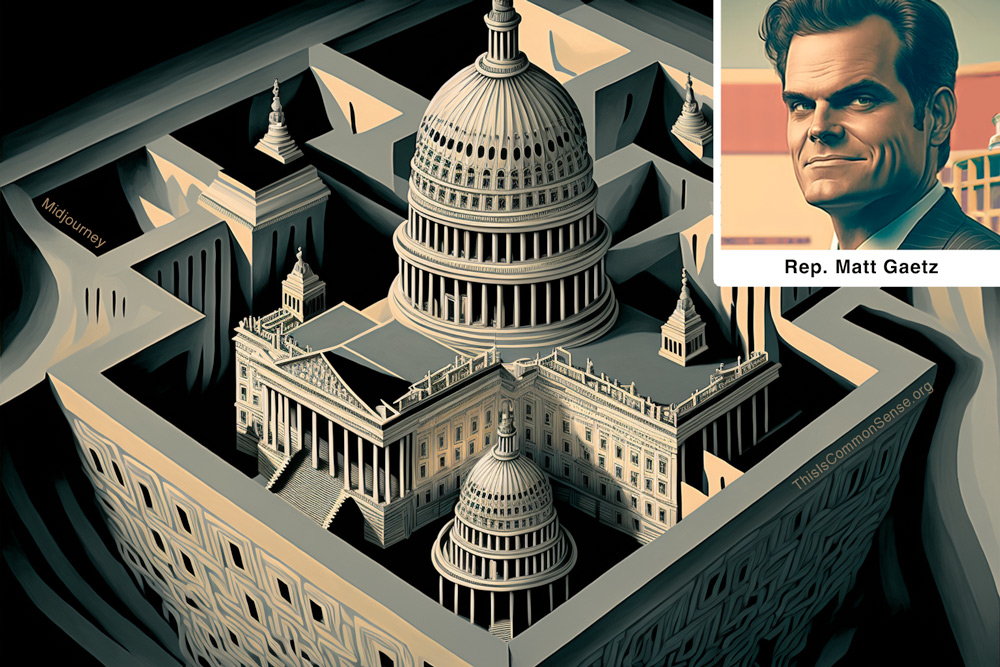
“We offered Kevin McCarthy terms last evening that he rejected,” Rep. Matt Gaetz (R-Fla.) told reporters last Tuesday. One of those? “We’ve sought a vote in [the] first quarter of the 118th Congress on term limits.”

By week’s end, however, McCarthy had been elected Speaker of the House . . . but only after having pledged to bring to the floor that congressional term limits amendment, authored by Rep. Ralph Norman (R-SC), one of the 20 holdouts, along with making other concessions

Meet the Press host Chuck Todd yesterday cast shade on the effort, calling these “show votes.” 

While it’s true that incumbents are unlikely to vote for the term limits amendment in the 2/3 supermajority the Constitution requires, or for the balanced budget amendment for which the holdouts, mostly Freedom Caucus members, also secured a commitment from McCarthy. 

“We’ve got to start taking steps to make fundamental change in America,” Rep. James Comer (R-Ky.) told Todd. And putting every U.S. representative on record on term limits sounds like a great first step for early 2023.

Worth the battle.

This is Common Sense. I’m Paul Jacob.


PDF for printing

Illustration created with Midjourney

See all recent commentary
(simplified and organized)
See recent popular posts

Categories
First Amendment rights media and media people national politics & policies social media

Twitterpated by the Feds

Elon Musk’s sunlight on Twitter’s backroom censorship dealings has cast a black shadow upon the U.S. Government.

The revelations are called The Twitter Files, and I linked to the first two installments, tweetstormed last week by Matt Taibbi and Bari Weiss, on Monday

But Musk’s released information to his select set of journalists did not stop there.

The third set was also made public by Taibbi, and dealt with the company’s deliberations and politics of January 2021, and the banning of a sitting president — and Twitter’s most popular user — from the platform.

Michael Shellenberger had the honor of delivering to the public the fourth set, showing how Twitter executives changed policies and made up stuff on the fly to ban the aforementioned Donald J. Trump.

The fifth batch, ushered into our view by Bari Weiss, again, included an especially interesting tidbit: “Internal correspondence shows those assigned to evaluate Trump’s tweets didn’t see proof of incitement of the Capitol riot” but “[t]hat didn’t stop for massive internal calls to ban the president” — quoting The Daily Mail’s synopsis.

“Between January 2020 and November 2022,” Taibbi tweeted in the sixth outing, “there were over 150 emails between the FBI and former Twitter Trust and Safety chief Yoel Roth… a surprisingly high number are requests by the FBI for Twitter to take action on election misinformation, even involving joke tweets from low-follower accounts.” Twitter’s “Trust and Safety” team appeared to go out of its way to find excuses to ban accounts, and is egregiously misnamed.

Michael Shellenberger’s contribution in the seventh Twitter File blast is perhaps most shocking of all:

  • The FBI was deliberately lying about the status and contents of the Hunter Biden laptop before as well as after the infamous (and suppressed) New York Post story.
  • The FBI “wargamed” about the laptop with social media executives before the story broke.
  • The FBI “compensated” Twitter for the collusion — to the tune of over $3 million.
  • And the FBI apparently has not stopped — its work with Twitter is ongoing.

To top it all off, Lee Fang supplied the eighth set, complete with poop about Pentagon pressure, propaganda, and “concierge service.”

In sum, the federal government made Twitter its b . . . uh . . . disinformation agent.

This is Common Sense. I’m Paul Jacob.


Note: Yes, Virginia, “twitterpatedis a word!

PDF for printing

Illustration created with DALL-E2, John Tenniel, JG

See all recent commentary
(simplified and organized)
See recent popular posts

Categories
deficits and debt folly national politics & policies

On Trees

There’s an old saying — some say it’s an ancient “Chinese saying,” but I first heard it attributed to an Indian philosopher — to the effect that “the best time to plant a tree is thirty years ago; the second best time is today.”

Eric Boehm, writing in Reason, riffs on it regarding federal spending: “The best time to stop borrowing heavily was yesterday (or several years ago), but the second-best time would be today. Instead, Congress is likely to make this problem even worse — again — by continuing to spend like there’s no tomorrow.”

In November, the federal government ran a $249 billion deficit, which, Boehm informs, is up $56B from the previous November.

Talk about November chills.

But worse yet is that Congress is gearing up for more. The omnibus spending bill in the works “will add between $240 billion and $585 billion to this year’s budget deficit.”

After a lifetime of deficit spending, this may seem only worth a furrow above the eyes, not an actual arched brow. But it does make a mockery of President Joe Biden’s boast of decreasing deficits on his watch. As Boehm explains, that’s merely an artifact of the Trump Era humungoid pandemic giveaways. There had to be some sort of let up from that binge. Nevertheless, the “underlying figures showed all along that the deficit situation was continuing to worsen, and that President Joe Biden’s policies were adding trillions of dollars to the deficit over the long term.”

It’s almost as if they think “money grows on trees.”

Would that it were the case, though, since there are only a limited number of trees. Taxation and especially debt are, to politicians, closer to infinity.

This is Common Sense. I’m Paul Jacob.


Update: Senator Mitch McConnell said, yesterday: “I’m pretty proud of the fact that with a Democratic president, Democratic House, and Democratic Senate, we were able to achieve through this Omnibus spending bill essentially all of our priorities.” The Republican Leader predicted passage on the 22nd.

PDF for printing

Illustration created with DALL-E2, John Tenniel, Thomas Cole, JG

See all recent commentary
(simplified and organized)
See recent popular posts

Categories
ideological culture national politics & policies political challengers

Surfin’ U.S.A.

Back in the Spring, a pollster was detailing his findings to a group of us. The Democrats were none too popular, he informed. And informed. And further informed. But at one point, the pollster stopped to remind: “Don’t get me wrong, that’s not to suggest the public is fond of Republicans.”

“We have the worst inflation in four decades, the worst collapse in real wages in 40 years, the worst crime wave since the 1990s, the worst border crisis in U.S. history, we have Joe Biden who is the least popular president . . . since presidential polling happened,” Washington Post columnist Marc Thiessen explained on Fox News, “and there wasn’t a red wave.”

Barely a ripple.

Voters, he continued. “looked at all of that and looked at the Republican alternative and said, ‘No, thanks!’”

Calling it “an absolute disaster,” Thiessen advised the GOP to do a “a really deep introspective look in the mirror right now.”

Watch for cracks.

More than the abortion issue or the mixed blessing of Mr. Trump’s omnipresence, I think the GOP’s problem was the lack of any serious, cohesive and positive agenda. We are indeed facing massive inflation, crime, cultural revolution . . . but what are you going do ’bout it?

Answers aren’t coming from the Republican Party.

In last year’s red wave across my home state of Virginia, it wasn’t now-Governor Glenn Younkin who made respecting the rights of the parents of public education students a cataclysmic issue. Parents did that.

The Republican Revolution of 1994 rode a tsunami produced in no small part by the term limits movement. With term limits measures on the ballot throughout the country, the GOP gained 52 seats to secure a majority after 40 consecutive years in the minority — even defeating the Democratic House Speaker. 

Want candidates to ride a popular, pro-freedom wave? 

Better start splashing.

This is Common Sense. I’m Paul Jacob.


PDF for printing

Illustration created with DALL-E

See all recent commentary
(simplified and organized)
See recent popular posts

Categories
free trade & free markets national politics & policies

The Biden’s War on Independents 

They know. They aren’t complete idiots. When enemies of the market routinely try to stop people from earning a living through restrictions like minimum wage laws and arbitrary licensing to thwart such dangerous activities as hair-braiding, few are ignorant of the disastrous consequences.

Case in point? 

The Biden administration is on the verge of using a federal version of California’s AB5 law to mass-slaughter the opportunities of millions of gig workers and freelancers. The administration hasn’t managed to do it legislatively. So it’s trying to inflict the damage with a Department of Labor regulation.

The idea is to stop companies from classifying independent contractors as independent contractors. Passed in California a few years ago, AB5 prohibited companies and many contractors from working with each other unless companies took them on as regular employees.

To avoid the costs of doing that, many companies instead simply ended their relationships with hundreds of thousands of gig workers. For example, Rev, a transcription service, stopped working with all freelancers residing in California.

California lawmakers knew how destructive AB5 would be when they passed it — proof-positive being the many exceptions for politically connected groups that were stipulated as part of the law. AB5 has now been repealed and replaced by AB2257, which increases the varieties of worker exempt from the new requirements. But it still leaves many other people, like California-based truckers, in legal limbo.  

It’s okay though, because all truckers do is deliver the stuff that all the rest of us need to survive.

This madness should not be imposed on everybody throughout the country.

And certainly not by back-room bureaucratic machinations.

This is Common Sense. I’m Paul Jacob.


PDF for printing

Illustration created with DALL-E

See all recent commentary
(simplified and organized)
See recent popular posts