Categories
First Amendment rights national politics & policies political challengers

The RFK Challenge

Yes, but . . .

When contemplating a candidate for office we may like, we do a lot of “Yes, but” thinking. It’s impossible not to.

Yesterday I considered the candidacy of Bobby Kennedy, Jr., in the context of the Republican/Democrat Duopoly™. Many of my readers may like his stances on COVID or war, but worry about other positions, like the Second Amendment and “climate change.”

Yes, but . . . there is another Yes, But context: the candidate forces mainstream voters and media manipulators to Yes, But their cherished positions.

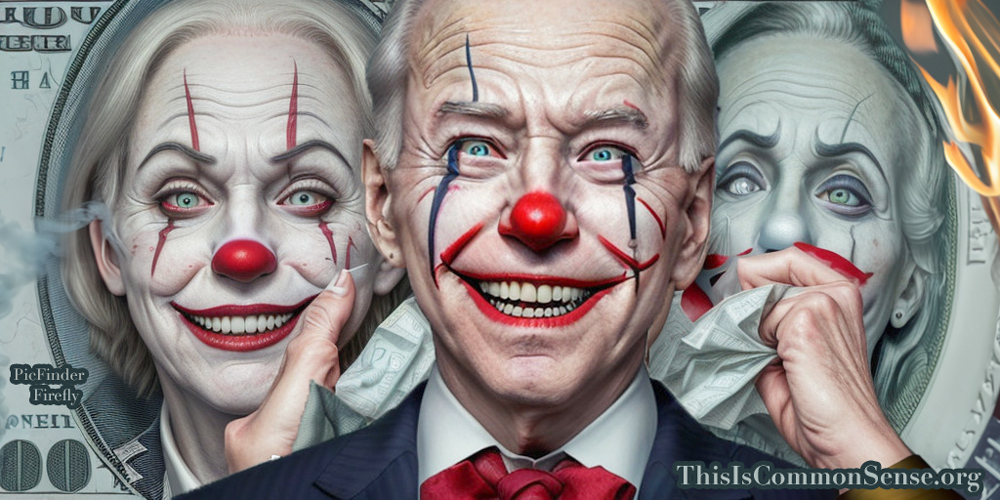
Yes, Trump was “a threat to democracy” for trying to “overturn an election.” RFK, Jr. grants that Democrat talking point. 

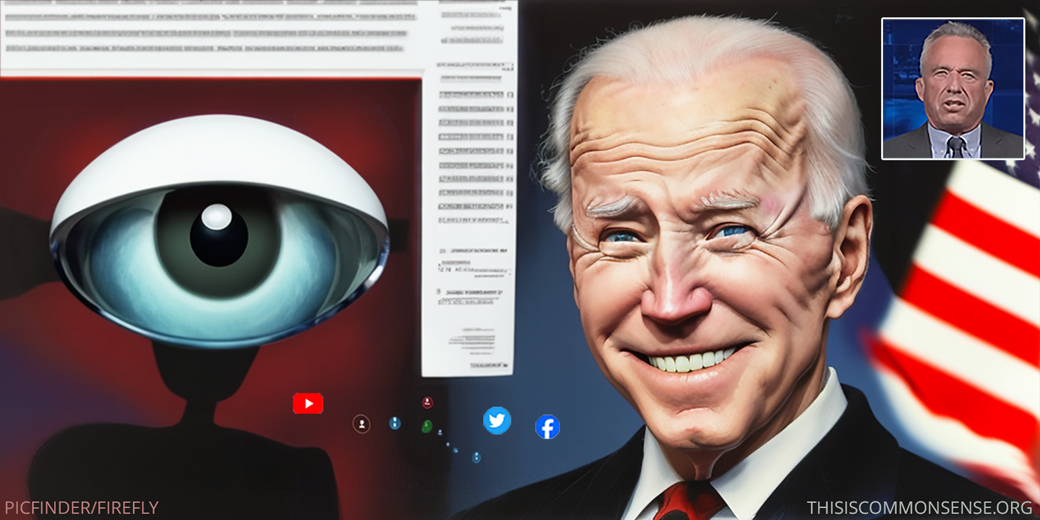
But when pressed by Erin Burnett of CNN, his response was a challenge: “I can make the argument that President Biden is the much worse threat to democracy, and the reason for that is President Biden is the first candidate in history — the first president in history — that has used the federal agencies to censor political speech, so to censor his opponent.”

Now your and my response might be, No, but . . .

As in, he was certainly not the first president in American history to directly censor political speech.

But the presidents who did that are all heroes to the CNN crowd, so they’ll have to say, “Yes, but . . .”

But what? What’s the response? 

The CNN article, linked above, was lame: “‘With a straight face Robert F. Kennedy Jr. said that Joe Biden is a bigger threat to democracy than Donald Trump because he was barred from pushing conspiracy theories online,’ DNC senior adviser Mary Beth Cahill said in a statement. ‘There is no comparison to summoning a mob to the Capitol and promising to be a dictator on day one. . . .’”

What CNN and the DNC and the whole establishment ignore is the vast suppression of thousands, millions of voices online, organized by the government and ex-government and close-to-government operatives.

Yes, but . . . they like censoring their competition!

This is Common Sense. I’m Paul Jacob.


PDF for printing

Illustration created with PicFinder and Firefly

See all recent commentary
(simplified and organized)
See recent popular posts
Categories
ballot access national politics & policies political challengers

The “We the People” Party Pooper

The only substantial challenger to the two parties, this presidential campaign season, has been Robert F. Kennedy, Jr. 

The son of a presidential primary frontrunner in 1968, and nephew of the 35th President of the United States — both assassinated — has been an environmental litigator and vaccine skeptic for years, and, unlike Presidents Biden and Trump, has publicly and fundamentally criticized the handling of the recent pandemic.

Though a Democrat for years, he was marginalized by the Democratic Party — an efficient machine for an astoundingly monolithic power center — and last October decided not to run as a Democrat. 

So he’s gathering signatures, creating parties, all sorts of schemes to make good on his promise of being on the ballot in every state of the union.

As Ron Paul’s last-minute ballot access coordinator in 1988, I know how difficult that is. The two parties have only continued to tighten their grip on American election “rules.” If you were wondering why Bobby Kennedy made his Veep choice so early and picked wealthy Silicon Valley lawyer Nicole Shanahan, the reason is that many states require a Vice Presidential running mate to be on the petition before signatures are gathered.

RFK, Jr., was forced to jump the gun. Plus, now a candidate, there are no campaign finance limitations on Shanahan putting her personal wealth into the effort. 

Interestingly, RFK has formed a “national” political party, the “We the People Party,” which has established footholds in California, Delaware, Hawaii, Mississippi, and North Carolina. He has also formed The Texas Independent Party and is on the ballot as an Independent in Hawaii, Nevada, New Hampshire, and Utah.

While in recent years there has been tremendous focus on how people vote, look at all the hurdles and walls still facing the who, if that candidate exists outside the major-party duopoly, a victim of all its silly, anti-democratic laws.

Maybe that’s one way Kennedy’s campaign can “do good,” by highlighting an issue neither party cares about: free and fair elections.

This is Common Sense. I’m Paul Jacob.


PDF for printing

Illustration created with PicFinder and Firefly

See all recent commentary
(simplified and organized)
See recent popular posts
Categories
general freedom media and media people national politics & policies

Awkward for Ideologues?

There’s good news about inequality?

In late March, George F. Will argued that the truth about inequality in America, according to his op-ed title, is “awkward for the left and right.”

He points to the reality of transfer payments in the United States. 

Ignoring that reality is what leads to awkwardness.

On the left, critics of capitalism portray low-income earners as a growing class of the impoverished . . . and high-income earners as a growing class of filthy rich. 

But by “not counting about 88 percent of government transfer payments that enlarge the buying power of lower-income households, and not counting taxes that lower the wealth of higher-income households, government statistics purport to prove that the average income in the top quintile of earners is 16.7 times that of the average in the bottom quintile. Counting transfers and taxes, however, the actual ratio is 4 to 1.”

So leftists ignore the “successes” of the very system they set up, the better to complain and demand more of what has already been done.

But what do rightists ignore?

That’s where Mr. Wills’s Washington Post editors (a class of professionals who usually determine titles and blurbs) may have given us the wrong impression. Most of his column explodes leftist interpretations of contemporary reality. But he does talk about “the populist right,”: the “national conservatives” who mimic the progressive left in favoring “industrial policy” that, he notices (as I’ve noticed here at Common Sense) “regressively funnels money upward to corporations.

“The populist right advocates protectionism (tariffs to shield corporations from competition), and the populist left advocates hundreds of billions of dollars of subsidies (for semiconductors, electric vehicles, solar panels, etc.).” Both favor the rich when it comes to regulations, while complaining about the rich in other contexts.

A poor way to help the poor.

This is Common Sense. I’m Paul Jacob.


PDF for printing

Illustration created with PicFinder and Firefly

See all recent commentary
(simplified and organized)
See recent popular posts

Categories
First Amendment rights international affairs national politics & policies

TikTok Smoke But No Gun?

I’d like to ban the Communist Party — in China. But TikTok — here?

The app’s possible use as spyware and worse by Chinese Communist Party operatives should be investigated thoroughly.

“Lawmakers and regulators in the West have increasingly expressed concern that TikTok and its parent company, ByteDance, may put sensitive user data, like location information, into the hands of the Chinese government,” explains The New York Times. “They have pointed to laws that allow the Chinese government to secretly demand data from Chinese companies and citizens for intelligence-gathering operations.”

This concerns me enough to not be on TikTok, but while we smell smoke, I see no smoking gun.

And banning Tik Tok has every appearance of doing what the CCP would do — and did with Facebook and YouTube and X (formerly known as Prince — er, Twitter). Not to mention being unconstitutional.

The TikTok ban that passed the House last week — with only 50 Democrats and 15 Republicans voting No — if passed by the Senate and signed by the President, would set up another level of surveillance and Internet control that would be used against American citizens beyond users of this social media video-sharing platform.

It comes down to good ends not justifying evil means, in this case an all-out government attack upon freedom of speech and press.

There are things the federal government could do — and already has done — to limit TikTok’s influence. Last year, the U.S. (along with Canada) banned it from all government devices. 

This didn’t even require an act of Congress. Arguably, Trump could have done this with Facebook and Twitter on federal government devices when it became clear that these platforms were being used to orchestrate partisan speech control.

And, of course, a general social cause against TikTok could be engaged without threat of force. Political leaders owe it to the people to speak out.

This is Common Sense. I’m Paul Jacob.


PDF for printing

Illustration created with PicFinder and Firefly

See all recent commentary
(simplified and organized)
See recent popular posts
Categories
crime and punishment ideological culture national politics & policies

Unpresidential but Precedented

President Biden may be doddering, dithering, and cranky, but his writers are mis-educated dolts.

The State of the Union address, last week, was performed before Congress by a man so hopped-up on stimulants that . . . one looks for precedents. Not among the U.S. Presidents, though, but among the Chancellors — the “schkankily clankily” guy, as Norm Macdonald referred to him; the man who is known to have been on drugs.

I bring up precedents because Biden’s writers did — idiotically.

The address began by memorializing President Franklin Delano Roosevelt’s 1941 address before Congress, in which FDR used the word “unprecedented.” Biden’s speech writers take this as an occasion to use the word. “Now it is we who face an unprecedented moment in the history of the Union.”

And then proceed to mention more precedents for the “unprecedentedness” of it all.

It’s almost as if they don’t know the meaning of their keyword.

The biggest precedent is the pure partisan nature of the message, which — instead of performing a sober constitutional duty to give Congress the president’s view of the union of the states — has become, in recent years, a simplistic barrage of invective against the president’s opposing party.

This year’s SOTU address was worse than ever on the partisan divide, with “populist” attacks upon the SCOTUS for allowing Roe v. Wade to fall, and relentless attacks on Republicans. The most interesting and substantive topic was Social Security, with the usual (quite precedented) promise to shore it up with tax increases . . . on the rich. (Reason magazine took the idea seriously and found its fault.)

Thankfully, Biden’s writers avoided the biggest State of the Union cliché of all: the traditional pronouncement that the state of the union “is sound.”

It is not.

This is Common Sense. I’m Paul Jacob.


PDF for printing

Illustration created with PicFinder and Firefly

See all recent commentary
(simplified and organized)
See recent popular posts
Categories
crime and punishment national politics & policies regulation

Stop the Work Stoppers

Republican Representative Kevin Kiley of California has introduced H.J. Resolution 116 to block “the rule submitted by the Department of the Labor relating to ‘Employee or Independent Contractor Classification Under the Fair Labor Standards Act.’ ”

116 is a legislative attempt to thwart legislation by regulators.

Labor’s rule is modeled on the AB5 Act passed in California several years ago. Catering to unions, AB5’s idea was to kill the livelihoods of many gig workers or freelancers by making it much harder for companies and independent contractors to deal with each other.

The new rule, too, aims to kill competition with unions and expand the pool of employees who can be unionized.

AB5 caused a firestorm, leading to citizen initiatives, court battles, and victories and setbacks for besieged employers and freelancers. There’s been some backtracking of AB5, in part because sponsoring lawmakers realized that it hurt even favored constituencies. But California is still a land mine for would-be freelancers.

The Labor Department is trying to impose AB5-style reclassification on the national level now that national lawmakers have failed to pass legislation to do it.

These days, the many dictators in our government often regard legislative means of passing legislation as an option only of first resort. If that fails, well, stick it to the people some other way.

So Kiley — and, hopefully, an effective congressional majority — must pass a law saying no, regulators, you may not pass this law in the guise of a regulation.

This is Common Sense. I’m Paul Jacob.


PDF for printing

Illustration created with PicFinder and Firefly

See all recent commentary
(simplified and organized)
See recent popular posts
Categories
ideological culture national politics & policies political economy

Shrinkflation, Shrunk Nation

In another pathetic pre-recorded speech, played before Sunday’s Super Bowl, President Joe Biden lambasted America’s corporations for “shrinkflation.” 

“As an ice cream lover,” he explained in the vid, “what makes me the most angry is that ice cream cartons have actually shrunk in size but not in price.”

The Guardian expands upon the president’s gripe: “Inflation dropped to 3.1% in December but some companies are thought to have responded to rising costs by marginally shrinking the size of products — shrinkflation — as well as changing recipes to reduce the amount of more expensive ingredients — sometimes known as ‘skimpflation.’”

My, oh my, so businesses must adjust to inflationary pressures as well. 

When the costs of their inputs go up, they do not automatically become charities. Knowing that consumers do not sport infinite incomes and demand schedules utterly “inelastic” — buying the same goods in the same quantities even at higher prices — they often adjust by reducing quality or quantity.

It is one of many ways that inflation hurts us.

Inflation has even been referred to as the sneakiest of all taxes, taking from the masses and giving to the insider class, those closest to government (those who receive newly-created money first).

Biden calls “shrinkflation” a “rip-off” and insists that “the American public is tired of being played as suckers.”

Well, that will prove true only if the American public rejects those politicians who push the policies that led to the inflation — politicians like those in the 116th and 117th Congresses, Donald Trump, and Joe Biden himself.

This is Common Sense. I’m Paul Jacob. 


PDF for printing

Illustration created with PicFinder and Firefly

See all recent commentary
(simplified and organized)
See recent popular posts
Categories
Accountability folly national politics & policies

Sympathetically Diminished

“I’m sympathetically diminished.”

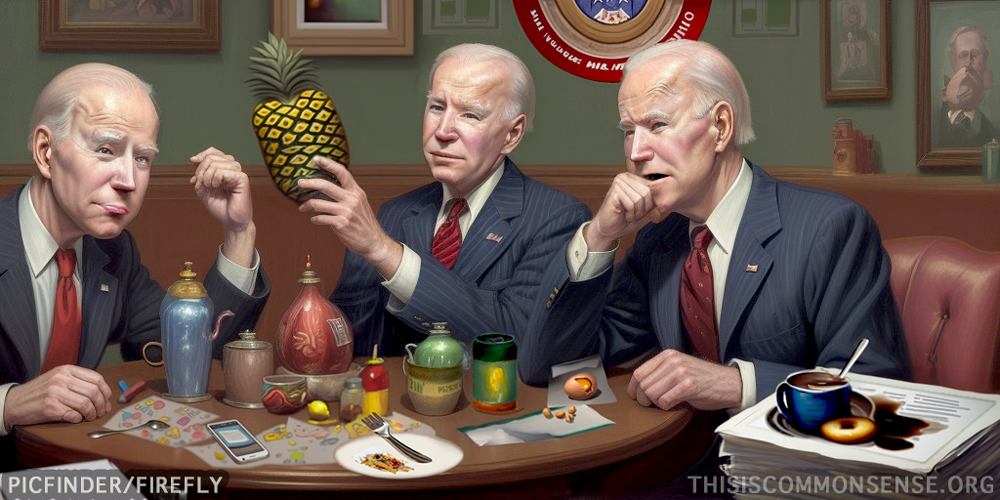
That’s how legal analyst Jonathan Turley described President Joe Biden’s “victory lap” over news that special counsel Robert Hur would not charge Mr. Biden with felonies for his “willful” mishandling and disclosure of classified documents. 

You see, in the special counsel’s “searing” 300-plus-page report, one reason for not prosecuting Sleepy Joe is that investigators found our president’s “memory was significantly limited.” In interviews, Biden couldn’t “remember when his son Beau died,” CNN explained, “nor the years he was vice president.”

Sure, it’s hard to testify about past criminal willfulness if one cannot remember the past. 

“Mr. Biden would likely present himself to a jury, as he did during our interview of him,” the special counsel points out, “as a sympathetic, well-meaning, elderly man with a poor memory.”

Ah, our 81-year-old commander-in-chief! Where did I put those nuclear codes?

Mr. Biden is “someone for whom many jurors will want to identify reasonable doubt.”

Yes, I certainly have my own misgivings about our commander’s . . . er, cognitive skills. How can a man incompetent to stand trial possibly be competent to preside over the federal government?

Biden’s personal attorney Bob Bauer and White House counsel Richard Sauber expressed their own doubts “that the report’s treatment of President Biden’s memory is accurate or appropriate.”

“Appropriate”?

They claim “a lack of recall” is “a commonplace occurrence among witnesses.”

If not leaders of the free world.

Is our major party choice for president going to be between a sitting chief executive who cannot be charged for criminal conduct because he is “not all there” and one who can be and is being prosecuted, strangely disadvantaged by his pre-octogenarian mental acuity?

This is Common Sense. I’m Paul Jacob.


PDF for printing

Illustration created with PicFinder and Firefly

See all recent commentary
(simplified and organized)
See recent popular posts
Categories
national politics & policies partisanship Regulating Protest

Home of the Surveilled 

Abusive investigations that must themselves be investigated are piling up.

In the case commanding our attention today, the meta-investigating organization is the Select Subcommittee on the Weaponization of the Federal Government. It is investigating the Financial Crimes Enforcement Network (FinCEN).

Who does FinCEN pursue? True scoundrels? Hapless executives caught in a regulatory net?

Nope. FinCEN has been on fishing expeditions. It hasn’t been going after persons suspected of either willfully committing crimes or even tripping over regulations accidentally, or at least not only such types.

It has been going after anybody whose purchasing history puts them in the category of wrong-thinking rightists — hence, I guess, crypto-terrorists.

FinCEN has been instructing banks to scan customer records for evidence of suspect purchases. Not illegal purchases. Just “suspicious” in light of an ideological filter, unconstitutionally applied.

On Twitter, Representative Jim Jordan reported recently that the subcommittee now knows that FinCEN required financial institutions to screen transactions in which terms like “MAGA,” “Trump,” “Bible,” and “Bass Pro Shop” popped up. 

Apparently, if you’re fishing while wearing a MAGA cap and quoting Genesis, you just might be on the verge of shooting up your local post office.

Please don’t ask me to explain what anybody involved with FinCEN could possibly be thinking by engaging in this illegal spying. Or whether they have even a glancing acquaintance with constitutional protections against unreasonable searches and seizures.

I’m just glad Jordan and his Weaponization Subcommittee are on the job, “watching the watchers.”

This is Common Sense. I’m Paul Jacob.


PDF for printing

Illustration created with PicFinder and Firefly

See all recent commentary
(simplified and organized)
See recent popular posts
Categories
deficits and debt national politics & policies political economy

The Economy Is Great-ish

“We have the highest share of working-age Americans in the workforce in 20 years,” Biden recently told reporters. “It’s no accident. It’s Bidenomics.”

Bidenomics being that old standby, tax-and-spend-omics.

So why do so many Americans think the economy is getting worse? Why do 84 percent say that their costs have gone up?

Well, says President Biden, the media mislead them. “You all are not the happiest people in the world [in] what you report,” is his view. “You get more legs when you’re reporting something that’s negative.”

The media do often mislead us; the negative news bias is real.

But I don’t think that our left-leaning, in-the-tank-for-Biden media can be blamed for the impression so many of us have that it’s harder to make ends meet.

Biden isn’t the only one professing puzzlement. Breitbart Business Digest observes that a “small army of establishment media types and economists” are intent on “unraveling what they take to be the great mysteries of our time.” As described by a recent Brookings Institution paper, this mystery is the “disconnect between consumer sentiment and the state of the macroeconomy.”

As BBD points out, the Brookings researchers simply start by assuming that everybody is wrong, then try to figure out why.

“A simpler explanation would be that the economy is falling short of the public’s expectations” because of things like high inflation, higher interest rates, and greater difficulty paying for groceries, Christmas presents, vacations. And rent, and medical bills, and tuition.

Saying it’s all in our heads won’t make tough times go away.

This is Common Sense. I’m Paul Jacob.


PDF for printing

Illustration created with PicFinder and Firefly

See all recent commentary
(simplified and organized)
See recent popular posts