Categories
Accountability ideological culture media and media people national politics & policies political challengers Popular responsibility

The Law of Unintended Trump Support

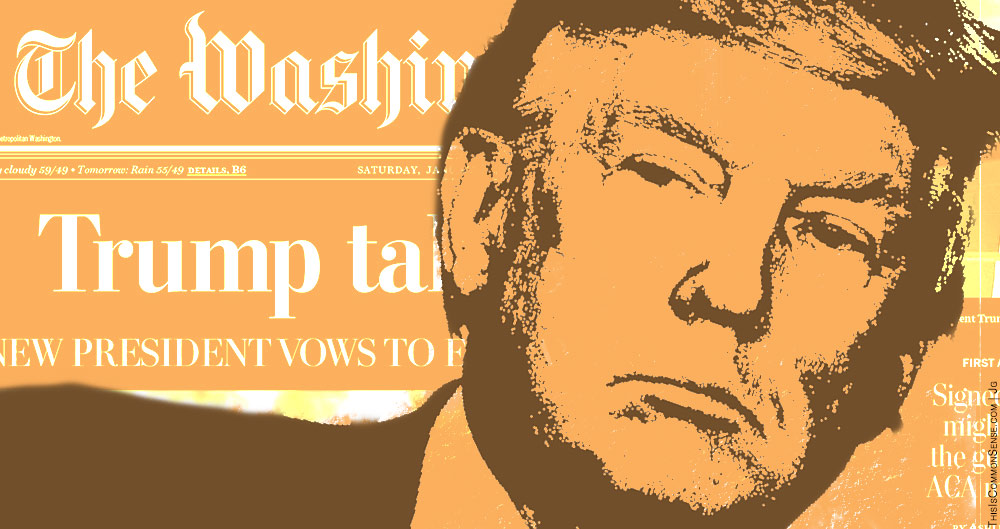
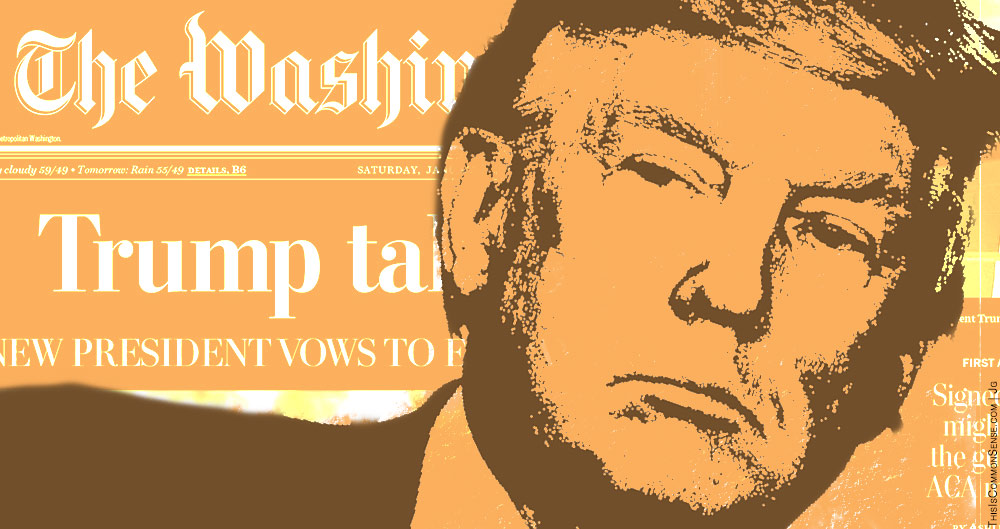
Last week, when President Donald Trump abandoned his previous policy position on getting U.S. troops out of Afghanistan in favor of continuing the establishment-supported policy of keeping those troops there, he was very well-received in our nation’s capital.

NeverTrumper/neo-con Sen. Lindsay Graham (R-S.C.) spoke of Mr. Trump’s “smarts” and “moral courage.”

The #NeverPraiseTrump Washington Post applauded the president’s valiant “self-correction.”

Yet when Trump holds a view contrary to the Washington consensus his wisdom and moral bravery elicit less celebration.

Instead, we hear that The Donald is unfit to command.

“I really question his ability to be — his fitness to be — in this office,” says James Clapper, the former Director of National Intelligence.

“The president has not yet been able to demonstrate the stability,” Sen. Bob Corker (R-Tenn.) concurred, “that he needs to demonstrate in order to be successful.”

And from the usual suspect list of television talking heads we get clinical diagnoses, talk of “erratic behavior and mental instability that place the country in grave danger.”

Mr. Trump combines every bad personality trait imaginable, the litany runs.

But all this is for nought.

Donald Trump has been able to withstand media negativity as well as the lack of support from his own party’s insiders for one simple reason: it validates him.

Every insider attack, every media-fueled outrage campaign, just proves him as the ultimate outsider to a system that the long-frustrated, increasingly angered electorate wants turned upside down.*

This is Common Sense. I’m Paul Jacob.

*This episode of Common Sense condenses my regular weekend remarks at Townhall.

PDF for printing


Categories
Accountability crime and punishment First Amendment rights general freedom media and media people moral hazard nannyism national politics & policies property rights responsibility too much government

Google: Disagreement

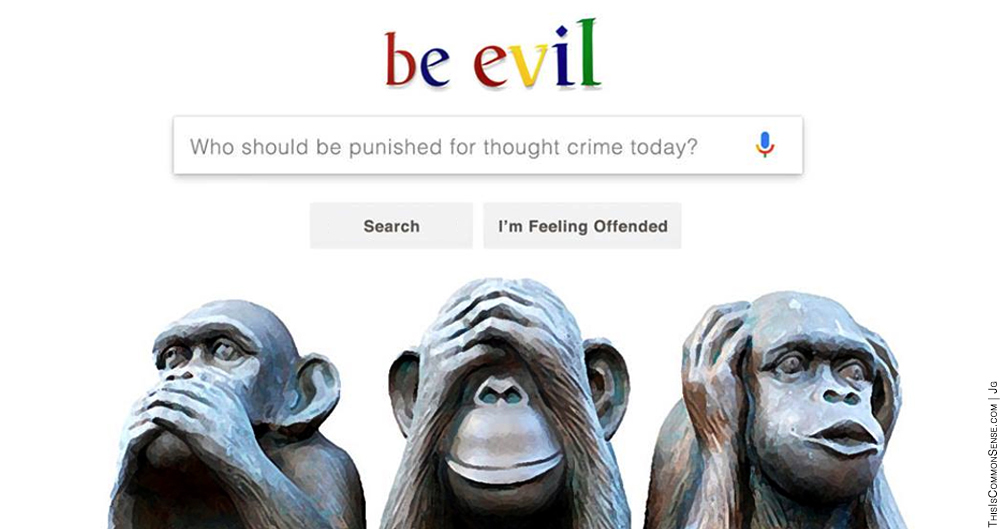
Once upon a time, Google penned a stern note to self: “Don’t be evil.”

What you regard as avoiding evil, though, depends on what you regard as doing good.

Does Google think it’s “good” to fire someone for offering reasoned objections to vapid pieties about why there are more men than women working as programmers, and about how to fix the problem? Assuming it is a problem.

If the answer is yes, then it’s up to more reasonable people to say, “No, Google, stomping on candid internal discussion of your (bad) politics and policies is not ‘doing good.’”

Alas, some Google critics push for a “remedy” worse than the problem: government force. They want government to impose new prohibitions and mandates on large private firms that help people to spread their opinions.

I don’t necessarily agree when a firm — Google, Twitter, PayPal or anybody else — stops providing services to persons expressing views that managers and HR departments disdain. Yet I may agree. No one is morally obligated — and no one should be legally compelled — to help spread the views of others.

I certainly refuse to distribute any installment of “Common Sense” guest-authored by The Anti-Paul-Jacob Club.

When market actors make bad decisions without violating anyone’s rights, others have many powerful and peaceful means of opposing those decisions. Criticism. Boycott. Competition.

But we shouldn’t seek to outlaw the decision-making.

The right to freedom includes no guarantee that one will always do the right thing as others see it.

This is Common Sense. I’m Paul Jacob.


PDF for printing


Categories
Common Sense ideological culture media and media people national politics & policies too much government

The Underground Amphibian

A new species of frog has been discovered, and I’m just happy it has nothing to do with online japes and jibes about Trump, social justice, or an ancient Egyptian deity. But before you can say “Praise Kek,” please note:

Sometimes a frog is just a frog.

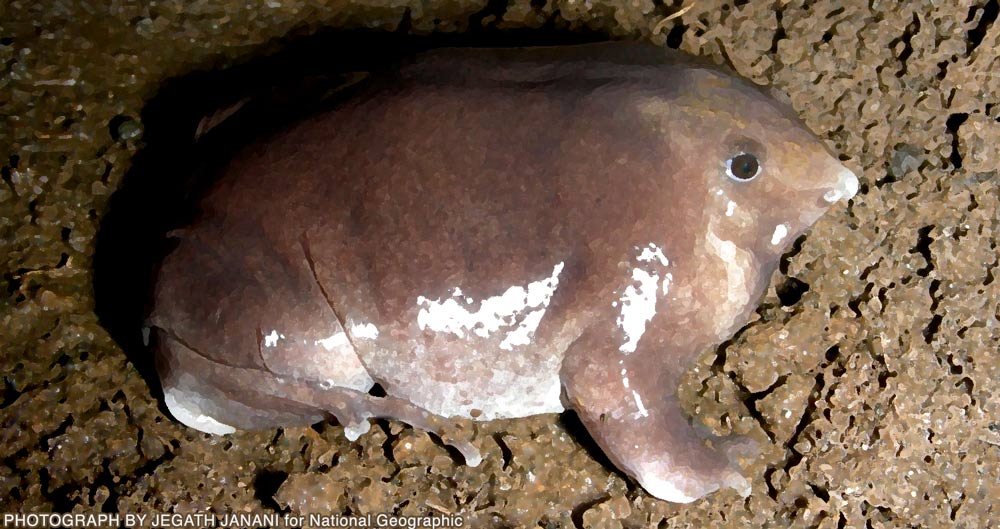
But this frog is special, living most of its life underground. It is purple. And though this is not stressed in the reports, it’s markedly gelatinous.

In an article entitled “New Purple Pig-Nose Frog Found in Remote Mountains,” Jason Bittel explains that the frog comes above ground only when it rains — which in the Western Ghats mountain range in India is during monsoon season.

Named after the discovers’ late colleague, Dr. Subramaniam Bhupathy, it is dubbed Bhupathy’s purple frog (Nasikabatrachus bhupathi). I have to tip my hat to them, so to speak, for the herpetologist’s first name seems more fitting for a submerged-in-earth amphibian: “Subramaniam purple frog” would almost qualify as a pun. And, as readers of these Common Sense squibs will confirm, I am not always so valiant in resisting the art of the pun.

But you don’t read these commentaries for science news.

So, a moral.

Around the world, amphibians are disturbingly under threat. As Alex Jones hyperbolizes, “they’re turning the frogs gay!” But be that as it may (or, more likely, may not), even under greater threat is political common sense.

Let’s hope it, too, will emerge with the coming monsoon.

In India? Your neighborhood? Kekistan?

Probably not in Washington, D.C. But it’s Friday, we can at least hope.

This is Common Sense. I’m Paul Jacob.


Printable PDF


Categories
ideological culture media and media people moral hazard

Is This Even Funny?

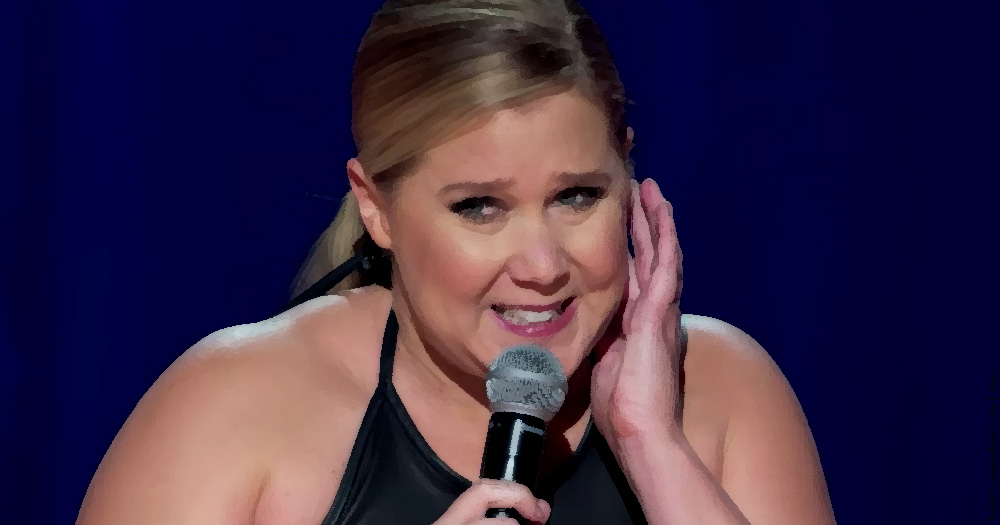
Stand-up comic Amy Schumer made headlines in Variety, this week, for her re-negotiations with Netflix over her recent comedy special, The Leather Special.

It initially garnered her a “mere” $11 million, while, Variety reported, comedians “Chris Rock and Dave Chappelle were given $20 million per special as part of their deals with Netflix,” according to a summary at Vulture.com.* “Schumer then went back and negotiated for ‘significantly more compensation,’” scuttlebutt has it.

After-the-contract negotiations seem weird to me . . . almost . . . indecent.

But then, this might be apt, considering Schumer’s characteristic form of humor, which is almost relentlessly of an intimate sexual nature. Like many another Netflix watcher, I could not finish her special. “Indecent” is the nice word for it.**

The special was so relentlessly panned that Netflix created a new feedback system to discourage viewers from leaving severely negative criticisms and evaluations. It was a big deal months back.

So why did she think she could get more? Though she now denies it, the early reports said she demanded some sort of parity with Rock and Chappelle. And that “equal pay” for “equal work” ethic does seem to be behind the very idea of her ex post negotiating strategy.

The thing is, Rock and Chappelle got more money, obviously, because their ability to make money for their venues is amply proven. Schumer, though she is not without talent and definitely has her partisans, is not as big an audience draw.

Like wages in the normal labor market, it’s about productivity.

And you’d have to pay me to watch The Leather Special in its entirety.

This is Common Sense. I’m Paul Jacob.


* Variety is behind a paywall. I’m quoting Vulture because, like any good scavenger, I’m not paying for Variety.

** No idea whether I would have made it through a special with Chris Rock or Dave Chappelle. I get the impression I’m not in the target audience.


PDF for printing


Categories
Accountability ideological culture media and media people moral hazard national politics & policies

One Way to Do It

While reading CBS’s recent story on Iceland’s success at reducing the number of Down syndrome cases, I was reminded of the Amazon Prime series Man in the High Castle.

The show, based on the celebrated alternative history novel by Philip K. Dick (1928–1982), explores a timeline wherein the Axis powers won World War II. The United States is divided between the Greater Nazi Reich and the Empire of Japan.

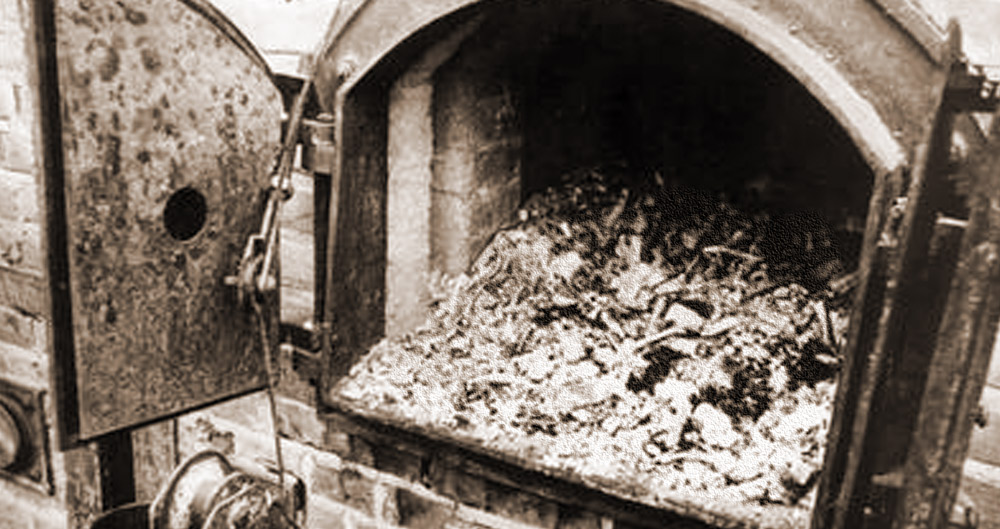
In one scene, one of the protagonists — a hero? a villain? — is stalled on a Midwest country roadside. He smells something in the air. Smoke. Ash.

The very American sheriff explains: it is a local hospital destroying defective humans. The weak, the sick, the disabled.

And we, the viewers, recoil: how evil. Nazis actually execute the weak, the sick, the disabled. Well, they did, in history, not just fiction.

But, as CBS explains, the reason Down syndrome cases are disappearing all over the place, and in Iceland most of all, is not a new cure. Chalk it up to the rise of prenatal screenings. We see fewer Down syndrome people because, before birth, they are executed. Aborted.

In our non-fictional timeline, many Americans are incensed that a few folks proclaiming to be Nazis have been “allowed” to demonstrate in public.

Nazism is evil. I agree.

But how do these morally horrified people react about the very “progressive” and culturally acceptable practice of killing the unwanted?

Think I’ve gone over the top, have abused a revered author to make a point alien to his own? Well, please read Dick’s “The Pre-Persons,” a story about abortion, way post-natal . . . until the age at which a person can understand algebra.*

Quite the moral calculation we make, eh?

This is Common Sense. I’m Paul Jacob.


* That could mean it’s open season for murder as states are moving to drop algebra requirements because so many fail to master the subject. 


PDF for printing


Categories
Accountability folly general freedom ideological culture media and media people moral hazard nannyism national politics & policies too much government U.S. Constitution

Statues and Limitations

“Should they take down the Jefferson Memorial?”

That is what PBS’s Charlie Rose asked Al Sharpton. Now, the “Reverend” is not my go-to source for political insight, but his answer* caught my attention.

“I think that people need to understand that, when people that were enslaved and robbed of even the right to marry and had forced sex with their slave masters, this is personal to us,” replied Rev. Sharpton. “My great-grandfather was a slave in South Carolina . . . Our families were victims of this.”

Asked if this precluded “public monuments” for “everyone associated with slavery,” Sharpton argued: “When you look at the fact that public monuments are supported by public funds, you are asking me to subsidize the insult to my family.”

One can attack the messenger, Sharpton, sure. But what if we instead think of him as our neighbor? I certainly wouldn’t want to insult a neighbor, much less make him pay for the privilege.

Notably, the Reverend embraced privatization, suggesting, “You have private museums.” Privatizing controversial monuments would certainly solve Sharpton’s stated problem.

Of course, the logic behind taking down statues or dismantling the Jefferson Memorial — or merely privatizing them — might also lead to changing the names of cities, counties and states, rivers and mountains. And it’s not just Washington and Jefferson — twelve presidents were slave owners, including Union General U.S. Grant.

Who knows how many are undeservedly memorialized?

Frankly, I’ve never liked the name of my Virginia county: Prince William. A liberty-loving people ought not be stuck with such a monarchial brand.

Let the people decide.

But by vote, not street brawl.

This is Common Sense. I’m Paul Jacob.


* This exchange begins at the 15:22 mark in the interview.


PDF for printing


Categories
Accountability general freedom ideological culture media and media people moral hazard national politics & policies Regulating Protest

Gatekeeping 2.0

There once was opinion hegemony, almost a monopoly. Official gatekeepers kept unwanted ideas — including some of mine, including many I strongly oppose — out of public consideration.

Then came the online media revolution, which switched influence from corporate, academic-approved media outlets to truly new media, like Facebook, Twitter and YouTube.

And now? The counter-revolution.

We saw it obviously in the downgrade and then banning of Milo Yiannopoulis’s Twitter, last year. Since then, new measures surface on a regular basis.

We helots, we commonfolk, must not be allowed actually to affect an election!

Or the hearts and inquiring minds of Americans, Europeans, and others worldwide.

Unless that opinion has received the imprimatur of the Center-Left.

I’ve written about this return of the Gatekeeper mentality before. The latest malefactor is YouTube, which locked Dr. Jordan Peterson out of his account this week* as well as put in place new policies to hobble the social sharing elements of YouTube.**

A week or so earlier, Patreon, an online crowdfunding patronage web service I’ve been thinking about trying out, cancelled independent journalist Lauren Southern’s account. Patreon managers charged that her most recent endeavor might cause “loss of life,” but, tellingly, “showed no evidence or proof, are allowing no appeal and have acted as judge, jury and executioner” — as one concerned netizen not inaccurately summarized.

The company’s CEO calmly explained himself to Dave Rubin on YouTube. Does he convince you?

I catch a whiff of panic.

This is Common Sense. I’m Paul Jacob.


* Dr. Peterson’s account has since been reinstated, no explanation given.

** You can learn all this and more on YouTube itself — so the platform hasn’t been shut down as such. Instead, a new Artificial Intelligence will restrict videos that do not even break YouTube terms of service, removing Likes, Comments, and Search features.


PDF for printing


Categories
education and schooling free trade & free markets general freedom ideological culture media and media people national politics & policies privacy property rights responsibility too much government U.S. Constitution

According to Economics

“Everywhere you look, economics is despised,” writes Tom Woods in his Tuesday email letter.

You know what isn’t despised? A daily email letter.*

But I digress; back to economics.

“The gimme-free-stuff people hate it because they don’t like being told that there might be undesirable side effects from seizing other people’s things.”

Well, true enough. But turn it around: many people demand free stuff at least in part because they do not understand the bigger picture . . . which Mr. Woods ably provides in his daily podcast and on his weekly Contra Krugman podcast with economist Bob Murphy.

“Politicians hate it, because it imposes logical constraints on what political activity can accomplish.”

True, but, like many in the general public (from whence they come), politicians’ prior lack of economic knowledge also leads, in part, to their hubris.

“Even some folks in the business world hate it, because (1) they’d rather agitate for special privileges than hear the case for free markets, and (2) they’d rather have low interest rates than be warned about the causes of the business cycle.”

Yes, too true. But, again, business people are generally just people, most of whom haven’t even been exposed to something beyond boring and misleading textbook econ, if that. Mr. Woods knows that, since that’s what his mission is, exposing more folks to ideas beyond what he calls “the index card of allowable opinion.”

Well, I’m all about allowing the unallowable — if it’s right!

This is Common Sense. I’m Paul Jacob.


* Historian Woods is now doing what I’ve been doing since 1999, providing a daily common-sense thought that is short and easy-to-read and dropped into your email box every weekday. Mine goes up online at ThisIsCommonSense.com; I don’t see his on his website . . . but I do see a lot of books and podcasts!


Printable PDF


Categories
Accountability folly free trade & free markets ideological culture media and media people national politics & policies

Next Bubble to Pop?

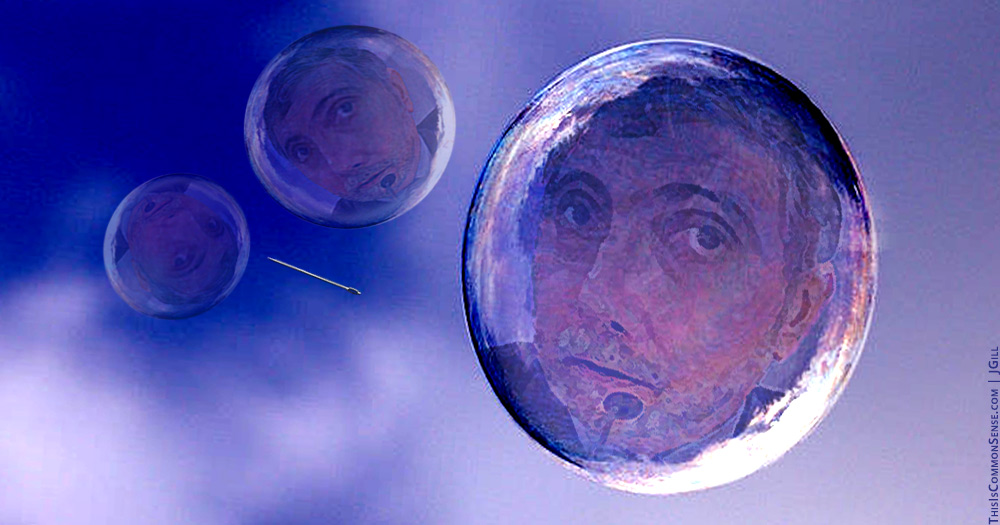
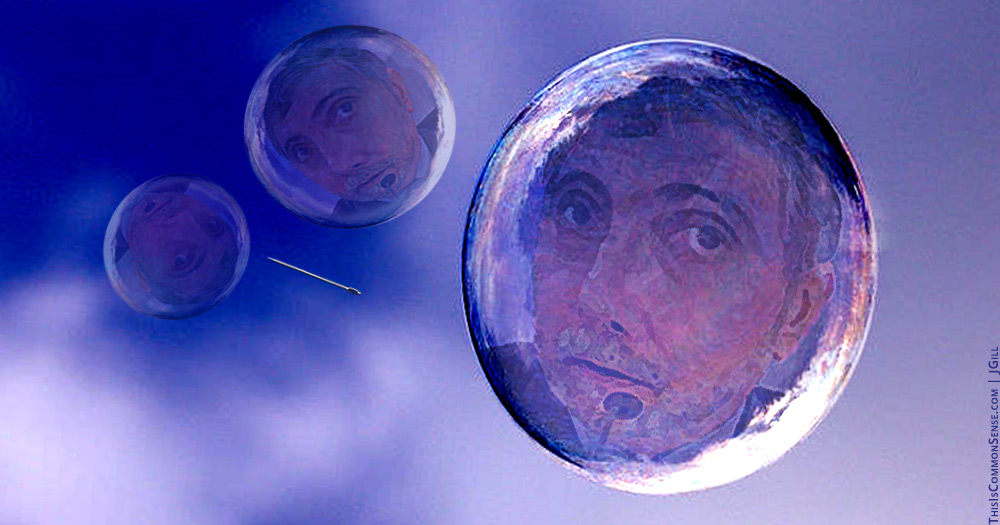
There was a great and wondrous moment, a decade and a half ago, when economist Paul Krugman, Nobel Laureate and New York Times’s unregistered shill for the Democratic Party, suggested that what the economy really needed was another housing bubble.

What he wrote, specifically, was this: “To fight this recession, the Fed needs more than a snapback; it needs soaring household spending to offset moribund business investment. And to do that, as Paul McCulley of Pimco put it, Alan Greenspan needs to create a housing bubble to replace the Nasdaq bubble.”

Krugman later reinterpreted that statement in a clever (if not convincingly honest) way. After the subprime loan industry collapsed in 2008, he attributed that bust to financial market malfeasance, not the Fed-inflated bubble we got . . . and that he had previously called for.

Now we are looking at several ready-to-burst bubbles:

  • The student loan debt problem seems scary.
  • The sovereign debt problem is undoubtedly more dangerous and far larger, but is perhaps still able to take on more fake money — all the world’s 1s and 0s have to go somewhere!
  • So the current bets seem to be on a huge auto loan industry bubble, about to pop.

Loan terms have increased in duration, and the average amount new car buyers are financing has jumped over 17 percent in five years. The idea has been “to continually lower monthly payments,” says David Stockman, “so people can get behind the wheels of vehicles they can’t really afford.”*

Which bubble does Krugman favor? I don’t have the stomach to check.

But, be certain, as we play pop goes the bubble, he’ll play pop goes the weasel.

This is Common Sense. I’m Paul Jacob.


* Stockman seems to be echoing warnings made by Eric Peters, of Eric Peters Autos.


Printable PDF


Categories
folly ideological culture media and media people meme national politics & policies

CNN, You’ve Been Trolled

The Cable News Network, known popularly and un- as CNN — and satirically as the “Clinton News Network” and “Fake News” — so hysterically hates the president that it has become completely unhinged.

Well, unhinged from decency and journalistic standards, anyway.

The latest slips downward?

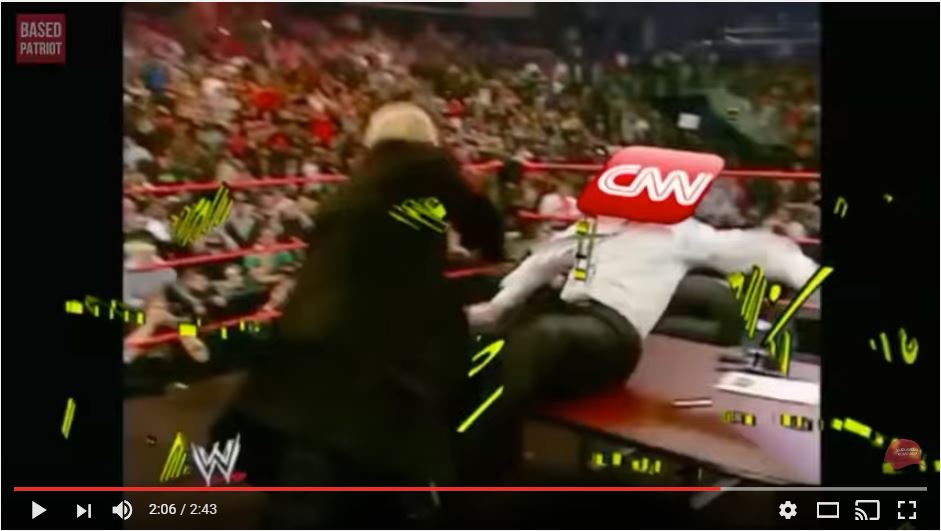
First, some pseudonymous guy* on Reddit created a little gif** that placed a CNN-logo on the head of a wrestler whom Donald Trump “took down” in some weird bit of nonsense publicity the entertainer-entrepreneur was prone to, pre-presidency. Trump then retweeted a version of the gif, calling CNN (once again) “fake news.” This made CNN look silly,*** so CNN tracked the originator down and pressured him to make a humiliating apology — for it and other, more tasteless contributions. He deleted most of what he had done on Reddit.

CNN looks petty: a bully. And clueless about the free-for-all that is the Internet.

The Twitterverse erupted against the news outfit.

This went super-viral on July 4, the same day that CNN tried to humiliate Mr. Trump by tweeting a quote from Abraham Lincoln: “Let the people know the facts, and the country will be safe.”

How apt!

And yet . . . Lincoln did not say it. Not exactly. The “fake news” network faked a presidential quote.

CNN apparently doesn’t understand that responding to trolls feeds the trolls and makes you look bad, to boot.

I suppose you could blame Trump for all this. His ridiculous tweets and whoppers have so corrupted the culture that his enemies (CNN being the obvious media leader) have adopted his methods.

But I won’t. Not this time.

Just blame the people at CNN.

This is Common Sense. I’m Paul Jacob.


* He referred to himself as a “shitposter,” which is what satirists and trolls on the Web are called.

** A “gif” is an image file, and has been around since the beginning of the World Wide Web. Nowadays, when we talk about “gifs” we usually are referring to brief animated gifs.

*** Frankly, it made the president look silly, too.


PDF for printing

CNN, Trump, meme