Categories
Accountability folly ideological culture media and media people moral hazard national politics & policies privacy property rights responsibility too much government

A Hailstorm of Orthodoxy

Don’t worry, scientist Roger Pielke, Jr., informs us. He is doing fine — he has tenure.

It is too bad, though, that he no longer works in climate science.

He was drummed out of that endeavor by journalists, big-monied foundations, and the White House.

Climate Scientist

Are you skeptical? Well, drill down into the Podesta emails on WikiLeaks. There you can read infamous billionaire Tom Steyer gloating, “I think it’s fair [to] say that, without Climate Progress, Pielke would still be writing on climate change for 538,” a popular website. Pielke has not been published there at all since 2014.

Pielke had made the mistake of publishing the results of his research. He claims not to be heretical on the main points of the current orthodoxy. But Pielke ticked off all the wrong people with his demonstration that the evidence did not back up the climate change movement’s much-repeated charge that the weather has gotten more traumatic as the planet has gotten warmer.

Pielke relates all this in a fascinating Wall Street Journal commentary, “My Unhappy Life as a Climate Heretic.” Pielke is actually somewhat philosophical about the political and foundational forces arrayed against him — expressing more dismay at his betrayal by journalists and academics.

“You should come with a warning label,” jested one journalist who had merely quoted him. “Quoting Roger Pielke will bring a hailstorm down on your work from the London Guardian, Mother Jones, and Media Matters.”

This “hailstorm” is more widespread and damaging than the results of global warming itself. It effectively distorts both scientific research and the news.

Thus, a political orthodoxy rides herd over public opinion. Over us. By squelching good journalism and honest science.

This is Common Sense. I’m Paul Jacob.


Printable PDF

global warming, climate change, skeptic, Pielke, science, illustration


Categories
ideological culture media and media people moral hazard nannyism national politics & policies porkbarrel politics responsibility too much government U.S. Constitution

Diversity, Identity, and the Liberal Implosion

“To paraphrase Bernie Sanders, America is sick and tired of hearing about liberals’ damn bathrooms.”

Finally. Some sense from the New York Times.

Mark Lilla, in “The End of Identity Liberalism,” delivers a valuable lesson about political correctness — without once mentioning the term “political correctness.”

Now this is a lesson we can get behind.

The problem is “diversity.” The center-left became so obsessed with it that it helped sink the last election for Hillary Clinton, Democrats at large, and the coherence and legacy of President Barack Obama.

“However interesting it may be to read, say, about the fate of transgender people in Egypt,” Lilla wrote in the Friday think piece, “it contributes nothing to educating Americans about the powerful political and religious currents that will determine Egypt’s future, and indirectly, our own.”

Fixating on diversity of gender identity and racial make-up in business and government has scuttled the rights-oriented approach of the older liberalism.

Alas, Lilla is not talking about the liberalism of J.S. Mill or Lord Acton. He is talking about FDR.

But compared to today’s “identity liberalism,” FDR’s burdensome promises look like sheer genius. And Lilla understands at least one thing about diversity: “National politics in healthy periods is not about ‘difference,’ it is about commonality. And it will be dominated by whoever best captures Americans’ imaginations about our shared destiny.”

He does not bring up the real liberal message: that the way to find commonality is to avoid making government all things to all people. It is to limit its scope, instead, so the president of the United States isn’t every school’s bathroom monitor.

Perhaps an essay on The End to Hubristic Liberalism is required?

Another day. And probably another paper.

This is Common Sense. I’m Paul Jacob.


Printable PDF

identity, diversity, politics, individualism, rights, individual, illustration, crowd


Original (cc) photo by James Cridland on Flickr

Categories
Accountability general freedom ideological culture media and media people nannyism Regulating Protest responsibility too much government

Tyranny’s Days Are Numbered

Fidel Castro, the Cuban dictator for half a century, died Friday night.

“Although Castro was beloved by a legion of followers,” The Washington Post acknowledged, “detractors saw him as a repressive leader who turned Cuba into a de facto gulag.”

Many on the American left — especially in Hollywood — have been surprisingly enamored of Castro, and the supposed “accomplishments” of better education and healthcare delivery in his socialist paradise.

I guess we must all weigh whatever policy advances were made against Mr. Castro’s faults.

As the New York Times detailed: “Foreign-born priests were exiled, and local clergy were harassed so much that many closed their churches. . . . a sinister system of local Committees for the Defense of the Revolution that set neighbors to informing on neighbors. Thousands of dissidents and homosexuals were rounded up and sentenced to either prison or forced labor. . . . jailing anyone who dared to call for free elections. . . . imprisoning or harassing Cuban reporters and editors.”

Fidel Castro’s death reminds me of Irving Berlin’s jazz tune about Adolf Hitler, When That Man is Dead and Gone:

What a day to wake up on

What a way to greet the dawn

Some fine day the news’ll flash

Satan with a small mustache

Is asleep beneath the lawn

When that man is dead and gone

Saturday morning, that news finally flashed for Cuban Americans in south Florida. Followed by jubilation. Horns honking. Smiles, cheers and songs. Jigs were danced.

Fidel Alejandro Castro Ruz — that dictator, the person who imprisoned and murdered many seeking freedom — is dead and gone.

For now, sadly, his brand of tyranny continues through brother, Raúl Castro. But its days, too, are numbered.

This is Common Sense. I’m Paul Jacob.


Printable PDF

Castro, death, Cuba, Communism, freedom, illustration


Categories
free trade & free markets general freedom ideological culture media and media people

In the Black

“Black Friday,” reads a meme making the social media rounds. “Because only in America [do] people trample each other for sales one day after being thankful for what they already have.”

Thankfulness is vital, I agree. But I’ve been up at the crack of dawn to “cash in” on Black Friday sales, and I’ve never witnessed any violence of any kind. Not a smidgeon. Not that it doesn’t happen — we’ve all seen the videos. It just isn’t the usual experience.

In fact, the camaraderie of strangers is one of the endearing aspects of standing in line waiting for a big box store to open at some forsaken hour.

Trust me, I’m decidedly not an enthusiastic shopper, so participating in Black Friday wasn’t my idea. My youngest daughter wanted to experience it. And taking a businesslike approach to Christmas shopping, she needed the savings. I liked her interest and initiative and so I said, yes, to getting up at 5:00 am.

But after staying up late talking with friends and relatives, that early alarm hit hard.

What I liked, in order, were: being with my daughter, our sleep-deprived sense of humor, the rush of doing something new, and a comforting visit to Starbucks.

For years, I rode this father-daughter Black Friday fast lane. But not this year. At age 17 (her, not me), with her social life and work, she’s got better things to do than partake in dawn shopping raids.

Still, if she ever asks me to go with her on Black Friday, I’ll be up and at ’em, thrilled for the opportunity.

Why? I know what I’m thankful for. What really matters.

This is Common Sense. I’m Paul Jacob.


Printable PDF

Christmas, Black Friday, family, values, trample, hypocrisy


Categories
ideological culture individual achievement nannyism responsibility too much government

Don’t Dress for Excess

Undoubtedly, men have it easy in several ways that women do not. Take something only seemingly trivial: clothing.

When men need to dress to impress, the answer is simple: a suit. There is not really a lot of variety here, and little is required of a man in his choice of suit.

Women, on the other hand, do not have a business and formal occasion uniform to rely upon.

Instead, they have fashion.

Which is a whirl of constant change and a world of enervating expense.

I wouldn’t put up with it. But then, I’m a man. The modern dress suit was developed to meet men’s needs for functionality as well as excellence. And our need to not think hard on a matter of mere garment.

So it is with no small pleasure to read, in the Telegraph, of a professional woman who forswears fashion to wear just one design of clothing. “‘I can tell you the cashier in the store look[ed] pretty confused when I asked if she had 15 extra sets of the whole outfit,’ she jokes, ‘but all in all, choosing the uniform was a pretty pain-free process.’”

And the style choice seemed obvious: “I’ve always felt that black and white is a cool and classy look,” so that’s what she went with.

She made herself culturally equal with men. Took for herself a formerly all-male advantage. And she did not depend upon a man for that advance, he-for-she style.

And did not look to government.

This is the way forward.

This is Common Sense. I’m Paul Jacob.


Printable PDF

fashion, government, suits, illustration


Categories
general freedom ideological culture nannyism national politics & policies Popular too much government U.S. Constitution

The Venezuela Chaos

I have friends who call themselves anarchists. Their theory? Government is always merely an open conspiracy of some to live at the expense of others.

Republicanism, on the other hand, proposes that if we limit government, we can hone it down to the level where there is no conspiracy, and everything the government does can plausibly help everybody.

Not just a few insiders.

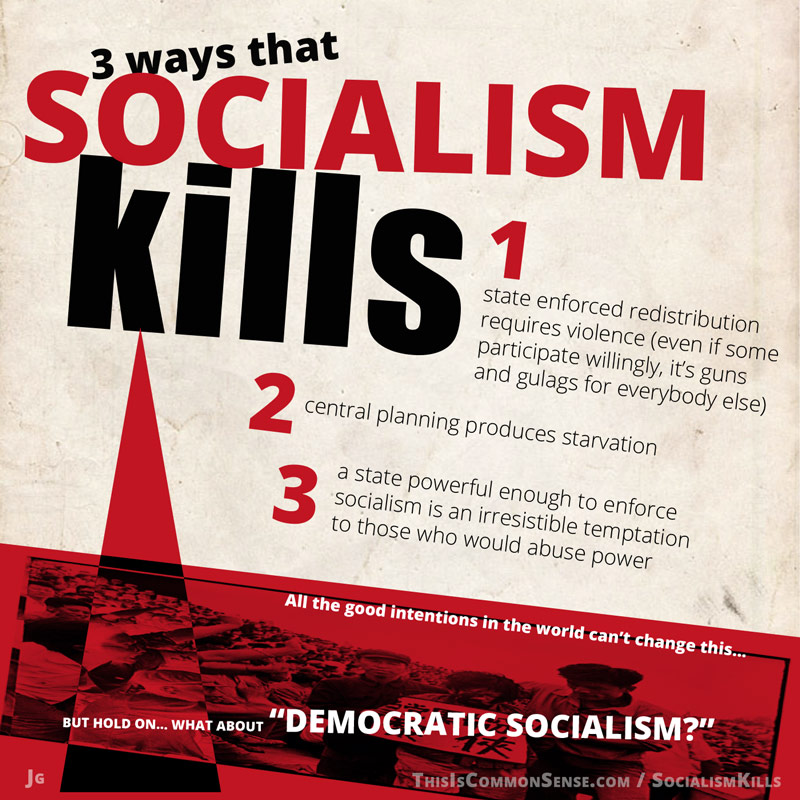
Socialism is the opposite notion. Socialists seek to grow government so far that it “naturally” serves everybody, not only the few. It’s all about “equality,” you see.

Here’s what we know for sure: socialism, when really tried, is so awful that it makes anarchy-as-chaos sound good.

The latest socialist horror is Venezuela, which is getting worse every day. Now hospitals place newborns in cardboard boxes. There are no other supplies.

But that’s not all. The special program for feeding everybody? It’s now mainly for feeding just those close to the government — precisely as my anarchist friends say all government is:

Six months after the creation of the Local Committees of Supply and Production (Clap) that is designed to “distribute food directly to the people,” the government has decided to change its approach by threatening those using the program.

The Venezuelan government announced that it will suspend delivery of food packages to those who criticize its policies.

Are socialist out to prove anarchists right?

I bet most of my readers still put some hope in limiting government to serve all. Venezuelan socialism demonstrates how badly the opposite idea is, showing us that serving everybody by total government just decays into the folks allied closely with government warring against everybody else . . . who starve in plain sight.

This is Common Sense. I’m Paul Jacob.


Ask the next question.

Questions Answered:

What is the difference between a republic and a socialist state?

What do anarchists think of government?

What happens when government tries to do everything for everybody?

The Next Question:

How do we convince well-meaning socialists that total government cannot work for the benefit of everybody? (Since the examples of the USSR, Communist China, and Venezuela haven’t worked so far.)


Printable PDF

government, bathtub, Venezuela, illustration


Categories
ideological culture national politics & policies political challengers

Double Bubble America

The “unexpected” Donald Trump presidential victory has put the folks at The Gray Lady a bit out of sorts.

Heather Wilhelm at the National Review pokes and prods at the absurdities of the New York Times’s cultural cluelessness. And ably enough. So I’ll stick to The Times’s recent “six views” of America’s ideological divide:

Julie Turkewitz recognizes two well-insulated informational bubbles at play. Nothing too controversial — or very deep.

Campbell Robertson muses upon the dominance of the “elites” against which Trump’s insurgents rebel, noting that “the elites are the still the ones who get to decide who gets to be elite.”

Laurie Goodstein takes on religious culture, making much of divergent spiritual outlooks, left and right.

Julia Preston peers at immigration and the prospect of sending a message by building a “wall.”

In the manner of the other five, Sheryl Gay Stolberg digs up real-world people — as does our speechifier-in-chief, Barack Obama — to lightly probe questions of assimilation versus multiculturalism.

Manny Fernandez concludes with a (yawn) discussion of giving and taking offense.

They all miss the underlying structural basis for the divide.

On one side: folks working in the private sector — or local governments and charities, or at home — who have seen the world pass them by in terms of income and security.

On the other: government workers and consultants (and other college grads) who make more, on average, than their “real world” counterparts.

The latter has advanced as a class; the former remain in stasis . . . at best.

A mystery?

No — it’s the predictable result of what Thomas Jefferson called “the parasite institutions now consuming us.”

This is Common Sense. I’m Paul Jacob.


Printable PDF

bubble, Trump, election, reasons, explanations, illustration


Original (cc) photo by diana MĂRGĂRIT at Flickr


Categories
ideological culture meme national politics & policies too much government

Warren and the Bogeyman State

“…the bogeyman government is like the bogeyman under the bed. It’s not real. It doesn’t exist.”

—Elizabeth Warren


Citation:

Categories
Accountability general freedom ideological culture moral hazard national politics & policies political challengers responsibility too much government U.S. Constitution

The Wisdom of the Founders

“At a certain point, you have to let go for the democracy to work,” President Barack Obama told HBO’s Bill Maher last week, praising “the wisdom of the founders.”

“There has to be fresh legs,” he continued. “There have to be new people. And you have to have the humility to recognize that you’re a citizen and you go back to being a citizen after this office is over.”

Maher failed to ask Mr. Obama how this “fresh” viewpoint squared with his support for Mrs. Clinton. Nevertheless, let’s applaud the president’s endorsement of term limits.

Speaking of the founders, and limits on power, and this being Election Day, I’m reminded of a commentary in Forbes, back on Election Day four years ago, written by Ed Crane, the man who built the Cato Institute into one of the nation’s preeminent think tanks. Bemoaning the “interminable presidential race,” Crane wished for “a nation in which it really didn’t matter who was elected President, senator or congressman.”

“Don’t get me wrong, because I’m not saying it doesn’t,” explained Crane, “only that it shouldn’t.” He added, “I believe the Founders had a similar view.”

His point is simple: Getting to vote for your next president and senator and congressman is swell, but it’s important to have a Constitution that restrains those elected, so they “don’t have a heck of a lot of power over you or your neighbors.”

“We are a republic of limited governmental ­powers,” or should be, argued Crane. “Such a nation allows for sleep on election night.”

Instead of gnashing of teeth.

This is Common Sense. I’m Paul Jacob.


Printable PDF

Constitution, voting, democracy, Ed Crane, fear


Categories
folly government transparency ideological culture media and media people nannyism national politics & policies

The Problem with Ruth Marcus

Channeling The Sound of Music’s Mother Superior, Washington Post columnist Ruth Marcus asks, “How do you solve a problem like Bill Clinton?”

Marcus means Bill’s problematic possible return to the White House, the scene of his crimes, as First Dude in a new Clinton Administration — specifically his difficulties with “the twin minefields of sex and money.”

Starting with sex, Marcus argues that, “Trump’s misbehavior with women is a far more important topic than Clinton’s” because “Trump is on the ballot; Bill Clinton is not.”

True, except that Mrs. Clinton has promised to place Mr. Clinton “in charge of revitalizing the economy,” which Mrs. Marcus called “crazy.” Maybe, but it wasn’t Trump’s idea to ballyhoo the old two-for-one Clinton couple “advantage.”

“There is no condoning a record that reflects not just serial adultery, but abuse of power,” writes Marcus. Yet, she does precisely that by adding, “Clinton was a successful president who deserved the two terms for which he was elected, but his misbehavior would disqualify him from a third term even if the Constitution allowed it.”

What?! Quite a convenient drawing of the line, eh?

Of course, the problem isn’t merely Bill, as the columnist admits: “[I]t has become clear that they cannot be trusted to appropriately navigate ethical boundaries between their private interests and public responsibilities.”

Complaining about the “incessant schnorring for private jets, luxury vacation lodging, expensive trifles” by the Clintons, Marcus warns that, “It cannot happen in a new Clinton White House, especially with a Republican Party already drooling over the prospect of congressional investigations.”

But, Ruth, how will electing Hillary Clinton the next president cause Bill & Hill to change their ways?

This is Common Sense. I’m Paul Jacob.


Printable PDF

Bill Clinton, First Gentleman