Categories
Accountability crime and punishment folly general freedom ideological culture media and media people moral hazard nannyism privacy property rights responsibility tax policy too much government U.S. Constitution

Brave New Paternalism

Michael Bloomberg is rich. He’s also in politics — a public health crusader.

And, for years, he “has personally funded and promoted all sorts of regressive taxes and regulations in an attempt to push people around,” the folks at Americans for Tax Reform tell us. “He uses the coercive power of the government to force people to live their lives as he sees fit.”

Onstage at a globalist event, One-on-One with Christine Lagarde — who is managing director of the International Monetary Fund — Bloomberg blurts out his approach to government policy regarding what he calls “those people.”

“If you raise taxes on full sugary drinks,” he says, “they will drink less and there’s just no question that full sugar drinks are one of the major contributors to obesity and obesity is one of the major contributors to heart disease and cancer and a variety of other things.”

Against the charge often made that such taxes fall heaviest upon the poor, he is forthright. Regressive? “That’s the good thing about them because the problem is in people that don’t have a lot of money.”

Notice that he is not talking about a public service campaign to help people learn how to drink (and eat) better. And he is not talking about removing all the government policies that have encouraged bad eating and drinking habits (as well as lethargy) — the government programs to encourage the overuse of high fructose corn syrup; the welfare state’s poverty trap that stifles life at the lower incomes; the subsidized consumption of food and drink — he wants to add another government program.

He can only see betterment by increased governmental bullying.

This is Common Sense. I’m Paul Jacob.



PDF for printing

Michael Bloomberg, tax, policy, nanny state, vice, social engineering, statist, technocrat

Photo by Center for American Progress

Categories
Accountability folly general freedom ideological culture moral hazard responsibility U.S. Constitution

China Marks Marx Anniversary

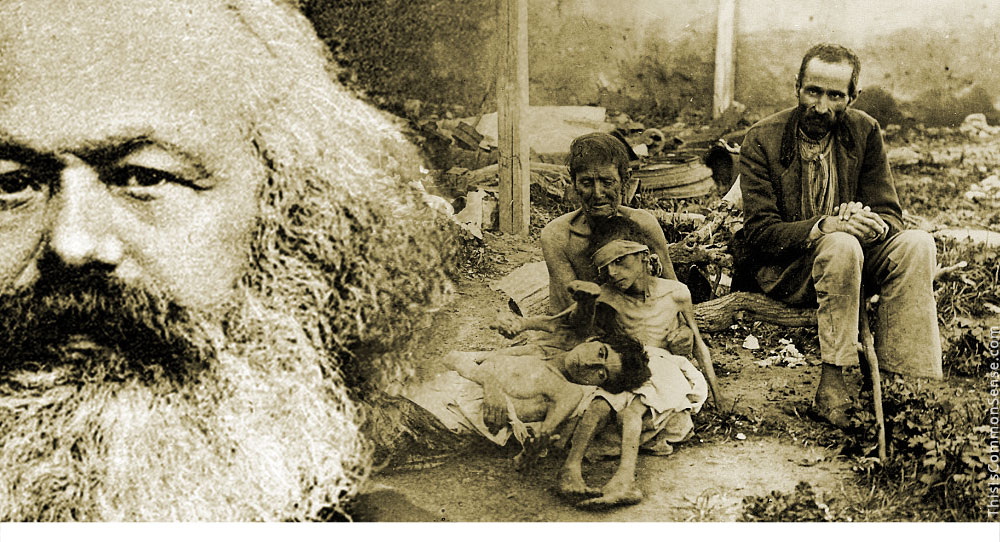
The Chinese government has sought to honor the birth of Karl Marx (1818-1883) by giving a giant bronze statue of the social philosopher and pseudo-economist to the German city of Trier, his birthplace.

Agreeing that Trier and Marx should be thus honored, local officials shamefully accepted the donation.

Marx was a bad guy. His willfully destructive anti-capitalist theorizing and polemics have been enlisted to enslave and murder many millions of people in the Soviet Union, China, Cambodia, Cuba and elsewhere. The story is told in works like Modern Times and The Black Book of Communism. One effective critique of Marxian ideas may be found in the second volume of Murray Rothbard’s History of Economic Thought.

We often hear that Communist implementation of Marxian theory poorly translates “real” communism/socialism/collectivism. No government unswervingly enacts all the ideas and prescriptions of a single intellectual founding father. But there is much in Marx’s volumes that openly demands the razing of the division of labor, profit-seeking, and other requirements of civilization.

In one article, Marx scribbled that “there is only one way in which the murderous death agonies of the old society and the bloody birth throes of the new society can be shortened, simplified and concentrated, and that way is revolutionary terror.” There’s plenty more where this came from.

When a major nation-state gives a town a statue, it’s hard to say no. But one needn’t accept it at face value. Install it on a base that lists the separate bouts of Marx-inspired mass murder. Or use it as a target in paintball tournaments.

Or just place it in the local cemetery. Where deadly ideologies should go.   

This is Common Sense. I’m Paul Jacob.
 

PDF for printing


Categories
Accountability crime and punishment general freedom ideological culture moral hazard nannyism national politics & policies privacy too much government U.S. Constitution

Hooray for Congress!

When Congress behaves badly, I criticize. When it works well, I applaud.

I’ve waited a long, long, long time to put my hands together in polite applause.

It happened yesterday.

The U.S. House of Representatives passed a Senate bill, largely along party lines, to give those facing a terminal illness the “right to try.” That is, the right to try experimental drugs and treatments that haven’t yet been approved by the federal Food & Drug Administration (FDA). 

Of course, Congress doesn’t actually give us rights. We have always had the common law right — indeed, the human right — to freely seek a path to wellness when we are ill.

From time immemorial. Even before the FDA.

So, this legislation was, more correctly put, a way to announce that the congressionally-created FDA would stop blocking our freedom . . . provided we are dying and the government-approved medical establishment has no more licensed hope to offer.

The bill now goes to President Trump. “People who are terminally ill should not have to go from country to country to seek a cure,” he declared in his last State of the Union, “I want to give them a chance right here at home.”

Democrats overwhelmingly disagreed. 

“This will provide fly-by-night physicians and clinics the opportunity to peddle false hope and ineffective drugs to desperate patients,” argued Rep. Frank Pallone (D-N.J.).

Rep. Jan Schakowsky (D-Ill.) likewise charged that the legislation “puts patients at risk by allowing the sale of snake oil.”

But of course these patients are dying. That’s already as “at risk” as it gets. Our right to live includes a right to try to live.

This is Common Sense. I’m Paul Jacob.
 

PDF for printing


Categories
crime and punishment education and schooling general freedom ideological culture responsibility Second Amendment rights too much government

What to Do

Another school shooting — more dead and injured, many more terrified by the violence. And, in its wake, more demands for

  • gun control,
  • schools as hardened targets, and
  • mental health initiatives.

Oh, and finger-pointing at video games, too.

So what should we do?

  1. Stop publicizing the names of these school shooters and plastering their faces all over the media.

I’m specifically not calling for any new law or government regulation. These criminals’ names must be publicly available. Let’s not reduce transparency in government one iota. Instead, let’s demand that our favorite media do the public-spirited thing: don’t make these killers personally infamous. I’ve written about this danger, which even the ancients recognized, before.

  1. Fix the background check database. The main system for preventing bad people from getting guns relies totally on checking gun purchasers against a database that is full of holes.

Late last year, a man convicted of domestic violence and with documented mental health issues passed the background check to purchase the weapon he used to murder 26 people in a Texas church. The Air Force had failed to transmit his criminal record to the FBI. If our elected officials, on both sides of the “gun control” issue, are serious about saving lives, they will concentrate first on making certain the background check database is complete, and systematically updated.

  1. Give students greater choice.

Being a teenager isn’t easy. The more choice they have in the schools they attend and the type of bullying education they receive, the better — not only for their education, but for their mental well-being, too.

Let’s face it: we cannot prevent all future acts of violence. And should be wary of those who claim they can. Still, we can take action. 

This is Common Sense. I’m Paul Jacob.

 

PDF for printing


Categories
Accountability crime and punishment education and schooling ideological culture national politics & policies responsibility Second Amendment rights

Cowards All Around

Just-retired Scot Peterson is a millionaire, thanks to the generous taxpayers of Broward County, Florida.

You know Peterson as the sheriff’s deputy assigned to protect students at Marjorie Stoneman Douglas High School, who, instead of entering the building where the shooter was mowing down 17 unarmed students and teachers, protected himself by waiting outside.

Peterson claimed “he remained outside the school because he didn’t know where the gunfire was coming from,” noted BuzzFeed. But “[r]adio transmissions from the day of the shooting have since contradicted Peterson’s defense . . .”

Following the cowardly non-performance of his duty, Peterson promptly retired and began drawing his pension. As the Sun Sentinel newspaper reported Tuesday, his monthly check is for $8,702.35 — an annual salary of $104,428.20.

Should the 55-year-old live to the age of 75, he’ll draw more than $2 million.

In fact, the cowardly Peterson is being further rewarded with a $2,550 annual raise — earning more in retirement than he was earning while actually working.

I use the word “earning” and the phrase “actually working” loosely.

Reacting to the news, the father of one of the murdered students called Peterson’s lavish pension “disgusting” and “outrageous.”

Recoil at the thought of this derelict policeman raking in such mega-moolah during decades of retirement — but that isn’t the only outrage.

How can Broward County afford to pay even their bravest police officers millions of dollars in retirement?

They can’t . . . for much longer.

Regardless, elected officials dare not do anything about it. They fear incurring the wrath of public employee unions . . . and risking their own pension windfalls.

This is Common Sense. I’m Paul Jacob.



PDF for printing


Categories
Accountability folly free trade & free markets ideological culture local leaders moral hazard nannyism property rights too much government

Amazon’s Jeff Bezos Is …

A half a year ago, when trying to make sense of the much-publicized search for Amazon’s “HQ2” — a second headquarters city, away from Seattle — I concentrated on the subsidies that cities and metro areas were apparently throwing at Amazon.

It all seemed desperate, indecent.

But there was a story behind the story. Amazon has every reason to be looking for an escape route from the Evergreen State’s biggest city.

The city’s leadership is nuts.

“Seattle City Council members have finally released draft legislation,” the Seattle TimesDaniel Beekman wrote last month, “for a new tax on large employers that would raise $75 million next year to address homelessness.”

The council blames the big companies for enticing workers into the city, thereby driving up rental costs and housing prices.

The tax would be on employee hours, would go into effect next year, and “in 2021, it would be replaced by a 0.7 percent payroll tax on the same category of companies,” explains the Seattle Times.

Now, if you tax something you discourage that something. That’s why progressives like sin taxes on sodas and fast foods. To discourage consumption.

So when progressives seek to tax big producers, they are apparently trying to tax away the housing crunch by driving away big business.

Amazon reacted. It put a halt to an expansion project.

“Jeff Bezos is a bully,” said Kshama Sawant, the confessed socialist, speaking for the council. “I think we are in broad agreement on that.”

If that is her attitude, and that of the council — and the consensus of the city’s denizens — then what Amazon’s Jeff Bezos really is?

A “good businessman.”

This is Common Sense. I’m Paul Jacob.



PDF for printing

Photo by JD Lasica


Categories
education and schooling general freedom ideological culture moral hazard nannyism national politics & policies too much government

Grading Democracy on the Curve

Voters, we are told, are amazingly ignorant. So, what to do?

“Ultimately, the ideal democracy is one in which as many citizens as possible vote,” writes Dambisa Moyo at The Guardian, “and the voters are armed with the most objective information. Yet today only a fraction of the electorate are voting, and many are armed with a diet of hyped-up statistics and social media propaganda.” Among her proposals is a voting booth access test: “why not give all voters a test of their knowledge?”

I can think of a whole bunch of reasons, as can Ilya Somin, over at Volokh Conspiracy, who considers just a few. One of the more interesting is this: whereas Moyo has no wish to shove poor people out of the voting booth, and so envisions public schools to teach to the test — “the knowledge needed should be part of the core curriculum” — Somin quotes John Stuart Mill about the very political dangers of the very idea of public schooling: “A general State education,” wrote Mill in On Liberty, would inevitably be devised to please and serve “the dominant power in the government, whether this be a monarch, an aristocracy, or a majority of the existing generation” and must constitute “a despotism over the mind.”

Though Moyo does observe incumbency and political careerism as big problems, she is innocent of the more fundamental issues.

Indeed, she does not consider the obvious: today’s voter ignorance of politics and government is in no small part the result of government schools.

For politicians, general ignorance is not a bug, it’s a feature.

Let’s look for solutions to political problems that do not give politicians more power.

This is Common Sense. I’m Paul Jacob.



PDF for printing


Categories
crime and punishment general freedom ideological culture initiative, referendum, and recall local leaders national politics & policies political challengers property rights Regulating Protest too much government

A Sanctuary from Centralization

Defiance . . . nullification. It is a trend.

I take it as a sign of our contentious times that we now witness states in open rebellion against centralized control from the Imperial City of Washington, D.C., while cities and counties are also rattling the chains set by their respective state capitals.

The sweep of marijuana decriminalization and legalization is only the most obvious. The rise of “sanctuary cities” defying federal government immigration laws — often backed up by state legislatures — has been a contentious issue, with progressives supporting this sort of nullification and conservatives opposing it.

But the latest development does not hail from the left.

In Illinois, a number of rural governments have taken a cue from the immigration debate by “declaring themselves sanctuary counties for gun owners,” we learn from the AP’s Don Babwin, writing in the Chicago Tribune. “The resolutions are meant to put the Democratic-controlled Legislature on notice that if it passes a host of gun bills . . . the counties might bar their employees from enforcing the new laws.”

An Effingham County Board Member calls “sanctuary” an attention-getting “buzzword,” reporting that “at least 20 Illinois counties and local officials in Oregon and Washington have asked for copies of Effingham County’s resolution.”

Now, cities and counties do not have an analogous relationship to their state governments as do states to the federal government: the states created the “United States of America,” while cities and counties are also state creations.

Yet this move is important. It shows a growing recognition of the tyrannical nature of centralized power.

And the usefulness of decentralization.

This is Common Sense. I’m Paul Jacob.

 

PDF for printing


Categories
education and schooling folly ideological culture media and media people moral hazard privacy

The Propriety of Cultural “Appropriation”

Young Keziah Daum committed a terrible crime. She wore a traditional Chinese dress and displayed it online.

No wonder she was chastised by hordes of frothing guardians of cultural purity.

Many Chinese themselves say they find the criticism baffling. Perhaps they are burdened by common sense. They are probably not sociologically sophisticated enough to mind when an American orders Chinese takeout, either.

“Puritanism is the haunting fear,” H.L. Mencken once explained, “that someone, somewhere, may be happy.”

Cultural appropriation” is the currently favored bludgeon wielded by today’s “puritans” to ruin enjoyment. According to this misbegotten notion, it is somehow wrong-souled to enjoy somebody else’s culture.

The very idea is hard to pin down. It is unduly fuzzy. How? Well, borders between countries or groups are pretty arbitrary as cultural boundaries. To try to be consistent, enemies of culture-grabbing would have to berate any partaking of culture not strictly one’s own.

Alas, the amount of culture a person can produce single-handedly is paltry.

Nor can anybody create any unit of culture without being influenced by — “appropriating” — the creations of others. Cultural creators have shamelessly “appropriated” each other’s stuff for millennia, a process that accelerated with improvements in travel and communication.

Should all seven billion of us live our lives in separate cubicles?

Enemies of “cultural appropriation” subscribe to every kind of silliness when they attack watching foreign films or wearing socks, dresses or Halloween costumes that evoke the culture of another country, state, town, or block.

No matter from whom they stole the idea of “cultural appropriation,” they should give it back.

This is Common Sense. I’m Paul Jacob.


PDF for printing


Categories
Accountability First Amendment rights ideological culture media and media people moral hazard U.S. Constitution

Exit Strategy Advised

The First Amendment applies only against governments, but our free speech rights can be violated by nearly anyone.

These days, these rights are most notoriously and routinely violated by mobs of students . . . attending colleges and universities nearly all of which depend upon taxpayer subsidies.

David E. Bernstein, writing at the Volokh Conspiracy, in “USC Law Professor: Supporters of Campus Free Speech are ‘Preying on Vulnerable Teenagers,’” makes a number of points regarding a law professor’s published defense of nasty student reactions to a Federalist Society speaker . . . on a campus not his own.

Bernstein notes that “the article has to have the requisite references to the Emmanuel Goldsteins of the modern left, the Koch Brothers, who are mentioned four times for no discernable reason.” The reason, of course, is demonization. For a movement needs enemies.

The USC law professor argues that journalists should ignore campus speaking events that “goad” students into “tactical mistakes” by the “mean-spirited provocations” of “seasoned political operatives preying on vulnerable teenagers and inexperienced young adults.”* Bernstein shows that the “tactical mistakes” amount to peaceful and intellectual speakers being “harrassed, shouted down, and subject to or threatened with violence”; every reasonable person knows that disagreeing with the ideas someone communicates does not excuse violating that someone’s rights.

No matter how “provocative.”

Most chillingly, the speaker who incited student ire and accusations, etc., had been advised by “a security guard” before his “talk” to devise “an ‘exit strategy.’” This indicates that the American taxpayer needs an exit strategy from subsidizing anti-democratic mob activism.

And its professorial enablers.

This is Common Sense. I’m Paul Jacob.


* Don’t you find this language awfully coddling of people who should be treated as responsible for their actions, and who, by their attendance at an institution of higher learning, should be capable of listening to any point of view? I find it maddening.


PDF for printing