
Categories
ideological culture media and media people national politics & policies partisanship

Not This King?

“This is why more Americans today identify as an independent than a Republican or a Democrat for the first time in American history,” argued Sarah Isgur during a panel discussion on ABC’s This Week program, the day after another fatal shooting by ICE agents in Minnesota. “Because no one actually believes that either side believes what they’re saying.”

Isgur, a writer and podcaster for The Dispatch, has worked on both Democratic (2016) and Republican (2012) presidential campaigns and even landed a job at the Department of Justice during President Trump’s first term, only later to be fired. 

“Look, honestly,” Isgur continued, “if Barack Obama’s federal officers had killed a member of the Tea Party, who had shown up, who had a concealed-​carry permit, who was disarmed before he was shot, that [the protester was armed] would not be what the Right is saying.”

She went on: “And, frankly, the left was all for big executive power, as long as it was Joe Biden. They’re not ‘no kings.’ They just don’t like this king.”

Throughout President Donald Trump’s first term, I recall shouts that he had overstepped his authority under the law only to discover, oftentimes, that the power he was wielding had been bestowed upon our president by a feckless Congress. What I found even more disconcerting was that at no time did those complaining seek to limit these excessive presidential powers.

It appears, as Sarah Isgur suggested, that their concern was not with an imperial presidency, only with this current person as that imperial president.

“If you actually want to do something about the problems, both sides need to actually say, presidents shouldn’t have this power,” Isgur explained. “The federal government shouldn’t have this power.”

Wise government depends on limiting power … no matter who is president.

This is Common Sense. I’m Paul Jacob.


PDF for printing

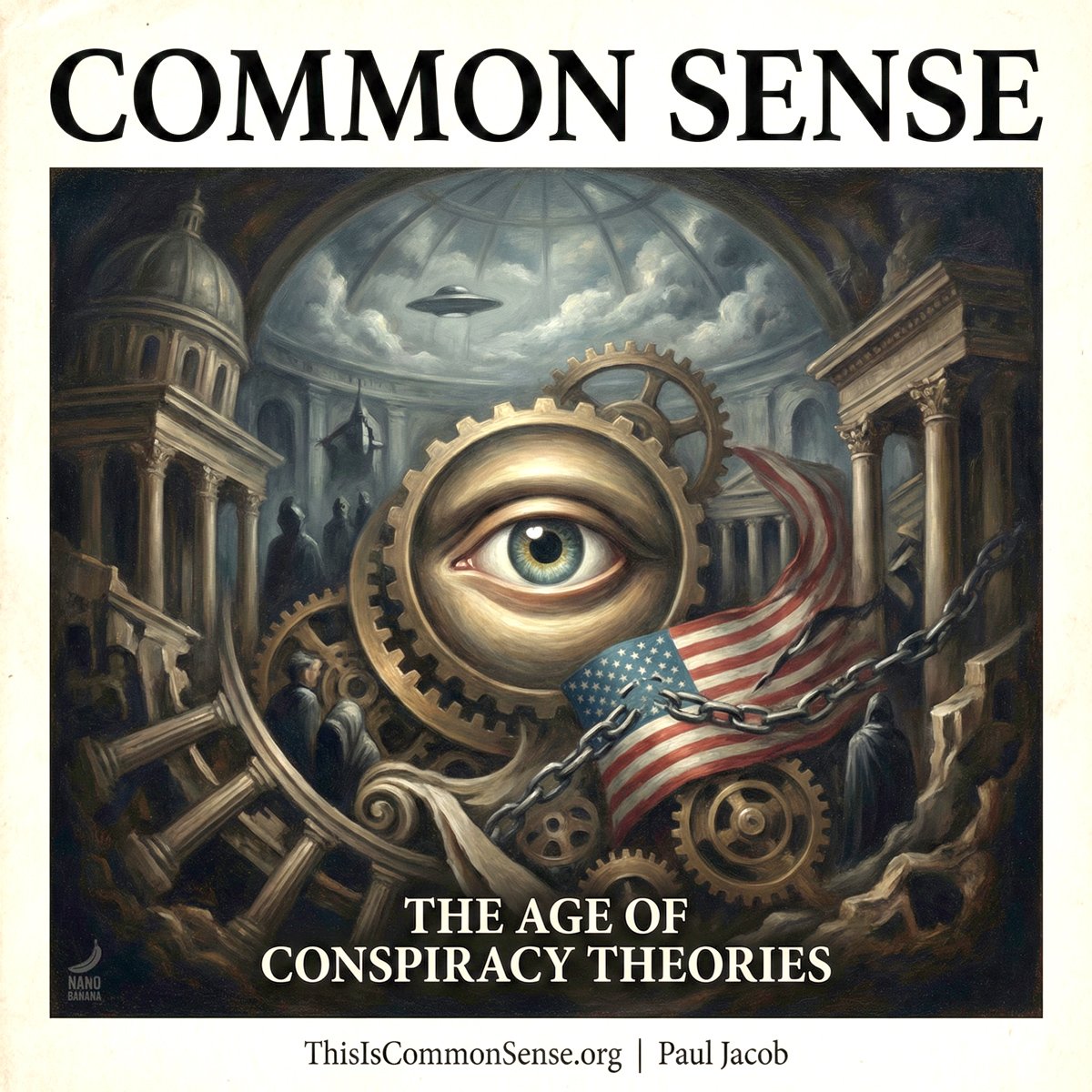
Illustration created with Nano Banana

See all recent commentary
(simplified and organized)
See recent popular posts

Categories
ideological culture media and media people national politics & policies

Rebel in Eden?

The title of Robert Bidinotto’s bracing new collection, Rebel in Eden: The War Between Individualism and Environmentalism, may occasion objection to the word “environmentalism.”

Of course, if “environmentalism” pertained only to how best to reduce pollution and litter and so forth, who would have need to combat it? Freedom-​minded individualists, for example, would debate means, not ends.

But that’s not the kind of thing that the environmentalists themselves — or “radical environmentalists,” to distinguish them from people who manage cleanup crews — focus on.

Radical environmentalists regard humanity as a blight on the face of the earth; they regard nature as an end itself (an “intrinsic value”) that should be left alone regardless of the cost to that mere interloper, man. In their view, plants and animals have “rights,” men and women do not; mining is “raping” the earth — all documented here

These are issues that Bidinotto has been reporting on and analyzing since at least the early 1980s, in places like the On Principle and Intellectual Activist newsletters and Reader’s Digest. So this collection has been in the making for some forty years.

Some of the don’t‑miss essays: “Death by Environmentalism,” “The Great Pesticide Panic,” “Animal Rights: A New Species of Egalitarianism,” “Global Warming and the New Totalitarianism,” “California, Thank Environmentalism for Your Wildfires,” “Environmentalism or Individualism?” I might list the whole table of contents.

Take a look. Bidinotto, by the way, has also contributed a piece “On Courage” to our sister website, StoptheCCP​.org.

This is Common Sense. I’m Paul Jacob.


PDF for printing

Illustration created with Nano Banana

See all recent commentary
(simplified and organized)
See recent popular posts
Categories
ideological culture judiciary property rights too much government U.S. Constitution

Who’ll Oppose the Quasi-Commie?

Should we expect a four-​year pitched battle?

I see one brewing between the new communist mayor of New York City and those judges who respect law and the U.S. Constitution.*

Some say that Zohran Mamdani, though on record admitting his goal of seizing the means of production, is technically not a communist. Well, if allowed to fully impose all he wants on New Yorkers, maybe that would amount to going straight to a fascist model of totalitarian governance — bypassing the Maoist-​Stalinist stage.

Giving him the benefit of the doubt.

But we do know that Mamdani was quick to hire such advisors as housing czarina Cea Weaver, who has lamented home ownership as a “weapon of white supremacy” and declared property as such to be something regrettably long treated as “an individualized good” that now must be treated as a “collective good.”

If you don’t own your house as an individual and have a spare room (or half a room), and somebody needs a place to live, could a Mamdani-​and-​Weaver-​run Big Apple compel you to give space to a stranger that you don’t want around? If property becomes a “collective good” and all must cuddle in the warm bosom of the state-​managed collective, the answer must be: yes.

But New Yorkers may not be quite doomed.

Not, anyway, if there are enough judges like David Jones, who recently interfered with an attempt by the Mamdani administration to interfere in the sale of many rental properties owned by Pinnacle Group.

Mamdani’s office says they’ll keep trying. 

Of course they will.

This is Common Sense. I’m Paul Jacob.


* Or the New York State Constitution, for that matter: see §7 (a), which clearly states that “Private property shall not be taken for public use without just compensation.” 

PDF for printing

Illustration created with Nano Banana

See all recent commentary
(simplified and organized)
See recent popular posts

Categories
ideological culture judiciary litigation

Trouble with Definitions

Is it time to push for a complete wall of separation between Sports and State?

The First Amendment helped the United States — together and separately — protect religion from the ravages of regulation, taxation, suppression, and favoritism. Maybe it’s time to extend the concept. 

This came to mind as I skimmed through the transcript to a current case before the Supreme Court, Little v. Hecox (Docket No. 24 – 38), which involves a challenge to Idaho’s law restricting “transgender women and girls” from participating in women’s and girls’ sports.

I doubt the forthcoming ruling will get government out of sports generally, much less out of sports in public schools — which is what this is all about, Idaho’s law applying only to athletic teams sponsored by public educational institutions (or certain nonpublic ones competing against public ones), not to purely private teams. 

One lawyer for the respondents, Kathleen R. Hartnett, Esq., got stuck with the “tough” job. She was asked by Justice Alito if an understanding of what men and boys are, and what women and girls are, was relevant to the Equal Protection Clause. She said yes, but then confessed to lacking a definition of the sexes for the Court.

Then “how can a court determine that there’s discrimination on the basis of sex,” Alito inquired, “without knowing what sex means.… ?”

Her answer started out on a most unpromising note: “I think here we just know …” immediately pivoting to the statute’s applicability. Alito went on to challenge her on a key notion in trans ideology, that one becomes trans just by saying so.

I see a lot of people online chortling on the comedy of it all.

But I think here we just know it’s … seriously troublesome.

This is Common Sense. I’m Paul Jacob.


PDF for printing

Illustration created with Nano Banana

See all recent commentary
(simplified and organized)
See recent popular posts

Categories
crime and punishment ideological culture subsidy too much government

Tip of the Socialism-berg 

“In 2024 alone, state Medicaid Fraud Control Units reported more than 1,151 convictions and more than $1.4 billion in civil and criminal recoveries,” writes Veronique de Rugy at Reason. “Federal enforcement recovers a tiny share of what is stolen. Fraud that goes undetected never appears in the data.”

And then she makes a claim that increasing numbers of astute observers make: “That’s only the tip of the iceberg.” She goes on to suggest that Medicare, the Supplemental Nutrition Assistance Program (SNAP), and “many other welfare programs” constitute a huge hunk of fraud.

The solution? “If we want less fraud,” she argues, “we need less government.”

Fraud and big government seem to go hand in hand. At least this kind of big government, which resembles the biggest kind of government imaginable. For taking wealth from many productive American citizens and giving it to a small but growing population of refugees from distant lands, that’s not necessarily fraud, I suppose, but it is something close to socialism.

We see in Venezuela just how devastating rule by thieving socialists can be. (Hugo Chavez nationalized oil industry infrastructure and then ran it into the ground.) In Minnesota and in other states of the union, we see a similar ethic. When done on a limited basis, we could call it “helping the poor,” the folks who just cannot produce what they need. That’s how transfer socialism was sold to us.

And they could say, truthfully, that’s not full socialism.

But extending the beneficiary class from our most needy friends and neighbors to the less-​and-​less needy, and then to waves of refugees from other countries, that’s a recipe for disaster. Like socialism when “full.”

How far should Americans go to help “others”? To our own ruin?

This is Common Sense. I’m Paul Jacob.


PDF for printing

Illustration created with Nano Banana

See all recent commentary
(simplified and organized)
See recent popular posts

Categories
ideological culture media and media people tax policy

Post California Soaking

Rumors that Washington Post owner Jeff Bezos has been pushing the Post in a more commonsensical editorial direction could very well be true.

A recent Post editorial slams progressives who “think of taxation the way teenage boys think about cologne: if some is good, more must be great.”

I’m no fan of even a moderate amount of that brand of cologne. But anyway. The Post is discussing a proposed ballot measure backed by the ultra-​lefty Service Employees International Union.

SEIU troops are currently collecting signatures. And before they’ve even gotten enough to post it to ballot, the people being targeted have started moving. 

Out of state.

The measure would impose a new 5 percent tax on billionaires. Some of the state’s billionaires, including Google cofounder Larry Page and Palantir cofounder Peter Thiel, aren’t willing to wait and see whether it actually reaches the ballot and passes in November. Why? The measure would apply retroactively “to those who were California residents on January 1, 2026.”

Some Democratic lawmakers are saying “good riddance,” as if it’s possible to loot billionaires who don’t wait around to be looted. Or that it’s good for state coffers to lose their billionaire entrepreneur “contributors.”

The Post says the retroactivity would open the measure to legal challenges, but that if it gets passed and survives litigation, “it’s a safe bet this won’t be a one-​off. Funding ongoing expenses like health care with one-​time taxes isn’t sustainable. Progressives will want to return to the well until they’ve sucked it dry.”

And no one should know better than Californians how dangerous dry wells are.

This is Common Sense. I’m Paul Jacob.

PDF for printing

Illustrations created with Nano Banana

See all recent commentary
(simplified and organized)
See recent popular posts

Categories
ideological culture property rights

Hot in New York City

Zohran Mamdani was not yet the new mayor of New York City when the city council signaled that it would serve as willing accomplice in his assault on fundamental property rights.

In December, the city council passed legislation that had been hanging fire for several years, the Community Opportunity to Purchase Act (COPA), to further limit New Yorkers’ right to use and dispose of their own stuff.

COPA would give “give certain nonprofits … an early shot to bid on certain residential properties that go up for sale, before they hit the wider market.” The law pertains to buildings “with poor conditions or where an affordability provision is expiring.”

COPA’s advocates contend, as if this were a response to the objection about how the new law violates property rights, that it gives nonprofits an advantage in the housing market.

What happens if quite wealthy nonprofits with enough political pull make an offer that a property owner declines? Will the property owner have the right to say “I pass” and then make the property available for anybody to bid on?

If COPA is not dead on arrival, it will depress market prices as the city strongarms owners into making deals at lower-​than-​market prices. And I doubt that a Mamdani administration will simply playact at eroding and destroying property rights.

Mayor Mamdani took office yesterday, on January 1, 2026, dedicated to the idea of replacing “the frigidity of rugged individualism with the warmth of collectivism.” It doesn’t portend to be a very good year for New Yorkers opposed to the heat of the looters’ madness.

This is Common Sense. I’m Paul Jacob.


PDF for printing

Illustration created with Nano Banana

See all recent commentary
(simplified and organized)
See recent popular posts

Categories
Common Sense general freedom ideological culture

Have an Endurable New Year!

So that was A.D. 2025.

We made it.

Endured.

What must we bear in 2026? 

Most of us, I think, would prefer “more of the same” to something entirely new. Especially if the “something new” can be interpreted as reaping all the consequences of bad choices all at once.

So what was 2025? Going by stats on this website, here’s what I’ve covered:

  • Fiscal Irresponsibility: 15% of coverage.
  • Free Speech/​Censorship: 20%.
  • Political Scandals/​Elections: 15 – 20%.
  • Government Overreach: 25%.
  • Representation/​Local Issues: 10%.

Grok did the analysis, and added another category, “Historical Reflections,” at 10% of content — but this likely reflects the “Today” feature on the website, highlighting the most important event(s) concerning human liberty occurring on each date. 

I do like to think that I have a sense of history, which informs what I do here. In 2023, a meme spread around the Internet, where women asked the men they knew how often they thought about the Roman Empire. “The results will surprise you,” for men tend to think about the past generally, and the classical Romans in particular, a great deal indeed. The meme played out as a “gender” issue, with women finding men’s apparent fixation inexplicable. 

Truth is, for me, I think a lot more about the Revolutionary War. I suppose it’s possible to identify people’s ideologies by which historical war they think about most. This last year and earlier — really since the 2019 protests in Hong Kong — I’ve developed this strong suspicion that we are already in a war and just don’t quite know it.

Wishing you the best in 2026. And girding for what comes. 

This is Common Sense. I’m Paul Jacob.


PDF for printing

Illustration created with Nano Banana

See all recent commentary
(simplified and organized)
See recent popular posts

Categories
government transparency ideological culture

That Non-​Science Stink

Not long ago we were screamed at: “Trust the Science!”

So those of us paying attention came to distrust the scientists.

Especially “scientists” in positions of political power.

Sadly, tragically, more than one scientific discipline has been perverted in shockingly non-​scientific ways. A hidebound denialism about new data has crept in. Sure, it is about the money, but often we catch a whiff of ideology.

This is apparently the case regarding astronomy — about which Harvard astrophysicist Abraham “Avi” Loeb offered testimony on a recent podcast

In 2014, a meteorite (CNEOS 2014-​01-​08) splashed into the Pacific Ocean — too fast to be solar-​system native, says the U.S. Space Command. Without investigating, a published paper dismissed the evidence, discouraging further inquiry; Avi Loeb, on the other hand, led a team to the site, producing evidence from the ocean floor as well as an actual research paper.

Loeb’s first paper on the current obsession, the third officially recognized interstellar object, 3I/​ATLAS, was published only on the condition he took out his killer final sentence — about the possibility that the object might be technological in nature (as its anomalies suggested). 

Loeb appeased the editor …  and then wrote a whole new article on that unspeakable (alien tech) possibility — for another journal.

NASA’s also infected. After watching a recent press conference by NASA on 3I/​ATLAS, Loeb argued it would have been better to have actual scientists field questions rather than feature NASA bigwigs dutifully reciting the currently acceptable (safe?) determination that the object is “just a comet.”

“The intellectual climate, right now in Academia, is such that any new knowledge is resisted by experts,” Dr. Loeb explains. 

That’s the opposite of science. 

This is Common Sense. I’m Paul Jacob.


PDF for printing

Illustration created with Nano Banana

See all recent commentary
(simplified and organized)
See recent popular posts

Categories
First Amendment rights general freedom ideological culture international affairs regulation social media

U.S. Bans EU Censors

European leaders are condemning American use of visa bans to penalize European enemies of American freedom of speech.

Which is understandable, since the U.S. State Department more than merely condemned the European Union.

In the words of Marco Rubio, the five just-​sanctioned persons “have led organized efforts to coerce American platforms to censor, demonetize, and suppress American viewpoints they oppose.”

Thierry Breton. Former EU commissioner and top proponent of the Digital Services Act, which seeks to force U.S. tech giants to “police illegal content more aggressively” or face big fines. “Illegal” here doesn’t mean speech deployed to commit bank robberies; it’s speech EU censors dislike.

Josephine Ballon and Anna-​Lena von Hodenberg. Leaders of HateAid.

Clare Melford. Leader of Global Disinformation Index, which, the State Department observes, exhorts “censorship and blacklisting of American speech and press.”

Imran Ahmed. Leader of Center for Countering Digital Hate, described by Breitbart as the “deplatforming outfit which defined its central mission as ‘Kill Musk’s Twitter.’ ” CCDH also worked hard to get Breitbart and other sites blacklisted from social media.

Maybe none of these villains was planning a trip to the United States anytime soon.

And, doubtless, much more could be done to combat overseas attempts to censor Americans. But at least this much action against enemies of our First Amendment rights is warranted, even if mostly symbolic.

Just give us a little more time, European leaders. We’ll do more to oppose and thwart your obnoxious global censorship agenda. 

This is Common Sense. I’m Paul Jacob.


PDF for printing

Illustration created with Nano Banana

See all recent commentary
(simplified and organized)
See recent popular posts