Categories
free trade & free markets general freedom Ninth Amendment rights tax policy

Taxation Rules

It turns out the United States is a tax haven.

Haven? Heavens! I live here. I don’t feel that low-tax feeling when April 15 rolls around.

But the Cato Institute’s Dan Mitchell, an expert on all things tax-policy — a dirty job, but somebody’s gotta do it — says “The U.S. Is a Tax Haven . . . and That’s a Very Good Thing.”

He is a huge fan of international tax competition. He likes it when governments at least marginally decrease the tax burden on prospective producers and investors, so as to lure production and investment from other tax jurisdictions. In his opinion, “we need some way to restrain the greed of the political class.”

Fans of big government disagree. Tax competition hinders their master plans to control and plunder the rest of us.

Mitchell knows that we mere U.S. citizens tend to lug a big tax load. But the United States is in fact “a tax haven. Not for Americans, of course, but . . . we have some good rules for foreigners.” In addition to their ability to exploit the especially robust corporate privacy rules of a state like Delaware, foreign investors can avoid taxes on interest and capital gains on their stateside investments.

Now, Mitchell says, let’s apply those “same good policies to Americans.”

Hear hear! Havens I can access are even more appealing than those I can’t.

This is Common Sense. I’m Paul Jacob.

Printable PDF

Overburdened Pack Mule


Categories
Common Sense general freedom ideological culture national politics & policies

Lions and Lambs

“March comes in like a lion, goes out like a lamb.”

Tell that to Indiana Governor Mike Pence, whose signing of the Religious Freedom Restoration Act (RFRA) into law at the end of March created a roaring controversy.

Does the law enable discrimination? Or protect religious freedom? Or both? Neither?

An Associated Press report explains: “Religious freedom laws like the one causing an uproar in Indiana have never been successfully used to defend discrimination against gays — and have rarely been used at all, legal experts say.”

Of course, discrimination continues. In 2014, a Texas restaurateur refused service to a gay couple. As a FindLaw.com article explains, the 1964 Civil rights Act “only prohibits discrimination on the basis of color, race, religion, or national origin, and says nothing about sexual orientation.”

So some states, such as New Mexico and Oregon, added legal protections for sexual orientation. But that’s led to reverse violations of rights — facing a $150,000 fine, a bakery closed its shop after the Oregon Bureau of Labor and Industries ruled it violated a lesbian couple’s civil rights by declining to make a wedding cake; a New Mexico photographer was found guilty of violating the state’s Human Rights law for declining to photograph a gay couple’s commitment ceremony.

In times’ past, both state and private violence enforced invidious racial discrimination. Thankfully, those days are gone — cafes, hotels and stores are open to all.

But the civil rights laws that prohibit discrimination in public accommodations cases are distinct from forcing photographers or florists or flutists to personally participate in a ceremony they choose not to.

This is Common Sense. I’m Paul Jacob.


Printable PDF

LIons and Lambs


Categories
general freedom ideological culture

Commanding Controversy

Is “Thou shalt create controversy” one of politicians’ Ten Commandments? Is “Thou shalt pass a law to solve every problem” their eleventh?

Meet Arkansas Senate Bill 939, which would authorize placing a monument to the Ten Commandments on capitol grounds. It passed the state senate last week, 27-3, and is headed to a similar slam-dunk in the House.

The Arkansas Democrat-Gazette reports that, according to authors Sen. Jason Rapert (R-Bigelow) and Rep. Kim Hammer (R-Benton), the effort “should be seen as a way to honor the historic role the biblical text has had in U.S. and Arkansas history and not seen solely as religious.”

No public dollars are involved, say proponents — private money is to purchase the obelisk. Opponents, many testifying, counter that the upkeep will still tap taxpayer money.

Not to mention the certain and certainly expensive litigation over the constitutionality of the endeavor.

I’m not one to shy from a constitutional battle, having launched more than a few of my own. But, well, I think the Ten Commandments might best serve as more than a prop.

Let me offer an alternative that (a) could actually get real people to read the Ten Commandments, no doubt with varied but valuable educational result, and (b) won’t cost the State of Arkansas one thin dime in maintenance or legal fees.

Download a copy of the Ten Commandments here. Share with others.

Reading and talking about the Decalogue has to be far better than picking an expensive fight about it.

No law necessary.

This is Common Sense. I’m Paul Jacob.


Printable PDF

Ten Commandments


Categories
folly general freedom too much government

All Wet

Which is worse, paying for stuff you use . . . or being constantly harassed for using it?

One consequence of widespread failure to charge market rates for water turns out to be hyper-regulation of hydro-usage, and the penalizing — even criminalizing — of using “too much” H2O.

To deal with drought, California now regards it as criminal to “waste” water. Don’t hose down that sidewalk! Las Vegas tries to save water by paying people to rip out their lawns. The EPA is developing technology to force hotels to monitor guests’ specific water usage.

In unhampered markets, sudden and big drops in supply tend to cause sudden and big rises in prices. People economize without being forced. If you must pay more for orange juice because of frozen crops, you either buy less juice or buy less of something else (if orange juice is your favorite thing). But the shelves don’t go bare.

The worse supply problems are, the higher the prices, the more customers economize, the more producers produce. So when there’s a local drought, what will a water company do (as opposed to an overweening water authority)? Charge more. Pipe in water from other states. Other solutions I can’t think of offhand . . . because I’m not running a water company. I lack the direct incentive that the possible profit from solving the problem provides.

Let people cooperate with each other. That is how they’ll solve their water problems — without governmental bullying.

The water will come like rain.

This is Common Sense. I’m Paul Jacob.


Printable PDF


Categories
crime and punishment general freedom

Big Brother Rides Along

Hertz has begun installing cameras in their rental cars as part of a system called NeverLost. But don’t worry, they’ve got no plans (they say) to use them (yet).

“The camera feature has not been launched, cannot be operated and we have no current plans to do so,” Hertz spokesman Evelin Imperatrice assures us. I guess Hertz is with St. Augustine about how all that exists time-wise is a vanishingly small present moment, inasmuch as the past is already gone, the future not yet here. Ergo, nothing to worry about.

Nevertheless, customers are worried.

“I even felt weird about singing in the car by myself,” says one.

“The system can’t be turned off from what I could tell,” reports another. “[And] the camera can see the entire inside of the car. I know rental car companies have been tracking the speed and movements of their vehicles for years but putting a camera inside the cabin of the vehicle is taking their need for information a little too far.”

I’m all in favor of extensive monitoring of police and others with government-conferred power over us, in a position to easily abuse that power. I’m not in favor of indiscriminate spying by everybody on everybody. Or of any gearing up to do that.

What to do? A little bit of tape over the lens, that’s one option. Another: boycott Hertz until they rip the cameras out. Or at least make them easy to turn off.

This is Common Sense. I’m Paul Jacob.


Printable PDF

Categories
Common Sense general freedom individual achievement meme U.S. Constitution

Everything That Could Be Done

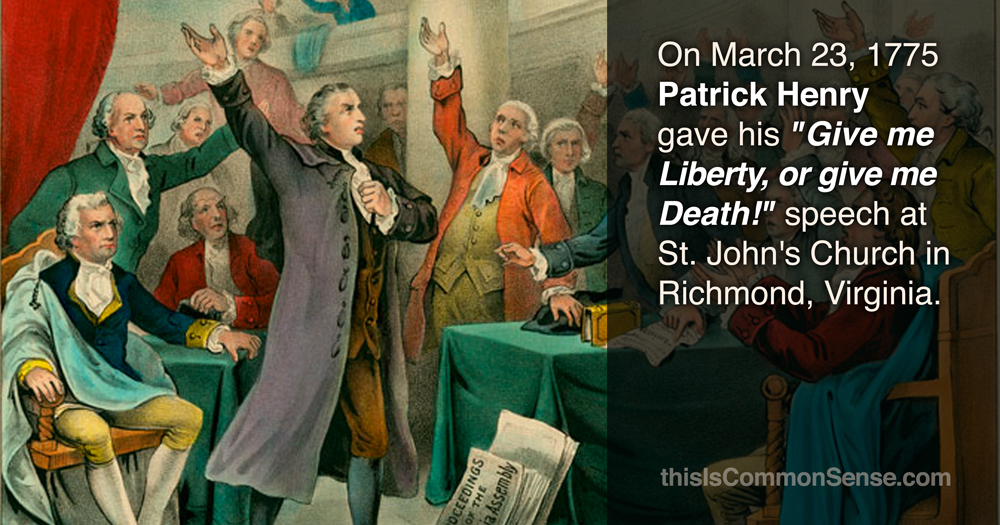
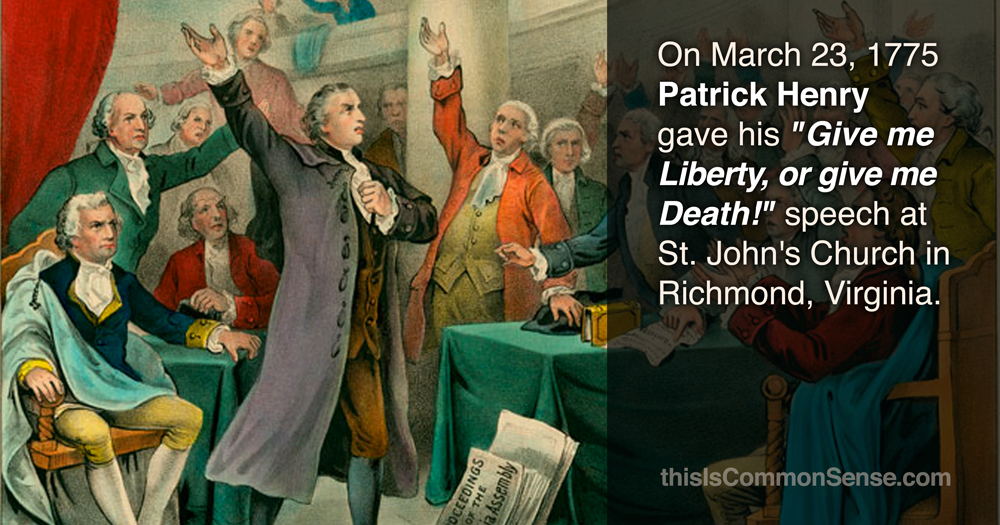
Two hundred forty years ago, the situation was dire. In the Virginia Colony, not too far from where I live, representatives to the Second Virginia Convention were debating the problems they were having with their “masters” in Britain — and the more dangerous, violent situation that was developing to the north.

Several days into the convention, Patrick Henry spoke. His speech was rousing. And it changed minds, concluding with the famous words “give me liberty or give me death!” — an ultimatum quite stark indeed.

Mr. Henry was for action, and waiting no longer. Addressing himself to the president of the convention, he said, “Let us not, I beseech you, sir, deceive ourselves longer. Sir, we have done everything that could be done to avert the storm which is now coming on.” And they had done a great deal, engaging in

– petitioning

– remonstration

– supplication

and, Henry went on, had even “prostrated ourselves before the throne.” And they got worse than the cold shoulder for all their efforts. They got the brush-off, the turn of the cold robe. Along with troops of occupation.

Hence the need for serious action.

Then, Americans were wrestling with the world’s most powerful nation: the British Empire. Today we again face the world’s most powerful empire: our own.

A federal regime similarly out of control in terms of spending and debt, arrogance and corruption, intrusiveness and incompetence. As if dictated by a know-it-all king of old, or a cabal of insiders acting as oligarchs.

Then it was a far-off Parliament; today it is our own far out-of-it representatives . . . duly elected.

We are engaged in a sort of class war, insiders vs. outsiders, and it is the insiders who are bringing the country to the brink of collapse.

The biggest difference between 1775 and 2015? We haven’t done all we can. There is much more to do. And possibly even succeed before the doom of another financial collapse, sovereign debt crisis, or . . . worse.

It often seems a Herculean task, but as Mr. Henry implored, “Sir, we are not weak, if we make a proper use of those means which the God of nature hath placed in our power.”

Let’s join together to give ourselves, our loved ones, and generations hence liberty.

This is Common Sense. I’m Paul Jacob.

Printable PDF

Read the entire speech here

Printable PDF of the entire speech here

Get a high-resolution screensaver of this day’s image. Click on the thumbnail picture below to open a large version that you can download.

The Meaning of "Liberal"


Categories
Accountability ballot access Common Sense First Amendment rights general freedom initiative, referendum, and recall

Really Protecting Our Rights

Incentives matter. Which is why Ohioans have much to celebrate
this week
.

Federal District Judge Michael Watson turned his previous temporary injunction against enforcement of Senate Bill 47 into a permanent injunction. That statue outlawed non-residents from helping Buckeye State residents by gathering petition signatures for an initiative or referendum.

The case is Citizens in Charge v. Husted. Citizens in Charge — where I work — protects initiative rights. Jon Husted is the Ohio Secretary of State.

But Judge Watson went further, declaring Sec. Husted’s office liable for damages to one of our co-plaintiffs, Cincinnati for Pension Reform. The judge found that “a reasonable official would have understood that enforcement of the residency requirement would violate plaintiffs’ First Amendment right to engage in political speech.”

Public officials have what’s known as “qualified immunity,” which protects them from liability when acting in good faith. A spokesman for Husted offered a defense: they were acting “on the assumption that the law is constitutional.”

“Some qualified-immunity cases are difficult,” countered election-law expert Daniel Tokaji. “Not this one.”

Ohio’s residency law was ruled unconstitutional in 2008, after Ralph Nader’s presidential campaign sued. In 2009, the previous secretary of state officially acknowledged the law unenforceable regarding all petitions. Yet, seeking to block citizen petitions, legislators passed it again, and Husted was quick to enforce.

Maurice Thompson of the 1851 Center for Constitutional Law, our attorney, cheered the “deterrence” this decision provides.

“If public officials from the governor down through the police know that they will be liable for enforcing an unconstitutional law,” he explained, “they are far more likely to take Ohioans’ constitutional rights seriously.”

This is Common Sense. I’m Paul Jacob.


Printable PDF

Categories
Accountability ballot access Common Sense general freedom government transparency

Pierce Petition Power

Pierce County, Washington, Executive Pat McCarthy charges that “a majority of the County Council bowed to political pressure, even though this could set a terrible precedent that the most basic administrative actions of government can be derailed by the simple act of signing a piece of paper.”

Yeah, right.

At issue is a $127 million construction project to build a new county administration building. Back in February, the Council voted 4-3 to move forward on the project.

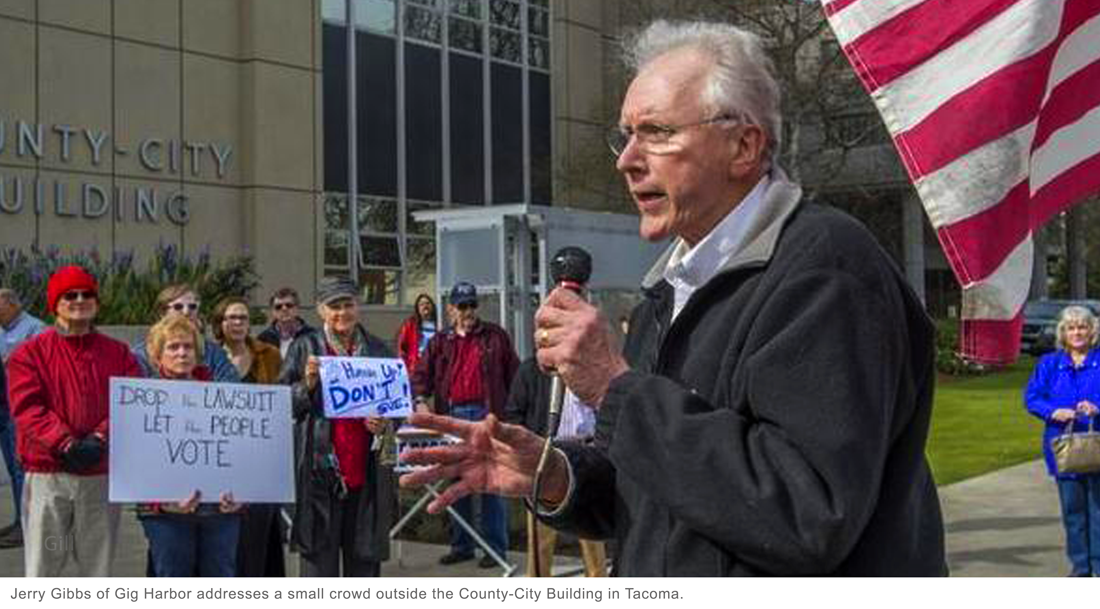
The total cost of the new building, including financing fees and interest, will add up to $235 million according to Jerry Gibbs and a group called Citizens for Responsible Spending. These activists filed a petition to demand a public vote on the issue next November.

As is all too common these days, their grassroots effort was quickly countered by the big guns: the city filed a lawsuit against them, attempting to block the referendum.

The lawsuit didn’t sit well with people in Pierce County.

“Why don’t they want this voted on by the people?” asked Gibbs.

“This is absolutely an abuse of power,” decried resident Sheila Herron, “this is bullying of a private citizen.”

Council Chair Dan Roach argued that the power to launch a court challenge must come from the council, which had not discussed it. He warned his fellow city officials: “you are sending a very chilling” message to citizens not to “dare try to challenge what we’re doing as the government.”

Last week, the County Council voted 4-3 to drop the lawsuit, bowing to political pressure . . . from the people they represent.

In short, good government broke out.

This is Common Sense. I’m Paul Jacob.

Printable PDF

Categories
Common Sense crime and punishment folly general freedom media and media people too much government

At Least We’re Not Turkey

Whenever I feel discouraged by the steady drumbeat of domestic assaults on liberty — from Obamacare to parents being accused of “child neglect” for letting their kids return from a playground by themselves — I try to remind myself:

Things Could Be Worse.

World history provides plenty of support for this dictum, but so does a glance at the newspaper. Like the story of how a single satiric Instagram post “could end up sending a former Miss Turkey to jail.”

An Istanbul prosecutor has been threatening to imprison Merve Büyüksaraç for up to two years for the heinous deed of insulting an official. Last summer she excerpted a satirical piece called “The Master’s Poem” that originally appeared in the magazine Uykusuz. Uykusuz has a habit of mocking Turkish politicians, including President Erdoğan.

“I shared it because it was funny to me,” she says. “I did not intend to insult Recep Tayyip Erdoğan.” Regardless of her motive, her post should not have put her at legal risk.

Buyuksarac is popular on social media — 15,000 followers on Instagram, double that on Twitter — a presence that makes her a target. The Turkish government doesn’t care whether she is an ardent dissident. They obviously just want to intimidate others with a readership who are inclined to ruffle the feathers of the powerful even a little.

So yes, things could be worse. Lots worse. They could also be a lot better. That’s what we have to fight for.

This is Common Sense. I’m Paul Jacob.

Printable PDF

Categories
Common Sense general freedom U.S. Constitution

Slavery & Racism

On Sunday, I marked an awful event in our history: The official beginning of chattel slavery as such in Britains American colonies.

At first, John Casor, an African indentured servant, had gained some control of his life. He charged his master, Anthony Johnson, a free black, with having forced him to labor longer than the term of his indentureship. He won, was freed, and then indentured himself to one Robert Parker.

But Johnson sued, and, on March 8, 1655, won Casor back as a slave for life.

The case established a civil ground for slavery, also enabling free blacks to own slaves. Even as late as the Civil War, the South harbored families of obvious African descent who themselves owned African-Americans as slaves.

On the surface, American slavery wasnt about race. But in the 1640 case of John Punch, sentenced to a life of slavery as criminal punishment for running away from his indentured servitude, his fellow escapees whites merely got longer terms of forced labor.

Racism, Thomas Sowell explains, became increasingly important to the peculiar institutionas time went on. If you exalt the notion thatall men are created equal,how do you square that with your slave-holding?

By denigrating the humanity of blacks.

This vile ugliness of racism is still with us, to some degree . . . and slavery, too at least, in small pockets around the globe and in a much bigger way in the Muslim world. An estimated eleven million slaves are held in Africa and the Middle East. And black Africans are still the main victims.

Sunday was also the 240th anniversary of Tom Paines first American call for slaverys abolition.

Ending slavery: its way past time.

This is Common Sense. Im Paul Jacob.


Printable PDF