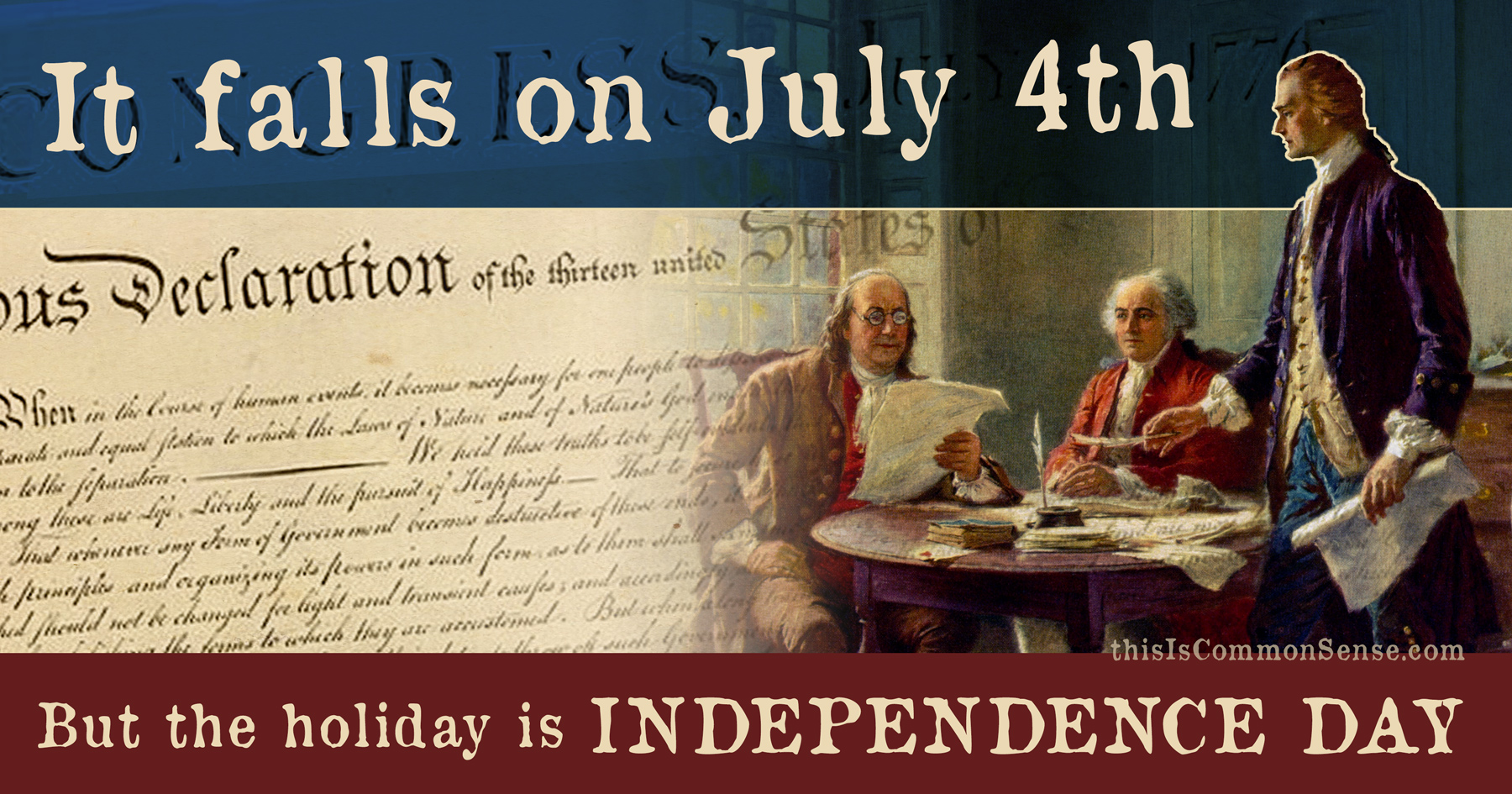
Those core ideas of independence and liberty still matter — perhaps now more than ever.
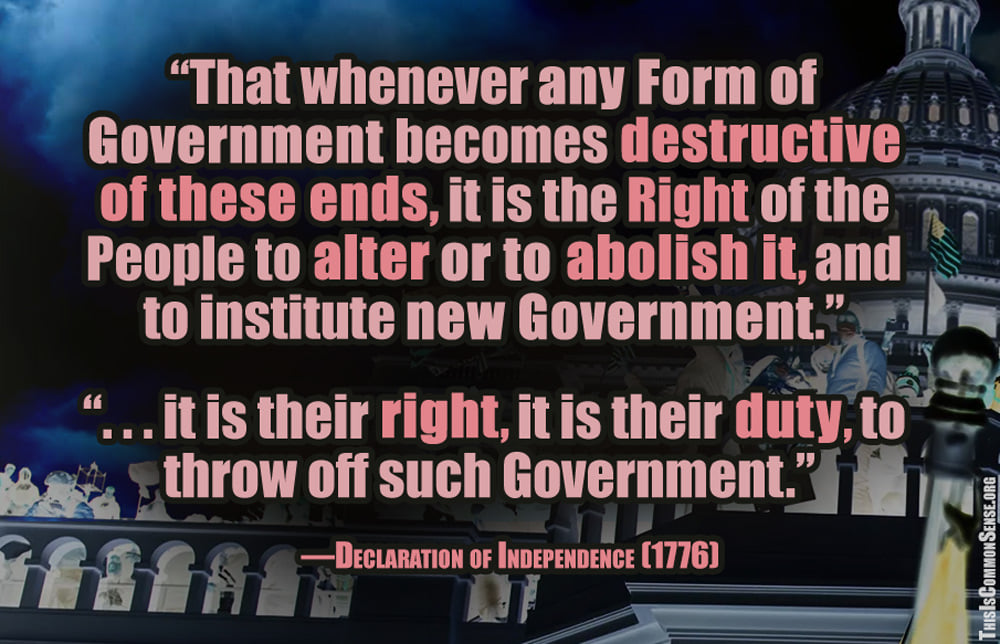
And to help take Common Sense with Paul Jacob beyond 2022, join . . .
See all recent commentary
(simplified and organized)
See recent popular posts

Those core ideas of independence and liberty still matter — perhaps now more than ever.
And to help take Common Sense with Paul Jacob beyond 2022, join . . .
See all recent commentary
(simplified and organized)
See recent popular posts

Speaking at a Christian conference in Chicago, Bill Barr said that our “whole civilization” is “under sustained attack by increasingly secular forces.”
Certainly, the western tradition in which we live is “Judeo-Christian,” yet the explicitly religious aspect of our civilization is openly mocked and undermined by major progressive institutions. But is the civilization itself under attack?
Well, if you lean left you might say No.
To others, the “woke” mob that dominatesso many major organizations in America is foursquare against freedom of speech and religion, and by demanding ideological conformity on a number of issues like sexual identity and racial “equity,” seems determined to re-make society from the ground up, and have that work done under mob violence threat as well as corporate compliance and state command.
But especially interesting is what Barr said was the foundation for today’s secular revolutionaries: the public schools.
“The variety of American beliefs now makes a monopoly on education untenable,” Barr argued, as quoted by The Federalist. “You can’t finesse it anymore. You can’t pretend what’s being taught in schools is compatible with traditional religion, nor can you pretend schools are neutral any more.”
This radical a critique of government schooling is something I used to hear only from libertarians. Barr’s advocacy of school choice is not as cautious as Republicans would advance decades ago. His is an attack on government-run schools as such: the constitutional and existential crisis in American education requires,Barr said, a direct attack upon the government monopoly over the provision of education.
The culture war just ramped up a notch.
This is Common Sense. I’m Paul Jacob.
See all recent commentary
(simplified and organized)
See recent popular posts

Following the pandemic-lockdown model, it is apparently now acceptable to annul the rights of French citizens if some persons may be hurt by the heat. Once again, adults are being treated as if not responsible for making their own judgments about personal risks.
In the Bordeaux area of France — the Gironde department, a “department” being a sort of county — officials recently banned various outdoor events, including concerts and commemorations of resistance to Germany during World War Two.
The department also prohibited indoor events in places that lack air conditioning.
“Everyone now faces a health risk,” one official explained, as if summer were a new thing.
We care about weather when deciding whether to proceed with events we have planned. We think nothing of calling off a parade on account of rain. By “we” I mean the organizers, who may or may not be a government entity.
But there’s a big difference between deciding oneself to cancel an event one is responsible for and a government’s decision to outlaw events produced by others.
Summer is just starting. Next comes winter. Cold.
Governments seem to be regarding the COVID-19 lockdowns as evidence of just how much pushing around we’ll accept in the name of eliminating all risk but the risk to freedom.
A lot, seems to be the conclusion.
We must show them otherwise.
This is Common Sense. I’m Paul Jacob.
See all recent commentary
(simplified and organized)
See recent popular posts
No, this is not the stated goal of the “landmark legislative package” signed by Governor Hochul. It is merely what the result will be . . . to the extent that these new laws further prevent innocent persons from arming and armoring themselves.
You see, determined killers have no qualms about evading gun-control laws, or much difficulty evading them. In New York, these laws now include a prohibition on selling body armor to anyone not a member of “specified professions” like the military and law enforcement.
Lawmakers and the governor ignore the slew of categories of other people who may have reason to especially protect themselves in public: unpopular people, famous people, wealthy people, people living in crime- or riot-ridden areas, and nervous people who, in the judgment of somebody else, may be going overboard.
All have a right to protect themselves.
But that’s a right not now defended in New York, whose politicians prefer to enact silly “performative” legislation banning “devices incapable of offensive use.” New Yorkers are just not supposed to notice that, in preparing to commit their crimes, bad guys do often use many of the same tools used by good guys to defend themselves . . . or just to eat steak (knives have been used to commit crimes) or go to the store (as cars can kill on purpose as well by accident).
It seems unlikely that governments will one day also restrict sales of steak knives and four-wheeled vehicles to members of specified blessed professions. But the dictates of mere common sense provide no assurance here.
This is Common Sense. I’m Paul Jacob.
See all recent commentary
(simplified and organized)
See recent popular posts

Now the ACLU is a changeling monster, with many at the organization arguing to ignore threats to what they regard as the wrong kind of speech. The erstwhile bastion of civil rights has even come out against restoring due process for the accused on our nation’s campuses.
Among longtime ACLU supporters discouraged by the retreat is David Goldberger. This lawyer believes that it has become “more important for ACLU staff to identify with clients and progressive causes than to stand on principle. Liberals are leaving the First Amendment behind.”
Or: progressives are no longer even a little bit “liberal.”
Fortunately, taking up the discarded banner is the Foundation for Individual Rights and Expression, until recently called the Foundation for Individual Rights in Education. The new name signifies an expanded mission.
FIRE will — we are assured — still combat threats to freedom of speech at colleges and universities, where it has been doing excellent work for years.
“To say the least, we have not solved the campus free-speech problem,” says FIRE president Greg Lukianoff. “But we started to realize if we wanted to save free speech on campus we have to start earlier and we have to do things not on campus.”
Freedom of speech is for everybody. In its heyday, the ACLU defended people of all walks of life, and offended tyrants everywhere. Now that progressives generally and Democrats specifically have gone pro-censorship, FIRE is taking up the cause of civil libertarianism.
Someone needed to.
This is Common Sense. I’m Paul Jacob.
See all recent commentary
(simplified and organized)
See recent popular posts

William Neuman, formerly of the New York Times, is a current example of this. St. Martin’s has just published his Things Are Never So Bad That They Can’t Get Worse: Inside the Collapse of Venezuela, and boy, do we get a story.
Hugo Chávez called himself a socialist, repeatedly, but Neuman won’t accept it. Why? Venezuela was basically ruined by Chávez and his henchmen and successors. So the former New York Times reporter provides excuses.
Which is not to say I have read his book, or will. I am entirely trusting a review by Jim Epstein, at Reason, and agreeing per a plethora of other examples with Epstien’s critique of Neuman’s denialism.
While Neuman insists that Chávez was, in effect, a SINO (Socialist In Name Only), using the s-word just as cover — “showcialismo” — Epstein takes us back to reality. “One classic definition of socialism is government control of the means of production. Chávez nationalized banks, oil companies, telecommunications, millions of acres of farmland, supermarkets, stores, the cement industry” and on and on. Now wonder, then, that “nationalization led to deterioration, abandonment, and collapse.”
Neuman cannot blame socialism, oh no. So he lamely argues it was just “bad management.”
But that is what socialism is, and must be. Even when managed by the very best experts, those experts must fail, in the end, because they lack the expertise that counts — the know-how that is spread out among all participants in society.
Markets leverage that knowledge best.
This is Common Sense. I’m Paul Jacob.
See all recent commentary
(simplified and organized)
See recent popular posts
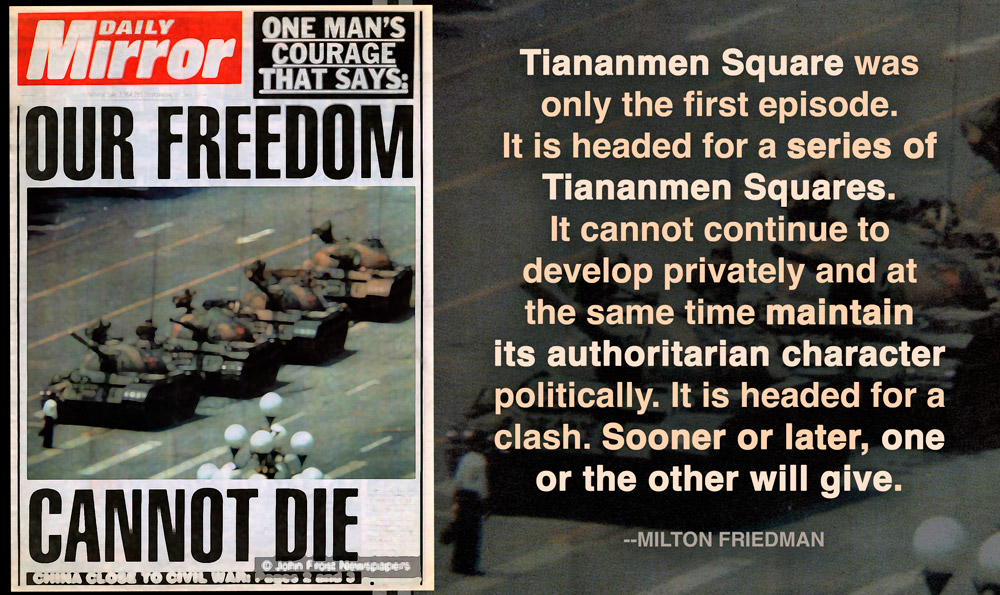
“The same thing will happen in China that happened in Chile. Political freedom will ultimately break out of its shackles. Tiananmen Square was only the first episode. It is headed for a series of Tiananmen Squares. It cannot continue to develop privately and at the same time maintain its authoritarian character politically. It is headed for a clash. Sooner or later, one or the other will give.”
–Milton Friedman

Or good gal.
Dennis Butler, a 37-year-old with an “extensive criminal history,” recently targeted the attendees of a party in Charleston, West Virginia.
Earlier, someone at an apartment complex had asked Butler to drive more slowly because there were children around. This made him feel explosive rage. So he fetched a semi-automatic weapon that he owned illegally and started firing into a crowd of party-goers at the complex.
A woman with a gun and presence of mind happened to be at the party.
“She’s just a member of the community who was carrying her weapon lawfully,” says police spokesman Tony Hazlett. “And instead of running from the threat, she engaged with the threat and saved several lives.”
No one in the crowd was reported to be injured.
I hope that if this heroic woman had been carrying her weapon unlawfully, relevant authorities would have cut her some slack. But it’s good that she didn’t have to deal with such a complication.
Butler is dead — shot multiple times by the woman with a gun. Police haven’t reported her name.
Just as well. We wouldn’t want her to become a target of gun-control groups upset that she used a pistol rather than sharp words to dissuade Butler from killing everybody.
This is Common Sense. I’m Paul Jacob.
See all recent commentary
(simplified and organized)
See recent popular posts
Now a Los Angeles County Superior Court judge has determined that the state failed to show that “gender-based classification was necessary to boost California’s economy, improve opportunities for women in the workplace, and protect California taxpayers, public employees, pensions and retirees.”
No news yet on whether the state will appeal.
In 2018, Brown had conceded that the law was probably doomed to be judged unconstitutional. But he apparently regarded questions of legality or constitutionality as irrelevant.
“It’s high time corporate boards include the people who constitute more than half the ‘persons’ in America,” he burbled in his signing message.
Fines for disobedience were to be steep: $100,000 for initial violations, $300,000 for subsequent violations.
Of course, it is neither immoral nor a crime to choose a man instead of a woman for a post. Making specific hires criminal depending upon the complexion of a business’s other hires amounts to the politicization of everything, swapping the goals of business for the goals of ideologues. It is destructive of individual rights and the requirements of conducting business profitably to compel employers choosing personnel to be guided by any considerations other than relevant qualifications. Or by any assessment but their own.
Managers of all non-government organizations should be free to use their own best judgment in hiring and contracting, whether the work involved is that of clerk, CEO, or board member.
This is Common Sense. I’m Paul Jacob.
See all recent commentary
(simplified and organized)
See recent popular posts

Kelly Gallaher is an activist in Mount Pleasant, Wisconsin, who provoked the ire of Village Attorney Chris Smith.
Seeking punitive damages, Smith has sued Gallaher for inflicting “emotional distress.” Her sin is penning “hundreds of posts on social media” criticizing Smith and other officials and their policies. (Hundreds! So many scribblings by just one person?)
The issue that apparently caused him to say “By Gawd, this is the last dang straw!” is term limits.
Recently, the town’s board of trustees voted to lengthen their elective term from two to three years. Gallaher and others called for a referendum to reverse the term-fattening.
To assuage concerns, Smith claimed that changing term limits had been discussed since 2018; in other words, the change wasn’t something being sprung without prequel. When Gallaher, remembering no such previous discussion, found no evidence of it, she suggested that Smith had lied.
Smith demanded a retraction. Gallaher didn’t want to retract, but did, fearing a lawsuit. Smith sued her anyway.
“The village attorney thinks he can use his law license to bully a political opponent into silence,” says Robert McNamara, the IJ attorney assigned to defend Gallaher. “But government officials are not in charge of how members of the public talk about politics, which is something we’ll be happy to explain to him in court.”
A politician so far from the spirit of American free speech is a politician who needs something more than a withering rebuttal in court. Think: recall vote.
This is Common Sense. I’m Paul Jacob.
See all recent commentary
(simplified and organized)
See recent popular posts