Categories
Accountability general freedom local leaders term limits

Political Babes

Robert Dover is a freshman state senator in Nebraska’s unicameral legislature, appointed last year by the governor to fill a vacancy. Dover says that learning the ropes at the capitol has been like “drinking from a fire hose.”

I sure hope he’s found the bathrooms. 

But have no fear: This rookie has already overcome that lack of experience, sponsoring a constitutional amendment, which faster than a Nebraska minute has 40 of 49 state senators enthusiastically signed on. 

What has folks at the capitol so excited? His amendment, LR22CA, would dramatically weaken their current term limit by giving legislators an extra term, so they can serve 12 years, before taking a break, and not be limited to just eight.

“Dover,” the Nebraska Examiner informs, “said he quickly learned how term limits were a bad idea after talking with legislative veterans, state agency heads and lobbyists.”

“Everyone I talked to said it was a horrible thing,” he offered. “To a person, they said (term limits) took away from the consistency at the Capitol.”

By which he means, the senator elaborated — and as the Lincoln Journal Star reports — maintaining “the right relationships between senators or interest groups to strike compromise.” 

Yes, indeed: the longer politicians stay in office the more they do “compromise” with special interests. 

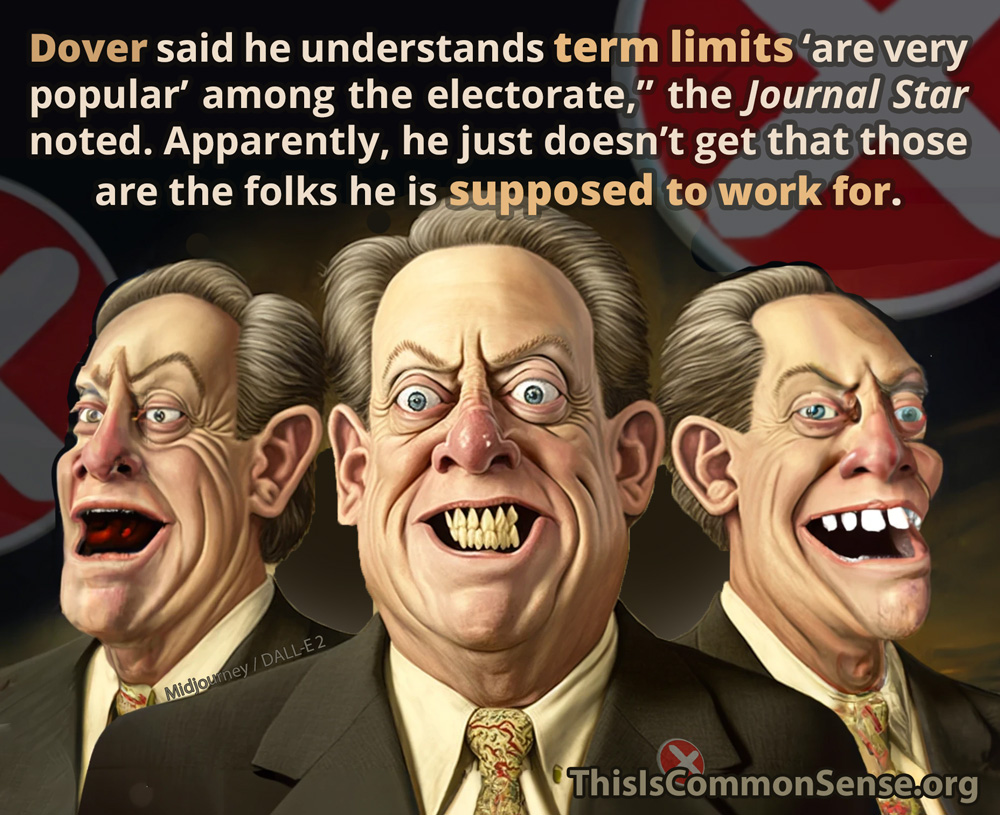
“Dover said he understands term limits ‘are very popular’ among the electorate,” the Journal Star noted. Apparently, he just doesn’t get that those are the folks he is supposed to work for. 

The senator complained that Liberty Initiative Fund, my organization, is sending postcards to voters across the state to inform them about his bill, calling our effort “a waste of money.”

That tells me it is money well spent

This is Common Sense. I’m Paul Jacob.


Note: Term limits have a long history of battling the political establishment in the Cornhusker State, which I wrote about back in 2011.

PDF for printing

Illustration created with Midjourney and DALL-E 2

See all recent commentary
(simplified and organized)
See recent popular posts

Categories
free trade & free markets general freedom too much government

Detonators in Place

You must place explosives a certain way when demolishing a building to avoid damaging surrounding structures. But if you just want to destroy, you can forget about such precautions.

Could this be the perspective of those demanding national rent control?

They forget — or ignore — the destruction of living space inflicted by incentive-incinerating rent controls in places like New York City and Santa Monica.

Rick Moran perceives that President Biden is making a “first move toward a radical national rent control law,” telling agencies to find ways to stop rent increases. Biden is doing so at the behest of 50 congressional communists who have implored him to take executive action to save tenants from rising rents.

According to their letter, “rent is too high and millions of people across this country are struggling to stay stably housed as a result.” Meanwhile, landlords are “increasing the rent for their own profit . . .”

Profit? In a market economy? 

Rising rents! Caused by . . . ?

But if you just want to “solve the problem” and have been trained to be heedless of the destruction regulation can cause, you needn’t think about cause and effect — who did what and how and why. In the interventionist mentality, when oil or food or housing prices zoom upwards, only one cause is possible, and it has nothing to do with politics and policies already in place.

Even if the government’s central banks have been zanily pumping up the supply of money and credit while city and state bureaus have been going all-out to hamper and halt production.

That single cause, they contend, can only be the grasping, grabbing, profit-seeking capitalists. You know. The bums who make their riches (when they do) by supplying us with what we need.

This is Common Sense. I’m Paul Jacob.


PDF for printing

Illustration created with Midjourney

See all recent commentary
(simplified and organized)
See recent popular posts

Categories
general freedom ideological culture international affairs

Brilliant Billionaire Buffoon

“[China’s] portion of the global economy and their portion of the global population match exactly,” Bill Gates informed his audience at Australia’s Lowy Institute. “Countries like Australia, U.S., we have per capita GDPs five times what the Chinese have, so we have a disproportionate share of the world’s economy.”

Funny that no one made a citizen’s arrest of the world’s fourth richest man, who, when it comes to personal wealth, is disproportionately disproportionate. But maybe the crowd has the respect for what people produce and earn that Mr. Gates appears to lack.

Gates main point was that China’s rise has been “great for the world.” 

While I’m not rooting for the Chinese people to be impoverished, I note that Uyghurs, Hong Kongers, Taiwanese and dissident Chinese aren’t exactly singing the Chinazis’ praises.

. . . except when Uyghurs are forced to sing Chinese Communist Party (CCP) propaganda songs in those re-education camps.

Australians are also well aware of China’s ugly behavior, having suffered under punishing economic sanctions ever since the Australian government suggested an international investigation into COVID’s origin and the CCP’s cover-up.

“Gates also leveled criticism at China,” explained Fortune: the billionaire “philanthropist” 

  • admitted that China is “not a democracy,” 
  • rebuked the country for not getting people vaccinated faster and 
  • referred to it as an “outlier today in terms of that level of wealth and still being as autocratic as they are.” 

Actually, “autocratic” is the nicest term available for such a regime. 

Bill Gates is a brilliant businessman, a billionaire many times over, but a complete buffoon (at best*) for failing to even mention the crimes against humanity being committed by the CCP government. 

When he thinks about world governance, now we know what he doesn’t think about.

This is Common Sense. I’m Paul Jacob.

* “Evil” is another explanation I’ve heard, but I’m not making that case here.

PDF for printing

Illustration created with Midjourney and DALL-E2

See all recent commentary
(simplified and organized)
See recent popular posts

Categories
folly general freedom ideological culture

The Wreckage of Racism

In the “urban forests” of our nation’s capital, several abandoned autos have been discovered. Which can mean only one thing: racism

“Deserted cars may be driving a type of racism,” The Washington Post headlined its take.*

The paper introduces readers to Nathan Harrington, executive director of the Ward 8 Woods Conservancy, who has discovered four decaying automobiles in those woods. 

No one knows how the cars got there. 

All that is known is that their presence is, well, racist

Blacks make up 87 percent of Ward 8’s population, one of the most heavily black areas of the city. “Advocates,” explains The Post, “call this neglect of Black neighborhoods ‘environmental racism.’”

An assistant professor of sociology and environmental studies at Boston College is offered to explain that, as The Post paraphrases, “environmental racism is linked to ‘racial capitalism’ — the idea that the economic value of a person is based on their race.”

And to think I was worrying that those rusting vehicles might be leaching dangerous elements into our environment!

“It’s deliberate inaction on the part of the agencies that control that land,” complains Harrington. Believable enough, on the surface, but we are presented with no specifics as to who has refused to help.

Nor are we provided any evidence that this failure of the DC government, if it even is one, can legitimately be ascribed to racial bias.

 The District of Columbia’s mayor happens to be black, as are eight of 13 city council members.

When four rusted-out cars in the woods become front-page fodder to focus on systemic racism, it seems things are looking up.

This is Common Sense. I’m Paul Jacob.


* This punny headline adorned the dead-tree edition. Online, the article’s headline is: “‘Environmental racism’ and the mysterious cars rusting in D.C. woods.”

PDF for printing

Illustration created with DALL-E2 and Midjourney

See all recent commentary
(simplified and organized)
See recent popular posts

Categories
First Amendment rights general freedom ideological culture

It’s His Party

If you’re a fan of freedom of speech, you’re probably also a fan of the First Amendment of the United States’ Constitution.

Unfortunately, governments keep trying to evade it.

When their censorship can’t itself be evaded, often the only thing to do is go to court. 

Merely showing a copy of the Constitution to the offending officials rarely suffices.

That’s why Kells Hetherington teamed up with the Institute for Free Speech to overturn a Florida statute requiring that “a candidate running for nonpartisan office may not state the candidate’s political party affiliation.” In a 2018 campaign for Escambia County School Board, Kells had been fined for calling himself a “lifelong Republican” as part of his candidate statement on the county’s website. In a later campaign, he kept silent to avoid another fine.

The Institute points out that in violating the First Amendment rights of candidates, Florida’s don’t-say-party law has especially hurt challengers. It has deprived them of a valuable shorthand way of indicating the tenor of their political views, a shorthand that incumbents have many more ways of communicating to voters outside the context of campaign statements.

Kells and IFS have won. Late last year, a district judge in Florida ruled that the First Amendment does indeed protect his right, as a candidate, to mention his political party.

Kells says that “hopefully, this will never happen again to any other candidates.” 

In any case, it’s clear that the Institute for Free Speech will never be out of a job. That First Amendment won’t enforce itself.

This is Common Sense. I’m Paul Jacob.


PDF for printing

Illustration created with Midjourney

See all recent commentary
(simplified and organized)
See recent popular posts

Categories
general freedom media and media people national politics & policies

How Congress Works

“Who knew that our time-tested and powerful democracy could not survive a few days of debate and disagreement on our most important questions?” asked journalist Glenn Greenwald weeks ago during the House voting for Speaker.

“To hear establishment mavens all tell the story,” he pointed out, “the failure of Congress to smoothly and swiftly and immediately elect a speaker that’s been preordained — with little debate (as it usually does) — has put the U.S. Government on the verge of collapse.

“Apparently, a healthy democracy requires that everyone march in lockstep, follow orders from on high, and never question anything,” he added sarcastically. 

Greenwald is onto something.

“One of the dirty secrets of how Congress works in the modern era,” he explained, “has been that actual members of Congress, your representatives, have very little power — almost none. They’re more like little, tiny chess pieces moved around for a tiny coterie of party leaders.

“It’s a dynamic that has turned Congress into a profoundly anti-democratic institution,” noted Greenwald. “And it’s one of the main reasons why we get so little reform and so much corruption out of [Congress].

“Many Americans remain convinced that the two parties can’t agree on anything . . . can’t make anything happen, when in fact they’re making a lot happen.” Such as making “tens of trillions of dollars fly out the door.”

Mr. Greenwald blames “a small handful of omnipotent party leaders, from each party, who are willing to play the game, join hands and ensure that totally insulated from election outcomes and public debate, the Washington consensus churns on.”

What to do? Greenwald did not mention term limits. But I just did.

This is Common Sense. I’m Paul Jacob.


PDF for printing

Illustration created with DALL-E2

See all recent commentary
(simplified and organized)
See recent popular posts

Categories
education and schooling general freedom ideological culture

Inherent Racism of Racism

New Hampshire bans public school teachers from telling kids they’re inherently racist or oppressive because of unchosen traits like skin color.

Some lawmakers want to overturn the ban.

The debated law, Right to Freedom from Discrimination in Public Workplaces and Education, is imperfect. But we live in a world where some taxpayer-funded educators, inspired by noxious doctrines like critical race theory, are eager to accuse students of being inherently racist or sexist or oppressive.

Obviously, though, moral wrongdoing is something chosen. One doesn’t commit it merely by having a certain hue, gender, or ancestors.

So how can one reasonably object to a provision stating that “No government program shall teach [that] an individual, by virtue of his or her age, sex, gender identity, sexual orientation, race, [etc.] is inherently racist, sexist, or oppressive, whether consciously or unconsciously”?

The law itself stresses that it’s not to be interpreted as prohibiting discussion of “the historical existence of ideas and subjects” like racism. Nevertheless, critics falsely claim that the law bans classroom discussion of racism as such. And their repeal bill, HB61, seeks not to perfect the current law but to repeal all sections “relative to the right to freedom from discrimination in public workplaces and education.”

New Hampshire lawmaker Jim Kofalt rightly reminds proponents of HB61 of the vision of Martin Luther King, a future where his children would “not be judged by the color of their skin but by the content of their character.”

This is Common Sense. I’m Paul Jacob.


PDF for printing

Illustrations created with Midjourney and DALL-E2

See all recent commentary
(simplified and organized)
See recent popular posts

Categories
defense & war general freedom international affairs

Playing With Fire?

In merely the last month . . . 

Belligerently attempting to enforce China’s illegal claim to virtually the entire South China Sea, a People’s Liberation Army jet intercepted a U.S. Air Force reconnaissance aircraft over international waters, coming within 20 feet, forcing the U.S. pilot to take evasive action to avoid a crash. 

And a war.

Which China’s continually threatened invasion of Taiwan would definitely precipitate. The sort of military assault that the PLA practiced this week, Reuters reported, sending 57 aircraft and four ships into “the sea and airspace around Taiwan, focused on land strikes and sea assaults.”  

Yet talk of a deadly conflict with China is not limited to Southeast Asia.

“Is India Getting Ready For A War With China?” was the headline of Peter Suciu’s 19fortyfive.com story last month detailing a clash between these two nuclear-armed, billion-plus-people nations sharing a disputed 2,100-mile border.*

The good news? The world may be waking up to the enormous threat posed by the Chinese Communist Party. 

Japan has announced it will double military spending — and deploy U.S. tomahawk missiles “capable of striking targets deep inside of North Korea and China.” To better counter the Chinazi threat to itself and neighboring Taiwan, the Japanese also have made “path-breaking” agreements to cooperate with the U.S. and the United Kingdom.

Take a smidgen of comfort, too, in the recent Center for Strategic and International Studies’ war games, which saw Taiwan, Japan and the U.S. “rapidly cripple the Chinese amphibious fleet” in beating back a Chinese invasion of the democratic island nation.

In renewing “its longstanding threat to attack Taiwan,” the CCP warned that foreign countries were “playing with fire.”

Correction: we’re no longer just “playing.”

This is Common Sense. I’m Paul Jacob.  


* CNN explained that the tensions between the two countries increased “sharply in June 2020 when hand-to-hand fighting . . . resulted in the deaths of at least 20 Indian and four Chinese soldiers in Aksai Chin-Ladakh.”

PDF for printing

Illustration created with Midjourney

See all recent commentary
(simplified and organized)
See recent popular posts

Categories
general freedom Internet controversy too much government

Regulatory Miasma

Rumors can fly fast. And the Internet not only aids in their spread, but can make even false rumors seem worthwhile.

The gas stove ban rumor, which spurred so many hilarious “memes,” is a case in point.

It appears to have started with a letter from Senator Corey Booker (D-NJ) and Representative Donald S. Beyer, Jr., to the chair of the U.S. Consumer Product Safety Commission about the risks associated with gas stoves per “indoor air pollution.” According to Rep. Beyer’s defensive tweet, which cleverly enough uses the buzzword “gaslighting,” such risks even include “childhood asthma,” though the word “asthma” does not appear in the politicians’ original letter.

What does appear is extra concern for the “cumulative burden to households that are already more likely to face higher exposure to both indoor and outdoor air pollution” — i.e., “Black, Latino, and low income households.”

Booker and Beyer did not quite suggest a ban; their concern was for more research and regulation. But on Monday, Bloomberg quoted the word “ban” from the lips of a government bureaucrat: “‘This is a hidden hazard,’ Richard Trumka Jr., an agency commissioner, said in an interview. ‘Any option is on the table. Products that can’t be made safe can be banned.’”

But that’s all very . . . iffy. More directly, and fueling the reaction, the Governor of the State of New York did propose a ban

Which all goes to show that the “over” in over-reaction can deflate pretty fast, down to a perfectly apt response, at the speed of . . . memes.

This is Common Sense. I’m Paul Jacob.


PDF for printing

See all recent commentary
(simplified and organized)
See recent popular posts

Categories
crime and punishment First Amendment rights general freedom

Commission by Omission?

Debra Paul, publisher of the weekly Londonderry Times, should not be facing jail time for publishing political ads.

In a land where a First Amendment explicitly if imperfectly protects freedom of speech, does anyone believe she should be?

Well, the New Hampshire attorney general, for one. 

For two, whoever called his attention to the trivial oversight that led to Ms. Paul’s arrest last August

Her venial sin, if it’s even that, was to publish political ads that failed to include the legend “Political Advertisement” as required by New Hampshire law. 

The violation is punishable by up to a year of incarceration and a fine up to $2,000.

As Paul noted in August, “This is clearly a case of a small business needing to defend itself against overreaching government. To threaten a small business owner with jail time over something this insignificant is very heavy-handed.”

Insignificant, why? 

Not labeling a political message “Political Advertisement” is only controversial in the slightest when the message imitates normal editorial or news content. The arrest warrant reports that the ads in question were on the order of “VOTE YES ARTICLE 2.” 

Obvious political advertising.

Months later, Paul still awaits her fate. An arraignment is scheduled for later this month. On the advice of her lawyer, she had little to say when we asked her for an update about the case. But she hinted that a political adversary may have filed the complaint against her.

The net of multitudinous picayune laws that snagged Paul can snag anybody who does anything more culturally and socially ambitious than sitting at home staring at the wall all day. Such regulations can be exploited by anyone eager to harass someone for reasons quite apart from an alleged infraction.

This is Common Sense. I’m Paul Jacob.


PDF for printing

Illustration created with Midjourney

See all recent commentary
(simplified and organized)
See recent popular posts