
Categories
general freedom media and media people national politics & policies

How Congress Works

“Who knew that our time-tested and powerful democracy could not survive a few days of debate and disagreement on our most important questions?” asked journalist Glenn Greenwald weeks ago during the House voting for Speaker.

“To hear establishment mavens all tell the story,” he pointed out, “the failure of Congress to smoothly and swiftly and immediately elect a speaker that’s been preordained — with little debate (as it usually does) — has put the U.S. Government on the verge of collapse.

“Apparently, a healthy democracy requires that everyone march in lockstep, follow orders from on high, and never question anything,” he added sarcastically. 

Greenwald is onto something.

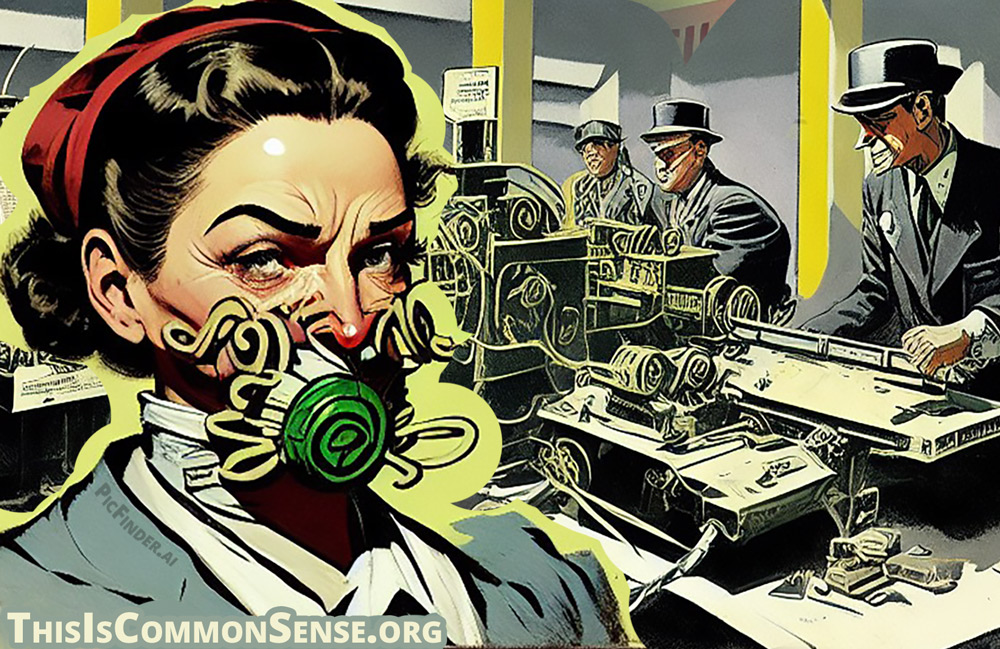
“One of the dirty secrets of how Congress works in the modern era,” he explained, “has been that actual members of Congress, your representatives, have very little power — almost none. They’re more like little, tiny chess pieces moved around for a tiny coterie of party leaders.

“It’s a dynamic that has turned Congress into a profoundly anti-democratic institution,” noted Greenwald. “And it’s one of the main reasons why we get so little reform and so much corruption out of [Congress].

“Many Americans remain convinced that the two parties can’t agree on anything . . . can’t make anything happen, when in fact they’re making a lot happen.” Such as making “tens of trillions of dollars fly out the door.”

Mr. Greenwald blames “a small handful of omnipotent party leaders, from each party, who are willing to play the game, join hands and ensure that totally insulated from election outcomes and public debate, the Washington consensus churns on.”

What to do? Greenwald did not mention term limits. But I just did.

This is Common Sense. I’m Paul Jacob.


PDF for printing

Illustration created with DALL-E2

See all recent commentary
(simplified and organized)
See recent popular posts

Categories
education and schooling general freedom ideological culture

Inherent Racism of Racism

New Hampshire bans public school teachers from telling kids they’re inherently racist or oppressive because of unchosen traits like skin color.

Some lawmakers want to overturn the ban.

The debated law, Right to Freedom from Discrimination in Public Workplaces and Education, is imperfect. But we live in a world where some taxpayer-funded educators, inspired by noxious doctrines like critical race theory, are eager to accuse students of being inherently racist or sexist or oppressive.

Obviously, though, moral wrongdoing is something chosen. One doesn’t commit it merely by having a certain hue, gender, or ancestors.

So how can one reasonably object to a provision stating that “No government program shall teach [that] an individual, by virtue of his or her age, sex, gender identity, sexual orientation, race, [etc.] is inherently racist, sexist, or oppressive, whether consciously or unconsciously”?

The law itself stresses that it’s not to be interpreted as prohibiting discussion of “the historical existence of ideas and subjects” like racism. Nevertheless, critics falsely claim that the law bans classroom discussion of racism as such. And their repeal bill, HB61, seeks not to perfect the current law but to repeal all sections “relative to the right to freedom from discrimination in public workplaces and education.”

New Hampshire lawmaker Jim Kofalt rightly reminds proponents of HB61 of the vision of Martin Luther King, a future where his children would “not be judged by the color of their skin but by the content of their character.”

This is Common Sense. I’m Paul Jacob.


PDF for printing

Illustrations created with Midjourney and DALL-E2

See all recent commentary
(simplified and organized)
See recent popular posts
Categories
defense & war general freedom international affairs

Playing With Fire?

In merely the last month . . . 

Belligerently attempting to enforce China’s illegal claim to virtually the entire South China Sea, a People’s Liberation Army jet intercepted a U.S. Air Force reconnaissance aircraft over international waters, coming within 20 feet, forcing the U.S. pilot to take evasive action to avoid a crash. 

And a war.

Which China’s continually threatened invasion of Taiwan would definitely precipitate. The sort of military assault that the PLA practiced this week, Reuters reported, sending 57 aircraft and four ships into “the sea and airspace around Taiwan, focused on land strikes and sea assaults.”  

Yet talk of a deadly conflict with China is not limited to Southeast Asia.

“Is India Getting Ready For A War With China?” was the headline of Peter Suciu’s 19fortyfive.com story last month detailing a clash between these two nuclear-armed, billion-plus-people nations sharing a disputed 2,100-mile border.*

The good news? The world may be waking up to the enormous threat posed by the Chinese Communist Party. 

Japan has announced it will double military spending — and deploy U.S. tomahawk missiles “capable of striking targets deep inside of North Korea and China.” To better counter the Chinazi threat to itself and neighboring Taiwan, the Japanese also have made “path-breaking” agreements to cooperate with the U.S. and the United Kingdom.

Take a smidgen of comfort, too, in the recent Center for Strategic and International Studies’ war games, which saw Taiwan, Japan and the U.S. “rapidly cripple the Chinese amphibious fleet” in beating back a Chinese invasion of the democratic island nation.

In renewing “its longstanding threat to attack Taiwan,” the CCP warned that foreign countries were “playing with fire.”

Correction: we’re no longer just “playing.”

This is Common Sense. I’m Paul Jacob.  


* CNN explained that the tensions between the two countries increased “sharply in June 2020 when hand-to-hand fighting . . . resulted in the deaths of at least 20 Indian and four Chinese soldiers in Aksai Chin-Ladakh.”

PDF for printing

Illustration created with Midjourney

See all recent commentary
(simplified and organized)
See recent popular posts

Categories
general freedom Internet controversy too much government

Regulatory Miasma

Rumors can fly fast. And the Internet not only aids in their spread, but can make even false rumors seem worthwhile.

The gas stove ban rumor, which spurred so many hilarious “memes,” is a case in point.

It appears to have started with a letter from Senator Corey Booker (D-NJ) and Representative Donald S. Beyer, Jr., to the chair of the U.S. Consumer Product Safety Commission about the risks associated with gas stoves per “indoor air pollution.” According to Rep. Beyer’s defensive tweet, which cleverly enough uses the buzzword “gaslighting,” such risks even include “childhood asthma,” though the word “asthma” does not appear in the politicians’ original letter.

What does appear is extra concern for the “cumulative burden to households that are already more likely to face higher exposure to both indoor and outdoor air pollution” — i.e., “Black, Latino, and low income households.”

Booker and Beyer did not quite suggest a ban; their concern was for more research and regulation. But on Monday, Bloomberg quoted the word “ban” from the lips of a government bureaucrat: “‘This is a hidden hazard,’ Richard Trumka Jr., an agency commissioner, said in an interview. ‘Any option is on the table. Products that can’t be made safe can be banned.’”

But that’s all very . . . iffy. More directly, and fueling the reaction, the Governor of the State of New York did propose a ban

Which all goes to show that the “over” in over-reaction can deflate pretty fast, down to a perfectly apt response, at the speed of . . . memes.

This is Common Sense. I’m Paul Jacob.


PDF for printing

See all recent commentary
(simplified and organized)
See recent popular posts

Categories
crime and punishment First Amendment rights general freedom

Commission by Omission?

Debra Paul, publisher of the weekly Londonderry Times, should not be facing jail time for publishing political ads.

In a land where a First Amendment explicitly if imperfectly protects freedom of speech, does anyone believe she should be?

Well, the New Hampshire attorney general, for one. 

For two, whoever called his attention to the trivial oversight that led to Ms. Paul’s arrest last August

Her venial sin, if it’s even that, was to publish political ads that failed to include the legend “Political Advertisement” as required by New Hampshire law. 

The violation is punishable by up to a year of incarceration and a fine up to $2,000.

As Paul noted in August, “This is clearly a case of a small business needing to defend itself against overreaching government. To threaten a small business owner with jail time over something this insignificant is very heavy-handed.”

Insignificant, why? 

Not labeling a political message “Political Advertisement” is only controversial in the slightest when the message imitates normal editorial or news content. The arrest warrant reports that the ads in question were on the order of “VOTE YES ARTICLE 2.” 

Obvious political advertising.

Months later, Paul still awaits her fate. An arraignment is scheduled for later this month. On the advice of her lawyer, she had little to say when we asked her for an update about the case. But she hinted that a political adversary may have filed the complaint against her.

The net of multitudinous picayune laws that snagged Paul can snag anybody who does anything more culturally and socially ambitious than sitting at home staring at the wall all day. Such regulations can be exploited by anyone eager to harass someone for reasons quite apart from an alleged infraction.

This is Common Sense. I’m Paul Jacob.


PDF for printing

Illustration created with Midjourney

See all recent commentary
(simplified and organized)
See recent popular posts

Categories
crime and punishment general freedom tax policy

Voting for Audits

Eighty-seven thousand new IRS agents!

What could possibly go wrong?

In a bill passed and signed last August, “$80 billion worth of new funding over the next decade” was shoveled at the Internal Revenue Service “so it could” — as a recent Reason article summarizes — “hire 87,000 new workers, purportedly to better target millionaire and billionaire scofflaws.”

The assurance that the new investment in personnel would not be directed towards “those making under $400,000 annually” was, as Reason’s Liz Wolfe makes clear, “not provided within the text of the actual bill.”

Ah — political promise over actual law and all bureaucratic experience. The IRS, you see, prefers to focus its audits on the lowest income earners, who were audited more often than millionaires.

Why? Well, the key is one feature of the tax code: the earned income credit. Which, it just so happens, is easy to get wrong. And upon which lower-income workers have come to rely.

The other reason is even more basic: “given a dearth of experienced auditors not likely to be fixed soon, the agency would rely on the easiest and least time-consuming types of audits.” Which are conducted through the mail. Easy. Cheap. And annoying.

Even with more IRS auditors with more experience, this path of least resistance — these earned income credit audits — will likely get the most use.

The reasons behind the reasons? Why were Democrats so eager to increase the ranks of tax collectors? Sure, Democrats love taxes. But like most tax hikers, they promote the idea that others will pay all those taxes; they promise to stick it to the rich . . . while ever-so consistently missing the mark and whacking the poor and middle classes.

This is Common Sense. I’m Paul Jacob.


PDF for printing

Illustration created with Midjourney and DALL-E2

See all recent commentary
(simplified and organized)
See recent popular posts

Categories
general freedom international affairs

What Is and Is Not Sinister

“Is this just human stupidity?”

asked that, last week, regarding the flourishing of the Omicron variants of SARS-CoV-2 in China. The Communist-run country is undergoing a huge spike in infections, millions of infections, after years now of totalitarian tracking and quarantine protocols.

I had mentioned the regime’s lack of interest in encouraging the growth of natural immunity, in its various forms. Instead of helping people cope with the new disease, the Chinazis thought they could corral their society to prevent the spread.

That broke down completely, this winter.

But was the quarantine policy and its breakdown just plain old stupidity? Folly in familiar forms?  “Or is it something more sinister?”

Well, yesterday Dr. John Campbell focused his regular online talk on how the totalitarian quarantines fell apart.

The Chinese infection rate had been relatively low — to the extent that we can trust statistics from a lying regime — because of the thoroughgoing nature of the quarantine policies, which immiserated millions, and caused numerous deaths, just as lockdowns would do in almost any society.

While acknowledging the protests that swept China, Campbell argues that a bigger factor in ending the policy was the fact that many Chinese were bribing officials to obtain negative results on the mandatory tests, thereby gaining license to go about as normal. And spread the disease — quite rapidly — in a low-immunity society, low in part because the CCP chose the Zero COVID policy . . . rather than a strategy of a freer society.

Still, in China and America, the totalitarian itch remains. The dream of zero transmission seems “rational” to many people, especially those who demand that The State solve every problem. It hasn’t worked anywhere, though. 

And not just due to the chronic bribery and corruption fostered by authoritarian societies, but because isn’t good medical or political science.

This is Common Sense. I’m Paul Jacob.


PDF for printing

Illustration created with DALL-E2

See all recent commentary
(simplified and organized)
See recent popular posts

Categories
crime and punishment general freedom Second Amendment rights

Concealed Carry and the Careful Criminal

Crime is the most basic of problems. But across the political spectrum we see different strategies. 

On the right, the go-to solution has always been to ramp up policing, to make the basic function of the state — crime-fighting — stronger and more effective

On the left, a leading idea has been to disarm the populace so people cannot do as much harm, and also to “rehabilitate” troubled folks with government TLC.

I grew up in the ’70s, when the failures of benevolent leftism (which we called “liberalism”) were becoming clear. So there was a reaction: Lock more people up.

That reaction fizzled in recent years, and, perhaps not wholly coincidentally, crime on a city-by-city case, as well as nationally, has increased. 

Nevertheless, during this period another policy has gained a huge momentum: instead of disarming the populace, arm them!

How’s that going? The most recent case study is in Maine, which in 2015 allowed permit-less concealed carry of firearms.

“While rates of violent crime increased nationally from 2015 to 2020,” writes Steve Robinson in “Maine Crime Fell Following 2015 Repeal of Gun Control Law” (MaineWire, December 29, 2022), “the rate of violent crime in Maine fell steadily beginning in 2015, after a slight increase from 2014 to 2015, according to data collected by the FBI’s Uniform Crime Reporting Program.”

Robinson notes that while the Maine experience doesn’t prove that “an armed society is a polite society,” it falsifies, quite clearly, the catastrophic predictions made by gun control advocates back in 2015.

I hazard it does much more. It shows that distributed power (in this case, firepower and defensive capacity) in the peaceful population is a separate, non-left/non-right solution to the age-old problem of crime.

This is Common Sense. I’m Paul Jacob.


PDF for printing

Illustration created with DALL-E2

See all recent commentary
(simplified and organized)
See recent popular posts

Categories
general freedom ideological culture

It’s a Heroic Life

“An icon with such well-established status is an irresistible target,” The Bulwark’s Claire Coffey writes about the holiday season favorite, It’s a Wonderful Life, “and the competition to come up with the definitive contrarian takedown of the film is now a Christmas sub-tradition in its own right.”

Last year, I had to correct Washington Post columnist Monica Hesse, who belittled protagonist George Bailey as “the tortured Boy Scout-type,” arguing that Mary, his wife, was “the real hero.”

One of the nicest things about the movie is that mythical Bedford Falls has a lot of ordinary heroes . . . just like in real life. And Mary is right at the top of the list. But with her husband George, whom she dearly loves, not instead of or as his chief competition. 

“George Bailey Isn’t the Hero of ‘It’s a Wonderful Life,’” insists the headline to Mickey Randle’s recent column at Collider, where we learn that “many of [George’s] responses to hardship” are “less than admirable.” I don’t know about “many,” but George does throw something of a tantrum upon discovering that his business will go bankrupt and he likely end up in prison. 

Hate me if you must, but I might throw a momentary fit, too, at that set of circumstances.

“Mary bears almost identical burdens,” notes Randle, “and always responds productively.” Of course, even Mary gets angry in one scene and smashes one of her favorite records. Apparently, this wonderful woman is not perfect. Who knew?

Randle concludes by calling the movie “significant because of its observations on gender,” suggesting: “We just have to remember to see things from Mary’s perspective.” 

But can anyone who knows Mary claim that George is not a hero from her perspective?

One major point of attack on the film has been the idea that, if George “had never been born,” the sweet and beautiful Mary would certainly not be “an old maid,” as depicted. Granted, her being single would not be for lack of trying by every able-bodied, cisgendered male person in Pennsylvania. But in her piece at The Bulwark, Coffey gets this right by noticing, “Mary could marry any man in town. She doesn’t want to. She wants George.”

Seems to me the criticism is intended to obscure the powerful moral of this movie: that good guys and good gals are winners, not losers. And that two people in love and committed to doing what they think is right are as unconquerable as anything this world has ever known. 

When push comes to shove, I put my faith in that tantrum-throwing George Bailey and the record-smashing Mary Bailey . . . working together. 

This is Common Sense. I’m Paul Jacob.


PDF for printing

Illustration created with DALL-E2

See all recent commentary
(simplified and organized)
See recent popular posts

Categories
education and schooling general freedom

In the Name of Equity

Last year, I noted complaints by Virginia officials about the high proportion of Asian students attending Thomas Jefferson High School for Science and Technology. These students studied too hard, supposedly.

Now we learn that TJ High administrators have been conniving to prevent students who won National Merit awards, issued for excelling on the PSAT, from being informed of this. Principal Ann Bonitatibus and another official, Brandon Kosatka, have been memory-holing the notifications for years.

You can’t report having won a National Merit award on a college application if you just don’t know.

The policy is consistent with the Fairfax County school district’s ugly new Harrison-Bergeronesque ideal of “equal outcomes for every student, without exception.”

Kosatka told a parent that the idea was to “recognize students for who they are as individuals, not focus on their achievements,” a nonsensical proposition. Individuals don’t just sit around being themselves; they do stuff. Kosatka also said that the principal didn’t want to hurt the feelings of non-winners of the Merit awards by acknowledging winners.

Bonitatibus and Kosatka should be fired — at least. Their job is to help students achieve, not to undercut them.

We’ll never rid the world entirely of resentment against achievement — or, for that matter, the benefits that flow from achievement. But we can teach kids that the proper response to disappointment at doing less than their best is to resolve to do better at the next opportunity. 

And to be inspired — not, heaven forfend, demoralized — by the heights that others do achieve.

This is Common Sense. I’m Paul Jacob.


PDF for printing

Created with DALL-E2

See all recent commentary
(simplified and organized)
See recent popular posts