Categories
First Amendment rights general freedom judiciary too much government

Hollowed-Out America

While Supreme Court Justice Neil Gorsuch’s comments in Arizona v. Mayorkas are worth studying in full — the case is about immigration — his thoughts on the late pandemic panic stand out.

“Since March 2020,” Justice Gorsuch writes, “we may have experienced the greatest intrusions on civil liberties in the peacetime history of this country. Executive officials across the country issued emergency decrees on a breathtaking scale. Governors and local leaders imposed lockdown orders forcing people to remain in their homes,” and the judge goes through a long list of decrees, including:

  • Closing churches but not casinos
  • Threatening violators with both civil penalties and criminal sanctions
  • Surveilling church parking lots, recording license plates, and issuing warnings against attending even outdoor services.

And he adds that the federal government got in on the tyrannies.

“Fear and the desire for safety are powerful forces,” he notes. “They can lead to a clamor for action — almost any action — as long as someone does something to address a perceived threat.” Gorsuch acknowledges this is not exactly a revelation: “Even the ancients warned that democracies can degenerate toward autocracy in the face of fear.”

There is a deeper problem, though, for the “concentration of power in the hands of so few may be efficient and sometimes popular. But it does not tend toward sound government.”

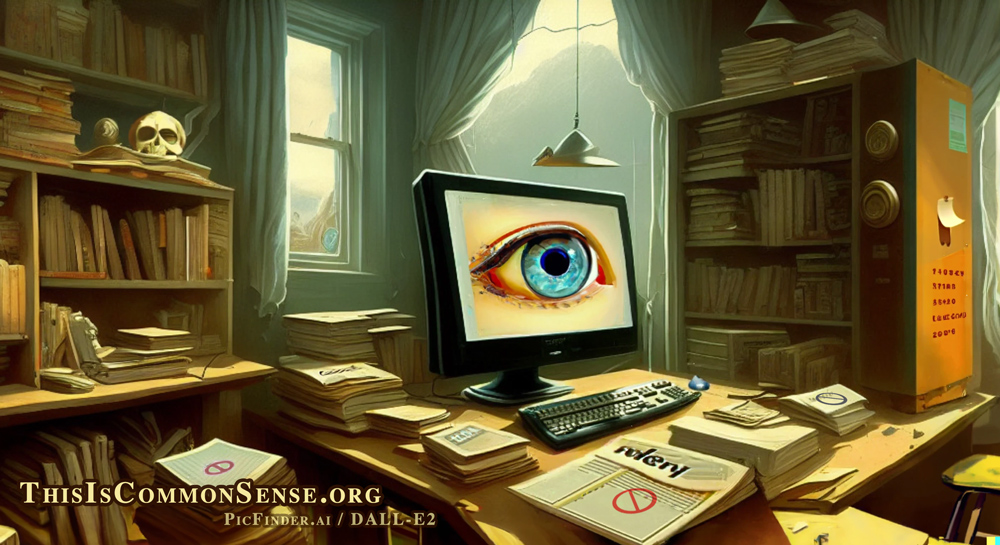
All the way through the pandemic, and even now, we have been barraged by messages about “misinformation and disinformation” about the disease and the treatments (proactive and reactive) against it. And the people in power — bureaucrats as well as politicians — were called “experts” while actual experts (along with earnest amateurs) were hounded, their ideas suppressed. 

Now we know that much of what was then held as good information was in error, even lies. 

Very unsound governance: Gorsuch characterizes it “a shell of a democracy.” 

“Hollow.”

This is Common Sense. I’m Paul Jacob.

PDF for printing

Illustration created with PicFinder.ai and DALL-E2

See all recent commentary
(simplified and organized)
See recent popular posts
Categories
First Amendment rights general freedom ideological culture

No Laughing Matter

Without freedom of speech, the jester’s art can be perilous.

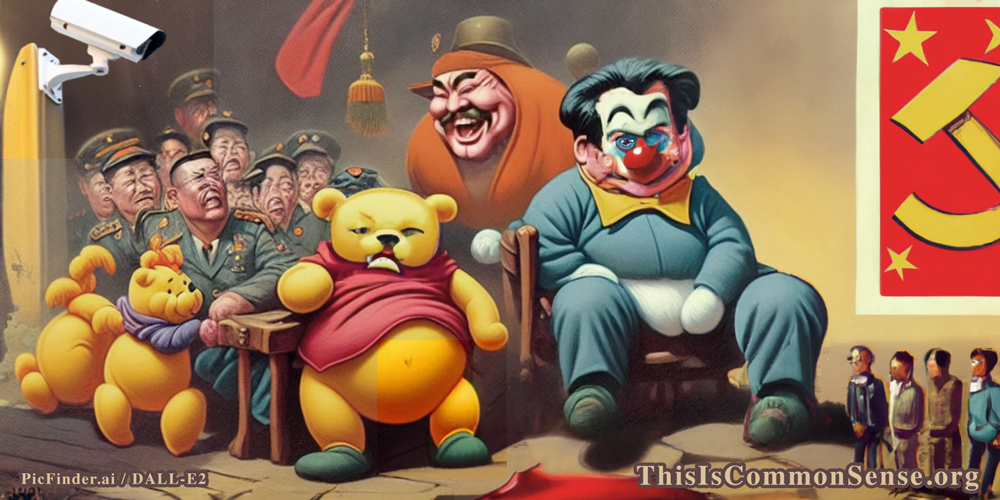
Chinese comedian Li Haoshi, who performs under the name House, recently did stand-up comedy at a Beijing club, after which, reports Reuters, “an audience member posted online a description of a joke he had made . . . describing it as demeaning to China’s People’s Liberation Army (PLA).”

That went viral on Chinese social media.

“In the joke,” Reuters explains, “Li recounted seeing two stray dogs he had adopted chase a squirrel and said it had reminded him of the phrase ‘have a good work style, be able to fight and win battles,’ a slogan Chinese President Xi Jinping used in 2013 to praise the PLA’s work ethic.”

Not exactly a ripsnorter, it is hardly biting satire, either — after all, Li steered clear of any mention of Winnie the Pooh.

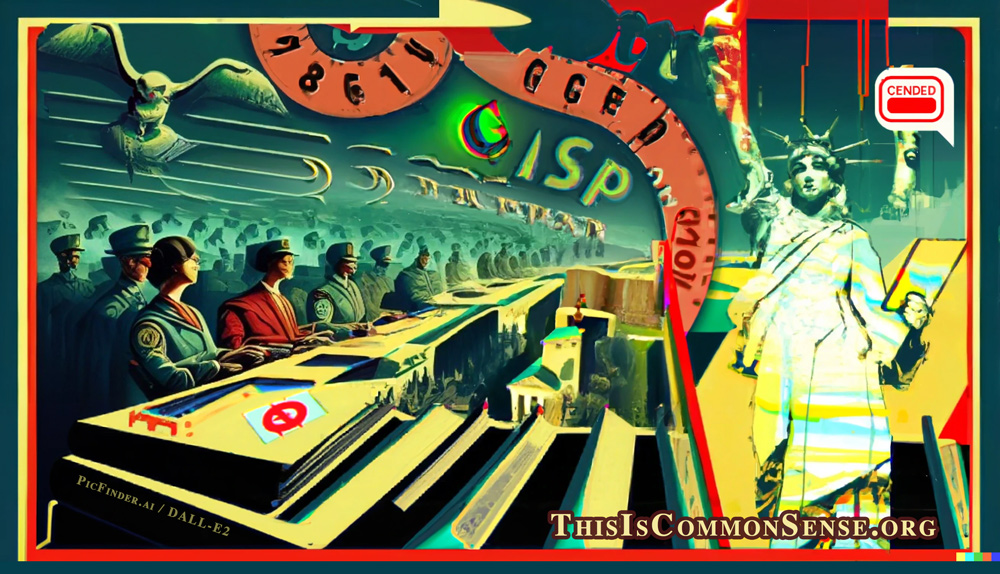
But no matter. Next thing the funny man’s employer knew, “China’s Ministry of Culture and Tourism Bureau said it would fine Shanghai Xiaoguo Culture Media Co 13.35 million yuan and confiscate 1.35 million yuan in ‘illegal gains’ from the firm.”

That’s a cool $2 million U.S. for the ever-so specific crime of “harming society.”

“In response to the fine, Xiaoguo Culture . . . said it had terminated Li’s contract,” and, for good measure if you are a totalitarian, Reuters adds that “Weibo appears to have banned him from posting to his account there.”

“We will never allow any company or individual [to] use the Chinese capital as a stage to wantonly slander the glorious image of the PLA,” declared China’s cultural ministry.

Suffice it to say, China isn’t currently known for its comedy. 

And won’t be until more people perform their own stand-up act.

This is Common Sense. I’m Paul Jacob.


PDF for printing

Illustration created with PicFinder.ai and DALL-E2

See all recent commentary
(simplified and organized)
See recent popular posts
Categories
general freedom individual achievement

A Life of Meaning

My wife and I are attending tonight’s Milton Friedman Prize for Advancing Liberty dinner at the Cato Institute. We are very excited, for this year’s award will be given to a very worthy recipient: Jimmy Lai.

The 75-year-old Lai, alas, won’t be there.* He sits in a Hong Kong jail for committing the Chinese Communist Party’s most feared crimes: speech, association, practicing religious faith, advocacy for democracy and human rights. And he awaits more charges that could (and probably will) keep him in prison for life.

Lai is no stranger to this audience. Last December, I gave two thumbs up to the Acton Institute’s documentary†, “The Hong Konger: Jimmy Lai’s Extraordinary Struggle for Freedom”; back in 2020, I noted his long deployment on Hong Kong’s front lines of freedom.

Lai escaped to Hong Kong from Communist China as a kid. His hard work and entrepreneurial skills made him a wealthy man. He used that wealth to advance freedom, including publishing the pro-democracy Apple Daily, which was shuttered by Chinese authorities in 2021 under the National Security Law. 

Mr. Lai could have escaped it all with plenty of money to live comfortably somewhere far away from the Chinazis. “I think you have to live a life of meaning,” he offers. “And I find taking responsibility to fight for freedom is meaningful for me.”

Thanks to Jimmy Lai and the Hong Kong protesters for standing up against the CCP, the world has a much clearer view of those imprisoning him. Let’s hope the world acts accordingly.

This is Common Sense. I’m Paul Jacob.


* The Wall Street Journal’s William McGurn, a friend of Lai, will give the keynote address. Jimmy Lai’s son, Sebastian, will be there to receive the award.

† The documentary now has over a million views on YouTube, which may be why Tik Tok “shut down” the Acton Institute’s account. Meanwhile, for context , a documentary to “mark the handover anniversary,” on which the Hong Kong government spent $1.3 million, garnered only 4,000 views.

PDF for printing

Illustration created with PicFinder.ai and DALL-E2

See all recent commentary
(simplified and organized)
See recent popular posts
Categories
education and schooling First Amendment rights general freedom

Freedom vs. Force at Harvard

Things haven’t been going well for freedom of expression on campus.

Institutions of higher learning where foes of free speech flourish include purported bastions of intellectual discourse like Harvard University. In 2022, Harvard ranked 170th out of 203 schools with respect to free speech on campus in an assessment by the Foundation for Individual Rights and Expression (FIRE).

According to a 2023 College Pulse survey, 26 percent of Harvard students say it’s sometimes okay to use violence to stop speech on campus. Only 27 percent say it’s always wrong to shout down a speaker.

“Many, many people are being threatened with — and actually put through —  disciplinary processes for their exercise of free speech and academic freedom,” says Janet Halley, of Harvard Law School. “Many people think that they’re entitled not to be offended.”

Jeffrey Flier, medical school professor, says free speech has been in decline at Harvard at least since 2007.

Halley, Flier, and more than 100 other Harvard faculty members have newly formed the Council on Academic Freedom.

Flier says it’s been too hard for professors to simply “[put] their head above the parapet [and say] ‘I think this is wrong.’ There hasn’t been any network of people from across the spectrum that could be able to do this. But that’s what we now have in the council.”

The Council seems to be off to a good start. Now let us see how many of the rest of the school’s 2,400 or so faculty members join up.

This is Common Sense. I’m Paul Jacob.

PDF for printing

Illustration created with PicFinder.ai

See all recent commentary
(simplified and organized)
See recent popular posts

Categories
general freedom ideological culture media and media people

Happier in the Moment?

When I express worry about children and teens being put through what we used to call “sex change” procedures, the push-back often runs like this: 

  • this is not happening; 
  • you’re falling for a “moral panic”; 
  • stop listening to right-wing propaganda!

But consult this video.

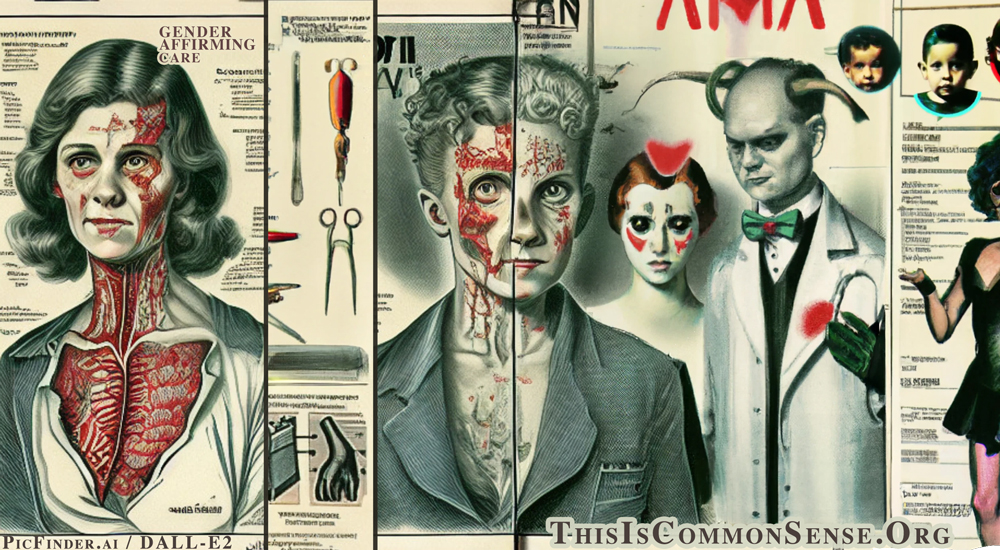
One interviewee who performs sex-change surgery discusses the “informed consent” of 14-year-olds. This doctor acknowledges that many children who agree to puberty blockers and surgery — changing their bodies irreversibly — end up regretting it.

“We talk about it [with the kids] but most of the kids are nowhere in any kind of brain space to really talk about it in a serious way. That’s always bothered me,” he says. “But you know, we still want the kids to be happy. Happier in the moment, right?”

“It’s everything you have been told doesn’t happen,” says my friend David Strom in his report on the Project Veritas investigation (“Undercover video: puberty blockers at 8, surgery as young as 10 in New York”).

“It happens,” David writes. “Watch the doctors who do it explain that they do and that they are eager to do it to even pre-adolescent children. Even admitting that the ‘science isn’t really settled,’ but hey, we’ll do it if you want.”

We don’t let kids do everything that adults may do because we know that it takes time for human beings to mature. Adults, too, may regret having undergone hormone blocking and genital surgery. But adults have the best chance, a real chance, to decide responsibly.

Peer-pressured, doctor-pressured, even legislature-pressured, and perhaps very confused 14-year-olds, 12-year-olds, 10-year-olds . . . and 8-year-olds . . . don’t have the same chance to make an adult decision.

This is Common Sense. I’m Paul Jacob.


PDF for printing

Illustration created with PicFinder.ai

See all recent commentary
(simplified and organized)
See recent popular posts

Categories
crime and punishment general freedom property rights

Rent-Free in Oakland

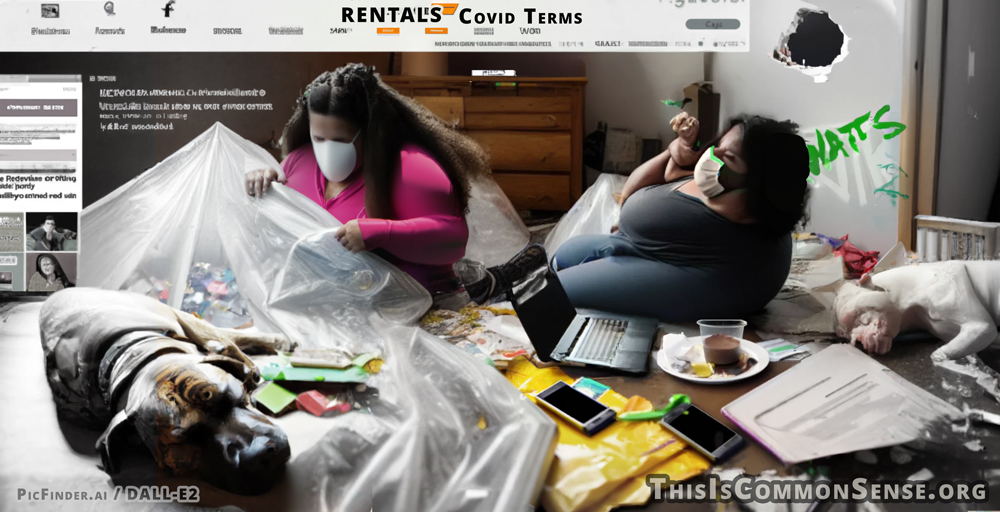
The city council of Oakland, California just voted 7-1 to end the town’s pandemic-rationalized moratorium on eviction for nonpayment of rent.

But it’s not over yet.

The moratorium will linger on until July 15. Three years is supposedly insufficient time for tenants to gird themselves to again honor the contract with the persons who provide them with shelter.

And then it still won’t be over.

The council’s slow-walk phaseout comes with a permanent new limitation on what landlords can do. This explains the lone dissenting vote, that of Council member Noel Gallo, who says that the rights of landlords are still being insufficiently protected.

As the text of the legislation passed by the council makes clear, its revision of the city’s “just cause” ordinance further violates the property rights of landlords. In part, the new ordinance provides that any failure to pay rent during the last three years which a tenant can plausibly attribute to the pandemic is sufficient to prevent an eviction, even if not relieving the tenant of the obligation to pay that rent.

Will the reprieve be too late and too little for property owners like John Williams? For the last three years, Williams has been stuck with a freeloading tenant who has been financially able to pay rent but who has refused to do so and refused to move.

The tenant, occupying half of the duplex where he also happens to live, owes him $56,000. And Williams is facing . . . foreclosure.

This is Common Sense. I’m Paul Jacob.


PDF for printing

Illustration created with PicFinder.ai and DALL-E2

See all recent commentary
(simplified and organized)
See recent popular posts
Categories
general freedom national politics & policies too much government

It’s Over But It Isn’t

Is the pandemic over?

On March 29, House Joint Resolution 7 passed with a 68–23 margin in the Senate: 47 Republicans and 21 Democrats voting Yea. Earlier this week, Joe Biden signed it into law.

But, as The Epoch Times explains, that resolution “states that the pandemic national emergency ‘is hereby terminated,’” but “does not impact the public health emergency, which is still scheduled to terminate on May 11.” 

But that lag — why terminate one (“national”) emergency footing and leave the other (“public health”) to linger for another month?

It’s worse than that, though. Back in September, President Biden told 60 Minutes that the pandemic was over, noting then that “no one’s wearing masks; everybody seems to be in pretty good shape.”

The administration offers bureaucratic rationales for the lagtime. But its impact on you and me is said to be zero: “To be clear, [the] continuation of these emergency declarations until May 11 does not impose any restriction at all on individual conduct with regard to COVID-19,” explains a January letter from the Biden administration to Congress.

Repeat that: the continuation of the emergency declarations does not impose any restriction at all on individual conduct. Which should have been true from the beginning, for the Constitution does not provide any powers to the general government over individuals on these matters.

Does public health really need another month of crisis . . . after acknowledging there isn’t a crisis anymore?

At least, there is a May 11th at the end of the tunnel.

This is Common Sense. I’m Paul Jacob.


PDF for printing

Illustration created with Midjourney

See all recent commentary
(simplified and organized)
See recent popular posts

Categories
education and schooling general freedom ideological culture

Down-Shifted Demographics

Until recently, the most obvious demographic trend has been the “squaring of the curve”: more people were hitting an apparently natural limit in their eighties and nineties, rather than dying off in their forties, fifties, and sixties.

Now, however, longevity stats are showing a new feature. A graph in a fascinating article puts it like this: “Americans die earlier than the English across the income distribution, despite typically earning significantly more,” with the article quickly clarifying the specifics: “America’s mortality problem is driven primarily by deaths among the young.”

The most vulnerable members of traditional society are newborns and the aged. But now it’s those reaching their alleged prime: “one in 25 American five-year-olds today will not make it to their 40th birthday.”

Is it COVID? No. This trend is older than 2020, and remember, in the recent pandemic it was the aged, not the young, who experienced higher rates of morality.

An article by Zach Rausch and Jon Haidt suggests that the problem may loom beyond America, for their work shows that “The Teen Mental Illness Epidemic Is International,” and I don’t think it is at all out of bounds to take higher youth rates of suicidality, desperate recreational drug use, and expressed anxiety and despair — and skyrocketing transgender rates, too — as stressors related to increased death rates. 

It is vital to study these things, for their main conclusion is startling and a general sign of deep cultural decay: “Teen mental health plummeted across the Western world in the early 2010s, particularly for girls and particularly in the most individualistic nations.”

We should ask ourselves: could this be related to the rise of a gerontocracy?

A society run by old people for old people may have nasty inter-generational side effects.

This is Common Sense. I’m Paul Jacob.


PDF for printing

Illustration created with PicFinder.ai and DALL-E2

See all recent commentary
(simplified and organized)
See recent popular posts
Categories
crime and punishment general freedom insider corruption

If It Can Happen to Trump

If it can happen to former President Donald Trump — something like the politically motivated ham-sandwich indictment issuing from an avid Trump-hating Democratic DA — can it happen to you and me?

It already happened to me. Fifteen years ago.

Handcuffs and leg-irons. Paul Jacob, Rick Carpenter, Susan Johnson.

The Oklahoma Three. Indicted by an arch enemy of citizen initiative, Oklahoma Apparatchik and Attorney General Drew Edmondson.

No, we hadn’t robbed a bank or gunned down the sheriff.

We were accused of not following all regulations in conducting a 2006 petition drive in Oklahoma. The fictional charge: “conspiracy to defraud the state of Oklahoma.”

The possibility of ten years in prison hung over our heads for a year and a half. In all that time, the AG started but never completed a preliminary hearing after which a judge could decide whether the indictment had enough evidence to warrant a trial. (Because it didn’t.) Then, the federal 10th Circuit declared unconstitutional the law we had allegedly violated, residency requirements for signature gatherers. 

Gritting his teeth and with smoke pouring out of his ears, Drew Edmondson dismissed the charges.

If somebody with official power like Edmondson or New York County District Attorney Alvin Bragg wants to wield it against you and is indifferent to the requirements of justice, he might just do that.

Can it happen to you? Maybe not. Keep your head down, never say anything somebody somewhere could dispute, don’t leave the house, always wear a disguise, never exercise your political rights in a way that might draw the attention of thin-skinned and scared denizens of the political establishment.

Do all this, and you’ll probably almost certainly be fine. Maybe.

Or just fight them anyway.

This is Common Sense. I’m Paul Jacob.


PDF for printing

Illustration created with Midjourney

See all recent commentary
(simplified and organized)
See recent popular posts
Categories
general freedom international affairs national politics & policies

Why We Fight

A recent Senate hearing addressed a big problem facing America’s All-Volunteer Force (AVF): recruitment. 

The Army fell 25 percent short of its 2022 goal; the Air Force is 10 percent below; the Navy met its target for enlisted folks but not officers; and the Marines hit their mark but said “never before” has it been so challenging.

“The Pentagon has attributed its difficulties to a variety of factors,” reports The Washington Post, “including the nation’s low unemployment rate, school closings during the coronavirus pandemic that limited recruiters’ access to high school students and faculty, and a shifting culture in which more teens gravitate to jobs with work-life balance.”

As The Post paraphrased Army Undersecretary Gabe O. Camarillo, “the most significant barriers to service [include] fears of death or injury, suffering psychological harm, and leaving behind friends and family.” 

Indeed, what with possibility of overseas deployment and combat, the job of soldier certainly does not score well in the “work-life balance” category. While a sense of mission — and the country’s need — has helped spark interest in the past, that need has been blurred by a long string of misguided military adventures in recent decades.  

Sure, President Joe has repeatedly promised American military force in defense of Taiwan against repeated Chinese threats to invade.* But do young Americans perceive this as anything to them? Has the wokeness mission, stressed by the administration and the Pentagon and interrogated during the Senate hearings, occluded the more traditional sense of mission upon which the AVF has relied?

It’s time for Mr. Biden to speak to the people on the military’s core mission — including his promises, and those of other politicians. Asking them to keep his word. 

Plus, a personal presidential request might add an element of responsibility and accountability from the commander-in-chief to the soldiers recruited.

This is Common Sense. I’m Paul Jacob.


PDF for printing

Illustrations created with Midjourney and PicFinder.ai

See all recent commentary
(simplified and organized)
See recent popular posts