Categories
Accountability folly free trade & free markets ideological culture media and media people national politics & policies

Next Bubble to Pop?

There was a great and wondrous moment, a decade and a half ago, when economist Paul Krugman, Nobel Laureate and New York Times’s unregistered shill for the Democratic Party, suggested that what the economy really needed was another housing bubble.

What he wrote, specifically, was this: “To fight this recession, the Fed needs more than a snapback; it needs soaring household spending to offset moribund business investment. And to do that, as Paul McCulley of Pimco put it, Alan Greenspan needs to create a housing bubble to replace the Nasdaq bubble.”

Krugman later reinterpreted that statement in a clever (if not convincingly honest) way. After the subprime loan industry collapsed in 2008, he attributed that bust to financial market malfeasance, not the Fed-inflated bubble we got . . . and that he had previously called for.

Now we are looking at several ready-to-burst bubbles:

  • The student loan debt problem seems scary.
  • The sovereign debt problem is undoubtedly more dangerous and far larger, but is perhaps still able to take on more fake money — all the world’s 1s and 0s have to go somewhere!
  • So the current bets seem to be on a huge auto loan industry bubble, about to pop.

Loan terms have increased in duration, and the average amount new car buyers are financing has jumped over 17 percent in five years. The idea has been “to continually lower monthly payments,” says David Stockman, “so people can get behind the wheels of vehicles they can’t really afford.”*

Which bubble does Krugman favor? I don’t have the stomach to check.

But, be certain, as we play pop goes the bubble, he’ll play pop goes the weasel.

This is Common Sense. I’m Paul Jacob.


* Stockman seems to be echoing warnings made by Eric Peters, of Eric Peters Autos.


Printable PDF


Categories
Accountability folly free trade & free markets general freedom local leaders moral hazard nannyism national politics & policies property rights responsibility too much government

Against Flexibility?

Do politicians have any idea what they are doing?

In Oregon, Senate Bill 828 just passed the Senate and is now being favorably reviewed in the House. The law would require “large employers in specified industries to provide new employee[s] with estimated work schedule and to provide current employee with seven days’ notice of employee[’s] work schedule.”

But will the measure help employees? Really?

The notion is called the “Fair Work Week.” Pushed by Democrats, it has gained bipartisan support. The basic idea: allow time (under full force of law) for workers to manage their own schedules and personal economies.

Trouble is, in the name of making work easier to manage, it attacks flexibility.

Which is something many workers want. More than notification.

Indeed, the study commissioned by the City of Seattle for their similar regulatory scheme acknowledged that reducing flexibility is not necessarily a godsend for workers.

“A more predictable schedule,” the report noted, “is not always one that an employee would prefer. A schedule known with certainty is a cold comfort if it yields too little income to survive.”

The report went on to explain that many of the labor market’s scheduling inconveniences are themselves the result of other government regulations, such as ObamaCare.

Christian Britschgi, writing at Reason, predicts that passing the Oregon law would mean “a fairer worker week” for some, but for others, “no work week at all.”*

Meanwhile, the Seattle study noted that it was workers in small businesses who are most likely to be discomfited by last-minute scheduling changes. The Oregon law applies only to big businesses.

This is Common Sense. I’m Paul Jacob.


* A standard, negative consequence of most “well-intended” legislation.


Printable PDF


Categories
folly free trade & free markets general freedom ideological culture moral hazard nannyism national politics & policies property rights responsibility too much government

Minimally Mugged By Reality

It should shock no one: forcing businesses to pay steep minimum wages ends up pushing some businesses out . . . of business. Yesterday I looked at what minimum wage laws can do to low-skilled workers. Today, consider the employers. When we make it harder to turn a profit, it becomes harder to profit. Businesses that can’t at least break even close their doors.

Many business owners are inclined to promote, politically, politicians who in turn support minimum wage hikes. Do they change their minds when mugged by reality? Alas, the trauma alone won’t convert a person to principled allegiance to free markets.

I was reminded of this fact by a story about business owners in Minneapolis who stress their Sandernista credentials.  

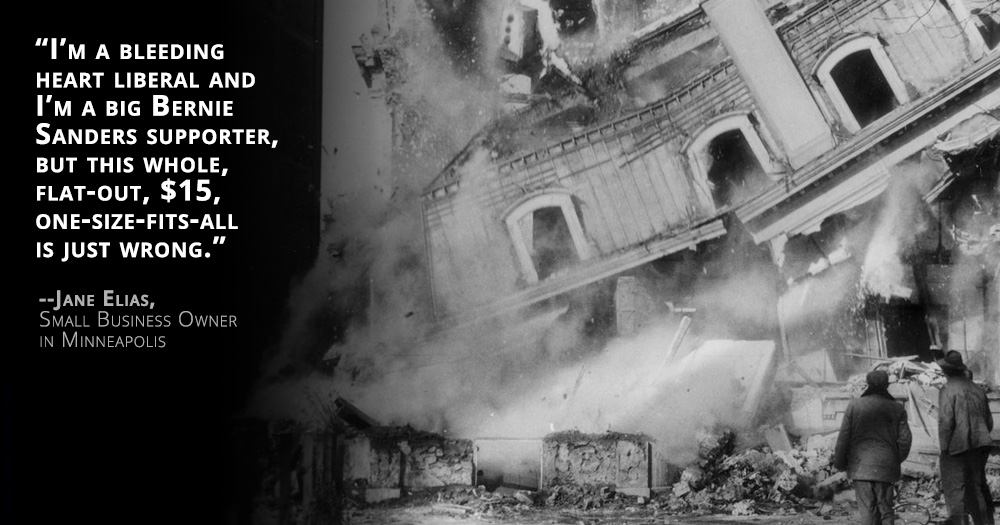
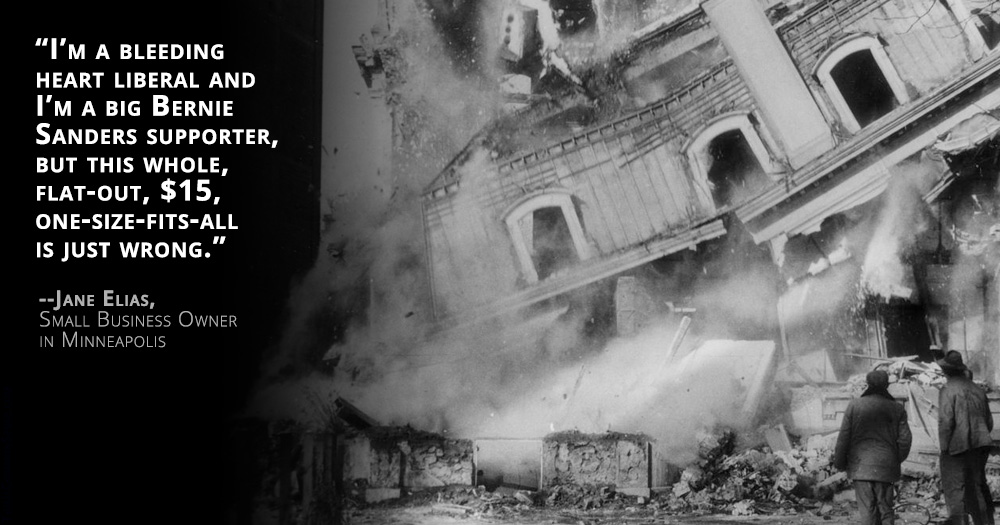
“I’m a bleeding-heart liberal and I’m a big Bernie Sanders supporter,” says businesswoman Jane Elias, an art store owner. “But this whole flat-out, $15, one-size-fits all is just wrong.” Another victim, restaurant owner Heather Bray, says she’s a “proud, proud progressive.” But: “The arithmetic doesn’t work. People will not continue to go to budget-conscious restaurants when they’re no longer budget-conscious.”

So . . . arbitrary minimum-wage demands don’t add up in light of the demands of running their businesses under their particular circumstances. Well, no disagreement here. But take it further, please. Keep doing the math. The bottom line is that everybody, not just you — and always, not just sometimes — has the right to make his own decisions about his own life and property.

And profit by it.

This is Common Sense. I’m Paul Jacob.


Printable PDF


Categories
free trade & free markets general freedom local leaders national politics & policies political challengers property rights responsibility too much government

The Real ObamaCare Opposition

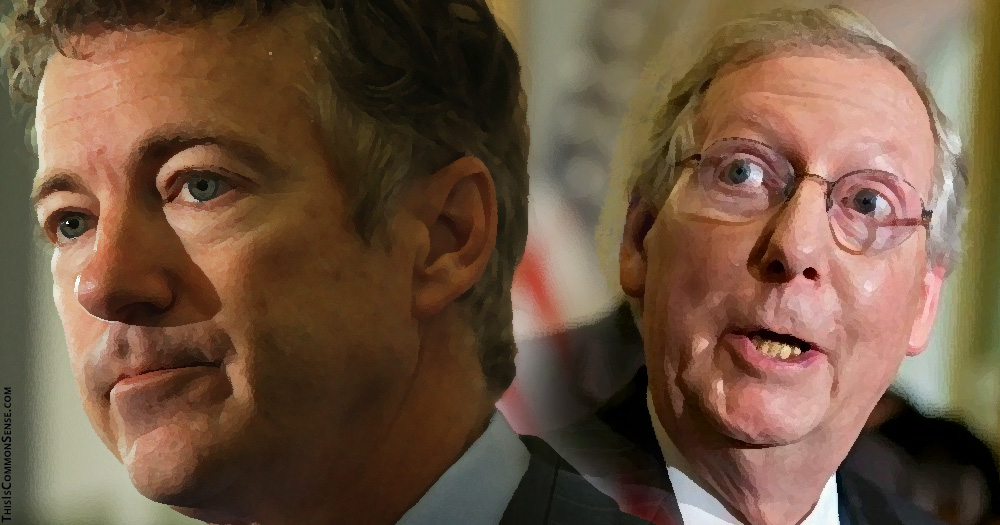
Senate Majority Leader Mitch McConnell (R-Ky) has introduced a bill to compromise between the House’s recent Affordable Health Care Act and the current “ObamaCare” Affordable Care Act. Though there seems to be some “what the heck, go with it” enthusiasm for it on Capitol Hill, it’s not coming from Senators Rand Paul of Kentucky, Ted Cruz of Texas, Ron Johnson of Wisconsin and Mike Lee of Utah.

‘‘Currently, for a variety of reasons, we are not ready to vote for this bill,” their joint statement from yesterday reads.

Their objections? Well, they agree that there are “provisions in this draft that represent an improvement to our current healthcare system but. . .”

— and this is a big but

“it does not appear this draft as written will accomplish the most important promise that we made to Americans: to repeal Obamacare and lower their healthcare costs.’’ Their opposition, the Boston Globe tells us, puts the TrumpCare wannabe in jeopardy.

Dr. Rand Paul is the key figure in the opposition. One of Capitol Hill’s ongoing amusements has been to watch the junior Kentucky senator repeatedly pit himself against his state’s senior member — who, the Globe tells us, now threatens “to bring the bill to a vote next week even if he doesn’t have the necessary votes.”

Pressure tactics.

Which you need to put an obviously bad bill through Congress.

Too many mainstream Republican congressmen lack the courage of their constituents’ convictions. They apparently do not really believe that a freed-up health care system and insurance market can work to the general good.

At least, not in time for the next election.

This is Common Sense. I’m Paul Jacob.


Printable PDF


Categories
crime and punishment folly free trade & free markets general freedom nannyism national politics & policies responsibility too much government

Serving Consumers? Punish!

New media ballyhooer Douglas Rushkoff made waves this week. Citing an un-named friend who went hysterical about Amazon.com’s purchase of Whole Foods, he asserted that such “unease is widespread, and has raised new calls for breaking up Jeff Bezos’s impending monopoly by force.”*

The company has “surely,” he claimed, “reached too far.”

Apparently, serving customers exceptionally well is bad for business.

Yes, he almost totally ignored the pro-consumer benefits of Amazon. Had to — his case makes no sense when you factor in us consumers. He focused, instead, on Amazon’s success in terms of its recent “online and offline retail sales growth” and its control of 40 percent of cloud storage and streaming services.

He went on to spin a bizarre fantasy about how disruptive bigness is in business. His economically illiterate farrago reminds me of the sad case made against pre-antitrust Standard Oil, a company which, during the whole time of its growth prior to break-up, kept on producing more fuel at ever-decreasing prices.** Broken up because of . . . fears about how businesses change. And of bigness itself.

As long as consumers are being served, this reaction strikes me as paranoid. When businesses get big (and even near-monopolistic) and then cease to serve customers, they fail. While serving customers, there is no call for fretting over businesses that move from one success to another  — which is what Rushkoff has the gall to worry about.

The call for Amazon’s break-up over-sells government and necessarily under-serves consumers.

This is Common Sense. I’m Paul Jacob.


* Rushkoff’s piece in Fast Company was the first I heard of such a “call.” Rushkoff is the coiner of the term “media virus” and a sort of populist pusher of market skepticism.

** For the bizarre story of the Standard Oil case, and how it made no economic sense whatsoever, see Dominick T. Armentano, Antitrust: The Case for Repeal (Ludwig von Mises Institute, 1999), p. 41-43, and Antitrust and Monopoly (Independent Institute, 1990), pp. 57-60.


Printable PDF


Categories
Accountability folly free trade & free markets general freedom initiative, referendum, and recall local leaders moral hazard porkbarrel politics responsibility too much government

Go Nats?

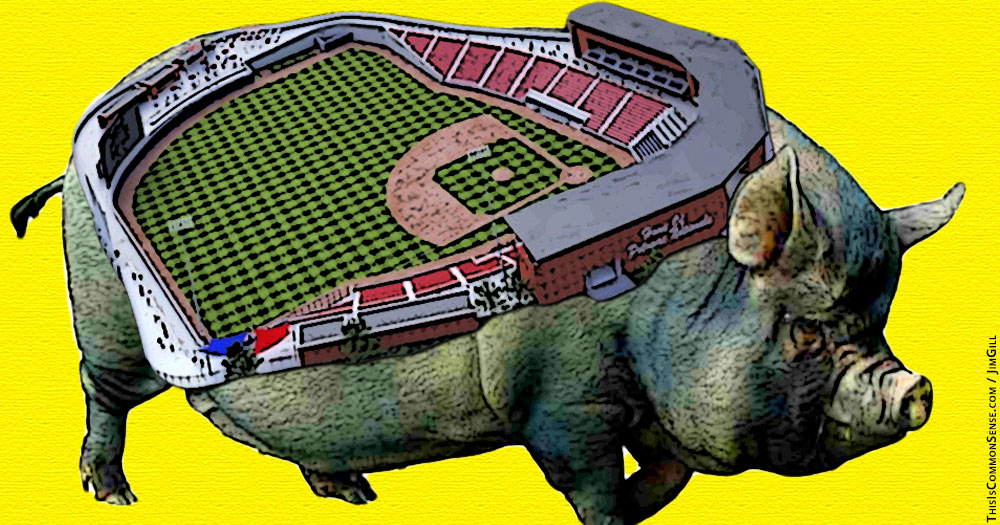
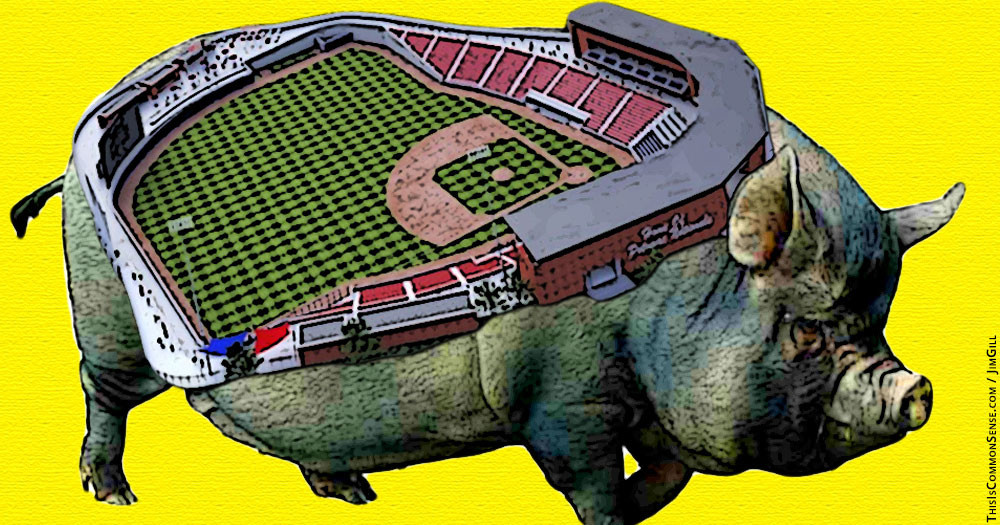
Just a few miles away from where I live sits the stadium of the Potomac Nationals. I’m a fan. I’d hate to see the team we call the P-Nats leave.

But . . . Hasta la vista.

The owner of this minor league affiliate of Major League Baseball’s Washington Nationals is demanding a new stadium. He threatens to move out of Prince William County, Virginia, if he does not get it.

The Prince William County board of supervisors has already expressed interest in floating bonds to raise the $35 million the fancy new stadium would require — with the privately owned team paying the money back, with interest, over the next 30 years.

Compared to other crony-ish deals around the country, not such a terrible taxpayer swindle. Still, zillions of wrongs don’t make this right. County taxpayers would be on the hook in case of default. And if the marketplace believed the team could actually make such payments, a bank or other investors would come to the rescue.

Thankfully, a monkey wrench has been thrown into the deal. A county supervisor has proposed that voters should get a chance to decide, via a November referendum. The board of supervisors will consider the referendum tonight.

Voters should get the final say. But if there is a referendum, as much as I love having the team here, I will vote NO. I don’t cotton to forcing others to pay for my preferred entertainment.

Government has certain legitimate roles. Subsidizing sports is not one.

Even if the new stadium would be closer to my home than the old one.

This is Common Sense. I’m Paul Jacob.


Printable PDF


Categories
free trade & free markets general freedom national politics & policies responsibility

The Poverty Retirement Non-plan

A “conundrum” is “an intricate and difficult problem” or “a question or problem having only a conjectural answer.”*

In his June 8 article, “The Jobs Conundrum,” economist Gerald P. O’Driscoll focuses on a very big problem that we do not have sure answers to, yet.

Unemployment figures are down, but the number of non-working adults in the prime of their lives is up. O’Driscoll explains: “Unemployment” is a term of art and does not mean simply the number of people not working. It comprises the number of people not working and who are looking for a job.” Many aren’t “unemployed” for the simple reason that they are not trying to be employed.

They are, I suppose you could say, in early retirement, mostly a kind of poverty retirement.

Economists call it a drop in “labor force participation.” It used to be that men in the prime of life not looking for work constituted a mere 6 percent of the population. Now it’s 15 percent.

O’Driscoll, I notice, doesn’t engage in much conjecture to explain why. He merely insists, instead, that the trend is big, unemployment figures don’t track it, and that it has huge consequences.

I’ve heard some interesting (and puzzling) theories about the whys, of course. Blame feminism; blame the welfare state; blame the Chinese!

But even before we settle on a definitive answer, many movers and shakers now contemplate establishing — and are even experimenting with — a universal basic income as a way to alleviate this problem.

My conjecture? It would make the problem worse.

This is Common Sense. I’m Paul Jacob.


* The original, primary meaning of “conundrum” — “a riddle whose answer is or involves a pun” — is not relevant to this pun-free column.


Printable PDF


Categories
folly free trade & free markets general freedom moral hazard nannyism responsibility too much government

Signature Nonsense

Did anyone really need this?

Last year, California’s Governor Jerry Brown signed into law Assembly Bill No. 1570, which concerns collectibles, particularly signed-by-author or artist books. But it doesn’t mention books, and is confusingly written. What a mess.

Who asked for it?

It certainly wasn’t the struggling booksellers who have come to depend on signed authors’ copies. In the Age of Amazon.com, book vendors need to add value to stay afloat.* Author-signed copies help.

The law says that for signed-by-creator collectibles sold for more than $5 — yes, a mere five smackers — sellers must provide customers a Certificate of Authentication. The law specifies nine “helpful” directions for said certificates. So imagine an edition of Brian Doherty’s Radicals for Capitalism, signed by the author at, say, a non-profit dinner, or at a bookstore signing, or even a late-night bar —discounted to not much over five bucks.** The bookseller must not only provide a certificate, but list the book’s provenance. Talk about an added cost of doing business.

I mention Mr. Doherty not merely because of his excellent book, but because he has not unreasonably confessed that “my own interests could be harmed by any attempt to actually enforce the letter of this law.”

This week on EconTalk, economist Mike Munger mentioned the market’s built-in regulatory features — reputation being the most obvious — for helping consumers avoid getting ripped off buying books . . . and paintings . . . and anything else improved by creator signature.

But, really, can’t we make do with a little caveat emptor as well as caveat lector? Better than regulations this dense.

This is Common Sense. I’m Paul Jacob.


* The number of independent bookstores plummeted (down a thousand) around the country between 2000 and 2007. But there seems to be an increase since then, despite (or because of?) Abebooks and Alibris and other dot coms.

** I found a signed copy of Doherty’s history at Abebooks for $10.


Printable PDF


Categories
folly free trade & free markets local leaders moral hazard nannyism property rights responsibility too much government

Housing Horror

Housing in Oregon’s north-central urban region is becoming more and more like San Francisco’s — out of the budgetary reach of huge swaths of average workers.

“The median rental household can’t comfortably afford a two-bedroom apartment in 28 of Oregon’s 36 counties,” Elliot Njus writes for The Oregonian. But it is worst in Portland and the three counties in the region: Multnomah, Washington, Clackamas. 

The findings come from a group called the National Low Income Housing Coalition. Njus quotes Alison McIntosh, of another group, the Neighborhood Partnerships, who not unreasonably concludes that “folks are really struggling to make ends meet.”

Well, yeah. This was predicted, long ago.

The state of Oregon began a comprehensive land-use planning system, decades ago, to prevent urban sprawl. At about the same time the Portland-region’s three major counties began a concentrated effort to . . . concentrate populations within the area. Confine them. Regulate them. Economists and other critics* from the very beginning predicted rising housing costs. And other problems.

Now, of course, the usual groups react in precisely the wrong ways: rent control. The State House in Salem recently passed legislation to uncork rent control. Thankfully for renters, the Senate nixed the idea. 

But we can be sure this proven housing killer (a disaster where tried) will resurface. Common sense (as well as reams of economic research) tells folks how bad an idea this would be, exacerbating the problem it aims to solve.

Alas, some folks look at government more as magic than as just another flawed, human institution.

This is Common Sense. I’m Paul Jacob.


* One set of critics can be found at the Cascade Policy Institute, which describes Oregon’s land-use regulatory system as “the nation’s most restrictive” — adding that “every square inch of Oregon has been zoned by government planners, with the result that development of any type is prohibited on most private land.”


Printable PDF


Categories
crime and punishment free trade & free markets general freedom moral hazard nannyism too much government

Sin, Soda and Say

Government policy in Seattle, Washington, is being driven by an outright socialist on the city council. The mayor, apparently starving for attention, proposed a goofy new sin tax last year.

Now, writes Reason’s Baylen Linnekin, “Seattle lawmakers are expected to vote early next week on a citywide soda tax that would add more than $2.50 to the cost of a twelve-pack of soda.”

The tax’s proponents’ rationale is too familiar: sugary sodas are bad for us, so we must be discouraged from drinking them.

Besides, politicians want to spend our money.

The problem, of course, is that the more successful they are at the first task, discouraging the ‘sin’ itself, the less revenue for them to throw at voters to prove their ‘caring’ nature . . . and buy votes.

But it is not as if those are the only competing factors involved. “The tax would undoubtedly drive consumers,” writes Linnekin, “to buy more groceries in the city’s suburbs.” Bellevue and Kirkland are nice towns. And nearby.

Arguing for a tax like this — as a social engineering mechanism — is not only crude, but flies in the face of the very best wisdom, that of Jean-Baptiste Say:

A tax can never be favorable to the public welfare, except by the good use that is made of its proceeds.

But elitist nannyism corrupts politicians, who make it their job to steer our consumption.* And they tend to be resistant to the “best scheme of finance,” which is, as J.-B. Say put it, “to spend as little as possible; and the best tax is always the lightest.”

If the tax goes in, Seattleites, drive to out-of-town Costco or Walmart.

Then drive your greedy nannies out of office.

This is Common Sense. I’m Paul Jacob.


* Considering the mayor’s push to include diet sodas in the sin tax, how competent at this are they? It’s the sugary drinks that are known killers, but the diet drinks are mainly imbibed by wealthier folks. The mayor wants to appease the socialist on the council, and pointedly not favor the “privileged.”


Printable PDF