Categories
folly government transparency national politics & policies too much government

It’s Only Money

“If we can put a man on the moon,” went the old 1970s saw, we can do . . . well, fill in the blank.

Anything!

Man, can that “anything” get really expensive. And when promoters of big government drive the program, anything quickly serves as a first-stage rocket to everything.

During the 2016 campaign, a Democratic Party activist knocked on my door to express confidence that Democrats would provide greater healthcare benefits. “Can we afford that?” I asked.

The question caught her off-guard, but after reflecting on the affordability for a brief moment on my step, she decided, what the heck, surely the great “we” can swing it.

Vermont Senator Bernie Sanders, the conscience of the Democratic Party (that he refuses to join), likewise ponders healthcare. Sans cost, again, focusing exclusively on bestowing benefits. 

Sanders has introduced legislation mandating that the federal government provide Medicare for All.

Fortunately, the folks at the Mercatus Center at George Mason University are not so arithmetic-averse, calculating the price tag for the socialist senator’s bill to be a whopping $32.6 trillion (with a “t”) over ten years. 

In fiscal 2019, the U.S. Government plans to spend $4.4 trillion, borrowing a trillion dollars of that to keep the federal spigots spewing cash. So, Bernie suggests nearly doubling annual spending, placing a giant $3.3 trillion cherry on top of the current fiscal pig-out. 

And who in Washington has any credibility left to argue against the socialist urging evermore deficit spending on top of massive debt and gargantuan liabilities? 

President Trump? Republicans in Congress? The very architects of annual trillion-dollar deficits for the foreseeable future?

 That “lunacy” refers to the moon? Mere coincidence.

This is Common Sense. I’m Paul Jacob.



PDF for printing


Categories
Accountability folly free trade & free markets general freedom moral hazard property rights responsibility too much government

Poison Is Poisonous

Venezuela’s socialist economy has been collapsing.

No big mystery. If, out of hostility to capitalism, a society keeps destroying everything that production, trade, and prosperity depend upon, the economy suffers. The benefits of markets don’t flow no matter what.

One assault has taken the form of hyperinflation — runaway printing of currency, done in part to dissolve government debt. Many Venezuelans are resorting to barter. It’s easy to understand why.

Or is it? A Reuters reporter says that economists say that “the central bank [of Venezuela] has not printed bills fast enough to keep up with inflation, which . . . reached an annual rate of almost 25,000 percent in May.”

So go faster!?

Dude. Dude. The massive expansion of Venezuela’s money supply is what’s causing massive jumps in prices. Just like any other economic good, the medium of exchange is subject to the laws of supply and demand.

Other things being equal, enormously increasing a supply of a good will enormously lower its market value or price. Money, too, has a price — in terms of the non-monetary goods being bought. If the pre-hyperinflation price of a dollar in terms of bread is one loaf and the post-hyperinflation price is one bread crumb, you won’t reverse the decline by printing even more dollars or bolívars even faster.

If you’re ingesting poison, you can’t fight the effects by being poisoned more and harder. The very first thing to do is stop ingesting the poison.

This is Common Sense. I’m Paul Jacob.



PDF for printing


Categories
Accountability crime and punishment folly free trade & free markets general freedom local leaders nannyism national politics & policies responsibility too much government

Kick the Addiction, Save Money

The political case for the War on Drugs has always been intuitive. “Drugs are bad” has trumped practical concerns. But the actual, responsible case for the political crusade has depended upon some concept of “social cost.”

Now that marijuana is being legalized state by state, the case against the greater War on Drugs is being taken seriously — enough to rethink all varieties of costs. Indeed, many now see the opioid epidemic as being driven, in part, by the War on Drugs, and not just as an excuse for a stronger crackdown.

Nevertheless, coming to some accounting — especially “social cost” accounting — remains difficult. This is especially true so long as its effects on freedom and the rule of law do not get figured in.

Somewhat surprisingly, even the budgetary effects of legalization have proven a bit tricky.

So it is welcome to read Harvard economist Jeffrey Miron’s study of marijuana legalization as it has occurred in the states of Washington, Oregon, and Colorado. He compares results of legalization with the predictions he had made eight years ago, in a previous Cato Institute study. It turns out that while tax revenues are far greater than expected, law enforcement costs have not gone down.

“Early experience suggests that governments will reallocate rather than reduce those expenditures,” Miron writes. “That reallocation may be beneficial, but it does not have a direct effect on the budget deficit.”

On a federal level, though, we might expect greater savings. How? We could shut down whole bureaus.

Yet, achieving such savings would require progress on Washington’s biggest addiction:  spending.

This is Common Sense. I’m Paul Jacob.



Studies cited:

Jeffrey Miron, “The Budgetary Effects of Ending Drug Prohibition,” Cato Tax & Budget Bulletin, Number 83, July 23, 2018.

Jeffrey A. Miron and Katherine Waldock, “The Budgetary Impact of Ending Drug Prohibition,” Cato Institute white paper, September 27, 2010.

PDF for printing


Categories
Accountability crime and punishment folly free trade & free markets general freedom moral hazard nannyism responsibility too much government

Taking a (Lemonade) Stand

When life hands you lemons. . . .

Once upon a time, putting up a summertime lemonade stand was the American way for kids to learn about hard work, good will, and entrepreneurship. Almost every kid had one, making some spendable profit selling the nectar.*

Some of the youngsters grew up to become Bill Gates and Steve Jobs and, well, lemonade’s one heck of a gateway drink.

But then, along came “progress” — that is, mandates and regulations slapped upon businesses. And the hordes of regulators required to enforce the morass of rules — “swarms of Officers.”

Soon lemonade stands were vanquished from our neighborhoods.

And America was made safe (at long last!) for . . . inane bureaucracy.

“Reports of kids’ lemonade stands being shut down for breaking local health or permitting laws have long left grown-ups feeling sour,” today’s Wall Street Journal informs. But the story also details how “a growing movement of adults is fighting back.”

So, when government policies hand you lemons, what do you do?

Make a map of all the lemonade stand clampdowns.

“I think the Constitution covers [lemonade stands] as written,” Dave Roland told the Journal, explaining the map he and his wife Jenifer have produced. “But if there’s any doubt about that, let’s get it fixed.” The Rolands run the Freedom Center in Missouri, but theirs is a regrettably national map.

Last month, the popular lemonade maker Country Time started “Legal-Ade,”  pledging to come to the defense of any kid “busted” for trafficking in lemonade.

Seriously.

“When life gives you arcane laws,” the company’s video says, “make lemonade.”

Taste the Common Sense. I’m Paul Jacob.


* The profit was made possible largely by pushing their costs off onto their parents. But isn’t that sorta what parents are for? And good lessons were still learned.

PDF for printing


Categories
Accountability folly general freedom government transparency initiative, referendum, and recall local leaders nannyism responsibility too much government

Minimum Sense

Suddenly, the Democrats who dominate the Washington, D.C., City Council seem unwilling to increase the minimum wage for tipped workers — despite their official support for legislative minimum wage rate increases.

And a vote of the citizens.

Initiative 77, which passed easily last month, requires restaurant employers to incrementally increase the “tipped wage” until rates “reach what will be the uniform minimum of $15 an hour by 2025.”

“Initiative 77 is something I believe will be very harmful to our restaurants and, more importantly, our restaurant workers,” argues Councilman Jack Evans, one of three council members pledging repeal.

A spokesperson for One Fair Wage DC, calling a repeal “deeply undemocratic,” notes that “D.C. voters don’t like it when Republicans in Congress do it, and we trust council will not stoop to that level.”

Yet it would not be “the first time the city’s lawmakers overturned a decision by the electorate,” the Washington Post reminds readers, citing “a decision in 2001 when the D.C. Council overturned term limits approved by voters.”*

I’m all for ballot measures to decide any issue the people have a right to decide . . . limited by all of our inalienable rights as individuals. Minimum wage laws constitute an abuse of our First Amendment right to association, which neither legislatures nor voters may legitimately abridge.

That the council doesn’t recognize this right of association, yet nonetheless thinks it should nullify a vote of the people tells you everything you need to know about the sorry state of representation.

This is Common Sense. I’m Paul Jacob.



* And even quoting moi on the incredible hypocrisy dating back 17 years: “If you’re in a city struggling to get representation in the first place, that’s a terrible signal to say that your own local officials don’t respect their own citizens.”


PDF for printing


Categories
Accountability ballot access folly general freedom ideological culture initiative, referendum, and recall media and media people national politics & policies political challengers responsibility U.S. Constitution

Should Non-Citizens Vote?

“A lot of people would like to say this is an immigration issue. It’s really not,” offered Gary Emineth, the head of North Dakotans for Citizen Voting and a candidate for state senator.  

“It’s really about preserving the right for U.S. citizens, and in our case, North Dakota residents, to only be the voters in all elections across the state of North Dakota,” added Emineth. “And that’s why we want it in the constitution.”

Turning in more than 35,000 voter signatures on petitions last Friday, Emineth and others placed a constitutional amendment on this November’s ballot that, if passed, would make voting the exclusive right of U.S. citizens in North Dakota.

Elsewhere in the country, Emineth points out, non-citizens are already voting — in Chicago and San Francisco, and in 11 cities across Maryland. Moreover, campaigns are underway across the country to give non-citizens the vote — in California, Connecticut, New York City, Boston and Montpelier, Vermont.

Opponents claim the North Dakota measure is completely unnecessary, as the state doesn’t currently allow non-citizens to cast a ballot, nor has any city yet attempted to allow non-citizens to vote. But Emineth’s goal is to keep it that way.

Moreover, University of North Dakota Law Professor Steven Morrison acknowledged to The Forum in Fargo that “the proposed amendment does clean up what could be a grammatical loophole since the word ‘every’ doesn’t conclusively exclude non-citizens from voting. . . .”

It is a very simple proposition: Do you want voting to be the exclusive right of U.S. citizens? Or should non-citizens be allowed to vote?

Coming to a ballot near and Fargo.*

This is Common Sense. I’m Paul Jacob.



* With some help from Liberty Initiative Fund.


PDF for printing


Categories
Accountability folly general freedom ideological culture media and media people moral hazard responsibility

Too Big for Breaches

“Any reporter who has covered Europe in the last decade has written a dozen articles or more,” The New York Times informs us, “about how one crisis or another has exposed the fundamental unsustainability of the European Union.”

I hadn’t noticed. Until recently, haven’t reporters and commentators been downplaying Europe’s looming crisis? But they cannot pretend “far right” separatist, decentralist and nationalist movements are marginal any longer, not after strong showings for Geert Wilders in The Netherlands and Marine Le Pen in France, and the Brexit vote.

Now everybody seems to be panicking.

Even the Times is half-predicting an end to what it calls the “European Experiment.”

The Times identifies the tension as arising from “calls for keeping out secondary migrants and demands to keep internal European borders open. It’s a version of the contradiction within the European Union itself: between an open union and a collection of sovereign states.”

Beneath all the brouhaha about freedom of movement across breached borders lies the real contradiction: between massive welfare states on the one hand and, on the other, freedom of movement, speech and all the rest.*

When governments offer freebies, they entice people into un-productive or at least sub-productive lifestyles. Which is not sustainable, especially when extensive. How many productive people must support how many unproductive people?

Then throw those domestic programs open to millions of migrants who lack even rudimentary language and First World skills? That’s how states subsidize their societies’ destruction.

Europe’s governments are way too big for their border breaches.

If you want traditional freedoms, you have to pare down government.

This is Common Sense. I’m Paul Jacob.



*Between social democracy (socialism lite) and the old liberal order.


PDF for printing


Categories
Accountability crime and punishment folly free trade & free markets general freedom judiciary local leaders moral hazard nannyism Second Amendment rights too much government U.S. Constitution

Ought Implies Cantifornia

“Strip away the absurdity,” writes Scott Shackford at Reason, “and it’s essentially a very technical ruling.”

Shackford is explaining a bizarre recent judgment of the California Supreme Court.

Politicians in Sacramento had, years ago, passed a gun control measure requiring gun manufacturers to “implement microstamping technology that would imprint identifying information on bullets as they were shot from semi-automatic weapons.” In 2014, Smith & Wesson announced that it would pull some guns from the California market rather than comply. Why? The technology just wasn’t ready yet.*

Since California’s Civil Code contains a section reiterating an old commonsense principle to the effect that the “law never requires impossibilities,” the National Shooting Sports Foundation sued to block the law.

But the group just lost.

The Court did say it could protect citizens from punishment, but it refused to nullify the legislation on constitutional grounds.

Unanimously.

Why do this? Apparently to protect California politicians in their ongoing social engineering schemes.

The dollar costs of trying to comply with impossible demands are huge, of course. But the biggest costs may be more subtle.

In moral philosophy, it is a truism to say that “ought implies can.” In natural law as understood long ago, an impossible law was thought not a law at all, justifiably ignored by anyone and everyone.

In a just state, flouting of maddening regulations like California’s would lead not merely to the defense of the absurdly put-upon citizen — as this court ruling still allows — but also to the nixing of the “impossible” law.

This is Common Sense. I’m Paul Jacob.



* Shackford notes that “a cynic might theorize that this is the law’s actual intent.” I wouldn’t limit that suspicion to folks given to cynicism. Pragmatists and political scientists and almost anyone else would be placing bets on that, too.

PDF for printing


Categories
Accountability First Amendment rights folly general freedom ideological culture media and media people moral hazard nannyism national politics & policies Regulating Protest too much government U.S. Constitution

Freedom “Weaponized”

Justice Elena Kagan has a way with words. The conservative majority on the court, she said after two recent rulings, is “weaponizing the First Amendment.”

What a phrase! But what does it mean?

“Conservative groups, borrowing and building on arguments developed by liberals,” explains The New York Times, “have used the First Amendment to justify unlimited campaign spending, discrimination against gay couples and attacks on the regulation of tobacco, pharmaceuticals and guns.”

First: if “liberals” now find themselves not supporting the idea of particular freedoms, or freedom in general, are they really “liberal”?

Second: “borrowing arguments” is what we expect to happen. Logic isn’t partisan.

Third: the point of the Bill of Rights is to “weaponize” the defense of freedom.

Remember, it is freedom of speech; freedom of the press; freedom of association; freedom of exercising one’s religion. The First Amendment weaponizes their defense by disallowing Congress from legislating against them.

Now, it has long been a “problem” that these listed freedoms blend together. They all work together or don’t work at all. And each points to freedom more broadly.

Kagan wants to read freedoms narrowly — though liberals historically have, indeed, read them broadly.

She’s objecting to two recent rulings. The first prohibits states from requiring pregnancy centers to talk up abortion options to their clients. An obvious free speech issue. The second prohibits governments from backing unions in their extraction of “agency fees” from non-members. An incontrovertible issue of freedom of association.

Kagan and The New York Times apparently think that “liberalism” means defending some freedoms in some contexts, but denying freedom in others.

This is Common Sense. I’m Paul Jacob.



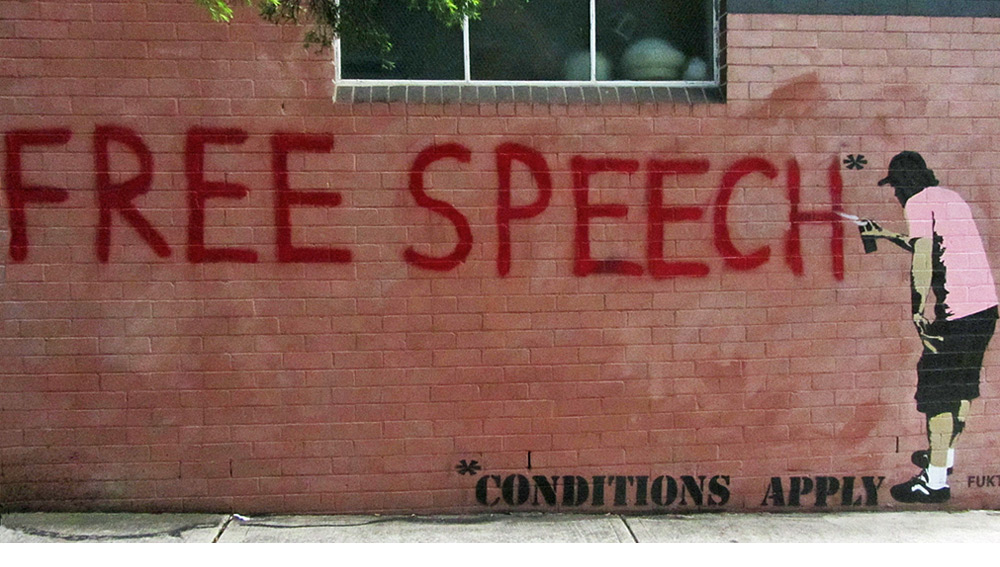
Illustration by Newtown grafitti


Categories
Accountability crime and punishment folly free trade & free markets general freedom ideological culture moral hazard nannyism national politics & policies privacy property rights responsibility too much government

Working to Boost Unemployment

Some government officials work overtime to throw people out of work.

What I’m referring to differs from losing your job or business because of slack performance or slackening sales. Instead, you lose the right to earn your living a certain way so that the government can benefit competitors at your expense.

Occupational licensing is great at dis-employing people. The regulations are especially galling when the work being regulated obviously requires no formal training in order to be done well and safely.

Hair braiding, for example.

The Institute for Justice — which has done incredible work over the years representing victims of destructive government mandates — just won a victory for hair braiders in Iowa. Thanks to IJ’s efforts, a new law there exempts braiders from having to waste time and money getting a cosmetology license in order to practice their craft.

Such battles are never won permanently, of course. Washington, D.C., recently started requiring day care providers to get a college degree or lose their job. (As I have argued in a Townhall column, the same “logic” would justify forcing people to get college degrees to become parents.) IJ is helping affected parties to challenge the absurd law.

It is time for a new licensing requirement. Nobody gets to become a local, state or federal lawmaker unless he first writes a million times in a row, “I will never help violate the rights of any man or woman to earn an honest living.”

This is Common Sense. I’m Paul Jacob.



PDF for printing