David Stockman has always sported a rather strict and gloomy view of the world. But even if you have not agreed with him in the past, the world may have caught up with him. Could it be that his vision of the near future is more likely than ever?
Category: folly
Categories
A Pointed Reminder
“In schools,” the Washington Post headline warned, “a pointed finger or a toy gun can spell trouble.” The front-page feature detailed a far too extensive and growing list of zero tolerance, zero commonsense punishments meted out to children as young as five at various “educational” institutions.
A ten-year old boy in Alexandria, Virginia, showed kids on the bus his new toy gun, which sported a bright orange tip to let even the most dense person know its essential toyness. Police arrested him the next day.
 His mother points out that her son did not threaten anyone. Or pretend to. Nevertheless, he has been “fingerprinted and photographed,” writes the Post. “He now has a probation officer, lawyers and another court date.”
In my Virginia county, Prince William, an eight-year-old boy contorted his hand and fingers into an apparently loaded pistol and through insidious manipulation of his mouth and lips may have imitated the sound of firing hot lead at a classmate, while said classmate was, in an evil orgy of violence, simultaneously pretending to be shooting arrows from an invisible bow.
The finger-slinger was suspended for “threatening to harm self or others.” He did neither, of course, but his offense is equivalent to having waved a loaded gun. (No word on the whereabouts of the silent-but-deadly pantomime archer.)
A five-year-old girl was interrogated by three school staff members, summarily found guilty of issuing a “terroristic threat,” and suspended for ten days for allegedly attempting to murder her friend and then commit suicide. She offered to unload her weapon all over her friend and herself. The weapon? A Hello Kitty gun, which fires bubbles.
The Post suggests the schools are jumpy after the shooting in Newtown, Connecticut. But this zero tolerance insanity didn’t begin last December.
My grandson was suspended from his public school more than a year ago. He was six and playfully shot his finger at several fellow students.
Educators, who long ago abandoned the distinction between play and reality, must have been shocked at the lack of fatalities.
Does the crusade against crime really require public institutions to reject, utterly, common sense?
Shouting “No!” . . . I’m Paul Jacob.
Wearing his I’m-Not-Partisan-No-Not-Me hat, President Obama has again declared war on partisanship, telling congressional Republicans to “peel off the partisan war paint.”
To be partisan in a bad way is not merely to belong to a political party and more or less support its program. It is to cling to party at the expense of Doing the Right Thing.
Unless, that is, it’s about opposing the program of a president determined to be partisan at the expense of Doing the Right Thing.
I often disagree with both parties. But let’s say that a representative of one party is marginally more reluctant to destroy our wealth and freedom than a representative of another party. Then I prefer the slightly more responsible stance of the former — and wish it were tougher and more consistent — even when the latter engages in name-calling and abuse of the former.
Demanding “perspective,” President Obama declares that he and the Congress should “not put ourselves through some sort of self-inflicted crisis every six months.” And I wholeheartedly agree. These crises happen because their spending programs always go up and up and up, even when a few “cuts” get made.
But the president doesn’t stop there. He explains they must “allow ourselves time to focus on things like preventing the tragedy in Newtown from happening again, focus on issues like energy and immigration reform. . . .”
Um, sir, please do not suggest that an unimpeded path to fiscal ruin is the only way to prevent fiscal ruin, or can somehow enable policymakers to prevent crazy gunmen from killing people. Please.
This is Common Sense. I’m Paul Jacob.
Adults have expressed disappointment in the behavior of young people since civilization began. You can read complaints about “the kids these days” on cuneiform tablets.
That being said, I have some sympathy for U.S. Senator Joe Manchin (D-W.Va.)., who has asked MTV to cancel its latest “reality TV” extravaganza, Buckwild, slated to debut in January. This West Virginia-based show show emulates Jersey Shore, a low-level satire on low-life New Jersey twentysomethings that I know too much about . . . without ever having watched.
“As a U.S. Senator, I am repulsed at this business venture,” Manchin asserts. He seems especially troubled by the fact that “some Americans are making money off of the poor decisions of our youth. I cannot imagine that anyone who loves this country would feel proud about profiting off of” the presumably horrid show.
First, as Ed Krayewski notes on Reason’s Hit and Run, were the senator really to take pride in business, he could mind his own: “The Senate . . . hasn’t passed a budget in more than 1,200 days. And, unlike MTV, it’s their job.”
Second, this is “Reality TV” here, folks. Not much to see. The truth is that Americans, for reasons ranging from Schadenfreude to mirth, like watching people make fools of themselves. And the youngsters hired on to play the foul-mouthed, inebriated, uncultured, promiscuous ninnies of Buckwild will be well paid for their efforts, and, as Americans chortle at them, they’ll chuckle all the way to the bank.
Third, they perform a useful service. Most folks watching fools don’t want to become fools themselves. They laugh. And, in so doing, begin to grow up.
This is Common Sense. I’m Paul Jacob.
Categories
Copyright and Wrong
Even if one disagrees that patent and copyright laws should be shelved (as some critics contend), no sensible person denies that these protections are subject to pretty ridiculous abuse. People have claimed extraordinarily ludicrous proprietary rights to everything from commonplace words (“spike”) to generic software functions (click to buy).
Now we have German publishers demanding payments from Google and other aggregators for the crime of pointing visitors to the publishers’ websites. Fair-use excerpts are unfair without compensation, according to the German Association of Newspaper Publishers and others. The idea seems to be, “You must pay us if you give our work free advertising.”
Suppose the demanded licensing rules were confined to commercial contexts. If applied consistently, the rules would jeopardize a wide range of hitherto uncontroversial citations, e.g., in book and movie reviews, not to mention books and movies. Making the demand even sillier is that Google enables sites to block any displaying of their content, or to reduce a search result for their site to a bare link with no snippet of text. No site is obliged to benefit from the horror of receiving Google-directed traffic.
Google is arguing its case publicly, and German business sentiment is hardly united in favor of mandatory licensing. According to Bernhard Rohleder, who heads an association of German technology companies, such legislation “would be unique worldwide [and would tell] investors: Innovative online services are not desired in Germany.”
Let’s hope sanity prevails. (Send me a nickel if you quote me on that.)
This is Common Sense. I’m Paul Jacob.
Categories
A Dog-Wagging Tale
In California and Rhode Island (to name just two states) cities are going bankrupt . . . or closing libraries and parks and cutting police and firemen to forestall going belly up. Meanwhile, they continue paying huge sums in employment benefits for folks who used to work at city hall, but have since retired into the politicians’ promised land.
Bankrupt cities don’t do so well at paying out those promises, though.
That’s why even many union members in San Jose and San Diego, California, supported the victorious citizen initiatives earlier this year that created a reasonable and workable pension program, and why serious pension reform passed through the legislature and was signed into law in deep-blue, heavily unionized Rhode Island.
In Los Angeles, former Mayor Richard Riordan’s Save Los Angeles campaign has worked mightily to prevent the city’s three pension systems from hitting the outrageous and piggy-bank breaking annual cost of $2 billion by 2017. Unfortunately, Riordan’s group abandoned a petition drive to place a reform measure similar to San Diego’s and San Jose’s on the Los Angeles ballot next Spring. The Service Employees International Union (SEIU) Local 721 claimed credit for blocking the initiative, claiming they convinced thousands of petition signers to withdraw their signatures.
Now, the Los Angeles Daily News reports that, “With no pension ballot initiative to fight, the unions can re-focus their energy and their money on the races for mayor, controller, city attorney and the City Council.”
“We are more freed up now,” said an anonymous union official.
And likely to have even more influence on how the city will be run and financed and managed.
Or should I say, “mis-managed”?
This is Common Sense. I’m Paul Jacob.
Categories
Judicial Temblor
A scientist does not kill anybody by failing to predict an imminent earthquake, even if he believes and says that it is unlikely to occur just before it does occur. Non-omniscient seismologists don’t kill people; earthquakes kill people.
Nevertheless, Judge Marco Billo sentenced six Italian scientists and a government official to six years in prison for manslaughter, and also billed them for court costs and damages to the tune of $10.2 million.
Some residents of the Italian town of d’Aquila applaud the penalties.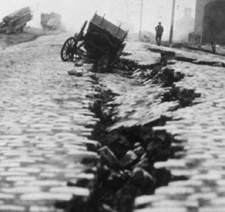
The seven defendants were members of the National Commission for the Forecast and Prevention of Major Risk, which had convened not long before the earthquake struck d’Aquila in April 2009, killing 309 people. Commission members did not issue a warning because the kind of small tremors that had been putting townsfolk on edge were, in their experience, not often the prelude to a major earthquake.
Their crime, then, was for uttering less-than-omniscient judgments in their field.
Suppose the defendants had instead determined that there should be an evacuation, that the town were then evacuated, and that a person died on the way out of town in a way directly attributable to the evacuation — but no earthquake then ensued. Also manslaughter?
If inability to eliminate uncertainty about future hazards is a crime, then we’re all guilty. But the real crime was committed by anyone having anything to do with this miscarriage of justice.
This is Common Sense. I’m Paul Jacob.
Categories
The Stockton Bust
Stockton, California, had seen a flurry of new home projects right up till the mortgage market crash. But, boy, did that come to a screeching halt. The crash led to foreclosures, which led to lower revenues from property taxes for the city. And though the city tried some spending cuts, they haven’t been enough. The Stockton City Council just voted, six to one, to seek federal bankruptcy protection.
Reasons for the bankruptcy, however, are not confined to reduced revenues. Add “soaring pension costs” and “contractual obligations” to the list of disaster factors.
And it’s pensions and medical insurance that make up the elephant’s share of “contractually obligated” must-pays. We’ll see if official bankruptcy will allow the city to get out from under that mess. The Chapter 9 plan includes dropping medical benefits for currently fully-covered retirees.
Who’s to blame? Politicians who negotiate really cushy deals for their (our) employees. The contracts obligate future taxpayers to pay out huge pensions for future retirees, rather than being funded (through insurance and investment) at the time of salary disbursement. The problem is that politicians love to make promises others must keep. Specifically, in this case, they contract defined benefit pensions not defined contribution pensions.
It makes no sense to do this, of course. It encourages irresponsibility, and is (to use a buzzword that should be used often against its usual purveyors) unsustainable. As proven by the Stockton bankruptcy.
Stockton is, so far, the largest American city to go belly up. We can expect further such busts, since the cause of Stockton’s problems — under-funded pensions coupled with full-coverage, gold-plated, lifelong health insurance for government retirees — remain endemic throughout the country.
This is Common Sense. I’m Paul Jacob.
Categories
Digital Divide 2.0
Remember the worrying over “the digital divide”?
During the “concern’s” heyday, I was more than a tad skeptical, as were many others. There’s only so much hand-wringing that a balanced, working person can stand.
Now we learn that all the yammering “inspired many efforts to get the latest computing tools into the hands of all Americans, particularly low-income families.” I’m not aware of any government programs to accomplish this, but then I don’t follow the handouts economy as closely as I could. But I do know that some charities got involved, putting computers into rural libraries and computer centers, for instance. (The Bill and Melissa Gates Foundation did a lot of this, years ago. Funny, though: I notice they didn’t supply any Macintosh computers.) And recylcing centers and garage sales made used computers — often hampered only by slightly out-of-date tech — available for pennies on the dollar.
If you want a computer in America, you can find one.
The New York Times tells us about an “unintended side effect” of all this computing power in the hands of the poor. The miserable masses, yearning to breathe free, are misusing the technology!
As access to devices has spread, children in poorer families are spending considerably more time than children from more well-off families using their television and gadgets to watch shows and videos, play games and connect on social networking sites, studies show.
This is called a “growing time-wasting gap.”
Reason’s Jacob Sullum neatly mocked this: “Silly lower classes! Don’t they realize this wonderful new technology is for self-improvement, not for pleasure?”
Maybe it’s time to stop taking politicians — and the “experts” who plead with politicians (to gain access to tax monies) — seriously.
Seriously.
This is Common Sense. I’m Paul Jacob.
Sticks and stones break bones, but words hurt more subtly. Old-school advice was that, growing up, one had to grin and bear it, let a few of our psychological wounds scab over, and get on with life.
But that is not “new school” wisdom. Nowadays, moved by a perhaps overweening sense of kindness (or politicized fear) educators tend to prohibit certain words, the better to protect some folks from taking offense.
The New York Post reports that, in a “bizarre case of political correctness run wild,” the people in charge of public schools have
banned references to “dinosaurs,” “birthdays,” “Halloween” and dozens of other topics on city-issued tests.
That’s because they fear such topics “could evoke unpleasant emotions in the students.”
Dinosaurs, for example, call to mind evolution, which might upset fundamentalists; birthdays aren’t celebrated by Jehovah’s Witnesses; and Halloween suggests paganism.
Even “dancing’’ is taboo, because some sects object. But the city did make an exception for ballet.
The “educrats” say such exclusions are nothing new, and I believe them.  They’re inevitable when you have a government-run school system that “services” a wide diversity of “clients.” The only real solution is to stop having the government run the schools. If you must support education with tax money, give vouchers to poor people. That would let a diversity of tutors and schools compete for parents’ and students’ attention . . . perhaps sometimes by catering to fears of dinosaurs, Halloween and dancing.
Odd, though, in one sense: If you really want not to “evoke unpleasant emotions in the students,” you could stop making them take tests. For most kids, tests are the most unsettling, truly horrifying aspect of schooling.
This is Common Sense. I’m Paul Jacob.