Categories
education and schooling folly general freedom

School Choice Reform at Last

How to get school choice reform? Keep fighting.

Last year, Texas Governor Greg Abbott, Republican, worked with families and school choice activists to pass school-choice legislation.

SB1 would have given parents who want to take their kids from public to private schools $8,000 a year for tuition, textbooks, and other expenses: taxpayer money that parents would have been able to spend as they saw fit instead of being forced to let public schools get it regardless of performance.

The educrats and their allies were opposed. “Public dollars belong in public schools. Period,” was the comprehensive argument of the Texas Democratic Party chairman.

With his own party constituting a majority of lawmakers in each legislative chamber, it seemed that Governor Abbott and families could have won anyway. The state senate did pass school-choice legislation. As it turned out, though, too many Republican lawmaker in the house were on the anti-choice team.

Which Republicans? The ones that Abbott and other friends of school choice targeted in this year’s primaries. They spent millions of dollars backing challengers who support school choice. And the governor appeared at campaign events to criticize incumbent Republicans who oppose it.

The net result? Of the current 21 anti-school-choice GOP representatives, only six to ten will be returning to the legislature in 2025. (The exact number won’t be known until runoffs on May 28.)

The elections may thus bring enough of a change in the state legislature to let school choice happen for parents and their students in Texas.

This is Common Sense. I’m Paul Jacob.


PDF for printing

Illustration created with PicFinder and Firefly

See all recent commentary
(simplified and organized)
See recent popular posts

Categories
education and schooling First Amendment rights

Hope for Campus Free Speech

The Understatement of the Month Award goes to David Lat, who says in a recent post that “when it comes to free speech and intellectual diversity, U.S. law schools continue to face challenges.”

One Big Challenge, more like: the contempt university policymakers routinely show for the speech of members of disfavored groups, if and when they say things that members of favored groups dislike.

Lat points to a decision, last month, by the Law School State Senate of Columbia Law School. The organization denied official recognition to a group formed to combat antisemitism, Law Students Against Antisemitism.

Reason: some pro-Palestinian students objected to LSAA’s definition of “antisemitism.”

The objection is cause for debate, sure, but not for preventing an organization from formally operating. Fortunately, after much attention was paid to the Senate’s decision by the Foundation for Individual Rights and Expression (FIRE) and others, the Senate reversed itself.

In addition to bad publicity, one thing that may help improve prospects for free speech on campus is a new rule issued by the American Bar Association, Standard 208.

Standard 208 requires law schools that want to be accredited by the ABA to “protect the rights of faculty, students, and staff to communicate ideas that may be controversial or unpopular.” This requirement is more encompassing than existing (if often ignored) protections of academic freedom for faculty members.

The ABA’s action is a big step, but not sufficient, Lat says. The cultures of our schools must change too.

This is Common Sense. I’m Paul Jacob.


PDF for printing

Illustration created with PicFinder and Firefly

See all recent commentary
(simplified and organized)
See recent popular posts

Categories
education and schooling First Amendment rights ideological culture

The De-Frocking of Jordan Peterson

The Canadian psychologist fighting for the right to opine without having to submit to “social media training” — reeducation — has lost a court battle.

An Ontario court has dismissed Jordan Peterson’s appeal of a decision that had ruled in favor of the autocratic College of Psychologists of Ontario (CPO).

A year ago, Dr. Peterson’s livelihood was jeopardized because, on social media, he challenged “consensus” determinations on matters like climate change, sex-change operations on minors, and COVID-19 policies.

That’s when CPO, a regulatory body established by legislation, told Peterson that he must either submit to degrading “training” as the penalty for participating in public discourse or forfeit his right to practice.

With the new ruling, “There are no other legal avenues open to me now,” he says on Twitter. “It’s capitulate to the petty bureaucrats and the addlepated woke mob or lose my professional licence.”

The setback pertains only to “this round,” though. And: “There is nothing you can take from me that I’m unwilling to lose.”

In a recent National Post column, he says that he can either comply with the reeducation and confess his ideological sins or “tell my would-be masters to go directly to the hell they are so rapidly gathering around themselves and everyone else.”

If you read Dr. Peterson’s warnings to fellow Canadians about the precarious state of their liberties and interpret his tone accurately, I think you’ll agree that he’s going with the go-to-hell option.

Peterson has made millions off the fame he garnered by opposing the compelled speech aspect aspect of Canada’s Bill C-16. Thanks to the marketplace of ideas, he has more go-to-hell money than most folks.

This is Common Sense. I’m Paul Jacob.


PDF for printing

Illustration created with Firefly and PicFinder

See all recent commentary
(simplified and organized)
See recent popular posts

Categories
education and schooling ideological culture scandal

The “Racial Animus” Gambit

Among the deflections littering former Harvard President Claudine Gay’s resignation letter is the claim that major criticisms of her conduct are “fueled by racial animus.”

The controversies have made Gay, a black woman, very visible. She may have been subjected to racial attacks in emails or on somebody’s blog. I haven’t seen reports of such. It’s possible.

But her letter makes it seem as if she feels all of it, all the criticisms of her understanding of policies regarding the treatment of Jews on campus and criticisms of her own treatment of the words of others in her published work, were “fueled by racial animus.”

If only blacks alone were ever charged with ambiguity about antisemitism or committing plagiarism, the implication might be at least superficially plausible. 

But it’s not.

Yesterday, I discussed the considerations that properly affect campus speech policies (“The Resignation”).

Here let me note, first, that scholars of all hues and sexes have been plausibly accused of plagiarism. Example: historian Doris Kearns Goodwin, white woman. Male example: Steven Ambrose.

And, second, that Harvard’s backing and filling and own animus in response to documented charges of plagiarism have converted the matter from a problem mostly for Claudine Gay personally to a problem for Harvard as an institution. By violating its own policies for dealing with the charges and by attacking the messenger, Harvard seemed to be saying that standards of scholarship like “Don’t plagiarize” don’t matter.

But they do.

This is Common Sense. I’m Paul Jacob.


PDF for printing

Illustration created with PicFinder and Firefly

See all recent commentary
(simplified and organized)
See recent popular posts

Categories
education and schooling First Amendment rights scandal

The Resignation

The fall of Harvard President Claudine Gay is not exactly the triumph we were looking for. 

Her resignation letter focused on the recent congressional hearings in which she found herself in the uncomfortable position of selectively defending free speech against a Republican politician slinging charges of “genocide” and “racism.” 

It was all very . . . the opposite . . . the upside-down . . . of how Democrats and Republicans had been dealing with free speech these last few years.

And that is the most important context. Her letter’s evasion of discreditable cases of academic plagiarism — at Harvard, no less! — while not honorable, was at least politically apt. One administrator’s fraudulent academic history is no match for the issue of freedom of speech.

Which, as a legal matter, is as Ms. Gay said it was, a matter of context. You have the right to advocate genocide or say racist things on your property or on hired property. You do not have the right to shout such things just anywhere.

But college campuses aren’t just anywhere. They are allegedly places for intellectual debate. The practice of academic freedom means that the property and customs of universities and institutions of higher learning allow differing opinions to be aired. 

In classrooms; in papers; in auditoriums. 

Still, these student academic free-speech norms don’t extend anywhere and everywhere, in all campus contexts. No student may hide behind “free speech” or “academic freedom” to corner and scream hatred of Israel at every Jew on the quad. That’s where Ms. Gay’s answers in congressional hearings were so unsatisfactory. Especially since Harvard and other major higher education institutions have been disallowing some speech from academic contexts and celebrating other quite threatening speech in the university’s public places.

Gay’s resignation reminds us of Al Capone’s imprisonment for tax evasion: a work-around at best. The underlying issues remain unresolved.

This is Common Sense. I’m Paul Jacob.


PDF for printing

Illustration created with PicFinder and Firefly

See all recent commentary
(simplified and organized)
See recent popular posts
Categories
education and schooling general freedom ideological culture

Division, Exclusion, Indoctrination

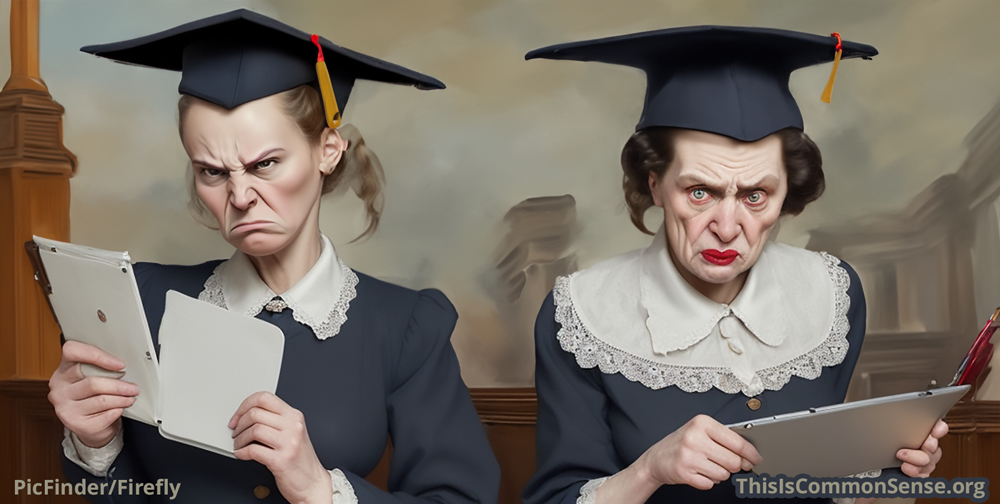
Wisconsin has decided to stop using tax dollars to subsidize ideological assaults on academic freedom.

Under the leadership of Assembly Speaker Robin Vos, the Wisconsin legislature struck a blow against DEI domination of the state’s university system.

The acronym means “diversity, equity, and inclusion.” Yet, the goal of DEI is to herd all participants in academic life into the same collectivist “antiracist,” anti-individualist straitjacket, no dissent permitted. What DEI really means, Vos says, is “division, exclusion, and indoctrination.”

The Vos-steered budget that passed in the last session eliminated $32 million from funding for the university system. It also hiked the pay of university employees and funded new campus buildings.

Using his line-item veto, the Democratic governor tried to thwart the move. But he couldn’t block the spending cut.

Then, after much negotiating, the university system agreed to freeze hiring of DEI officials, transfer DEI employees to other jobs, and implement race-blind, merit-based admissions policies.

Bullied by lefties, the board of rejects initially rejected the deal by a 9–8 vote. Vos wouldn’t budge. The board met again and accepted the deal.

As National Review’s editors put it, “when push came to shove, it wasn’t worth rejecting pay raises for all employees and putting building projects on hold for the sake of a handful of progressive ideologues.”

Until the whole house of cards collapses and there’s no longer any public funding of higher education, all states assailed by DEI should do the same kind of thing.

This is Common Sense. I’m Paul Jacob.


PDF for printing

Illustration created with PicFinder and Firefly

See all recent commentary
(simplified and organized)
See recent popular posts

Categories
education and schooling First Amendment rights general freedom international affairs

Cold Climate in Hong Kong

“There is no ‘red line,’” says an anonymous thirty-something Hong Kong humanities professor. “If they want to come after you, everything can be used as an excuse.”

Grace Tsoi, writing for the BBC, shows what happens when political correctness returns to its roots in totalitarianism. As it has in Hong Kong, in the “People’s [sic] Republic [sic] of China [sick].” The young academic Ms. Tsoi is quoting elaborated the situation: “He says his nightmare is being named and attacked by Beijing-backed media, which could cost him his job, or worse, his freedom.”

Political correctness can cause academics in America their jobs, of course. But as relentless as our woke media and online mobs may be to “de-platform” people they disagree with, it’s harder to go all the way.

Under a totalitarian state, it’s easier to be more thorough.

That’s why totalitarianism is the modish form of tyranny that tyrants aspire towards.

More power.

“In the academic year 2021/22, more than 360 scholars left Hong Kong’s eight public universities,” Ms. Tsoi explains. “The turnover rate — 7.4% — is the highest since 1997, when Hong Kong returned to Chinese rule, according to official data. Foreign student enrolments have dropped by 13% since 2019.”

The chilling effect is arctic. Self-censorship has become the rule, in advance of expected censure, censorship, or worse. Hong Kong academics blame all this on 2020’s National Security Law, which “targets any behaviour deemed secessionist or subversive, allowing authorities to target activists and ordinary citizens alike.”

It’s worth remembering that while “secession” is a dirty word for the powerful, and subversion the enemy of all, it does depend on context: secession from a tyrannical state is liberation; subversion of an unjust system is justice.

This is Common Sense. I’m Paul Jacob.


PDF for printing

Illustration created with PicFinder and Firefly

See all recent commentary
(simplified and organized)
See recent popular posts

Categories
education and schooling general freedom

The Homeschooling Surge

Although homeschooling had once been common in the United States, by the 1970s few families taught their kids at home.

This began to change in the 1980s and 1990s. Researcher Brian Day estimates that by 2019, some 2,300,000 children were being homeschooled.

During the recent pandemic, even more parents gave homeschooling a try. But the trend had already been intensifying for decades. Not coincidentally, of course, because public schools continued to get lousy report cards, with the quality of government-provided education demonstrably in steep decline.

In a recent article on the growth of homeschooling, The Washington Post concludes that it has become “America’s fastest-growing form of education” as families “embrace a largely unregulated practice once confined to the ideological fringe.”

Apparently, now even normal people are rescuing their kids from the educrats (unlike back in the day, when only fringe parents like my wife and I did so).

Looking at data from some 7,000 school districts, the Post concludes:

  • The number of homeschooled kids has increased by 373 percent in Anderson, South Carolina. It increased by 358 percent in one Bronx district.
  • In 390 districts, for every ten children being taught in public schools in the 2020–2021 academic year, one child was homeschooled.
  • The Post estimates that between 1.9 million and 2.7 million kids are currently being homeschooled in this country.

Post-lockdowns, the practice is still going strong. In most districts for which data is available on the 2022–2023 school year, homeschooling “dropped from its pandemic peak. . . . Yet even in those places it remains elevated well above pre-pandemic levels, and in 697 districts it kept increasing.”

That’s good. For the children.

This is Common Sense. I’m Paul Jacob.


PDF for printing

Illustration created with PicFinder

See all recent commentary
(simplified and organized)
See recent popular posts
Categories
education and schooling ideological culture sports

Un-Sportsmanlike Conduct

Tonight, the undefeated Dukes of James Madison University will travel to play the Thundering Herd of Marshall University in a Sun Belt Conference college football game. My youngest graduated from JMU, so I feel heavily invested in the team. 

Duuuuukes!

One might think this sport and spectacle a welcome relief from politics — and surely it is — but not entirely. Because, of course, these great college football programs are attached to public universities financed by us, by our tax dollars. 

The problem? As The Athletic put it recently: “For the second consecutive year, James Madison looks like one of the best teams in the Group of 5. And for the second consecutive year, the Dukes are ineligible for the postseason.”

The Group of 5 are the five best football-playing conferences after the best five conferences known as the Power-5. That’s pretty impressive — especially considering this is only the second year since James Madison made the jump from the second division into the first division of football-playing schools of higher yearning and earning. 

JMU is in the big leagues; it can now play for the national championship. Well, not now. Again, this year, like last year, JMU’s football team is banned from playing in a bowl game or being declared the champion of the conference . . . even though last year they did win the conference . . . except for the rule that says they cannot win the conference.

This year, the Dukes are 6-0 and could perhaps go undefeated. What if College Football’s Magic Computers pick them as among the best? They would still be denied a chance to compete.

Why? Well, those are the rules the colleges and conferences have agreed on. The rationales don’t hold much water. It seems like a hazing ritual holdover to me. 

But, of course, the universities can do whatever they want.  

And suffering the harsh two-year punishment is not so terrible for the coach who will possibly have a decade-long career, or the university that will play on in perpetuity. 

All the unfairness is placed on the shoulders of the student athletes. Denied the conference honors and the post-season play they deserve, these unpaid players who’ve earned millions for their schools have at least learned a lesson. When it comes to sports and money, the kids come last. 

This is Common Sense. I’m Paul Jacob.


PDF for printing

Illustration created with PicFinder.ai

See all recent commentary
(simplified and organized)
See recent popular posts
Categories
education and schooling general freedom ideological culture

Bad Math Baltimore

You may have thought it couldn’t get this bad. 

“Not one student at 13 high schools in Baltimore City, Maryland, achieved proficiency in math,” informs the city’s Fox 45 News, “as indicated by state math exams.”

That’s 40 percent of the city’s high schools and we’re talking not a single soul managed to come in at “proficiency.” Not mastery, mind you. 

“Among those 13 high schools,” the report continued, “a total of 1,736 students participated in the test with 74.5% of them achieving the lowest possible score of one out of four.”

Okay, okay, but what about the city’s best schools?

Well, a Fox 45 News follow-up found that only “11.4% of students” even at “Baltimore’s five top-performing high schools” are “proficient in math.” 

Adding, “In fact, not one high school student in the entire city, last school year, achieved a top level of math proficiency.”

Jason Rodriguez, with People Empowered by the Struggle, an edgily named Baltimore nonprofit, calls it “educational homicide.”

“It’s not a funding issue,” says Rodriguez. “We’re getting plenty of funding.” He thinks “accountability is the issue” and has “been calling for the resignation of the school CEO.”

Young people in Baltimore can learn mathematics just as well as young people anywhere. That we know. But they also need functional families as well as functional schools. The government, plausibly the chief cause of the dysfunction of both, has only official responsibility for the latter.

Sure, it sounds like time to lop off the top brass. But also past time to give every parent of a school-age child in Baltimore (and everywhere) a choice about where to go to school — purchased with the tax dollars that taxpayers are already providing.

Currently, to no avail. 

This is Common Sense. I’m Paul Jacob. 


PDF for printing

Illustration created with PicFinder.ai

See all recent commentary
(simplified and organized)
See recent popular posts