Categories
ideological culture national politics & policies political challengers

Double Bubble America

The “unexpected” Donald Trump presidential victory has put the folks at The Gray Lady a bit out of sorts.

Heather Wilhelm at the National Review pokes and prods at the absurdities of the New York Times’s cultural cluelessness. And ably enough. So I’ll stick to The Times’s recent “six views” of America’s ideological divide:

Julie Turkewitz recognizes two well-insulated informational bubbles at play. Nothing too controversial — or very deep.

Campbell Robertson muses upon the dominance of the “elites” against which Trump’s insurgents rebel, noting that “the elites are the still the ones who get to decide who gets to be elite.”

Laurie Goodstein takes on religious culture, making much of divergent spiritual outlooks, left and right.

Julia Preston peers at immigration and the prospect of sending a message by building a “wall.”

In the manner of the other five, Sheryl Gay Stolberg digs up real-world people — as does our speechifier-in-chief, Barack Obama — to lightly probe questions of assimilation versus multiculturalism.

Manny Fernandez concludes with a (yawn) discussion of giving and taking offense.

They all miss the underlying structural basis for the divide.

On one side: folks working in the private sector — or local governments and charities, or at home — who have seen the world pass them by in terms of income and security.

On the other: government workers and consultants (and other college grads) who make more, on average, than their “real world” counterparts.

The latter has advanced as a class; the former remain in stasis . . . at best.

A mystery?

No — it’s the predictable result of what Thomas Jefferson called “the parasite institutions now consuming us.”

This is Common Sense. I’m Paul Jacob.


Printable PDF

bubble, Trump, election, reasons, explanations, illustration


Original (cc) photo by diana MĂRGĂRIT at Flickr


Categories
Accountability crime and punishment folly nannyism national politics & policies responsibility too much government

Virtually Useless

Here is something I don’t quite understand about us moderns — we, oh-so-sophisticated citizens of the world; we who say that government is instituted to help us . . . but often we expect almost no real help when it comes to even the basics.

Take this very “virtual” venue: the Internet; “the Web.”

This wasn’t a thing in the first decade of my adult life. I never expected to spend so much time “on” something that did not, then, exist in any meaningful way.

Well, computers opened up brave new worlds for us, but, did you notice? Bad guys were right there from the beginning, making “viruses” and “spyware” and “malware” of all kinds. Destroying billions of dollars of data and equipment, robbing us of the most important thing of all: time.

And what did the United States government do?

Nothing, or next to it.

Belatedly, and haphazardly, it scraped together a digital defense for its own infrastructure, and began to cook up ways to surveil us all.

But did it offer to help? What programs did it provide the public, or the states, to assist us with bad guys trying to steal our savings, credit, and virtual identities?

I haven’t seen anything. And our local governments have stood around useless, too.

Yet I haven’t heard anyone complain.

Our security has been up to us. Long ago, John McAfee invented the first anti-virus software, and an industry grew up from his kernel — and that industry is where we turn to for help.

Government has mostly just stood by — in the sole area of the computer industry that it could plausibly have warrant to “interfere.”

This is Common Sense. I’m Paul Jacob.


Ask the next question.

Questions Answered:

Does government fulfill its main function consistently?

Who do Americans turn to for effective security?

The Next Question:

If government doesn’t even bother doing its main job, why give it more jobs?


Printable PDF

web, crime, virus, government, illustration


Categories
ideological culture meme national politics & policies too much government

Warren and the Bogeyman State

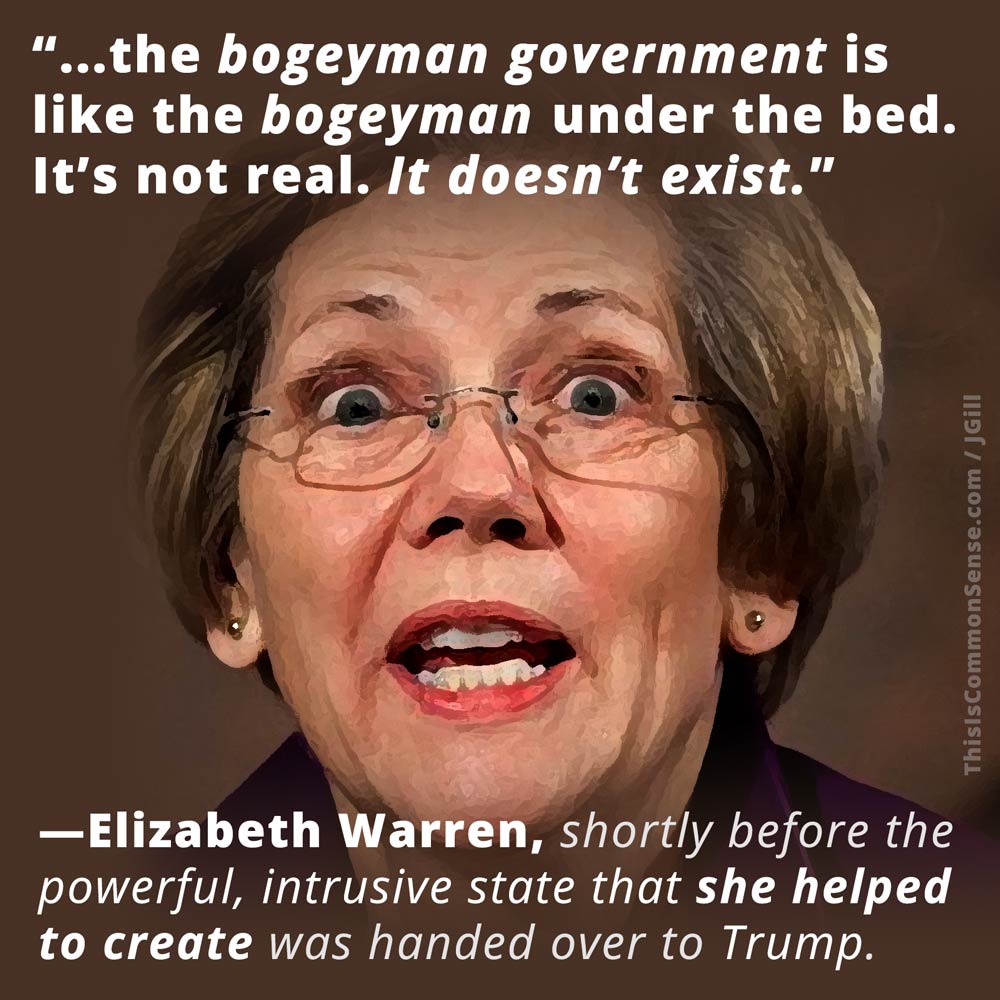
“…the bogeyman government is like the bogeyman under the bed. It’s not real. It doesn’t exist.”

—Elizabeth Warren


Citation:

Categories
Accountability general freedom initiative, referendum, and recall moral hazard national politics & policies political challengers term limits too much government U.S. Constitution

Fear and Freedom

“If Libertarian Gary Johnson doesn’t win the presidency,” I posted to Facebook last Monday, “I’m leaving the country.”

Well, Johnson didn’t win. And I wasn’t kidding. I’m writing this from a Parisian café.

Of course, I was also tongue-in-cheek, since — spoiler alert! — I am coming home next week.

This week, I’m speaking at the Global Forum on Modern Direct Democracy in San Sebastián, Spain — a gathering of pro-initiative folks from all over the world. We want people’s votes to count, even if we disagree with their candidate or issue.

Which brings us back to Donald J. Trump’s surprise victory. Protests have broken out in several cities — some violent. And some folks say they’re scared of what Trump may do as president. Sure, one can snicker at these fearful responses as liberal whining. And to the extent they’re talking about university professors canceling tests and coddling “traumatized” students . . . well, no argument here.

Still, I don’t just sympathize when I hear people fear a politician with power, I empathize.

For a long time, I’ve been worried by out-of-control presidential power — from unconstitutionally making laws through executive orders to making war without any real check on that power. Scary. Whether that president is George W or Obama or Hillary or Trump.

Government is a monopoly on force. Therefore, by definition, government is frightening.

Democracy is often an antidote to tyranny, a check on power, but not always. That’s why folks who truly appreciate democracy believe in individual rights that transcend any vote-getting public decision mechanism.

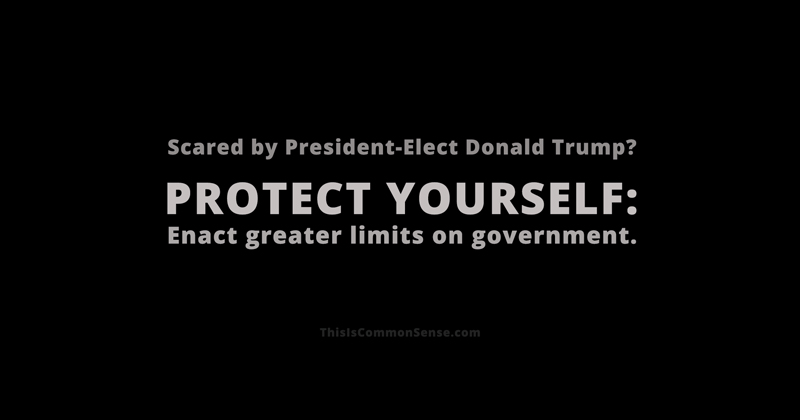
Scared by President-Elect Donald Trump? Protect yourself: enact greater limits on government.

This is Common Sense. I’m Paul Jacob.

 

Ask the next question.

Questions Answered:

Is fear a natural byproduct of government?

Which presidential powers lack sufficient checks and balances?

What is more important: individual freedom or democratic decision-making?

Is democracy a check on power or an enhancement?

The Next Question:

How do we go about creating greater limits on political power?


Printable PDF

Protect Yourself, limited government, meme


Categories
Accountability ballot access general freedom incumbents initiative, referendum, and recall national politics & policies political challengers responsibility too much government U.S. Constitution

Votes Without Poison

Strange election. So . . . round up the usual suspects!

Immediately after Hillary dried her tears and conceded, out came the Tweets, then the analyses: the “third parties” are to blame!

Over the weekend, I focused* on one such election post-mortem. The basic idea is not altogether wrong: minor party efforts together may have cost the Democrat her Electoral College advantage this time around, just as Nader’s Green Party run spoiled Al Gore’s bid in 2000 and several past congressional races have been spoiled for the GOP by Libertarians.

Is there a problem here? Yes. But do not blame the minor party voters. It’s the way we count their votes that is “problematic.” The current ballot-and-count system turn voters most loyal to particular policy ideas into enemies of those very same ideas.

When we minor party voters turn away from a major party — usually because said party tends to corrupt or betray our ideas, or make only small steps toward our goals — our votes aren’t so much wasted as made poisonous.

Because the candidate least preferred may prevail.

But there’s a way out: On election day, voters in Maine showed how to cut through the Gordian Knot. Voting in approval for Question 5, Maine now establishes “ranked choice voting.”

Under this system, you don’t “waste” your vote when expressing a preference for a minor party candidate. You rank your choices and, if your first choice proves unpopular, your second choice (or maybe your third) gets counted. So you don’t “poison” your cause.

Republicans and Democrats have more than enough reason, now, to adopt ranked choice voting across the country.

This is Common Sense. I’m Paul Jacob.

 

* See yesterday’s links page to my weekend Townhall column for the basic references. But there were many, many articles on the Minor Party Effect, including a skeptical one by Sasha Volokh’s.


Ask the next question.

Questions Answered:

What is the effect of minor parties on major party outcomes?

What causes those effects, voter intent or something else?

Is there a way to prevent this, short of further sewing up the ballot access system to minor parties?

The Next Question:

What might our elections look like if people spent more time discussing issues and ideas … and less about class, culture wars, and sex crimes?


Printable PDF

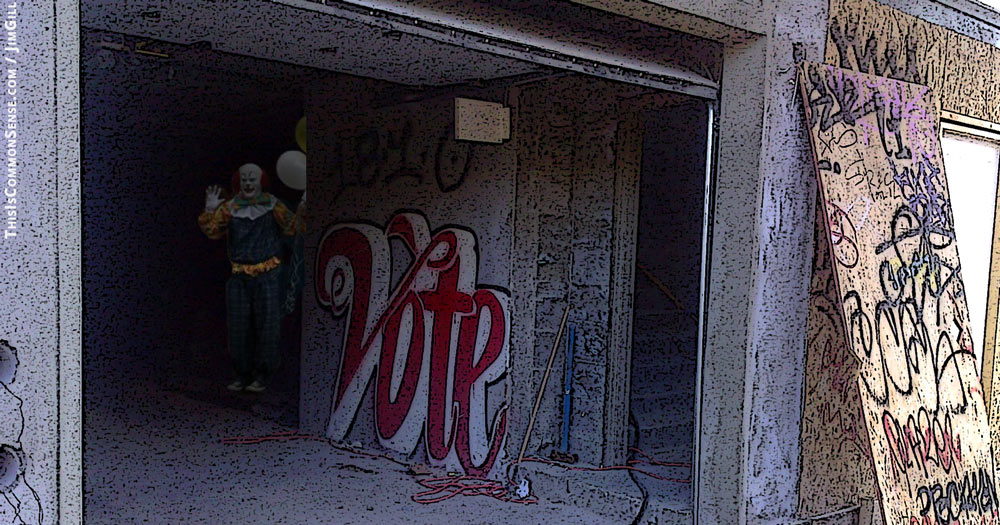
ranked choice, vote, voting, democracy, clown, illustration


Categories
Common Sense

The Kettering Hope

Maybe President-Elect Donald Trump can whip Washington into shape. We can hope. And help. Especially on congressional term limits.

But remember: local political fiefdoms can oppress as harshly as the Feds. So . . . who is whipping your town into shape?

Well, welcome to Kettering, Ohio.

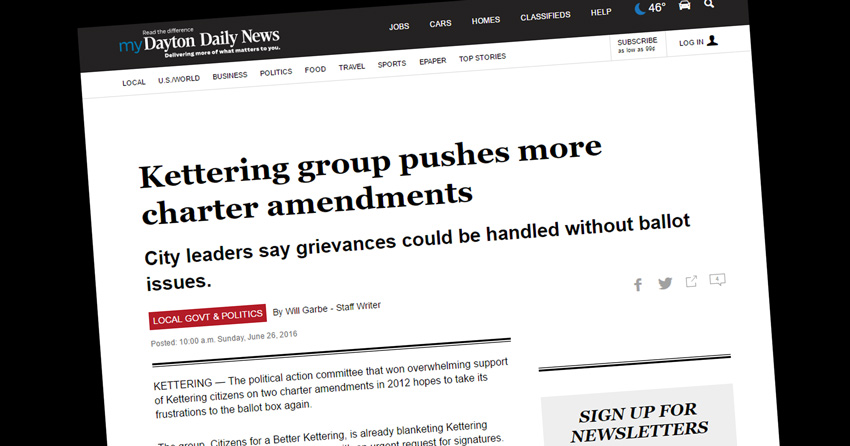
Just months ago, Kettering’s powers-that-be placed a new charter amendment on the ballot to weaken term limits. And one citizen, Ron Alban, wasn’t amused. He and two other longtime residents formed Citizens for a Better Kettering (CBK), but not merely to fight the attack on term limits. They also petitioned five new reforms onto the city ballot.

I met this busy activist back in January, while he was working to place an ethics reform measure on the Ohio ballot — before being blocked by the state ballot board. In 2012, Ron had organized a petition drive to put a pay cut and council term limits on Kettering’s ballot. Both passed.

Ron’s CBK measures were: to protect citizen input at council meetings; to require greater transparency on city salaries; to hold elections for council vacancies; to strengthen citizens’ ability to enforce charter provisions; and banning the city council from proposing future charter amendments dealing with term limits, council pay and the citizen ballot initiative process.

On Tuesday, the anti-term limits charter amendment failed.

And all five reform amendments passed overwhelmingly.

Alban and CBK aren’t as media savvy as Mr. Trump, or as wealthy. But their incredible success is a bright beacon of hope.

Most cities in this country have a petition process whereby thoughtful, hardworking citizens can change their local world. Most of us can do what Citizens for a Better Kettering just did.

This is Common Sense. I’m Paul Jacob.


Printable PDF

Kettering, Ohio, reforms, initiatives, illustration


Categories
Accountability moral hazard nannyism national politics & policies political challengers too much government U.S. Constitution

Term Limits Trump

Entering his campaign’s homestretch, underdog Donald J. Trump gave an important speech at Gettysburg, Pennsylvania. He emphasized his support for term limits in what he called his “100-day action plan to Make America Great Again.”

“[R]estoring honesty, accountability and change to Washington” is the top item on Trump’s agenda, along with a pledge to begin the drive for “a Constitutional Amendment to impose term limits on all members of Congress” on his very first day in the Oval Office.

Public disgust with the corrupt status quo in Washington — and the hope that he will shake things up — drove Trump’s victory.

Yet, today, the Elections Committee of Michigan’s House of Representatives hears testimony on several bills to weaken or repeal term limits. Have the limits lost public support? Not on your life.

Politicians simply want to stay ensconced in power, reaping the many benefits they’ve bestowed upon themselves. They want to stay in power longer.

Just look to California. Back in 2012, a dishonest ballot explanation tricked voters into thinking they were tightening their term limits law. But what they were actually doing was voting to weaken it.

Now, Golden State legislators can stay in the same seat for a dozen years. And special interests have noticed. They’re “investing” more heavily than ever before.

The Los Angeles Times summarized the result in its headline: “Longer terms for California’s Legislature mean a flood of cash from interest groups . . .”

Here’s for enacting real term limits at every level of government. And if the politicians and special interests don’t like it — good!

This is Common Sense. I’m Paul Jacob.


Printable PDF

Donald Trump, term limits, president, first, illustration


Categories
Accountability media and media people moral hazard national politics & policies

Indecency Abounds

The most indecent aspect of this bizarre election year? The “grab them” comment . . . from a decade ago? The lies about lies about lies? The “debates”?

Maybe not. Maybe it’s the infamous “mainstream media.”

Last week I wrote about the most obvious case, that of Donna Brazile and her helping hand emails to the Clinton campaign, accomplishing what years of mere induction and analysis could not: justifying, totally, the epithet for CNN as the “Clinton News Network.”

But it was nearly the whole media that was in the tank, as we say nowadays, for Mrs. Clinton. This has been obvious for some time. Even mainstream media mavens have noticed it, as I wrote not too long ago.

Will more journalists and TV faux-journalists notice?

They certainly have now noticed that they did not see a Trump victory coming.

Delusional about Hillary Clinton’s likability, and about how normal folks react to her history of corruption and scandal, TV talking heads and powerful newspapers doubled down in her favor . . . which may have actually helped precipitate a result against their intention.

The mainstream media triggers much of America, you see, especially the parts of the country that revolted against the prospect of a Clinton Dynasty.

Not that I place myself above journalists as objective, either. I’m not a journalist. I’m an activist. I am for liberty. Responsibility. Accountability. Limited government. I’m no more a fan of major party messiahs than I am of their rah-rah boys in the journalist biz.

I’m not exactly shouting about Trump’s win. I’m just happy that Hillary — and her vast Democratic-partisan media conspiracy — lost.

If this be indecency, make the most of it.

This is Common Sense. I’m Paul Jacob.


Printable PDF

Donald, Trump wins, media, failure, illustration


Categories
Accountability general freedom ideological culture moral hazard national politics & policies political challengers responsibility too much government U.S. Constitution

The Wisdom of the Founders

“At a certain point, you have to let go for the democracy to work,” President Barack Obama told HBO’s Bill Maher last week, praising “the wisdom of the founders.”

“There has to be fresh legs,” he continued. “There have to be new people. And you have to have the humility to recognize that you’re a citizen and you go back to being a citizen after this office is over.”

Maher failed to ask Mr. Obama how this “fresh” viewpoint squared with his support for Mrs. Clinton. Nevertheless, let’s applaud the president’s endorsement of term limits.

Speaking of the founders, and limits on power, and this being Election Day, I’m reminded of a commentary in Forbes, back on Election Day four years ago, written by Ed Crane, the man who built the Cato Institute into one of the nation’s preeminent think tanks. Bemoaning the “interminable presidential race,” Crane wished for “a nation in which it really didn’t matter who was elected President, senator or congressman.”

“Don’t get me wrong, because I’m not saying it doesn’t,” explained Crane, “only that it shouldn’t.” He added, “I believe the Founders had a similar view.”

His point is simple: Getting to vote for your next president and senator and congressman is swell, but it’s important to have a Constitution that restrains those elected, so they “don’t have a heck of a lot of power over you or your neighbors.”

“We are a republic of limited governmental ­powers,” or should be, argued Crane. “Such a nation allows for sleep on election night.”

Instead of gnashing of teeth.

This is Common Sense. I’m Paul Jacob.


Printable PDF

Constitution, voting, democracy, Ed Crane, fear


Categories
Accountability ballot access incumbents moral hazard national politics & policies political challengers responsibility

Vote Early & Often?

Voted yet? The Pew Research Center thinks about 50 million Americans have, representing 38.5 percent of the voter turnout forecast.

I’m for making it as easy as possible for people to cast a ballot. Who isn’t? Well, I mean who among normal people isn’t? I’m not counting politicians and their hacks.

But even I am opposed to extended “early voting.”

Here’s why:

First, the longer the voting period goes, the greater the cost — as more paid advertisements, phone calls and mailings are needed to keep reaching voters over many weeks. No problem here with more money in politics — money is essential, and my candidates and ballot issues could certainly always use more promotion. But let’s not artificially advantage big money by running the meter.

Several states now allow more than six weeks of voting prior to so-called Election Day. Even a three-week voting period is far more expensive than building toward a single day — or, say, a weekend through Tuesday voting period (four days).

Second, we ought to vote together, close to the same time, all of us privy to the latest public knowledge. This year’s drip of near daily “October”* surprises, thanks to WikiLeaks and the FBI, shows the potential problem should a major scandal or incident impact the race after so many folks have already voted.

Third, early voting tends to advantage incumbents. Challengers often don’t catch up to the better known and organized incumbent until the final days of the race.

As for voting often, as in more than once, that’s a crime. Plus, with these candidates, once is more than enough.

This is Common Sense. I’m Paul Jacob.
 

*Well into November, some of these surprises, eh? I mean, it is as if they saved the blood rituals for last.


Printable PDF

vote, early, often, democracy, early voting, illustration, joke, meme