Categories
meme nannyism too much government

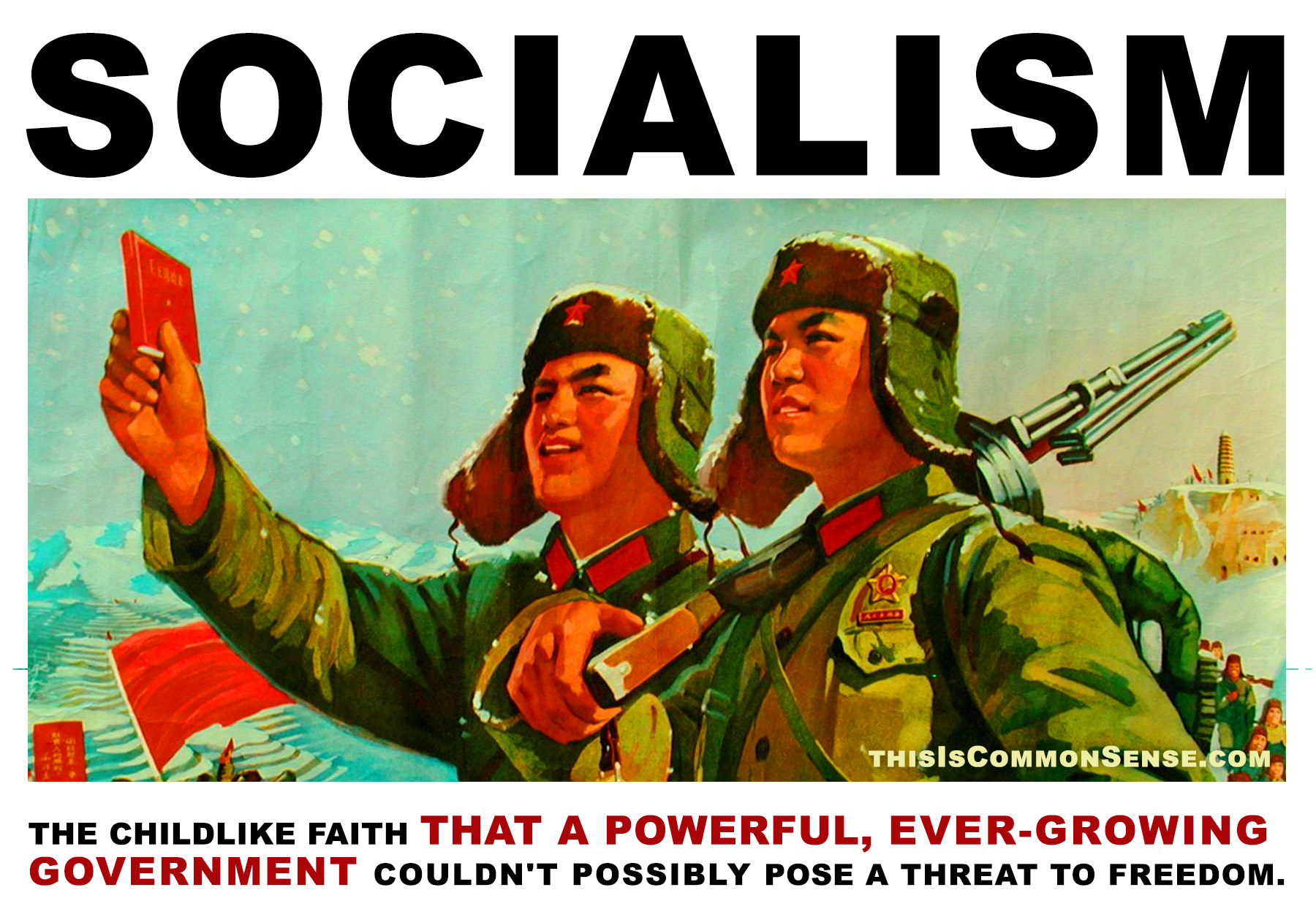
The Meaning of “Liberal”

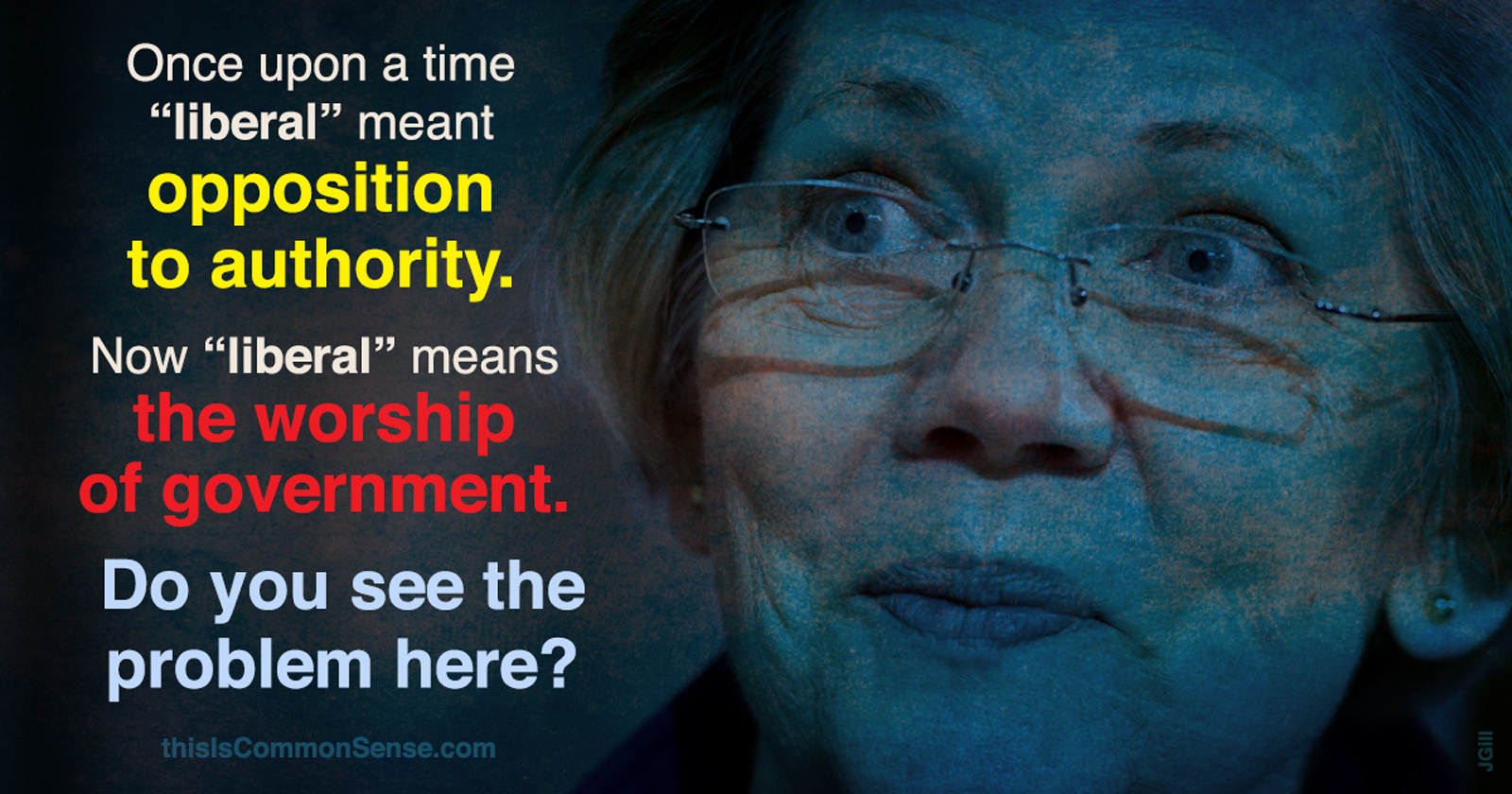
Once upon a time “liberal” meant opposition to authority.

Now “liberal” means the worship of government.

Do you see the problem here?


Shared ideas matter. Please pass this along to friends.

Get a high-resolution screensaver of this image. Click on the thumbnail picture below to open a large version that you can download.

The Meaning of "Liberal"


Categories
Accountability folly free trade & free markets general freedom ideological culture meme nannyism national politics & policies

“The Good Kind of Socialism”

Don’t worry…

Bernie only wants “the good kind of socialism.”


Click here for a high resolution version of this image:

Bernie Sanders, The good kind of socialism, presidential race, progressivism, progressive, socialist, education, meme, cartoon, illustration, Jim Gill, Paul Jacob, Common Sense


Categories
folly general freedom moral hazard nannyism national politics & policies responsibility

Town, County, Stasis

The savvier economists (and intellectuals like Steven Pinker) like to remind us that it is progress that must be explained; poverty is natural.

But when you see poverty settle in like an infestation of slime mold, staining a whole modern city or region, you begin to wonder. As Ron Bailey wonders in his excellent Reason report on West Virginia’s impoverished McDowell County . . .

WHY DON’T THESE PEOPLE JUST MOVE?

The feeling of being trapped in your community — in your hovel, in your own blighted life — does not come, these days, from mere poverty alone. I remember the Joads in The Grapes of Wrath; my family has a history. Once upon a time, folks in America, when industry ran out, left. Traveled. Migrated — to find work where industry boomed.

And sure, McDowell used to be much more populated. Bailey’s family left two generations ago.

But the stragglers?

Almost any community has its specific enticements.

But one thing becomes clear, as you read through Bailey’s sad survey (in part memoir, since he has family ties there): government is the worst culprit.

A lot of welfare goes into McDowell, and a huge percentage of the population is retired or on disability.

“If you get public assistance to supply your needs without any effort from you,” explains one young man who came back to his beleaguered hometown, “you’ve got no incentive to better yourself or your situation.”

Government subsidizes poverty. Sure, it prevents destitution. Utter misery. But it also traps people, robbing them of their wherewithal to get up and go and achieve something.

Modern government is in the stasis business. Our assistance programs don’t just assist.

A modern American nightmare.

This is Common Sense. I’m Paul Jacob.


Printable PDF

chained, West Virginia, poverty, welfare,


Categories
folly free trade & free markets general freedom meme national politics & policies

Robert Reich, Mythed Up

[mks_dropcap style=”letter” size=”62″ bg_color=”#ffffff” txt_color=”#000000″]C[/mks_dropcap]onsumer sovereignty is the idea that in markets consumers call the shots. In capitalism, most mass production is indeed for the masses, and the masses have a big say in what gets done. All profits and wages of successful businesses come from consumers.

But don’t take this too far.

Consumers don’t “create jobs,” for example.

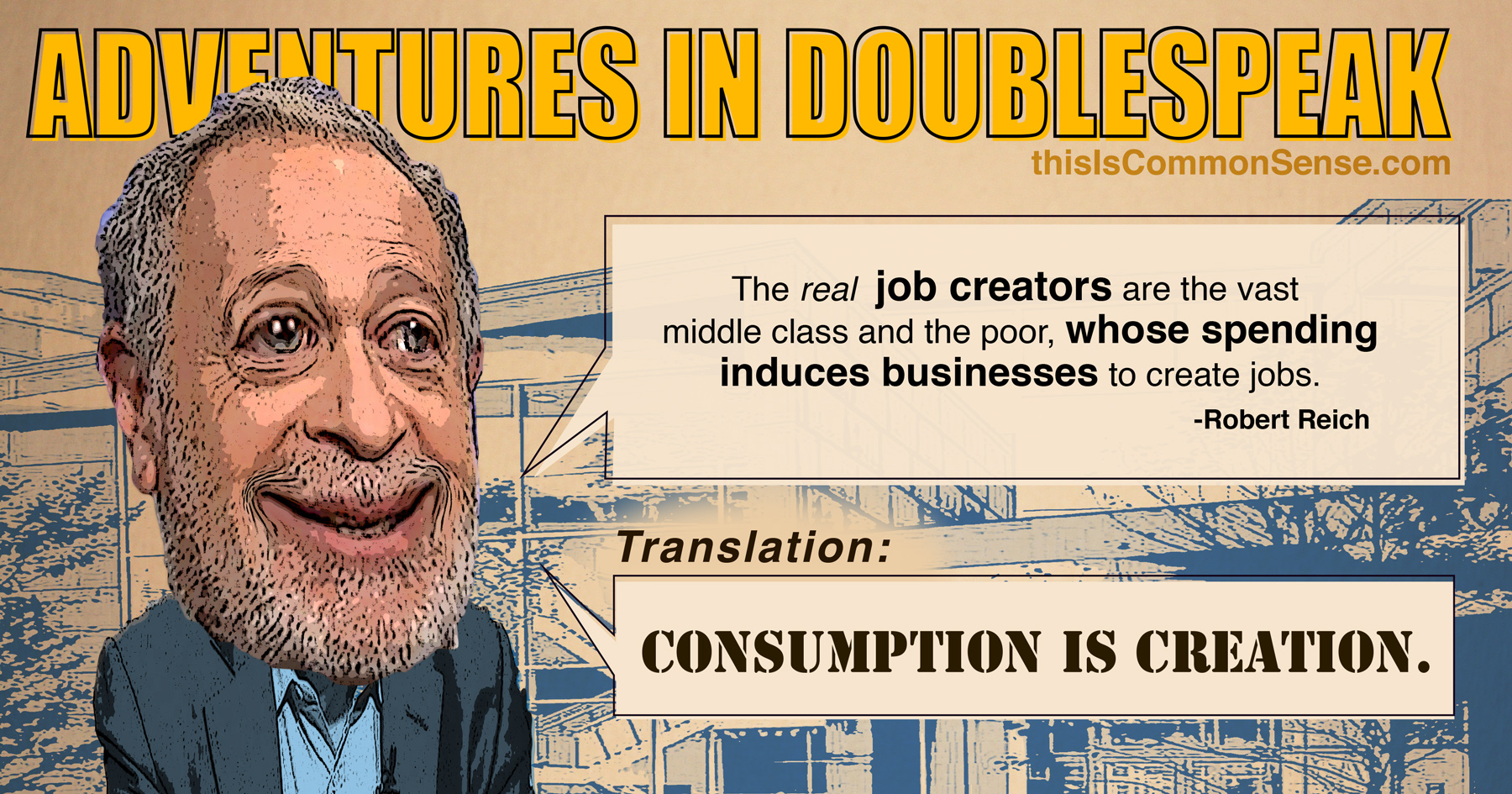
Recently, Clinton-era Labor Secretary Robert Reich has been floating this bizarre notion. To his Facebook audience, last month, he wrote that it is a myth that “the ‘job creators’ are CEOs, corporations, and the rich, whose taxes must be low in order to induce them to create more jobs.

Rubbish. The real job creators are the vast middle class and the poor, whose spending induces businesses to create jobs. That is why raising the minimum wage, extending overtime protection, enlarging the Earned Income Tax Credit, and reducing middle-class taxes are all necessary.”

So, we have people in roles of “producers” and “consumers,” and it is the consumers who “create jobs”? And they do this by “inducing” businesses to, wait, uh, “create jobs”?

Face it: businesses create jobs — out of capital from somebody’s invested savings. Entrepreneurs brace themselves to take big risks, fronting workers’ wages as well as hiring and purchasing capital goods and material.

Before a penny is spent by consumers.

Only when entrepreneurs guess right does the flow of money come full circle.

Reich repeated his quasi-Keynesian rap yesterday: it’s spending consumers who “get businesses to expand and hire.”

Truth is, Reich doesn’t “get” basic economics. But he does understand political equations, which is why folks on the Democratic left think he’s a genius.

This is Common Sense. I’m Paul Jacob.


For a high resolution version of today’s picture (perfect for use as a screensaver), click on the image below to open in new window. Also, please do feel free to share with your friends.
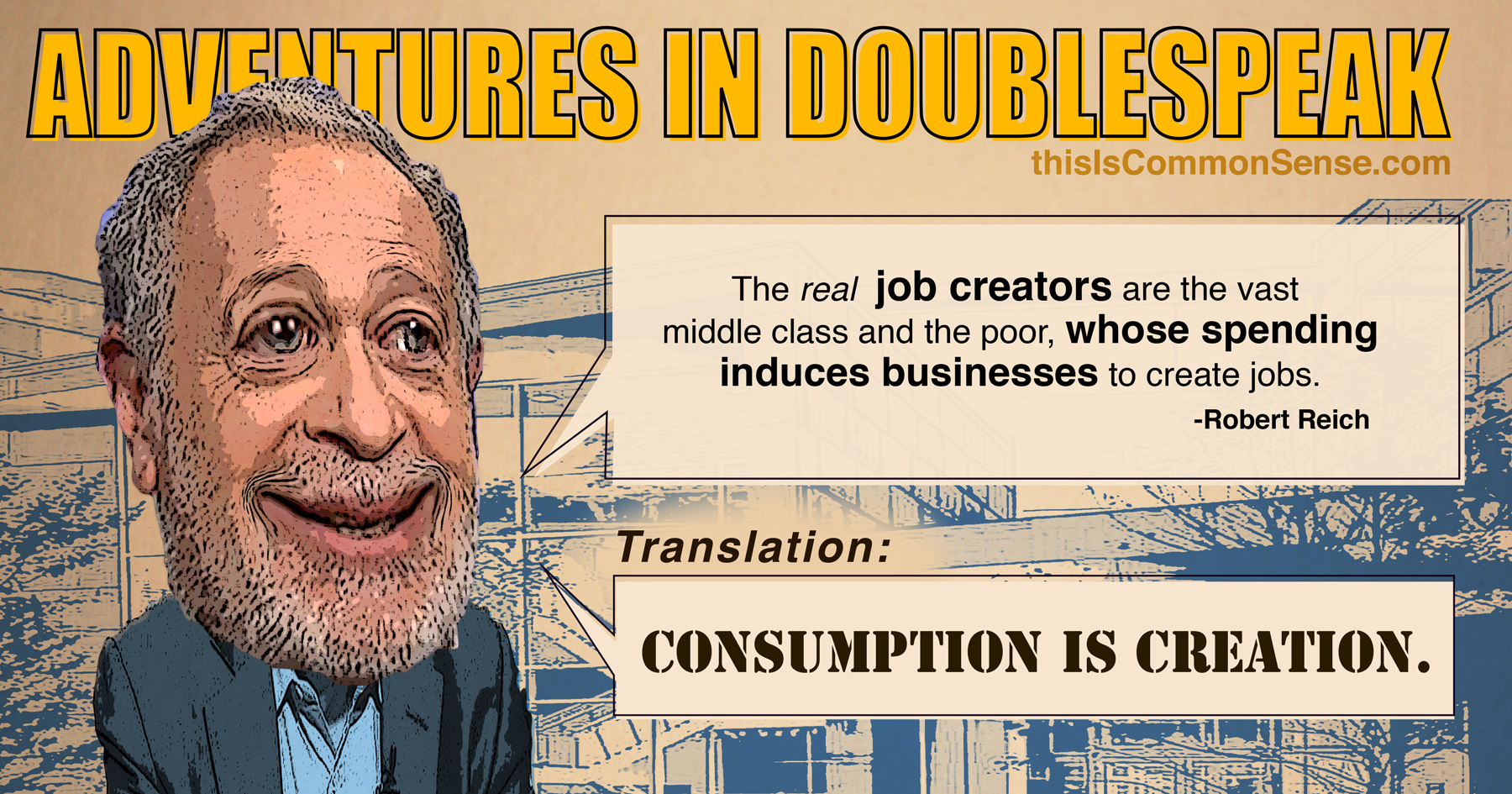
Robert Reich Doublespeak


Categories
Accountability education and schooling general freedom ideological culture national politics & policies

Parents in Context

Consider the intersection of freedom and decontextualized fragments.

The specific “decontextualized fragments” in question appear in great and not-so-great works of literature, assigned in public schools for young adults to read: a graphic rape scene in Toni Morrison’s Beloved; racial slurs in Huckleberry Finn; sex, violence.

“Virginia regulators are drafting rules that would require school districts to red-flag objectionable teaching material and make it easier for parents to control what books their children see in the classroom,” reports the Washington Post.

Those regulations won’t be finalized for a year or more (because government bureaucracies are painfully slow). Yet an “earlier version of the language released on a state website drew hundreds of comments from the public,” the Post informs.

“Most parents were supportive of the change. . . .”

Teachers? Against.

Stafford County Public Schools literacy coordinator Sarah Crain worries about literature being wrongly labeled “sexually explicit.” To “reduce a book or a work down to something that is a mere decontextualized fragment of the work,” she argues, “actually impedes the ability for teachers and parents to have informed conversations.”

What about freedom?

Well, public schools aren’t primarily about freedom.

Teachers have a job to do; students follow instruction.

And it is pretty easy to see one reason for the opposition by “the professionals”: the new rules would entail more work.

Nonetheless, parents and their kids deserve as much choice as can be provided. And in every context.

Here, freedom means acknowledging the right of parents to decide. Not experts. Parents.

This is Common Sense. I’m Paul Jacob.


Printable PDF

education, parents, children, Virginia, freedom


Original photo credit: wealhtheow on Flickr


Categories
general freedom meme national politics & policies too much government

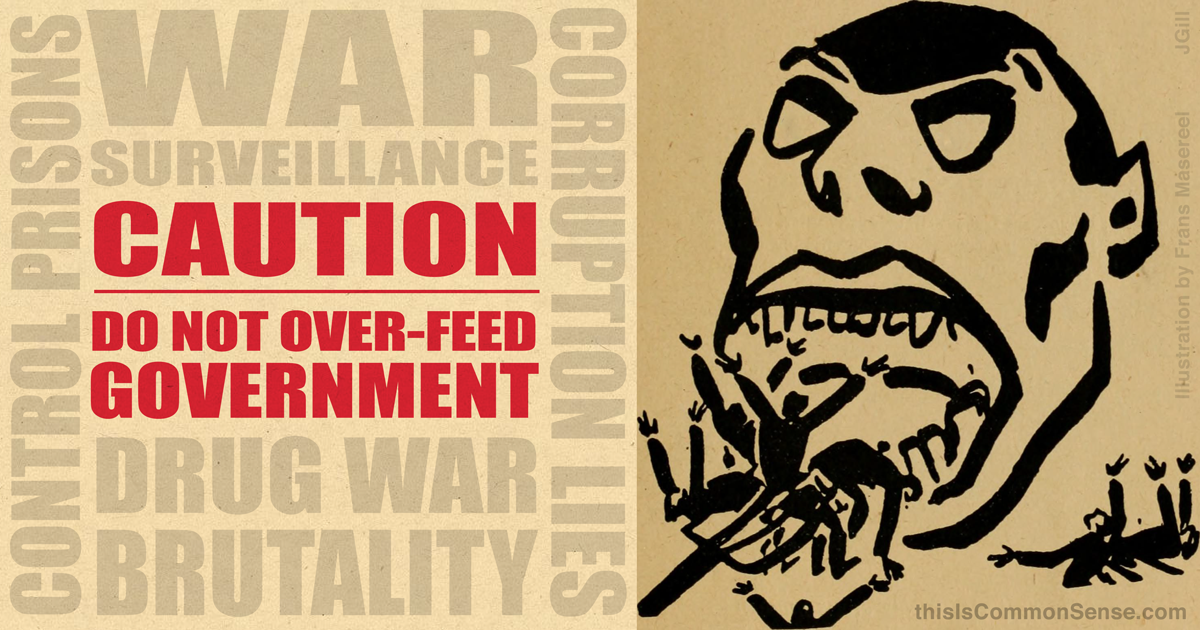
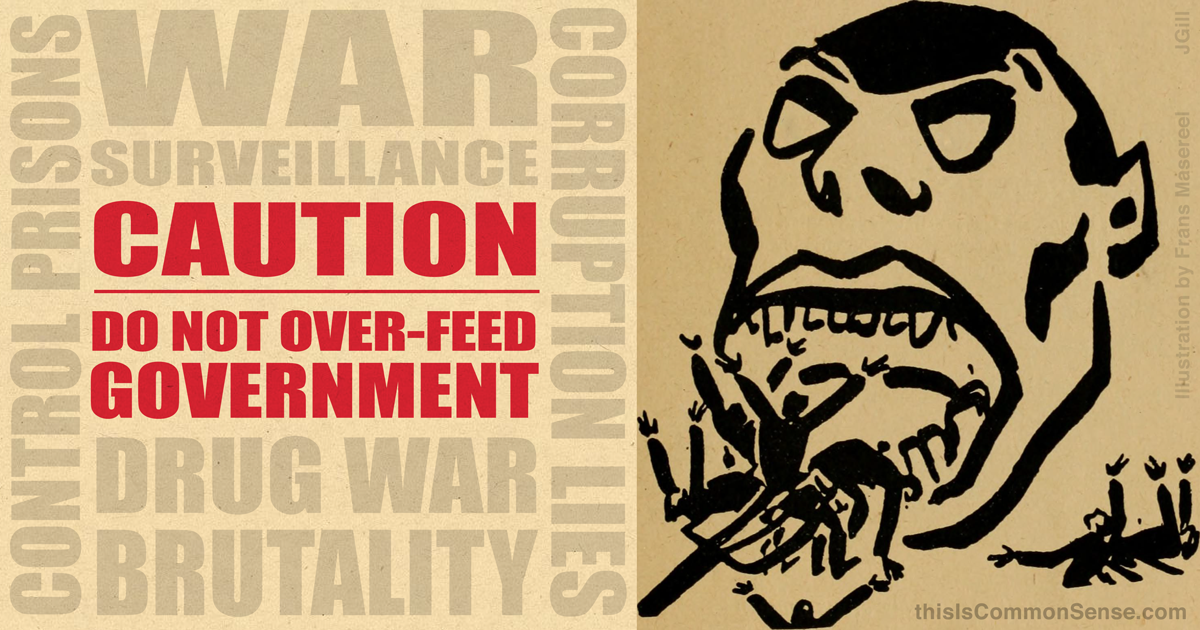
Over-Feed At Your Own Risk!

Caution: Do Not Over-Feed Government!


Get a high-resolution screensaver of this image. Click on the image below to open large version that you can download.

CAUTION_DontOverFeed


Categories
general freedom ideological culture individual achievement too much government

The Pattern Here

Thomas Sowell, who retired from his syndicated column last week, may be the greatest public intellectual of our time.

Though he is “an original,” an iconoclast, his work is best seen as the carrying on of a tradition. Or two.

Consider his most famous research area: race. An African-American, Sowell is the age’s most persuasive dissident to the dominant strains of racial advocacy. He brought much common sense to a subject beset with unhinged passion.*

And yet even here he was obviously drawing on traditions that, if not well known, were firmly established.†

One of Sowell’s most important contributions, in books such as A Conflict of Visions and The Vision of the Anointed, is his distinction between two very different ways of looking at the social world:

  • the “constrained vision” . . . . of most conservatives and classical liberals; and
  • the “unconstrained vision” . . . of so many socialists, anarchists and progressives.

For many conservatives, this is Sowell at his best. But is it original? A few of my readers could probably lecture me on its origins in a famous essay by F. A. Hayek, “Individualism: True and False.”‡

Over at the Foundation for Economic Education, David R. Henderson addresses the one area where I tend to disagree with Sowell: foreign policy. Henderson gently calls out Sowell’s apparent credulity regarding the dishonesty of our war party leaders. Sure, Henderson writes, “[t]here are downsides to distrust. . . . But there are upsides too.”

Mourning the loss of trust in presidents, Sowell blames it on presidents lying to us in recent decades. But, as Henderson notes, “war presidents” lying to us about war is not new — providing examples.

Pity that Sowell, of all people, does not see the pattern here.

This is Common Sense. I’m Paul Jacob.


* See Sowell’s Ethnic America: A History, Race and Culture: A World View, and The Economics and Politics of Race: An International Perspective; but also popular argumentation, such as Pink and Brown People and Black Rednecks and White Liberals. And then there is the important Civil Rights: Rhetoric or Reality?

† Economists W. H. Hutt and Gary Becker, at the very least, provided the background for Sowell’s research with their respective books The Economics of the Colour Bar and The Economics of Discrimination.

‡ See F. A. Hayek, Individualism and Economic Order. In another essay, Hayek provides Sowell with the seed of Knowledge and Decisions.


Printable PDF

Thomas, Sowell, intellectual, race, Common Sense


Categories
Accountability crime and punishment general freedom moral hazard national politics & policies privacy responsibility

In Plain Sight

The Berlin terrorist attack just a little over a week ago fit a noteworthy pattern. German authorities had investigated Anis Amri — the Tunisian man who drove that large truck into a crowded Christmas market, killing 12 and wounding 56 others — and found “links with Islamic extremists.”

Later killed in Milan, Italy, Amri had been wanted in Tunisia for “hijacking a van” and jailed in Italy for arson and a “violent assault at his migrant reception center.” And yet with all that known or easily knowable, the German authorities couldn’t prevent him from killing innocent Germans.

It’s not just a European phenomenon, either.

Consider Omar Mateen, this country’s worst mass shooter, having massacred 49 people in Orlando’s Pulse nightclub. The FBI had spent ten months looking into Mateen.

Years before the Boston Marathon bombing, the FBI had tracked Tamerlan Tsarnaev, one of the bombers.*

“In case after case . . . authorities have come forward after the fact to say that they had enough cause to place the suspect under surveillance well before the violence,” the Washington Post recently noted. This was the case with the majority of recent lone-wolf terrorism plots.

“If any lesson can be learned from studying the perpetrators of recent attacks,” a report in The Intercept concluded, “it is that there needs to be a greater investment in conducting targeted surveillance of known terror suspects and a move away from the constant knee-jerk expansion of dragnet surveillance . . .”

Yet intelligence agencies are still grabbing our metadata in violation of the Fourth Amendment. That needs to stop.

The fact that known threats are consistently not being stopped suggests curtailing mass surveillance won’t hurt our security, but improve it.

This is Common Sense. I’m Paul Jacob.


* The same is true regarding the Ft. Hood (work-place) shooter, Nidal Hasan. Likewise, Abdulhakim Mujahid Muhammad (formerly Carlos Bledsoe), who was under the active eye of the FBI after returning from Yemen . . . until he opened fire on a Little Rock, Arkansas, recruiting station killing one soldier and wounding another. Ditto Ahmad Khan Rahami, the less deadly bomber in New York City and New Jersey.


Printable PDF

terrorism, surveillance, privacy, fingerprint, targeted, illustration


Categories
ideological culture media and media people national politics & policies political challengers

Democracy — Oh, My!

The President-elect has had some difficulty booking celebrity acts for his inauguration. And instead of taking this as a cue to trim down on celebratory excess, his team has extended the guest performer list to include New York’s world-famous chorus line dancers, the Rockettes.

The leggy, sequined showgirls might seem a perfect fit for the President-elect’s celebration — more, say, than a ballet troupe, or a string quartet — but one among the Rockettes protested.  Being a part of a performing team might seem a dream job, but not for Phoebe Pearl. She was, she wrote on Instagram, “overwhelmed with emotion,” and not in a good way. She felt “embarrassed and disappointed” that the gig “has been decided” for her.

She feels . . . coerced.

Dan Avery, writing before Christmas, characterizes the contract as a matter of “force.”

Welcome, Ms. Pearl, to the world that most American workers already know.

But the silliness reached high pitch with actor George Takei, who tweeted: “The members of the Rockettes and the Mormon Tabernacle are like all of us: Forced to go along with something horrible they didn’t choose.”

Democracy — oh, my!

Most people have had to put up with democratic results they did not like. Are Democrats only now understanding this?

To a degree, I sympathize. Which is why I want limits placed on government. Perhaps Democrats should have thought of this every time they cheered as their elected candidates increased presidential power. Did they not realize that someday they might lose?

And if you want a right of refusal, make sure it is in your contract.

The Rockette does not have a leg to stand on.

This is Common Sense. I’m Paul Jacob.


Printable PDF

Rockettes, democracy, inauguration, Trump, media, entertainment, illustration, association, voluntary


Categories
Accountability government transparency initiative, referendum, and recall local leaders moral hazard

Rules for Rulers?

Politicians in Tampa, Florida, have forced citizens there to vote for term limits, and then vote to keep those term limits again and again — against attempts to repeal or weaken the limits. So I keep my eye out for news from the city.

Earlier this month, Mike Deeson, an investigative reporter with WTSP 10 News, Tampa Bay’s CBS affiliate, exposed Mayor Bob Buckhorn’s open violation of the city charter’s requirement that all department heads must be city residents. Buckhorn hired Sonja Little, now the city’s highest paid employee, to serve as his Chief Financial officer, and admits on camera that he promised her she would not have to move into the city.

“The question is,” the mayor explained, “do you want talent or do you really make the residency — she’s only about a mile away from the city border — the issue?” Buckhorn answers his own question, “I would rather have talent” . . . than follow the law.

In even slipperier fashion, Mayor Buckhorn has attempted to get around the clear, unequivocal wording in the charter by claiming Ms. Little has served as the “interim” Chief Financial officer for the last five years!

Reporter Deeson asks the operative question: “[I]f you’re going to ignore the residency requirement, what other parts of the charter should you just ignore?”

Deeson worries about provisions requiring competitive bidding, guarding against conflicts of interest and mandating term limits, which is “particularly problematic for a mayor who is in his second term and has to leave office when it’s over.”

On social media, Tampa residents are unloading on the mayor with numerous variants of: “This is truly what’s wrong with government.”

This is Common Sense. I’m Paul Jacob.


Printable PDF

Tampa, initiative, corruption, Mayor, Mike Deeson, Mayor Bob Buckhorn