Categories
defense & war public opinion

Iran: What Next

The Iran Question dominates the news.

Most papers and programs have numerous takes at the top of the page or the hour devoted to Israel’s attack on Iran’s nuclear program; President Trump’s demand that Iran unconditionally surrender, and the government of Iran’s defiance; and Trump’s latest statements vaguing up “his decision” to bomb Iran.

And in a man-bites-dog angle, I’m going to agree with The New York Times.

Specifically, the editorial board’s “America Must Not Rush Into a War Against Iran,” run yesterday.

Where the Times is right regards not the disputed facts and theories about the conflict, but whether the United States military, under direction of its Commander-in-Chief, should bomb Iran.

That is not merely open to debate but must be debated.

Many in Trump’s base oppose any involvement: Trump was voted into office to stop the endless wars.

But it’s not just the matter of politics. It’s a constitutional issue: “An unprovoked American attack on Iran — one that could involve massive bombs known as bunker busters — would not be a police action or special military operation,” the Times declares. “It would be a war. To declare it is not the decision of Mr. Netanyahu or Mr. Trump. Under the Constitution, Congress alone has that power.”

And if we wince at the idea of our dysfunctional Congress grandstanding and bloviating about such a weighty matter, consider this: the congressional debate must occur in a context where Americans debate. We debate; the People.

After all, we end up playing lots of heavy roles in these things. 

This is Common Sense. I’m Paul Jacob.


PDF for printing

Illustration created with Krea and Firefly

See all recent commentary
(simplified and organized)
See recent popular posts

Categories
defense & war international affairs

Still a Big Advantage

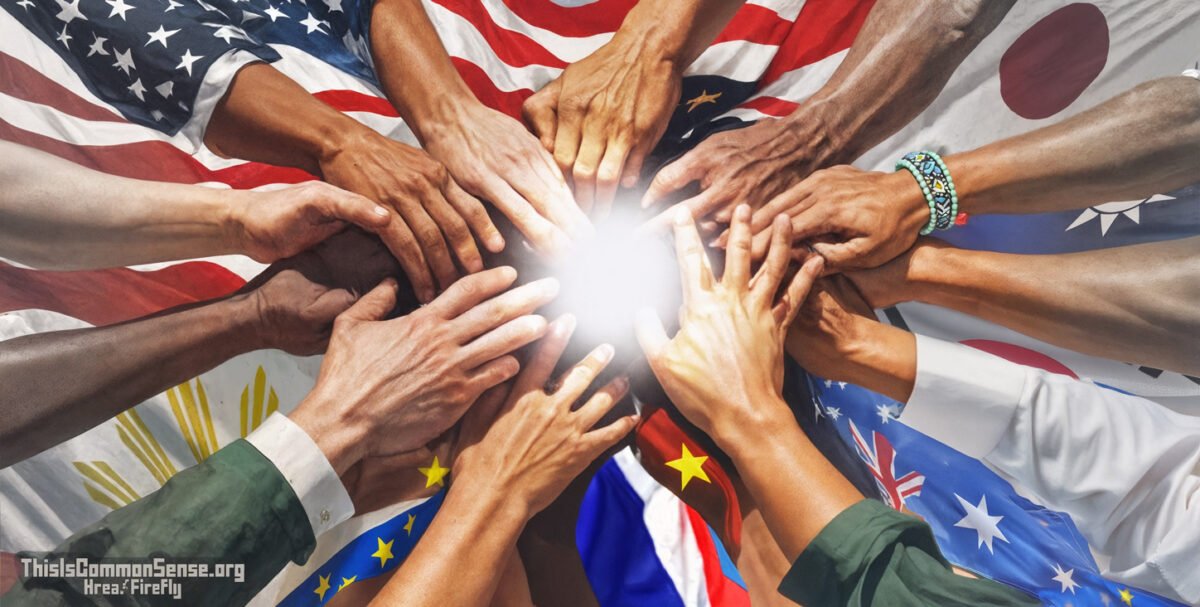
In all the talk of America First — and of the United States as the indispensable nation — we Americans sometimes forget this doesn’t mean “America Alone.” 

“Ultimately, a strong, resolute, and capable network of allies and partners is our key strategic advantage,” U.S. Secretary of Defense Pete Hegseth recently informed the Shangri-La Dialogue in Singapore. “China envies what we have together. And it sees what we can collectively bring to bear on defense.”

Hegseth was speaking directly to Indo-Pacific allies, whom he reminded: “it’s up to all of us to ensure that we live up to that potential by investing” to “quickly upgrade [our] own defenses.”

Our alliances of free nations in Europe and Asia constitute a huge edge against a bullying, totalitarian China.

My entire life, these past six decades, Big Daddy America was by far the biggest, best military on the block. Still is the best. But it’s no longer the biggest: China now has a bigger navy, much greater shipbuilding capacity, and many more soldiers in uniform. Technological and other strategic advantages have been diminished as well.

The defense secretary acknowledged that — after “a lot of ongoing conversations with our military leadership in the Indo-Pacific” — “there is something to be said for the fact that China calculates the possibility and does not appreciate the presence of other countries . . . as part of the dynamics or decision-making process, and, if that is reflected in their calculus, then that’s useful.”

We cannot afford to squander our “ally advantage.” We need each other.

This is Comon Sense. I’m Paul Jacob.


PDF for printing

Illustration created with Krea and Firefly

See all recent commentary
(simplified and organized)
See recent popular posts
Categories
government transparency international affairs media and media people national politics & policies

Lying About Killing for Votes

Some foreign policy issues, such as regarding Israel and Palestine, are confusing enough that many of us tend to be wary of sharing our opinions. 

But no matter how reticent we may be, we can agree on this: there should be no outright lying about our positions. 

Mitchell Plitnick is a progressive who is willing to confront this prevarication problem forthrightly. Of the many “disheartening moments” during the last presidential campaign, “few,” he admits, “were quite as deflating as that moment when the ostensibly progressive, leading member of The Squad, Alexandria Ocasio-Cortez stood at the podium at the Democratic National Convention and told the audience that then-Vice President Kamala Harris was ‘working tirelessly to secure a ceasefire in Gaza and bring the hostages home.’

“We knew she was lying,” Plitnick confesses. “AOC herself knew she was lying. But it was just the message that the crowd — who were more than eager to show their support for the Democrats despite the party’s utter refusal to allow even the most conciliatory and moderate Palestinian voice to be heard — wanted to hear, and they ate it up.”

This willingness of the few to promote a blatant lie, and of the masses to believe it, might be the most disheartening thing about modern politics.

And as for the truth, how do we know Plitnick is right about the prevarications? “The utterly shameless nature of the lie has now been confirmed by no less than nine officials from Joe Biden’s administration and reported on by Israel’s own Channel 13 news program, Hamakor. . . .”

We, the people — pro-Israel and pro-Palestinian and otherwise — may all wish for a ceasefire.

But it’s clear that the last administration wanted nothing to do with it.

And lied about it. For votes.

This is Common Sense. I’m Paul Jacob.


PDF for printing

Illustration created with Krea and Firefly

See all recent commentary
(simplified and organized)
See recent popular posts

Categories
international affairs public opinion

An Independent Nation

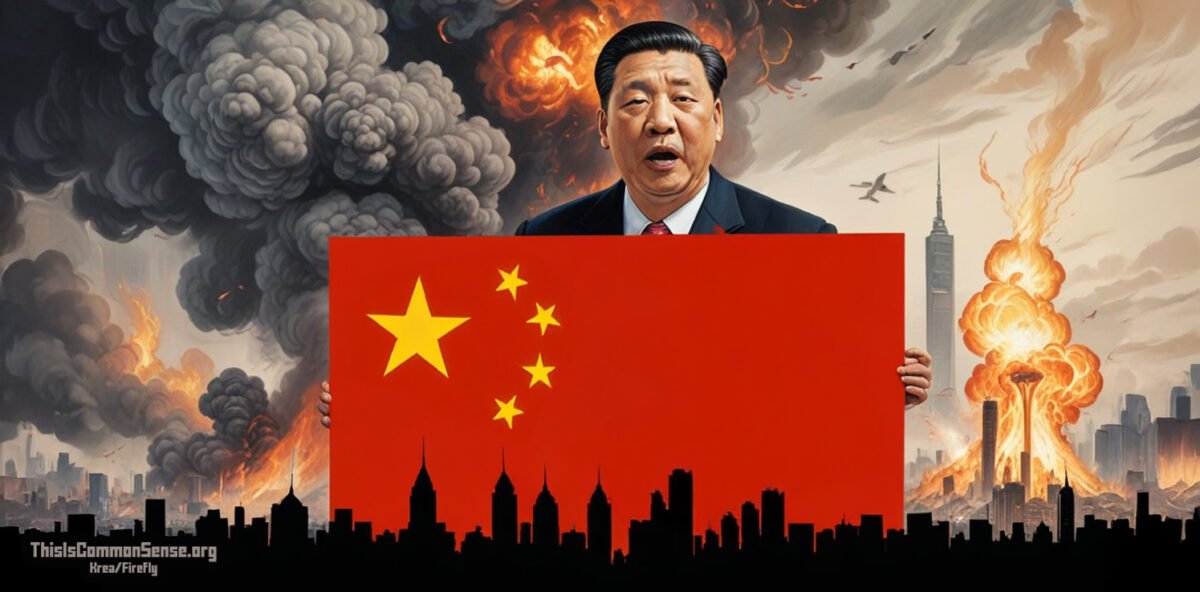
Our leaders have been surprisingly expressive in signaling U.S. military support for the defense of Taiwan. 

Ironic, considering that official U.S. policy is dubbed “strategic ambiguity,” meaning we don’t say one way or the other about our defensive intentions for helping the island nation against a regularly threatened and rehearsed-for Chinese invasion or naval blockade. 

Four separate times during his term, however, former President Joe Biden publicly pledged American military help to counter a People’s Republic of China assault on Taiwan. As for the Trump 2.0 Pentagon, weeks ago it leaked (or suffered a leak of) a global defense strategy memo that said preventing a PRC takeover of Taiwan was the “sole pacing scenario” engaging our armed forces. 

Surprising unanimity for the two parties in Washington. But has anyone asked what the American people think?

Well, Humanity for Freedom Foundation conducted a poll, released yesterday.*

Informed that “China claims Taiwan as its own territory,” 82 percent of respondents agreed that “Taiwan is an independent country.” Only 3 percent felt “Taiwan is part of China.”

A 58 percent majority favored full U.S. diplomatic recognition for Taiwan. When it comes to American military defense, a plurality of 39 percent wanted to continue the status quo of not saying (“strategic ambiguity”), while 32 percent of Americans preferred their government make a clear commitment to Taiwan. Only 2 percent supported ending arm sales and adopting a neutral stance.

The above results are thoroughly — and surprisingly — non-partisan, with arch conservatives and far-out progressives finding common ground to defend Asia’s freest society against the world’s most maniacal totalitarian state. 

Could the specter of a future dictated by the Chinese Communist Party be bringing the world closer together?

This is Common Sense. I’m Paul Jacob. 


* In full disclosure, I’m on HFF’s board of directors. As for the national poll, it had 800 respondents, giving the results a 3.5 percent margin of error with a 95 percent confidence level. Full results are here.

PDF for printing

Illustration created with Krea and Firefly

See all recent commentary
(simplified and organized)
See recent popular posts
Categories
defense & war international affairs

To Halve and Halve Not

“Why is Taiwan such a hot flash point?” 

That’s what U.S. Senator Tom Cotton (R-Ark.) asked Admiral Samuel Paparo, head of the United States Indo-Pacific Command. “Why could it lead not only to a catastrophic war, but also global Great Depression? Why should Americans care about an island on the other side of the world?”

The admiral told the Senate Armed Services Committee that the senator’s “last point [was] quite salient. Many a research organization postulate that conflict in the western Pacific over the Taiwan question would result in a 25 percent GDP contraction in Asia and a knock-on effect of 10 to 12 percent GDP reduction in the United States of America, with unemployment spiking seven to 10 points above base and likely 500,000 excess deaths of despair above base as well.

“This is just the importance of the regional stability to the world economy and its effect on people’s lives,” added Paparo. “And this is a function of freedom of navigation; it’s a function of the world dependency on semiconductors.”

“And to be clear,” offered Sen. Cotton, “simply having the conflict over Taiwan which is such a center of gravity in the modern economy could lead to many of the consequences you just outlined.”

Paparo explained that “most of the things” he has “studied indicate that American intervention would halve that impact,” adding “a successful American intervention would. 

“Still a grave result,” Admiral Paparo acknowledged, “but half as grave, with savings of a lot of human misery.”

Let’s hope and pray and prepare militarily to deter Chinese aggression.

This is Common Sense. I’m Paul Jacob.


PDF for printing

Illustration created with Krea and Firefly

See all recent commentary
(simplified and organized)
See recent popular posts

Categories
defense & war international affairs

Resisting Invasion

“China is the Department’s sole pacing threat, and denial of a Chinese fait accompli seizure of Taiwan — while simultaneously defending the U.S. homeland,” Secretary of Defense Pete Hegseth declared (using the latest jargon) in a memo setting forth global U.S. strategy, “is the Department’s sole pacing scenario.” 

Recently shared with military brass and congressional national security committees, and recently leaked, Hegseth’s Interim National Defense Strategic Guidance is, according to The Washington Post, “extraordinary in its description of the potential invasion of Taiwan as the exclusive animating scenario that must be prioritized over other potential dangers.”

While I can’t find a copy of the leaked document, The Post relates that “given personnel and resource constraints,” the United States will focus on China and “pressure allies in Europe, the Middle East and East Asia to spend more on defense to take on the bulk of the deterrence role against threats from Russia, North Korea and Iran.”

This makes enormous sense. We are already at war in Ukraine and across the Middle East, while China, the most dangerous aggressor, has been ratcheting up its bullying and threats against its neighbors whom we have pledged to defend. 

Taiwan is too important — especially strategically, but also economically, and even symbolically, as an incredible democratic success story — to allow it to be gobbled up by the genocidal Chinese Communist Party regime. 

Europe can step up to defend itself and is increasingly doing so. Germany has troops and tanks headed to Lithuania, the first such deployment since the Second World War.

These are serious times. Glad to have a more serious plan to address them. And to count other free countries as allies. We will need each other.

This is Common Sense. I’m Paul Jacob.


P.S. On four separate occasions, President Biden publicly promised that the United States would come to Taiwan’s assistance militarily should China’s repeated threats to invade come to fruition, but where President Trump would stand in his second term seemed uncertain. Would he make a deal with Xi Jinping that sold out Taiwan, as John Bolton, his former national security advisor, has claimed? Bolton has been wrong before.


PDF for printing

Illustration created with Krea and Firefly

See all recent commentary
(simplified and organized)
See recent popular posts

Categories
Common Sense video

A Truce

This commentary, Common Sense with Paul Jacob, usually deals with man’s inhumanity to man — man’s insanity to man, oftentimes. But on this Christmas Eve, let’s for just a moment focus squarely on some beautiful days of sanity and humanity that somewhat magically broke out of the ugliness of “total war” back eleven decades ago: World War I, “The Great War.”

Let’s remember the good times.

The Christmas Truce
History Channel
A Sign Of Friendship In The Midst Of War I
THE CHRISTMAS TRUCE 1914
The Great War
Christmas Truce of World War I 
Joyeux Noel / 2005 film (video, 13:35)

This is Common Sense. I’m Paul Jacob. Merry Christmas!

See all recent commentary
(simplified and organized)
See recent popular posts
Categories
initiative, referendum, and recall national politics & policies

The Battle Ahead

Tonight — or hopefully sometime before Christmas — we will know who the next president of these United States shall be. 

I’m also anxious to find out who wins control of the U.S. Senate and House — and most excited to see the outcome of 11 statewide ballot measures that I’ve been engaged in — across ten states, including eight states with Citizen Only Voting Amendments on the ballot, most critically North Carolina and Wisconsin. 

But my elation in expectation on this fine day is greatly tempered by the sobering reality that awaits on Wednesday. No matter who wins . . . something approaching half the country will be deeply distraught. 

I’m tired of hearing that America is “over” — that this experiment in freedom and democracy has run its course and is destined to soon fail. But on Wednesday I’ll no doubt hear that chorus again from the losing side.

No one gets a prize for predicting America’s demise — only for preventing it. 

What worries me most, however, are the challenges Wednesday’s winner will face from a world at war in Europe and the Middle East, with conflict rapidly approaching in Asia. 

“World War III,” as columnist George Will wrote weeks ago, “has begun.”*

Yet, the election has been largely devoid of serious foreign policy discussion. “The U.S. presidential campaign is what reckless disregard looks like,” quipped Will. “Neither nominee has given any evidence of awareness of, let alone serious thinking about, the growing global conflagration.”

Whoever wins today (or whenever): Buckle your seatbelts. 

This is Common Sense. I’m Paul Jacob. 


* Mr. Will believes history will look back to mark the beginning of the Third World War with “Russia’s 2014 seizure of Crimea,” during the Obama administration. 

PDF for printing

Illustration created with Midjourney

See all recent commentary
(simplified and organized)
See recent popular posts

Categories
defense & war international affairs

The Beam in Microsoft’s Eye

Microsoft has just published a pretty good update on the cyber-threat landscape, Digital Defense Report 2024

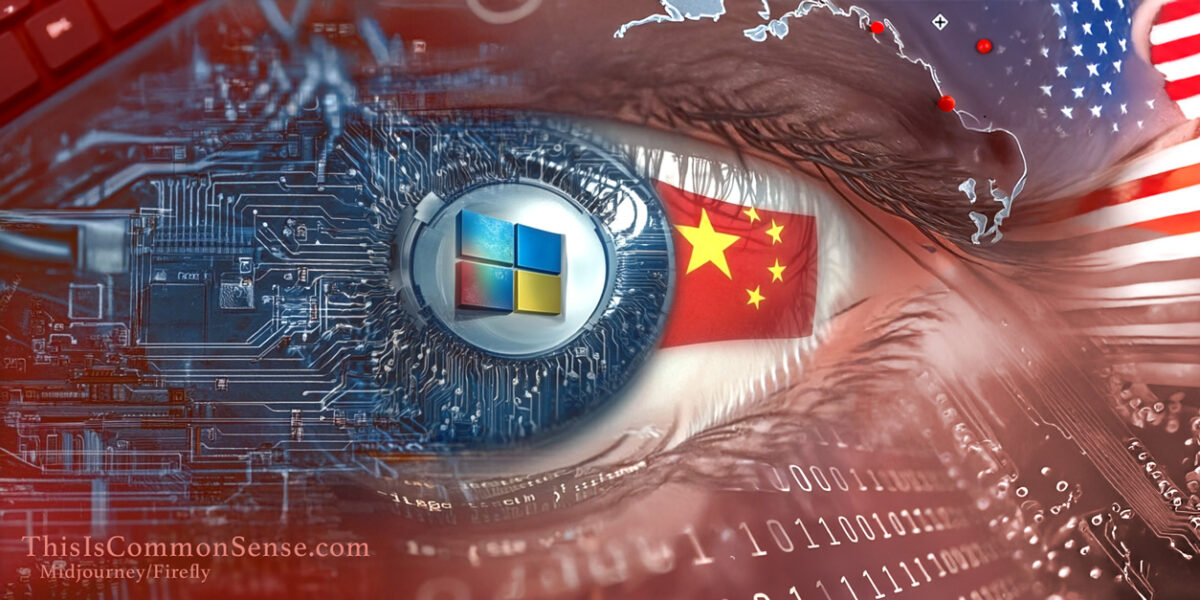
The report comprehensively describes the recent prolific activity of state-affiliated hackers all over the world, primarily those affiliated with China, Iran, North Korea, and Russia.

In the case of China, we have a series of “Typhoon”-named cyberattacks: Raspberry Typhoon, Flax Typhoon, and Granite Typhoon, to name a few, that “have intensively targeted entities associated with IT, military, and government interests around the South China Sea.”

The toll of cyberattacks in the U.S. — all kinds from all sources — has been extensive. In the recent year, “389 healthcare institutions were successfully hit by ransomware,” resulting in closures and medical delays.

The report is also about what we’ve been doing to defend ourselves: not enough. The authors say that although better cybersecurity is important, we also need “government action” that makes it costlier for states to launch these attacks.

We need something else, too. We need companies like Microsoft to abstain from helping adversary states to cyberattack us.

At Breitbart, Lucas Nolan reports that Microsoft has been maintaining close ties with the Chinese Academy of Sciences for over a decade. Among the details of a lengthy indictment, Nolan offers a list of publications coauthored by Microsoft and CAS researchers “in the fields of artificial intelligence, machine learning, data mining, computer vision, and even cybersecurity.”

Why help China gain knowledge that can be used to hurt us?

This is Common Sense. I’m Paul Jacob.


PDF for printing

Illustration created with Midjourney and Firefly

See all recent commentary
(simplified and organized)
See recent popular posts
Categories
free trade & free markets international affairs tax policy

Trump’s Tariff Question

If Donald Trump fails to re-take the White House in November (and then for real in early 2025), his legacy may quickly devolve into a matter for historians, not live politics. After people calm down and the culture war stuff recedes (once again, if allowed by events), what will be left to argue over are a half-dozen major issues, which include war, mass migration . . . and tariffs.

Tariffs have long been Mr. Trump’s major hobby horse; he gets excited about 100 percent levies. The whole business about the “bloodbath” quote was his insistence that American auto industry will be destroyed if Trump himself doesn’t get the chance to erect ultra-high tariffs against automobiles from Mexico.

Trump looks at tariffs on foreign goods as harming foreign nations and helping us, the Americans.

But it is worth noting that economists from Adam Smith and David Ricardo onward have regarded tariffs as chiefly harming consumers within the country that erects them. 

At Reason you can read Veronique de Rugy make the classic free-trade case, anew, in “No, Trump-Style Tariffs Do Not Grow the Economy.” If Frédéric Bastiat didn’t convince you, maybe de Rugy will.

But something’s missing. Surrounding Trump’s talk against free trade in general and China in particular there was always another element that neither Bastiat nor de Rugy emphasize: free-trading with China helps Chinese and Americans, sure; gotcha — but it also helps the Chinese state, and its ruling Communist Party. 

“Trump is an avowed restrictionist on both immigration and trade,” de Rugy writes. But both unchecked immigration and free trade present problems not economic so much as political. It’s about real bloodbaths, actual warfare, not metaphorical ones.

Even if Trump misdiagnosed the domestic economy, he saw problems with China perhaps more clearly than anyone else.

This is Common Sense. I’m Paul Jacob.


PDF for printing

Illustration created with PicFinder and Firefly

See all recent commentary
(simplified and organized)
See recent popular posts