Categories
general freedom nannyism

The Next Population Explosion

While I sit way out here on the margins of big technological trends, Elon Musk pitches a very science-fictional near-future. 

“With robotics and AI, this is really the path to abundance for all,” he said at January’s World Economic Forum in Davos. “If you have ubiquitous AI that is essentially free or close to it and ubiquitous robotics, you will have an explosion in the global economy that is truly beyond all precedent.”

The world’s richest man predicted that humanoid robots will soon become pervasive: “there will be more robots than people.”

I’m not much of a science fiction reader — does Nineteen Eighty-Four count? — but from movies and friends’ book suggestions, it sure seems that sci-fi writers have not predicted universally cheerful outcomes from Elon’s prophesied robot population explosion.

How would we control such creatures? Isaac Asimov wrote a lot about this, using his “Three Laws of Robotics,” a Three Commandments for artificial beings. The first reads “A robot may not injure a human being or, through inaction, allow a human being to come to harm.” But surely another scenario is more realistic, Jack Williamson’s The Humanoids (1948). There the shiny robots — primed with “To Serve and Obey, And Guard Men From Harm” — set up a totalitarian society without the State. 

Just the humanoids, nannying humans about.

What would life be like with all these “helping hands”? 

Remember Thoreau’s warning in Walden (1854)? “If I knew for a certainty that a man was coming to my house with the conscious design of doing me good, I should run for my life. . . .”

Ronald Reagan quipped that “I’ve always felt the nine most terrifying words in the English language are: ‘I’m from the Government, and I’m here to help.”

Elon Musk merrily imagines an “upgrade” to busybodies and governments.

Artificial busybodies and governments. On auto-pilot.

Terrifying.

This is Common Sense. I’m Paul Jacob.


PDF for printing

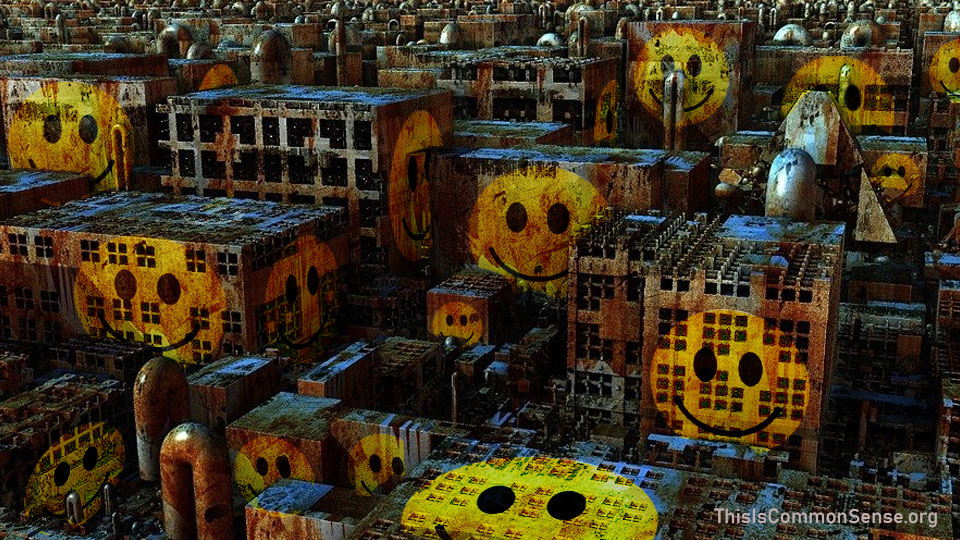
Illustration created with Nano Banana

See all recent commentary
(simplified and organized)
See recent popular posts
Categories
ideological culture

The Portlandia Problem

Whatever happened to Portland, Oregon?

Describing two “anarchists” in that riot-torn city, Nancy Rommelmann paints quite a picture in the May 2021 issue of Reason: “They are outfitted in the black bloc uniform of head-to-toe black; the boy carries a steel baton and wants me to know it. There is nonetheless something patrician about them, as if under different circumstances one might encounter them at cotillion. The uniform conceals their identities, but it can’t hide the sense of entitlement that allows them a cheap laugh at the cop, at the fan.”

The mocked cop? Sitting inside a federal building next to an industrial fan airing out the place after being attacked . . . with a thrown bucket of diarrhea.

Ms. Rommelmann wonders why these miscreants think it acceptable to throw excrement around.

“‘Do you believe that property is worth more than human lives?’ asks the boy.

“‘Do you believe the police should be allowed to murder people?’ asks the girl.”

Rhetorically. 

For there had been, that year, only “one deadly police shooting in Portland.”

Thirteen years ago, Portland’s anarchist craze was still latte liberal, when 75,000 showed up to cheer on candidate Barack Obama. That was when it was “a little bit goofy, a little bit twee,” as Rommelmann puts it. 

What went wrong? 

Well, both city and state are solidly Democratic, and the Democrats’ leftist pieties disabled them from ever standing up to the violence of ideologues.

Utopians with every instinct to turn common sense on its head can only take each failure to establish their ideals as an excuse to turn up the volume. And violence.

Our civilization has seen this before. The utopians bring only dystopia.

This is Common Sense. I’m Paul Jacob.


PDF for printing

See all recent commentary
(simplified and organized)
See recent popular posts

Categories
folly ideological culture too much government

Not So Great . . . Again

“We’re not going to make America great again,” New York Gov. Andrew Cuomo proclaimed at a bill-signing ceremony this week. And then, further poking the president, the governor added, to gasps from the audience: “It was never that great.”

America — for all its faults, failings, and wrongdoings — has been a tremendous force for good, for freedom. At the same time, talking about how great we are really seems . . . what’s the word? Boastful.

“We have not reached greatness,” Cuomo went on to clarify. “We will reach greatness when every American is fully engaged. We will reach greatness when discrimination and stereotyping against women, 51 percent of our population, is gone and every woman’s full potential is realized and unleashed and every woman is making her full contribution.”

This is pie-in-the-sky stuff. Utopianism. The state government of New York is not going to succeed — or even actually try — to “engage” every citizen “fully.” Neither will the Empire State help “every” female New Yorker to self-actualize . . . while magically wiping out “stereotyping.”

When very real governments fixate on fantasy, they can only fail. Achievable responsibilities — like fixing roads, improving schools, enforcing laws — fall by the wayside. 

Both President Trump and Governor Cuomo would do well to concern themselves with running the government. Leave the greatness to the rest of us.

Oh, and the rest of the story? 

“I’m Andrew Cuomo, and I work for you,” the governor said in a 2010 video announcing his entry into the gubernatorial race. 

“Together,” he went on to declare, “we can make New York great again.”

This is Common Sense. I’m Paul Jacob.


PDF for printing