Categories
deficits and debt partisanship too much government

Upstart?

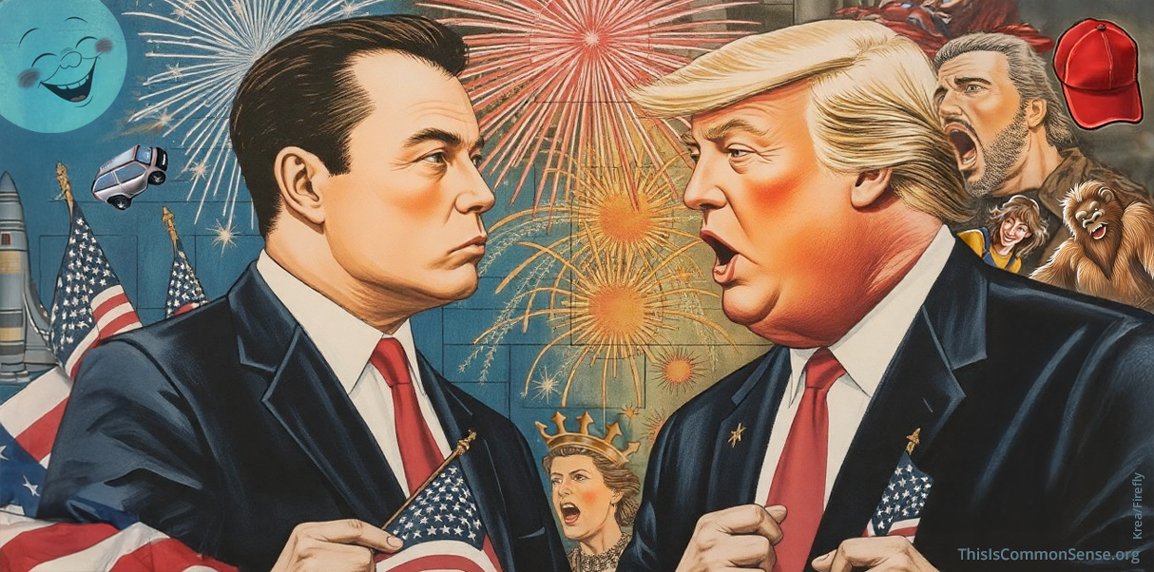
The spectacular fallout between Donald Trump and Elon Musk over the Big Beautiful Bill in particular (but deficit spending and debt accumulation in general) promises political watchers a big, ugly brawl.*

Now, billionaire Musk appears to be serious about his proposed “third party,” the “America Party.” A name perfectly designed to ruffle Trumpian feathers. It might steal some of the thunder of “America First” and “Make America Great Again.”

The president mocks the notion, saying that third parties “have never succeeded in the United States.”

Well, that is not exactly true. For a long time, it was second parties that had problems. 

The first party, the Federalists, basically lost for a generation, finally withering away against the onslaught of that most American party of all, the Democratic-Republican. 

When the victorious party reformed under the leadership of Andrew Jackson and Martin Van Buren to become the Democratic Party, the Whig Party emerged to counter-​act Jackson’s imperial presidency. The Whigs had some success — if with a string of presidents almost no one remembers — only to lose ground to Democrats and then a whiggish replacement, the Republican Party.

Yes, Trump’s own party was a “third” party once.

And it achieved power largely because the Democrats split into two for the 1860 election, leaving a sectional plurality candidate (Abraham Lincoln) to win the Electoral College as a Republican.

In modern times, Republicans and Democrats have ably squelched challenger parties

So Trump’s right — in spirit.

Now enter Andrew Yang, enthusiastic for the upstart. But how can his Universal Basic Income agenda fit with Elon’s fight against over-spending? 

This is Common Sense. I’m Paul Jacob.


* Though, some wonder if the Trump-​Musk feud isn’t all an act.

PDF for printing

Ilustration created with Krea and Firefly

See all recent commentary
(simplified and organized)

See recent popular posts

Categories
ballot access national politics & policies political challengers

The “We the People” Party Pooper

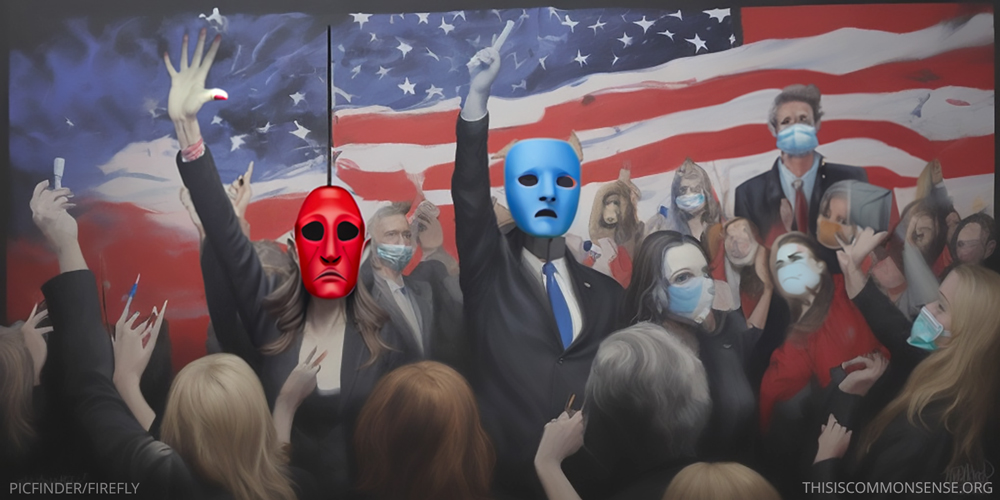
The only substantial challenger to the two parties, this presidential campaign season, has been Robert F. Kennedy, Jr. 

The son of a presidential primary frontrunner in 1968, and nephew of the 35th President of the United States — both assassinated — has been an environmental litigator and vaccine skeptic for years, and, unlike Presidents Biden and Trump, has publicly and fundamentally criticized the handling of the recent pandemic.

Though a Democrat for years, he was marginalized by the Democratic Party — an efficient machine for an astoundingly monolithic power center — and last October decided not to run as a Democrat. 

So he’s gathering signatures, creating parties, all sorts of schemes to make good on his promise of being on the ballot in every state of the union.

As Ron Paul’s last-​minute ballot access coordinator in 1988, I know how difficult that is. The two parties have only continued to tighten their grip on American election “rules.” If you were wondering why Bobby Kennedy made his Veep choice so early and picked wealthy Silicon Valley lawyer Nicole Shanahan, the reason is that many states require a Vice Presidential running mate to be on the petition before signatures are gathered.

RFK, Jr., was forced to jump the gun. Plus, now a candidate, there are no campaign finance limitations on Shanahan putting her personal wealth into the effort. 

Interestingly, RFK has formed a “national” political party, the “We the People Party,” which has established footholds in California, Delaware, Hawaii, Mississippi, and North Carolina. He has also formed The Texas Independent Party and is on the ballot as an Independent in Hawaii, Nevada, New Hampshire, and Utah.

While in recent years there has been tremendous focus on how people vote, look at all the hurdles and walls still facing the who, if that candidate exists outside the major-​party duopoly, a victim of all its silly, anti-​democratic laws.

Maybe that’s one way Kennedy’s campaign can “do good,” by highlighting an issue neither party cares about: free and fair elections.

This is Common Sense. I’m Paul Jacob.


PDF for printing

Illustration created with PicFinder and Firefly

See all recent commentary
(simplified and organized)

See recent popular posts