
Categories
initiative, referendum, and recall too much government

SF Scheme Scuttled

The proposed tax was very popular. In San Francisco. It polled at nearly 75 percent in favor. 

But it possessed a fatal flaw. 

And worse.

The fatal flaw? The numbers didn’t add up.

Organizers spent nearly half a million bucks developing and promoting and getting the petition signatures to place Proposition K on this November’s ballot.

The notion? Tax Amazon sales within city limits to fund a guaranteed income scheme in the Golden City.

But then they learned — after it qualified for the ballot — that it was an incoherent tax-and-spend mess. Its chief pusher, John Elberling, admitted, reports The San Francisco Standard, that “he made mistakes in calculating how Amazon earns its revenue in the city.” And, The Standard continues, “the City Controller’s office found that the tax measure would actually harm hundreds of small businesses in San Francisco and cut revenue to the city’s general fund by about $10 million a year.”

So Elberling ate crow, admitting to error (and also, apparently, to misleading petition signers), and a judge removed Prop K from the ballot.

Whew. Disaster averted.

Alas, Elberling promises to “perfect” his scheme, and advance it again.

Which is ominous, for the core idea itself — adding on more taxes to fund a trendy-but-disastrous “guaranteed income” — is not the way out of California’s progressive-induced nightmare. It’s just a vastly bigger version of what’s gone on before.

If Californians don’t develop more common sense about the limitations of salvation-by-government, they are doomed to repeat such folly.

That goes double for San Franciscans.

Who this time have a reprieve, thankfully.

This is Common Sense. I’m Paul Jacob.


PDF for printing

Illustration created with DALL-E

See all recent commentary
(simplified and organized)
See recent popular posts
Categories
tax policy too much government

For a Thousand Years

Time for a gas-tax holiday. 

When the people lie prostrate, when the people groan under heavy burdens, when the people just can’t take it anymore — and when an election is coming up — that is the time for politicians to relieve everyone’s burden.

A bit.

Treasury Secretary Janet Yellen favors considering a temporary gas-tax holiday to emulate some of the states. Reviving the Keystone oil pipeline — no, not something to consider, she says. But she’s okay with a brief gas-tax break.

Let’s do better.

I propose a millennium-long gas-tax holiday, government-barriers-to-drilling holiday, regulation-of-all-industries holiday. Under my plan, government gets all the way out of the way of all markets so we can all be as prosperous as possible, whether or not a big economic crisis is underway.

But would there be any such crises — long-term and intractable economy-wide crises, I mean — if my plan were enacted?

When government does everything possible to injure the economy and prevent recovery, it takes a long time for markets to bounce back from shocks. If ever.

Un-fetter the markets, though, and economic actors would be able more rapidly to adjust to major jolts. If gas imported from overseas plummets, producers could then quickly adapt by expanding production. They cannot readily do so now because government imposes so many barriers.

The politicians’ preference for modest, namby-pamby reprieves are not only substantially weak, they send the wrong signals. They get doled out as if government were doing us a special favor . . . by not beating us up so badly for a very little while.

We need freedom. On an ongoing basis.

This is Common Sense. I’m Paul Jacob.


PDF for printing

See all recent commentary
(simplified and organized)
See recent popular posts
Categories
Accountability deficits and debt national politics & policies subsidy

What a Relief

Based on a quick look at the Edward M. Kennedy Institute for the United States Senate’s splash page, I wasn’t immediately sure what, precisely, the institute’s raison d’être might be. On the top menu bar there’s a slogan: “Just Vote.” Big clue? 

On the About page, though, we are told its mission: “educating the public about the important role of the Senate in our government, encouraging participatory democracy, invigorating civil discourse, and inspiring the next generation of citizens and leaders to engage in the civic life of their communities.”

As for the vision thing, that’s supplied by its namesake, Ted “I Survived Chappaquiddick” Kennedy: “To preserve our vibrant democracy for future generations, I believe it is critical to have a place where citizens can go to learn first-hand about the Senate’s important role in our system of government.”

I guess that explains why the institute’s Boston location sports a replica room of the U.S. Senate chambers.

Which costs serious money, of course.

Paid for entirely by the ultra-rich Kennedys?

Fact check: no. 

Some of it is paid for by you and me — courtesy of Congress and COVID!

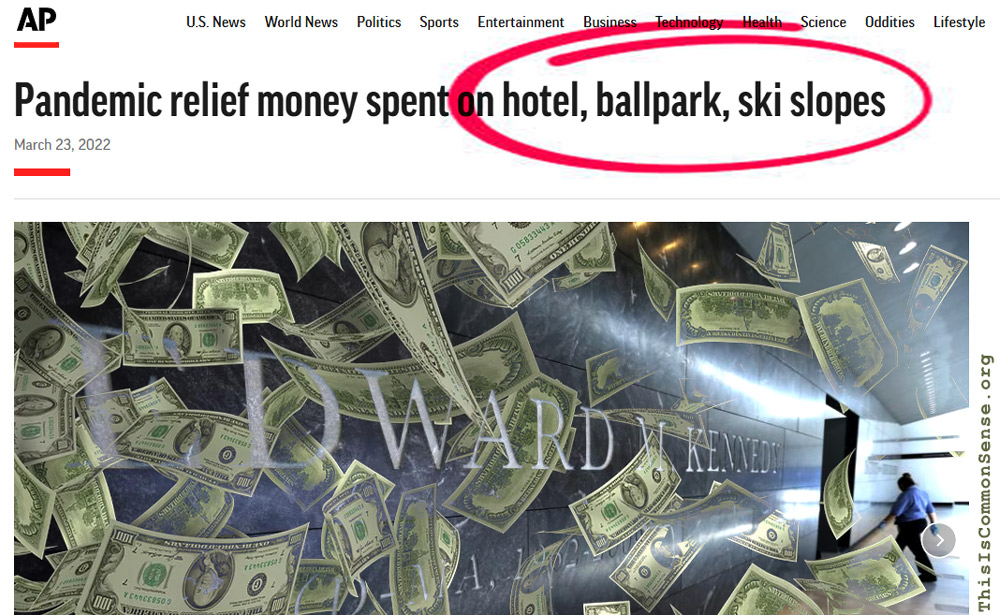
You see, part of last year’s $350 billion in pandemic relief went to Boston’s memorial outfit for its once-favored now-deceased multi-millionaire politician. Five million bucks, it turns out, was used (the AP tell us) to pay off the institute’s debt. 

But don’t worry: the Kennedy Institute wasn’t singled out. Relief funds — which you might think would focus on struggling local libraries, community centers, and the like — also went to building a posh hotel and a minor league baseball stadium. And much, much more.

While politicians are good at spending money, especially for “emergencies,” they aren’t good at spending it well.

This is Common Sense. I’m Paul Jacob.


PDF for printing

See all recent commentary
(simplified and organized)
See recent popular posts
Categories
deficits and debt

Sitting on the Volcano

“Wait, it gets worse.”

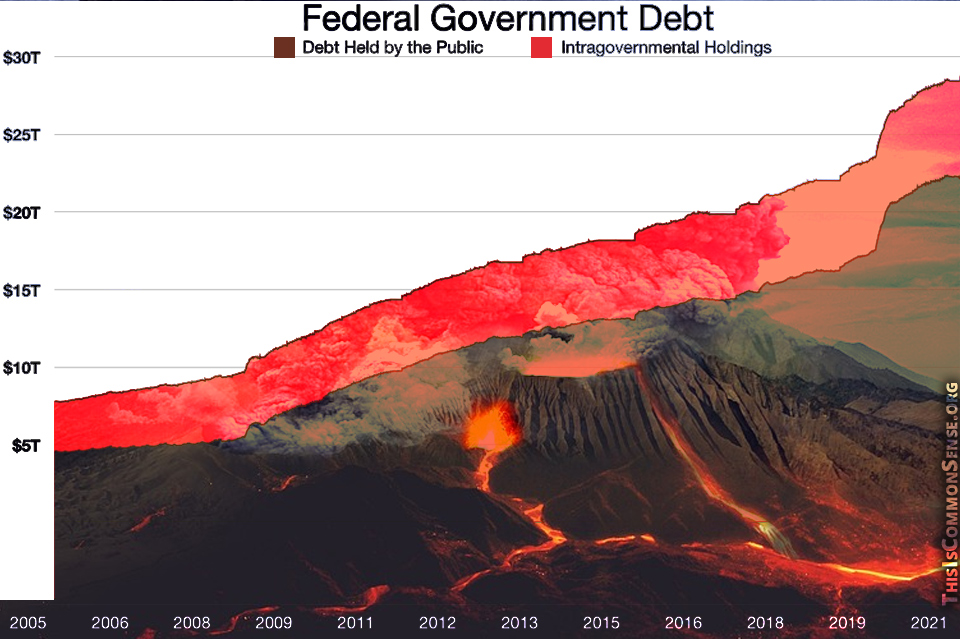
Over halfway through Eric Boehm’s Reason discussion of our government debt situation, he gets to a crucial point: “The federal government’s debt is particularly susceptible to rising interest rates . . . because so little of it is locked into long-term interest rates. If you have a 30-year fixed-rate mortgage on your house, rising interest rates won’t bother you much. But the federal government overwhelmingly relies on short-term debt, with an average maturity time of just 69 months.” 

So the standard approach to inflation, with the Federal Reserve raising interest rates, would hit the federal budget like an exploding volcano. 

When talking trillions, it’s hard to keep a sense of proportion. Boehm puts it this way: “A one percentage point increase in interest rates translates into a $30 trillion increase in interest costs.” 

Debt service is one of the reasons why the sages at the founding of America were, if not united in opposition to federal debt, overwhelmingly leery of it. But that leeriness did not stop federal borrowing. Only for one brief moment did the United States’ government not hold debt.

Borrowing was one thing when gold or silver fettered our finances to some limits. But paper and digital money have divorced us from a sense of reality.

We pretend that debt’s reality can be perpetually postponed, but we always “pay” — in lost prosperity; in inequality; in economic dislocation; in political unrest. But when the volcano erupts, then we really pay. 

As we awake to our indebtedness, let’s recognize that our political culture has allowed it to get so far out of hand. Fundamental political reform is imperative.

This is Common Sense. I’m Paul Jacob.


PDF for printing

See all recent commentary
(simplified and organized)
See recent popular posts
Categories
national politics & policies partisanship tax policy

Billionaires Backed Better

It’s a cliché of politics that the Republican Party is The Party of the Rich while the Democrats serve the Poor and Downtrodden.

But were that true, why so many Democratic billionaires?

And why is President Biden’s Build Back Better legislation offering the top income quintile a tax cut worth billions and billions?

At issue is a “$285 billion tax cut that would almost exclusively benefit high-income households over the next five years,” write Alyssa Fowers and Simon Ducroquet in the pages of The Washington Post. “The measure would allow households to increase their deduction from state and local taxes from $10,000 to $80,000 through 2026, and then impose a new deduction cap through 2031.”

“It’s the second-most expensive item” — when figured in budgeting terms, not merely in outlays.

True to form, Democrats promise that it would raise revenue, actually — eventually. In time-honored procrastination fashion, the legislation jiggers with the deduction cap over time, decreasing the cap in the future. A typical (and easy to re-jigger) politicians’ ploy.

What this is all about is subsidizing the rich in high-tax “blue states” — politically protecting Democrats in California and New York, to name the most obvious two, allowing them to pretend to “soak the rich” and “help the poor,” and decreasing the incentive in those states for the rich to leave for lower-tax environments, like Texas and Florida.

Arguably, these “SALT” caps are the worst sort of tax break possible, since they are regional (affecting different states differently) and even partisan. Not to mention regressive.

Instead of “Build Back Better,” the Biden plan should be dubbed the “Failed State Bailout.”

This is Common Sense. I’m Paul Jacob.


PDF for printing

billionaire

See all recent commentary
(simplified and organized)
See recent popular posts

Categories
ideological culture

Party Like It’s Versailles

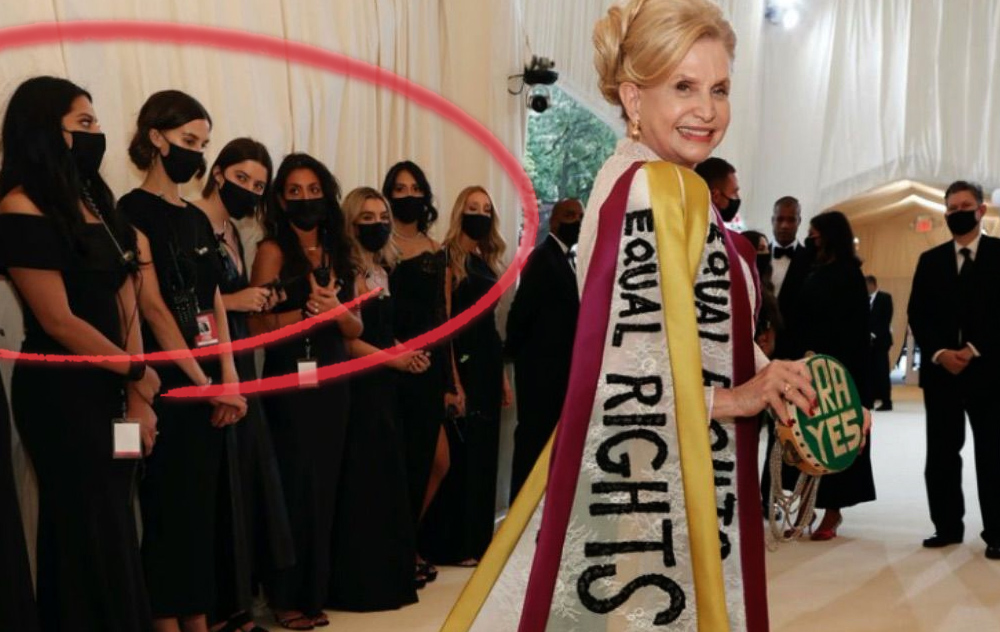
It was quite the party. All the big names were at the Met Gala, coughing up $30 thousand per ticket. Representative Alexandria “Woman of the People” Ocasio-Cortez (D-N.Y.) turned heads with her stunning dress . . . emblazoned with the big red words: “Tax the Rich.”

Other women at the event sported similar ideological markers: “Equal Rights for Women” and . . . excuse me . . . “Peg the Patriarchy.”

The most common comment? The sheer elitist effrontery. 

This was of and for the poshest of the posh: celebrity culture. And couture. 

The stars and politicians and multi-millionaires presented themselves proudly, smiling, unmasked — while waited on by staff all masked up.

It takes a certain amount of gall to parade before the plebes, maskless while they are masked — though we are told the celebs masked up once the red carpet parade was over. To pretend to be “with the people” and somehow against the rich while hobnobbing with the super-wealthy is one thing, but twirling and smiling and showing off while the lowly servants are not even allowed to show their faces . . . undermines that whole “tax the rich” theme.

Meanwhile, the president expressed pent-up anger at those who resist being vaccinated (“We’ve been patient, but our patience is wearing thin”) and the vice president tweeted that one way to “end the pandemic” is by “protecting the vaccinated.”

The vaccinated are allegedly protected — by their vaccines.

All this echoes Marie Antoinette — had she ever possessed the temerity to parade about as Jean-Paul Marat.

This is Common Sense. I’m Paul Jacob.


PDF for printing

See all recent commentary
(simplified and organized)
See recent popular posts
Categories
Accountability local leaders tax policy

Balking in Baltimore

So far, the besieged businessmen of the Fells Point area of Baltimore are only threatening to withhold payments of taxes and fees to the city.

If and when they follow through, the plan is to place the withheld funds in escrow. The money would then be turned over to the city government if and only if the city again meets minimal standards of performance. 

Tax resistance? Sure. But not in the usual mode.

Fells Point shop owners are rebelling against a “culture of lawlessness” in their streets, streets managed or mismanaged by the city. They want police to do more — be free to do more — about crime.

In a letter to Baltimore Mayor Brandon Scott and other officials submitted not long after several shootings in the area, thirty-seven Fells Point businessmen demand that the city “Pick up the trash. . . . Enforce traffic and parking laws. . . . Stop illegal open-air alcohol and drug sales. . . . Empower police to responsibly do their job. . . . Please do your job so we can get back to doing ours.”

What will happen? I fear that, despite this worthy protest, city officials will continue to turn a blind eye. I fear that they will regard the protest as a PR problem, one that will go away and allow them to go on with the usual business of government — the way they see it. Their evasive initial responses to the letter are not encouraging.

Baltimore businesspeople are not trying to dodge city taxes here. They understand very well that one cannot expect to get something for nothing. They just want to get something.

This is Common Sense. I’m Paul Jacob.


PDF for printing

See all recent commentary
(simplified and organized)
See recent popular posts
Categories
national politics & policies tax policy

The Six-Trillion Dollar Man

“Mr. Biden is making a six-trillion dollar bet that promoting popular programs will be popular,” offered NBC Meet the Press host Chuck Todd on Sunday, “and that he’ll be rewarded for getting things done, long before the actual bill comes due.”

That “Six trillion dollars”? New splurging “on social spending, infrastructure, climate change, health care and more.” 

The host intoned that this constitutes the “return of big government.” 

“We have to prove democracy still works, that our government still works,” Joe Biden, the 47th president, implored Congress last week, “and we can deliver for our people.”

Spend = Deliver. 
Deliver = Democracy. 
Democracy = Spend!

So goes a federal “democracy” wherein voters never get a straight, democratic choice on how much government should spend and tax.* Instead, politicians opt for their beloved “deficits forever” method. Purchase votes today — “People like it when you give them money” — and leave for future generations of voters the tax burden needed to pay that bill. No pain, all gain. 

Smart re-election strategy, some say. 

“Democratic strategists are betting that the infighting in the Republican Party, the extremism on display during the Jan. 6 attack . . . and the sheer scale of the trillion dollar programs Democrats have pushed through this year,” reports The Washington Post, “leads to a reorienting of partisan divisions that can overcome historical patterns.” Meaning Democrats avoid the traditional loss of congressional seats for a president’s party.

“Will voters care about the scope of Mr. Biden’s plans?” Todd inquired. “. . . care about the price tag?” 

Likely to the degree they notice paying that price. 

“President Trump and the Republicans may have made it a bit easier for Mr. Biden by spending big themselves,” reminded Todd.

He’s not wrong there.

This is Common Sense. I’m Paul Jacob.


* Colorado voters have such a choice: a vote on any tax increase and on government spending increases. It’s called the Taxpayer Bill of Rights (TABOR) and was passed by citizen initiative back in 1992. The politicians and lobbyists just hate it, as I detail here

PDF for printing

Photo by Anno Málie

See all recent commentary
(simplified and organized)
See recent popular posts

Categories
national politics & policies responsibility

The Accelerators

“We can do $10 trillion,” declared Rep. Alexandria Ocasio-Cortez (D-NY) last week.

“I know that may be an eye-popping figure for some people,” explained the photogenic pop-eyed pol, “but we need to understand that we are in a devastating economic moment, millions of people in the Unites States are unemployed, we have a truly crippled health-care system and a planetary crisis on our hands, and we’re the wealthiest nation in the history of the world.”

In other words, the sky is falling . . . and we still have checks.

The Bronx congresswoman, described as “one of the most influential members” by MSNBC’s Rachel Maddow, trumpeted that tidy sum in response to last week’s “go big” proposal by President Joe Biden to spend a special new $2.2 trillion under the loose label of infrastructure, which AOC argued “is not nearly enough.”

This new two-tril spending bill is “a follow-up to the $1.9 trillion stimulus approved in March.” And just Part 1 of a two-package infrastructure and other stuff Biden plan. 

“The White House is reportedly willing to spend $4 trillion across the two packages,” Business Insider reports, “a sum that would bring recovery spending under his term to nearly $6 trillion.”

Biden’s term has been only 76 days.

A couple trillion here, a couple trillion there and pretty soon you’re talking real money . . . except under Modern Monetary Theory, which Ocasio-Cortez embraces. The idea being: government can print as much money as politicians want to spend

While this road to bankruptcy has been paved with the partisan political intentions of big spending politicians of both major parties, right now it is the Democrats hitting the gas.

This is Common Sense. I’m Paul Jacob.


PDF for printing

See all recent commentary
(simplified and organized)
See recent popular posts
Categories
tax policy

Just Never Satisfied

The top federal income tax rate is currently 37 percent.

It’s been higher — 94 percent at one point during the Second World War, 91 percent in the 1950s . . . on income above a certain threshold.

Back in the 1890s, the federal government briefly taxed income at 2 percent. It was quickly struck down by the U.S. Supreme Court as unconstitutional. 

Those were the days.

In 1913, the 16th Amendment was ratified, giving Congress “power to lay and collect taxes on incomes” overriding the constitutional provisions that the high court had cited in 1895. The first federal rates were 1 percent for the lowest income bracket, 7 percent for the top bracket, on income above $500,000.*

By 1916, the lowest percentage was 2, the highest 25, on income above $2,000,000.

The good news: skyward tax rates aren’t set in stone. The bad news: once a precedent for a new tax has been established, you can expect worse to come.

So what happens if California Assemblyman Rob Bonda gets his way? He seeks a tax of “just” 0.4 percent on the accumulated wealth of “just” “the top 0.15%” wealthiest Californians, “about 30,000 people.” If these wealthiest leave the state, they would still be subject to the tax for ten years(!). 

Presumably, this latter, and quite brazen, aspect of an already brazen tax would be subject to constitutional challenges.

If Bonda’s proposal is enacted and upheld, would the scope of its reach stay put at 0.4 percent of holdings and 0.15 percent of Californian taxpayers?

It would not.

This is Common Sense. I’m Paul Jacob.


* That was a lot of money back then — worth $13 million today.

PDF for printing