Categories
Accountability general freedom ideological culture national politics & policies Popular too much government

Pulling It Off

Give democratic socialism a chance? 

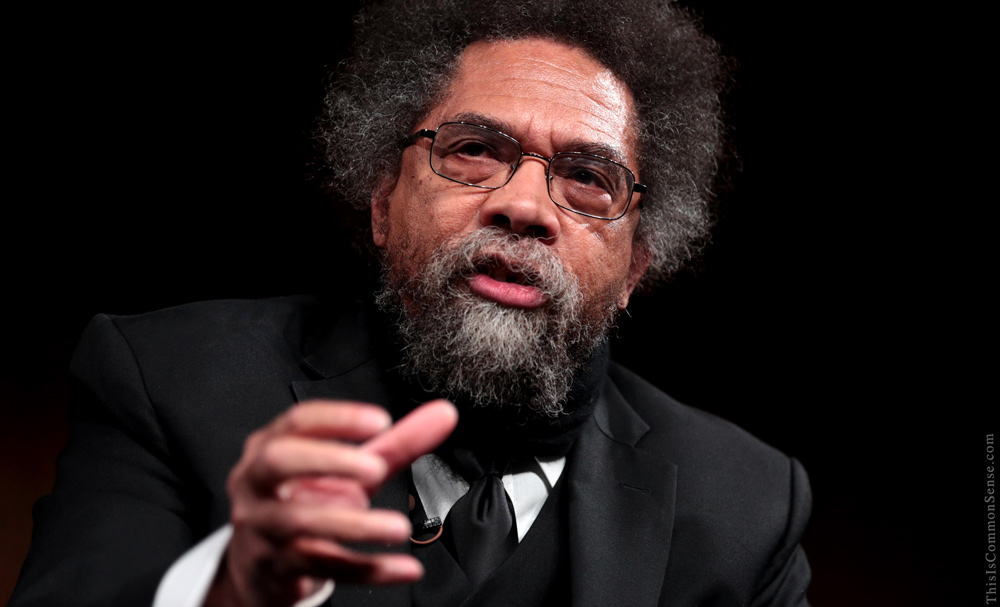
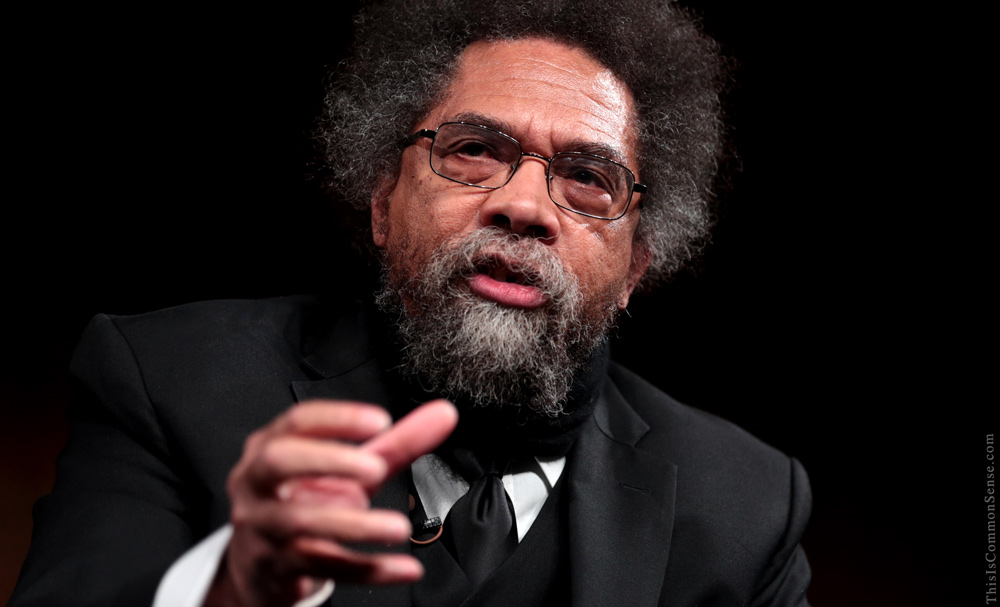
So says Dr. Cornel West, the “provocative democratic intellectual” who serves as one of eight honorary co-chairs of the Democratic Socialists of America. 

This accomplished Professor of the Practice of Public Philosophy at Harvard University, and Professor Emeritus at Princeton, explained to Fox News host Tucker Carlson that socialism’s “fundamental commitment is to the dignity of ordinary people and to make sure they can lead lives of decency.”

“What happened in Venezuela?” Carlson asked West. “They called that democratic socialism. But they don’t have toilet paper and it’s less equal than ever.”

“But part of the problem is though, brother,” the professor responded, “that any time there [have] been attempts by ordinary people to engage in self-determination, they can get crushed by external nations. Look at U.S. policies toward Venezuela [which have] been very, very ugly — Nicaragua in the same way.”

West offered nary a specific to his charge, but was handy stating his conclusion. “So, we have never had a chance to really pull it off,” the “it” being socialism. 

“So it’s only been a movement so far.”*

How convenient.

West implicitly acknowledges that those ruling Venezuela and Nicaragua are practicing socialism. But he won’t hold them or the -ism responsible for the economic collapse, the hunger, the exodus of millions of very desperate “ordinary” citizens, the arbitrary arrests, use of torture and murder of innocent citizens. 

Dr. West, a follow-up question: Just what specific U.S. policy triggered these socialists to murder and torture their own people?

This is Common Sense. I’m Paul Jacob.


* Dr. West also announced that socialism “is not an ‘ism,’ brother.” I think the professor needs to take a course in ism-ology.
PDF for printing


Photo by Gage Skidmore

Categories
national politics & policies responsibility too much government

The Problem with Public Accounts

President Trump’s promise not to cut one dime from Social Security and Medicare doesn’t square with the fiscal cliff these programs are headed for. To save the system, benefits must be cut, taxes must be raised, or both.

Or else replace the system.

No wonder, then, that John Stossel insists we “Fix Social Security Before It Goes Broke,” and rescues a decades-old proposal: “private accounts,” which he says “would certainly pay retirees more than Social Security will ever pay.”

In Chile, where they have tried this, private accounts have worked out pretty well, contributing to the once-impoverished country’s rise to “the richest country in Latin America.” 

Had the United States adopted such a system, at Social Security’s inception, the amount of capital flowing into projects big and small would have not merely prevented the stagflation of the Seventies and brought us almost unimaginable wealth, it might have turned political eyes towards accountability, prudence and stability.

But, because Social Security was set up as a Pay As We Go system, we paid . . . and the money went.

It got so messed up that by the 1980s Ronald Reagan charged Alan Greenspan with “fixing” it. That “fix” mainly meant increasing taxation. The decades of revenue surge over outflow was spent by Congress for war and handouts. And now we’re reaching a repeat of the late 1970s’ Social Security insolvency.

Meanwhile, Chilean leftists “hold street protests against private accounts,” Stosssel reminds us. “They’re angry because capitalists get a slice of the pie.”

Back in the USA, Democrats demand that more benefits be wrung from Social Security. Are they dead set on proving why socialism doesn’t work?

This is Common Sense. I’m Paul Jacob.


PDF for printing


Categories
Accountability general freedom ideological culture porkbarrel politics responsibility too much government

Ask the Next Question

Republicans are very reliable. When given our system’s “Mandate of Heaven” — majorities in both houses of Congress and the Presidency — they can be relied upon to do one thing: add debt by piling up huge deficits.

It happened under George W. Bush, and it is happening under Donald J. Trump: “The Trump administration expects annual budget deficits to rise nearly $100 billion more than previously forecast in each of the next three years,” the Wall Street Journal tells us, “pushing the federal deficit above $1 trillion starting next year.”

Republicans should ask themselves why. And while they ask themselves that, everyone else should ask the next question: why do politicians who say they want one thing so often deliver its opposite?

This is not a mere “right-wing” phenomenon. Leftists say they want “democratic socialism,” but, as Irving Kristol noted, at some point not far down their road to Utopia, “democratic socialists” must choose between democracy and socialism.* By promising everybody everything, too quickly everybody gets shanghaied into service to produce that “everything,” finding themselves conscripts in socialism’s army.

The equation of socialism with regimentation and general un-freedom has been clear for over a century, explained carefully by sociologists, economists and even politicians.* And yet, increasingly, today’s Democrats are embracing a philosophy with proven anti-democratic features.

Could some deep principle be at play?

Probably. It is built into the very nature of state governance, of politics itself. It may be why republics metamorphose into empires, conservatives go radical and liberals become serviles.

Which is why effective democracy requires limited government. To minimize that boomerang effect.

We might start by limiting spending.

This is Common Sense. I’m Paul Jacob.


* Herbert Spencer’s writings on socialism include The Man versus the State (1884) and Industrial Institutions (1896, Principles of Sociology, Vol. III, Part VIII); German politician Eugene Richter’s satire Pictures of the Socialist Future (1896) is well worth reading; and economist Yves Guyot preceded Ludwig von Mises’ classic Die Gemeinwirtschaft (1922, translated as Socialism: An Economic and Sociological Analysis, 1950) with several books, including The Tyranny of Socialism (1893) and Socialistic Fallacies (1910).

PDF for printing


Categories
Accountability folly free trade & free markets general freedom moral hazard property rights responsibility too much government

Poison Is Poisonous

Venezuela’s socialist economy has been collapsing.

No big mystery. If, out of hostility to capitalism, a society keeps destroying everything that production, trade, and prosperity depend upon, the economy suffers. The benefits of markets don’t flow no matter what.

One assault has taken the form of hyperinflation — runaway printing of currency, done in part to dissolve government debt. Many Venezuelans are resorting to barter. It’s easy to understand why.

Or is it? A Reuters reporter says that economists say that “the central bank [of Venezuela] has not printed bills fast enough to keep up with inflation, which . . . reached an annual rate of almost 25,000 percent in May.”

So go faster!?

Dude. Dude. The massive expansion of Venezuela’s money supply is what’s causing massive jumps in prices. Just like any other economic good, the medium of exchange is subject to the laws of supply and demand.

Other things being equal, enormously increasing a supply of a good will enormously lower its market value or price. Money, too, has a price — in terms of the non-monetary goods being bought. If the pre-hyperinflation price of a dollar in terms of bread is one loaf and the post-hyperinflation price is one bread crumb, you won’t reverse the decline by printing even more dollars or bolívars even faster.

If you’re ingesting poison, you can’t fight the effects by being poisoned more and harder. The very first thing to do is stop ingesting the poison.

This is Common Sense. I’m Paul Jacob.


PDF for printing


Categories
meme

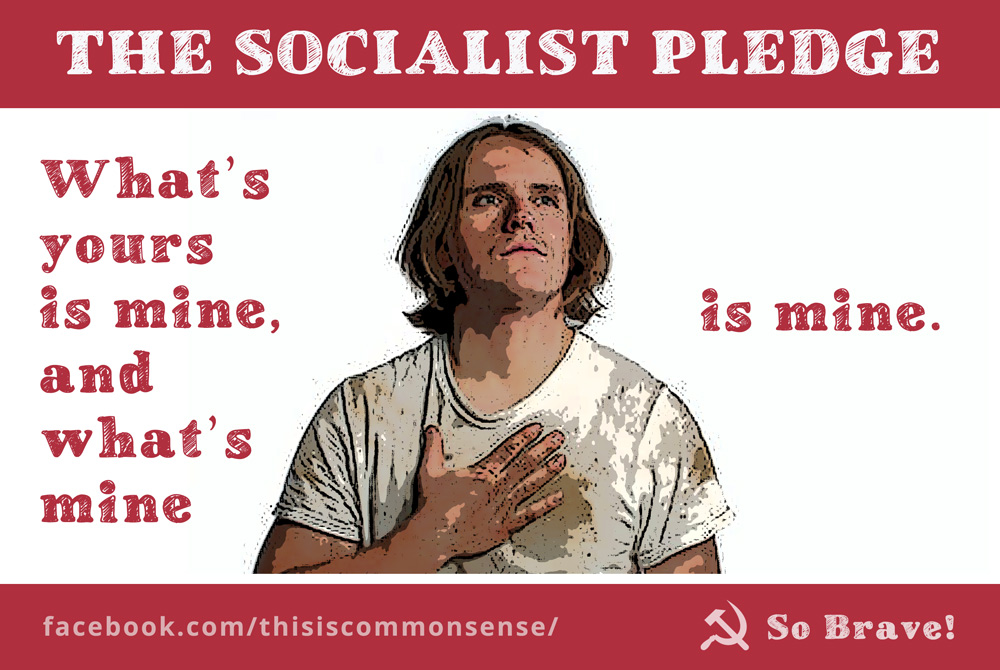
The Socialist Pledge

What’s yours is mine, and what’s mine. . .

is mine.

Categories
Accountability folly general freedom ideological culture media and media people moral hazard responsibility

Too Big for Breaches

“Any reporter who has covered Europe in the last decade has written a dozen articles or more,” The New York Times informs us, “about how one crisis or another has exposed the fundamental unsustainability of the European Union.”

I hadn’t noticed. Until recently, haven’t reporters and commentators been downplaying Europe’s looming crisis? But they cannot pretend “far right” separatist, decentralist and nationalist movements are marginal any longer, not after strong showings for Geert Wilders in The Netherlands and Marine Le Pen in France, and the Brexit vote.

Now everybody seems to be panicking.

Even the Times is half-predicting an end to what it calls the “European Experiment.”

The Times identifies the tension as arising from “calls for keeping out secondary migrants and demands to keep internal European borders open. It’s a version of the contradiction within the European Union itself: between an open union and a collection of sovereign states.”

Beneath all the brouhaha about freedom of movement across breached borders lies the real contradiction: between massive welfare states on the one hand and, on the other, freedom of movement, speech and all the rest.*

When governments offer freebies, they entice people into un-productive or at least sub-productive lifestyles. Which is not sustainable, especially when extensive. How many productive people must support how many unproductive people?

Then throw those domestic programs open to millions of migrants who lack even rudimentary language and First World skills? That’s how states subsidize their societies’ destruction.

Europe’s governments are way too big for their border breaches.

If you want traditional freedoms, you have to pare down government.

This is Common Sense. I’m Paul Jacob.


*Between social democracy (socialism lite) and the old liberal order.


PDF for printing


Categories
crime and punishment general freedom ideological culture moral hazard nannyism political challengers privacy Regulating Protest too much government

Don’t Enable Tyrants

If I deliberately help somebody to do evil things — and nobody is holding a gun to my head — I am thereby doing evil myself.

A person should not let himself be in that position. Not even if he’s “just doing my job” and looking for a non-evil job would be demonstrably inconvenient. To have a motive for doing a bad thing is not by itself exculpatory.

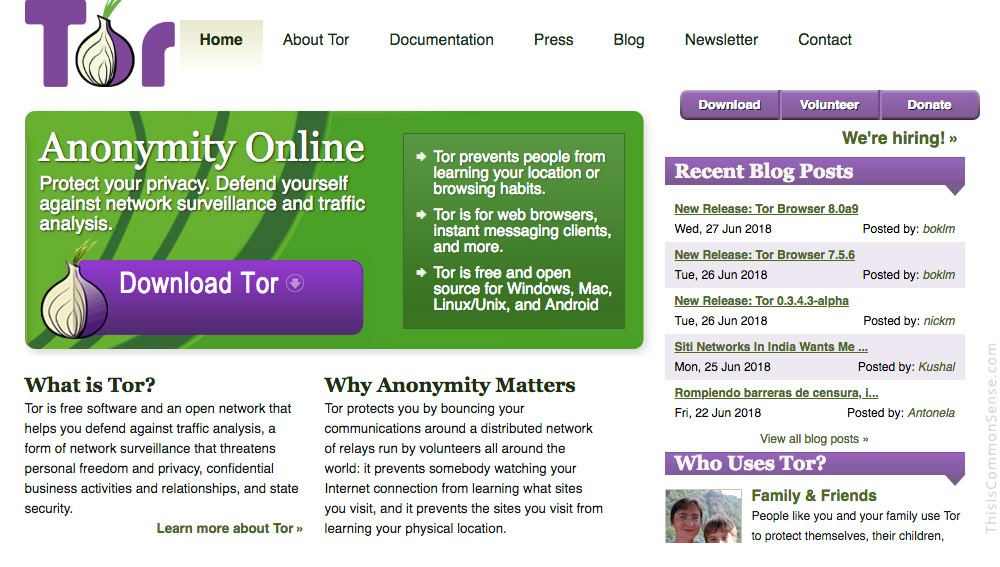
What provokes this observation is a newly amplified assault by the Venezuelan government on the rights of its citizens. The government is seeking to violate the right to peacefully read stuff on the Web by blocking Tor software, which allows users to elude government surveillance and reach banned websites.

Venezuelan dictators Chavez, now dead, and Maduro, still there, have never hesitated to stomp freedom in the name of a spurious greater good. Somebody like Maduro is certainly unscrupulous enough to go after Tor for thwarting censorship. So he fulfills that requirement. I doubt that he possesses very extensive programming ability.

Tor may not be perfect, but it’s pretty robust. You need substantial resources, such as those at the disposal of a government, to stop it. You also need to know what you’re doing. The coders on Venezuela’s stop-Tor team are probably smart enough to grasp the purpose of their work.

They and all other such collaborators should defect to the other side: that of programmers working to protect innocent people from government-sponsored cyber-assault.

This is Common Sense. I’m Paul Jacob.


PDF for printing


Categories
Accountability folly general freedom ideological culture moral hazard responsibility U.S. Constitution

China Marks Marx Anniversary

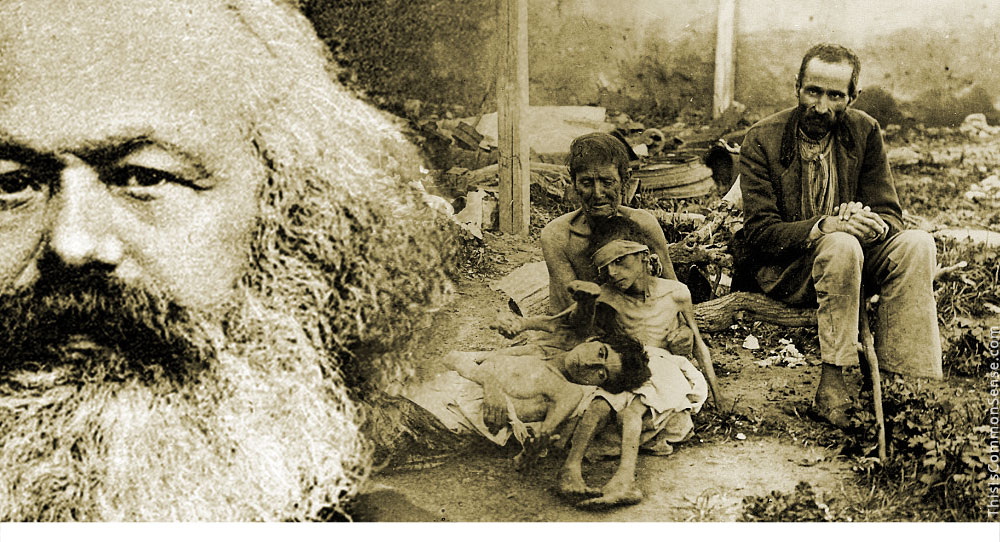
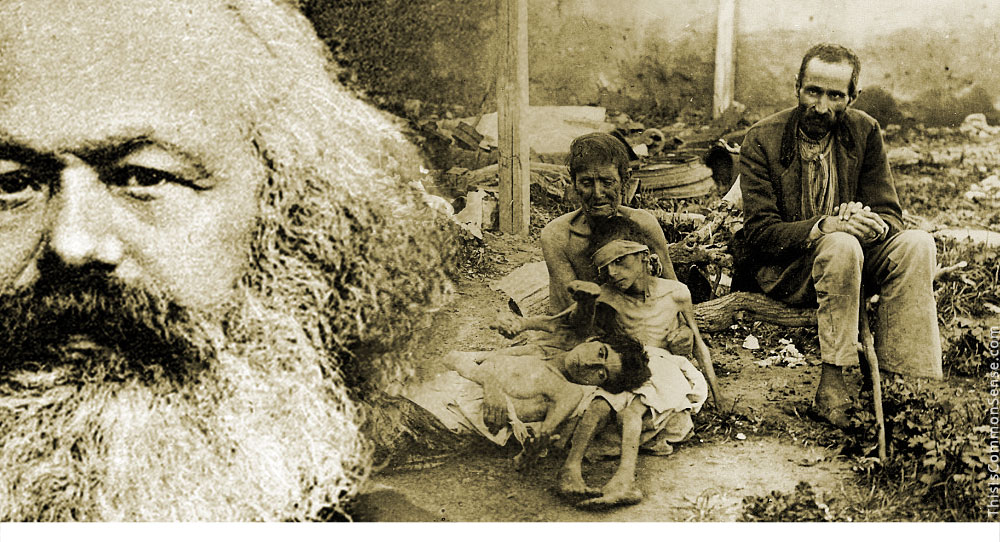
The Chinese government has sought to honor the birth of Karl Marx (1818-1883) by giving a giant bronze statue of the social philosopher and pseudo-economist to the German city of Trier, his birthplace.

Agreeing that Trier and Marx should be thus honored, local officials shamefully accepted the donation.

Marx was a bad guy. His willfully destructive anti-capitalist theorizing and polemics have been enlisted to enslave and murder many millions of people in the Soviet Union, China, Cambodia, Cuba and elsewhere. The story is told in works like Modern Times and The Black Book of Communism. One effective critique of Marxian ideas may be found in the second volume of Murray Rothbard’s History of Economic Thought.

We often hear that Communist implementation of Marxian theory poorly translates “real” communism/socialism/collectivism. No government unswervingly enacts all the ideas and prescriptions of a single intellectual founding father. But there is much in Marx’s volumes that openly demands the razing of the division of labor, profit-seeking, and other requirements of civilization.

In one article, Marx scribbled that “there is only one way in which the murderous death agonies of the old society and the bloody birth throes of the new society can be shortened, simplified and concentrated, and that way is revolutionary terror.” There’s plenty more where this came from.

When a major nation-state gives a town a statue, it’s hard to say no. But one needn’t accept it at face value. Install it on a base that lists the separate bouts of Marx-inspired mass murder. Or use it as a target in paintball tournaments.

Or just place it in the local cemetery. Where deadly ideologies should go.   

This is Common Sense. I’m Paul Jacob.


PDF for printing


Categories
Accountability folly general freedom incumbents media and media people moral hazard nannyism national politics & policies political challengers porkbarrel politics responsibility too much government

Twirling Towards Freedom?

Does Bernie Sanders remind you of “Citizen Kang”?

Vermont’s [S]ocialist Senator is whipping up a new plan for America: to “guarantee a job with at least a $15-per-hour wage and health benefits to every adult American ‘who wants or needs one,’” we are told.

What was it that the slavering alien Kang promised* in The Simpsonseighth season opening episode? Well, we know how that episode ended, with Homer Simpson revealing the ’90s’-era presidential candidates to be aliens in disguise, Kang being elected, humanity enslaved, and Homer uttering the immortal words “Don’t blame me, I voted for Kodos.”

And then Kodos, in cahoots with Kang, cracking the whip on Homer.

One shouldn’t have to read George Fitzhugh, the antebellum sociologist who attacked the very idea of free markets and free labor, insisting that slavery is a good thing and the very best form of socialism, to know that socialism and slavery go together hand in glove, whip in hand.

In an age of handouts for nothing, at least Sanders’ socialist proposal suggests productivity. But paying for it by nixing corporate “tax breaks”** is absurd. “Republicans have long opposed a federal jobs guarantee,” Fox News tells us, “saying such a plan would be too expensive and impractical.” And it’s productive people who would pay for it, making them de facto slaves to the system . . . even more than they are now.

But when socialists talk about “jobs,” worry about a more direct form of slavery.

And yes, I can imagine Bernie, with his four houses, flicking the whip.

I won’t be voting for him, if he runs.

Or for Kodos.

This is Common Sense. I’m Paul Jacob.


* Actually, Kang was known not for a promise but for his campaign speech (as Bill Clinton), saying, “[W]e must move forward, not backward; upward, not forward; and always twirling, twirling, twirling towards freedom!”

** The only funding source mentioned in the reports I read.


PDF for printing


Categories
general freedom ideological culture media and media people moral hazard

The Cuban Slavery-and-Freedom Sandwich

How easy is it to mix freedom with just the right amount of slavery?

New York Times reporter Azam Ahmed regards the attempt to mingle political opposites as noble or at least understandable. He doesn’t call Cuban Communism and its destructive effects “bad” — it’s a “unique tapestry.”

He wonders, instead, to what extent the Cuban government can fine-tune the contradiction.

According to the article, Cuba’s newest Dear Leader “will have to foster the growing private sector . . . while guarding against the income inequality it often brings. . . . Move too slowly and it risks economic collapse and widespread discontent. . . . Move too fast, and it risks unstitching the unique tapestry of Cuba’s social project.”

“Unique”? With or without cigars and salsa, the “social project” of repressing a hapless populace is as old as civilization. And as a “tapestry,” we’ve seen this warp and weft before.

Under freedom, inequalities are unavoidable.* On the other hand, nothing is wrong with inequality per se. Nature, human beings and economic outcomes are inherently unequal. Equality arrives only with the grave.

A government working to phase out slavery and phase in freedom may have legitimate problems in transition. But it is wrongheaded to seek just the right “balance” of both. How can any degree of freedom and markets fail to threaten a revolution, the purpose of which is a thoroughgoing assault on freedom and markets?

My advice to Cuban social engineers? Abandon Communism altogether and embrace prosperity and freedom instead.

This is Common Sense. I’m Paul Jacob.


* Speaking of inequality, Cuba’s head commies certainly have not lived like the masses they’ve kept down.


PDF for printing