Categories
election law partisanship

Pennsylvania Steal

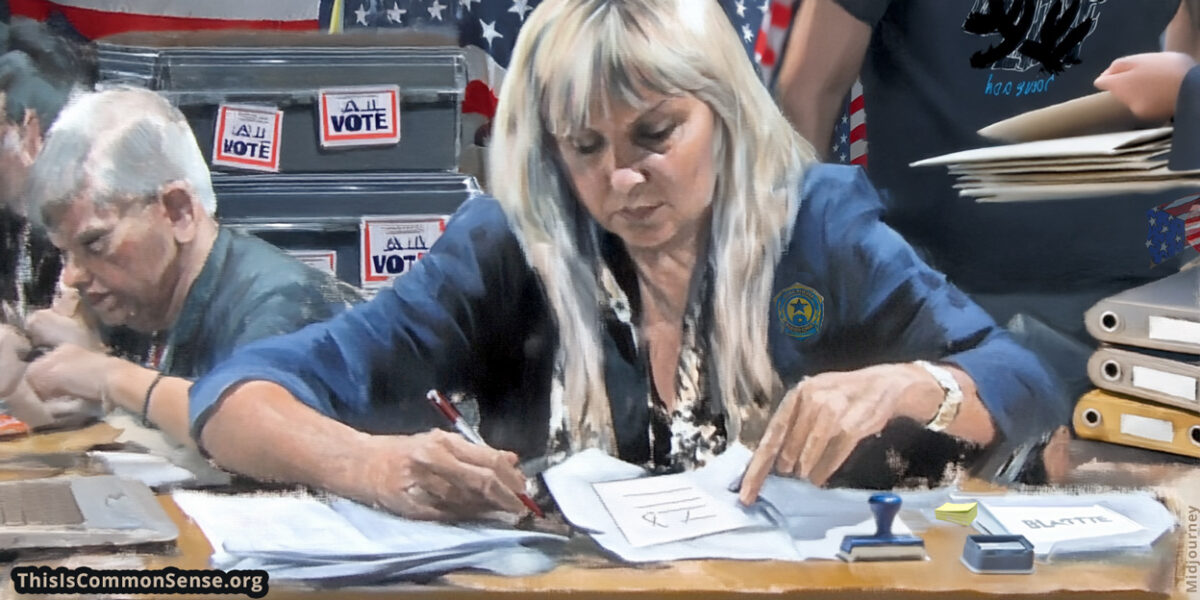
We must hope that a Democratic effort in Pennsylvania to steal the election for U.S. senator has indeed been thwarted. A new state supreme court ruling with its concurring opinions is definitive.

Problem is, a previous ruling from the same court had already been definitive.

Yet not only have election officials been counting unsigned or undated or improperly dated mail-​in ballots in an effort to rescue incumbent Democrat Bob Casey from defeat at the hands of his Republican challenger, Dave McCormick, via a rejiggering recount, at least some of the election officials breaking the law weren’t even bothering to try to obscure the effort with an “Aw geez, this is perfectly compatible with a reasonable interpretation of election rules and the supreme court ruling” fig leaf.

In Bucks County, county commissioners voted 2 – 1 to proceed with an attempted election-​stealing despite the advice of their own counsel.

Bad as this is, get this: Diane Ellis-​Marseglia, one of the two Democratic commissioners who determined that it was okay to count bad ballots, announced that she didn’t care about whether she was violating the law. Even though her job is to apply it, not to flout it with revolutionary (or corrupt insider) fervor.

“I think we all know that precedent by a court doesn’t matter anymore in this country, and people violate laws anytime they want,” she said. “So for me, if I violate this law, it’s because I want a court to pay attention to it.”

Attention has been paid. We hope it’s enough.

This is Common Sense. I’m Paul Jacob.


PDF for printing

Illustration created with Midjourney and Firefly

See all recent commentary
(simplified and organized)
See recent popular posts

Categories
property rights too much government

Philadelphia Freedom?

It’s fun to watch intrusive, abusive, and exclusive government operations fail. It’s instructive to see how they react.

Years ago, internationally renowned artist James Dupree purchased a large building in Philadelphia’s depressed Mantua neighborhood to renovate it not only into his studio, but into a place other artists could practice their crafts.

Sadly, the Philadelphia Redevelopment Authority (PRA) thought it should be taken from him and then transferred to a supermarket.

Dupree fought back. He got the Institute for Justice on his side and, after years of litigation, the PRA finally gave up, returning the title it had taken it had taken from him.

But with some final remarks from Brian Abernathy, PRA’s executive director, who thought it his mission to bring “healthy food” to the community:

Unfortunately, the legal costs associated with Mr. Dupree’s appeals make it impossible to continue. Despite all the work to date, PRA will end condemnation proceedings enabling Mr. Dupree to keep his studio. While we have explored the potential of building around Mr. Dupree’s property, a viable project under these conditions is not possible. In short, the inability to acquire Mr. Dupree’s property puts the prospect of bringing fresh food to this community at serious risk.

Nonsense. A successful artists’ complex is an asset to the health of a community, its economic health. And citizens, had they kept their community clean, and had the core city government helped keep it peaceful, would have eventually encouraged private expansion to serve local grocery needs.

Meanwhile, the PRA had not even lined up a business to put in the studio’s place. It was all speculation.

A “successful” PRA would probably have wound up with an empty lot.

This is Common Sense. I’m Paul Jacob.

Categories
Second Amendment rights

Common Sense Reprieve

She must still suffer bogus punishment for her non-crime.

But at least Shaneen Allen won’t have to rot in prison for up to ten years.

What is the charge? Crossing a state border.

I’m glad that she no longer lives in the purgatory of that possibility.

And I think I know how she feels, having been arbitrarily threatened with prison myself, along with two colleagues, for a “crime” that was, in fact, a non-crime.

Twice a victim of real crime last year, Ms. Allen has a concealed carry permit from her home state of Pennsylvania. Her duly licensed gun was in her purse on the day she drove into New Jersey. A routine traffic stop led to its discovery and to Atlantic County Prosecutor James McClain’s injudicious determination to throw the book at her for possessing that gun in New Jersey without New Jersey’s permission.

Laws at all levels of governance being what they are — prolific, contradictory, and potentially ruinous — let’s agree that Allen should have double-​checked her assumption that her constitutional right to bear arms would not dissolve en route to the Garden State. Let’s also agree that crossing a border between two states of our union hardly stacks up to bank robbery or murder.

This kind of lapse of due diligence should not be used to destroy a life.

In late September, bowing to public pressure, McClain reversed himself. Shaneen Allen must enter a so-​called pre-​trial intervention (PTI) program, but no longer faces prison. The Daily Caller called the prosecutor’s welcome caving to public pressure a “stunning outbreak of sanity.”

I call it Common Sense. I’m Paul Jacob.

Categories
education and schooling First Amendment rights free trade & free markets

Demanding Demands

Logic and evidence? Or bullying and intimidation?

A member of a local Pennsylvania teachers union has demanded the resignation of the vice president of the West Chester Area School Board, Heidi Adsett, for suggesting in a letter to the editor that, instead of threatening to strike, teachers unsatisfied with hefty compensation packages try their luck elsewhere.Free Speech Zone

Adsett had also said that Pennsylvania should ban teacher strikes.

The member of the West Chester Education Association spoke up at the school board meeting after the letter had been published, objecting to Adsett’s statement on the grounds that it expressed “publicly venomous animosity [against] our teachers,” and clashed with support for public education. Other union members applauded. Others professed confusion about whether Adsett was speaking officially for the whole board.

In his report on the fracas, Ben Velderman quotes the president of Stop Teacher Strikes, Simon Campbell, who observes that congressmen “are interviewed all the time. None of them say, ‘Well, I want to make it clear that I’m not representing the whole of Congress.’”

Union defenders “can’t argue the facts,” says Adsett, “so they have to try and argue by bullying and intimidation.”

Whether public employees should be permitted to strike is debatable. Were education privately run and unions not free to bully persons crossing picket lines, then parents, taxpayers and schools wouldn’t have to worry about being pushed into paying teachers far above market rates. But that’s not the current situation. We have public schools, and our democratically elected school board members should be just as free to speak — to debate — as voters are.

Democracy, after all, requires free speech. And public education, for all its problems, surely doesn’t require democracy’s suppression.

This is Common Sense. I’m Paul Jacob.

Categories
ideological culture national politics & policies

Wealth on Welfare

Should a $2 million lottery winner be heartlessly denied food stamps?

In the Philadelphia Inquirer, Jay Ostrich, public affairs director at the Commonwealth Foundation for Public Policy, tells the story of “Leroy Fick, who won a $2 million lottery jackpot, but still legally collected food stamps.”

That is, until “Michigan enacted a $5,000 asset test” for those applying for food stamps, thereby stopping “exploiters such as Fick from taking advantage of the system.”

Now the Pennsylvania Department of Public Welfare is doing likewise, implementing rules to block food stamps for anyone under 60 with $2,000 or more in assets ($3,250 if over 60 years of age) — excluding one’s home, car, a second car (if valued under $4,650) and retirement savings.

With state and federal welfare spending up 52 percent since 2002, and the friendly state facing a budget crunch, an estimated 2 percent of recipients could be affected to the tune of $50 million in annual savings.

But Philadelphia Mayor Michael Nutter calls the change “one of the most mean-​spirited, asinine proposals to come out of Harrisburg in decades.” It’s “a disgrace,” according to State Sen. Shirley Kitchen (D‑Philadelphia).

The Philadelphia Inquirer editorialized against the asset test on the grounds that it would “punish families for having a few dollars in a bank account.”

Punish? Not getting a handout is hardly punishment. The law just means that those with significant assets have to buy their own groceries.

This is Common Sense. I’m Paul Jacob.

Categories
free trade & free markets too much government

Backbreaking Spending

Pennsylvania’s Republican governor, Tom Corbett, went into back surgery last week. The Pennsylvanians who voted him into office may be hoping he’s getting a backbone installed. But no such luck: Doctors call his treatment “routine.”

Too bad, for Corbett needs something to help him stick to his campaign promise of  “saying no” to spending.

Since taking office Corbett has  radically increased the salaries of his executive staff as well as stuck the state with another big sports stadium project.

Just what a cash-​strapped state needs!

There’s a huge philosophical problem with forcing some folks (say, opera buffs) to pay for the entertainments of other folks (say, my fellow sports fans). It’s just not right. (It’s wrong the other way ’round, too.)

It’s also silly economics. And increasingly unpopular. People are “stadium fatigued,” according to Chris Friend in The Philly Post. Worse yet, the particular minor league stadium Corbett just pushed will accrue benefits chiefly to the New York Yankees, not the Philadelphia Phillies (or even the Pittsburgh Pirates). It’s a bizarre project, when you think about the cui bono of it. 

Finally, when you think of who pays, the stadium’s $20 million price tag marks only a fraction of the cost, since the bond for that figure will balloon over time, with interest due.

Paid for by Pennsylvania taxpayers.

I love sports. I look forward to the day when the industry is as self-​sufficient as it ought to be, and people like Corbett have the spines to stay out.

This is Common Sense. I’m Paul Jacob.

Categories
initiative, referendum, and recall

The Pennsylvania Challenge

Political change sometimes happens in hiccups.

A burst of innovation. Then a slump in its pace. An idea’s day may be done … or may just lie dormant, awaiting conditions for resurgence. Perhaps one tipping point is a rise in the number of voters who have become really, really, really fed up with the excesses of the ruling class.

Consider statewide citizen initiative rights, which many states installed between 1898 and 1920, with few more in the 1970s and Mississippi in 1993. The current total is 24.

Citizens of the other states need initiative rights too. Especially those graded F by the Citizens in Charge Foundation for their lack of initiative rights — for example, Pennsylvania. The Keystone State was rocked by a major legislative pay scandal a few years back, not to mention several scary judicial scandals. 

Michael Nerozzi and Nathan Benefield of the Commonwealth Foundation argue that only initiative rights will enable genuine reform. Pennsylvania’s constitution recognizes the right of citizens to “alter, reform or abolish their government in such manner as they may think proper,” but citizens are thwarted by the politicians.

Citizen initiative, the authors say, “is the only reliable mechanism for implementing reforms such as a part-​time legislature, term limits, state spending caps, and abolishing gerrymandering.”

It’s a tough sell with the political class. But Pennsylvanians can and will win the right of citizen initiative when enough of them insist. Strongly.

This is Common Sense. I’m Paul Jacob.

Categories
First Amendment rights

Free Speech Assault Dropped

America has a relatively robust tradition of respecting freedom of speech. Nevertheless, our government officials often find criticism not only annoying but actionable.

But actionable how? 

Campaign finance regulation offers officials one avenue to go after political critics. The CFR regime is so ambiguous and complex that it often seems to cover anything anybody might say at any time about anybody running for office. But the ever-​metastasizing repressive power of campaign finance regulation was probably not what Pennsylvania Attorney General Tom Corbett was relying on when he subpoenaed Twitter, the micro-​blogging company, to try to learn who was savaging his conduct as attorney general.

Corbett demanded names, street addresses and IP addresses of two Twitter subscribers who have been claiming that his investigation into public corruption was politically motivated. Twitter representatives were threatened with arrest if they failed to appear before a grand jury to “give evidence regarding alleged violations of the laws of the Commonwealth of Pennsylvania.”

Corbett’s office claims that the subpoena had nothing to do with aversion to political criticism but was related to a particular prosecution. Perhaps the angry tweeters were really a single disgruntled defendant, only pretending to be contrite in court? 

Regardless, the attorney general was obviously on a fishing expedition, one that targeted First Amendment rights. The outcry from Twitter users, the ACLU, and others was swift and vehement, so Corbett has dropped his abusive subpoena.

Perhaps he should also drop his gubernatorial campaign.

This is Common Sense. I’m Paul Jacob.

Categories
free trade & free markets too much government

Keystone Cops in Philly Folly

This March, armed Pennsylvania State Police bravely raided three popular bars in Philadelphia. 

They confiscated liquors that allegedly had not been properly registered with the state Liquor Control Board. Brewers and importers must pay a $75 registration for each separate potable they sell in the state.

Some unnamed concerned citizen had complained. The three bars were affiliated, so maybe a resentful competitor had something to do with it.

According to the owners, many of the confiscated ales had been duly registered. But when the state police couldn’t instantly confirm this, they just grabbed cases and kegs and towed them away. 

Even in the case of unlicensed ales, what is the virtue of raiding a bar to sloppily “check” their status and then steal supplies? Especially when it’s not the bar owners who are legally obligated to register the brands? 

Some clerk could have just dropped by, inspected the booze, asked a few questions. Or just called the brewery and said, “Hey, you forgot to register such-and-such.”

Of course, the whole idea of requiring separate registrations of each separate beverage is silly to begin with. 

Further, the state police could have, and should have, simply declined this wrongheaded mission.

Apparently we can’t count on better lawmaking and better, more sensible regulations. But we do count on our police.

This is Common Sense. (Let’s practice it.) I’m Paul Jacob.

Categories
initiative, referendum, and recall

A Friend in Pennsylvania

“Slow, corrupt and expensive is no way to run a state government.” That’s what Pittsburgh Post Gazette columnist Brian O’Neill wrote recently about the Pennsylvania Legislature.

The state budget remains unset three months past deadline. O’Neill bemoaned that for the seventh consecutive year “America’s Largest Full-​Time State Legislature has been unable to perform its principal task on time.”

What a mess! What to do?

O’Neill suggests cutting the 253-​member legislature down to 201. He points out that this 20 percent cut would translate to savings of $60 million dollars or more a year.

Sounds good: Fewer politicians, less cost. But reducing the number of legislators won’t solve the problem. It may make it worse.

A Pennsylvania senator represents 250,000 citizens, a representative only 61,000. Compare that to California, where a state senator represents more than 900,000 people and a representative 460,000. And California’s budget is a bigger mess.

The math is simple: A single citizen’s voice is more pronounced to a Pennsylvania state legislator. The cost to challenge an incumbent is far less, there, as well.

So don’t cut the size of the legislature. But by all means cut the cost.

The problem Pennsylvanians have in reforming their state is that — shockingly — self-​interested politicians are resistant to reform, and the voters lack an initiative process to do the job themselves.

This is Common Sense. I’m Paul Jacob.