(pictured above: mostly peaceful explosion)
Categories
Governments and Experts

(pictured above: mostly peaceful explosion)
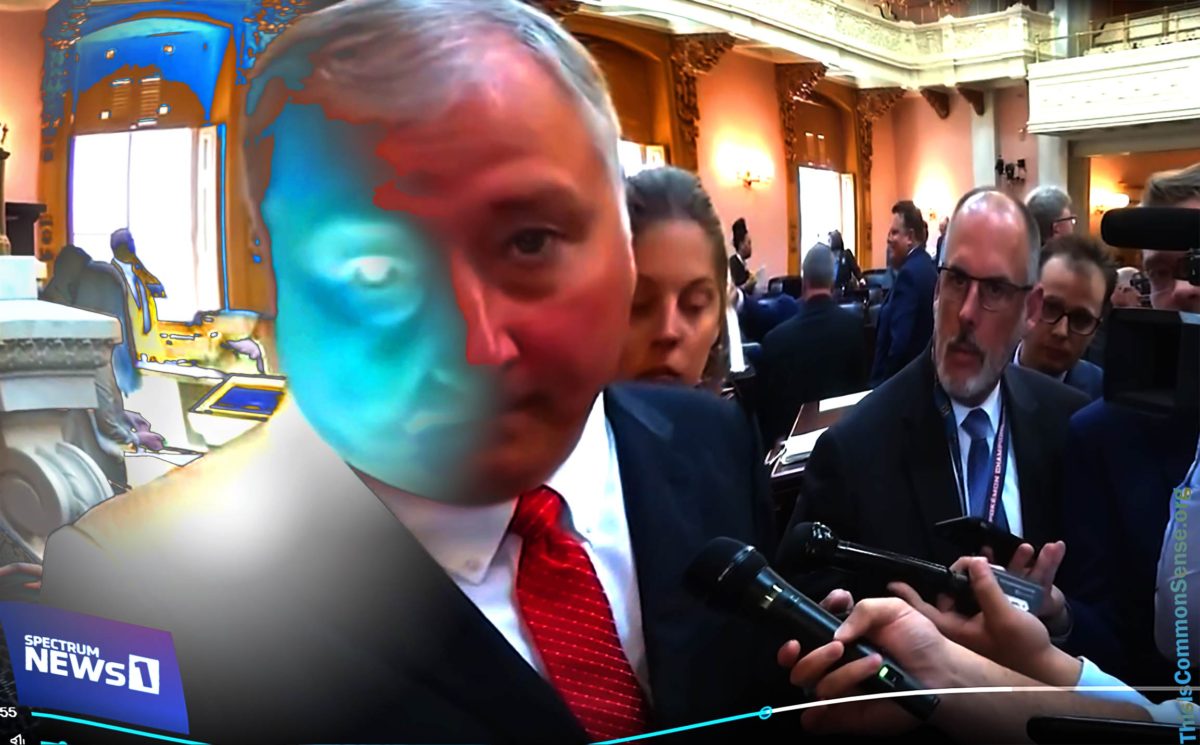
An “expensive friend” — in documents obtained by federal prosecutors, that’s how former FirstEnergy CEO Chuck Jones sized up former Ohio Speaker of the House Larry Householder.
What made the Speaker so Big Ticket?
“Republican Larry Householder hatched a plan to cement his hold on power for an additional 16 years,” The Columbus Dispatch reported, “and Akron-based FirstEnergy Corp. invested $2 million into the effort.”
Their scheme?
Petition a citizen initiative onto the ballot to slap lifetime term limits on legislators, rather than the current eight-year consecutive limits, as bait to hook pro-limits voters — emphasizing this toughening part, while hiding the fact that the eight-year limits in each chamber would be doubled to a 16-year limit in either.
The initiative would also set a brand-new clock, wiping out all past service so that Householder could command the House, uninterrupted, for 16 more years.
“He told me he’ll retire from [the House],” Jones joked with an associate, “but get a lot done in 16 more years.”
The pandemic stopped Householder’s scam. And then, last July, the FBI dropped the other shoe, arresting him for racketeering. Now awaiting trial, Householder has been pushed out as Speaker and then expelled from the House completely — the first time in over 150 years.
FirstEnergy fired CEO Jones — who, according to The Washington Post, “prosecutors continue to investigate” for his “involvement in a $60 million bribery scheme secretly funded by the company to win a $1 billion legislative bailout.”
Mr. Householder never liked term limits, but his corrupt attempts to thwart them serve as evidence of their importance.
This is Common Sense. I’m Paul Jacob.
See all recent commentary
(simplified and organized)
See recent popular posts

“FirstEnergy Solutions might not want to spend its bailout money just yet,” warns a story in Crain’s Cleveland Business.
At issue? A possible statewide referendum on House Bill 6.
HB6 would, according to the Cleveland Plain Dealer, “gut Ohio’s green-energy mandates and set up customer-funded subsidies to nuclear and coal power plants.” It passed the majority Republican state House “thanks to key support from several House Democrats.”
Passage of HB6 through both houses of the Ohio Legislature and its signature by Governor Mike DeWine would force Ohio ratepayers to fork over roughly $150 million in subsidies to FirstEnergy Solutions for its two nuclear power plants.
Except for one thing — in Ohio, voters possess a powerful political weapon: the referendum.
Already a diverse coalition of opponents to the bill has formed Ohioans Against Corporate Bailouts, filed a referendum and kicked off a petition drive that has “until October 21, 2019, to collect the 265,774 required signatures.”
“HB6 has created some strange bedfellows,” the Plain Dealer notices, including bringing together “environmental groups, the fossil-fuel industry, renewable energy companies, and some small-government activists” in opposition.
“Many of the forces that fueled the Trump presidency, before 2016 — I’m talking the Tea Party and others — could be supportive in undoing this bill,” explains Paul Beck, former chair of Ohio State University’s political science department. “And so could people on the left. You may find an incredible divergent group of people aligned with each other.”
“Liberals hate that it subsidizes dirty coal plants,” reports Crain’s. “Many conservatives hate that it picks winners and losers by subsidizing one industry over another.”
Thankfully, the fate of the giveaway rests in the hands of Ohioans, not their subsidy-loving representatives.
This is Common Sense. I’m Paul Jacob.

See all recent commentary
(simplified and organized)
See recent popular posts
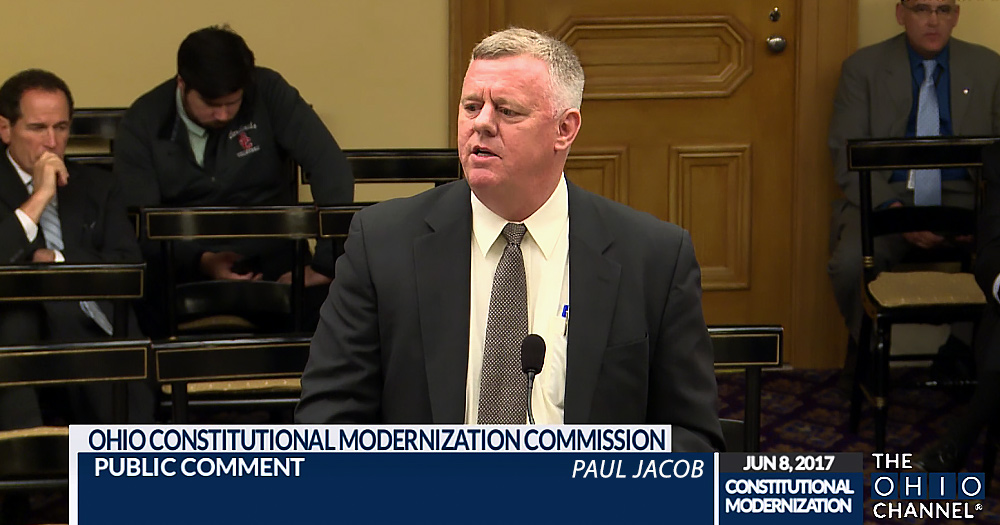
Last week, the Ohio Constitutional Modernization Commission considered whether to recommend a constitutional change to create an obvious double standard: requiring citizen-initiated constitutional amendments to obtain a 55 percent supermajority vote, while the very same amendments proposed by legislators would only need 50-percent-plus-one for passage.
I traveled to the capitol in Columbus, joining a room full of Ohio citizens and organizations testifying in opposition. As I explained at Townhall yesterday, after hearing from the people, the Commission tabled the idea.*
For more than four years, the Constitutional Revision and Updating Committee deliberated over how to improve the constitution and came to a consensus in favor of the aforementioned double standard (sent to the full Commission). And yet, at a well-attended public hearing, no one defended the proposal.
While bias favoring the legislature seemed obvious, commissioners bristled at the suggestion that — established and funded by the legislature — they lacked independence. “If there were one or two legislative members on our committee, that was it,” offered non-legislator Janet Abaray.
Actually, four of the nine members on Abaray’s committee are currently state legislators — not one or two. Plus, two more previously served in the legislature. That’s two-thirds of the committee comprised of current or former legislators.
Moreover, the published minutes provide a peek into the thinking behind the proposed double standard. For instance, “what have emerged lately are initiated amendments to the constitution that are inconsistent with the purpose of the constitution.”
It is the people who will decide what belongs in the people’s constitution — not the legislature.
And not the legislature’s commission.
That’s the truth that Ohioans spoke to power.
And power listened.
This is Common Sense. I’m Paul Jacob.
* The commission came to this conclusion with only one dissenting vote.

Former State Representative Matt Lynch got right to the point in his Cleveland Plain Dealer op-ed: “The people’s right to amend the Ohio Constitution through the ballot initiative is under attack.”
Created by the Ohio Legislature to consider constitutional amendments, the Ohio Constitutional Modernization Commission (OCMC) has a hidden purpose: provide cover for that same legislative body. As Lynch aptly notes, the OCMC “is filled with politicians and lobbyists. Thus, commission recommendations must be scrutinized for fidelity to the public good versus the special interests of political insiders.”
This Thursday at the capitol in Columbus, OCMC will consider whether to recommend that state legislators propose an amendment to the state constitution to make future amendments more difficult. That’s an awfully bad idea in itself. But, bizarrely, the greater difficulty would depend entirely on who proposes the amendment.
The working OCMC recommendation makes no change to the legislature’s ability to propose and pass constitutional amendments. What it would do is make it tougher for citizen-initiated amendments. Most unhelpfully, the recommendation would require only citizen-proposed amendments to garner a supermajority of 55 percent of the vote.
Consequence? Suppose a measure proposed by citizens — term limits, ethics reform, government transparency — was massively outspent by powerful interests, and yet still won 54.9 percent of the vote. It would lose.
Yes, the 45.1 percent of voters would defeat the 54.9 percent of voters.
Call it “New Math.”
The very same issue proposed by legislators would win . . . and be added to the state constitution.
“The double standards are breathtaking,” writes Lynch,* adding, “and no other state has such unfair rules.”
This is Common Sense. I’m Paul Jacob.
* Sunday at Townhall, I also discussed this double standard. And the word may be getting out. Townhall always adorns my column with a photograph — this time featuring Ohio Attorney General Mike DeWine, also a Republican candidate for governor in 2018. DeWine’s campaign objected to being pictured, arguing they have no involvement with the OCMC. DeWine’s picture has been removed.

Maybe President-Elect Donald Trump can whip Washington into shape. We can hope. And help. Especially on congressional term limits.
But remember: local political fiefdoms can oppress as harshly as the Feds. So . . . who is whipping your town into shape?
Well, welcome to Kettering, Ohio.
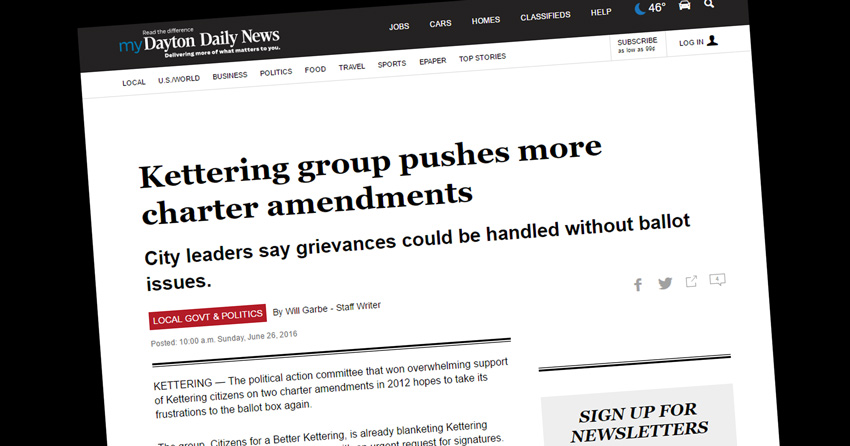
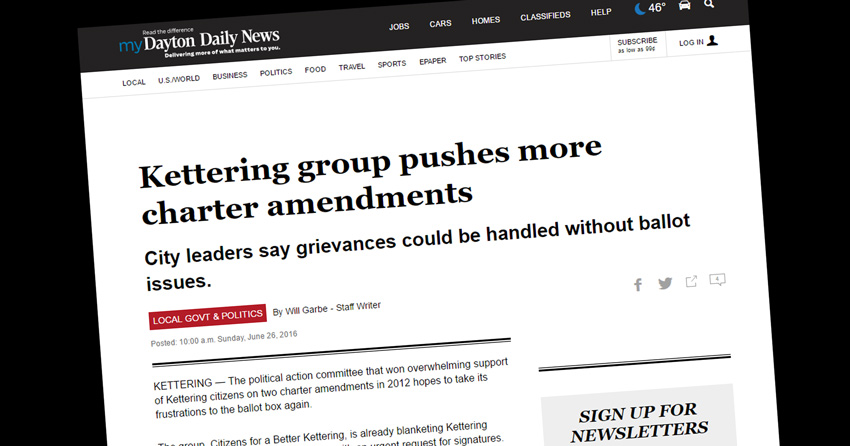
Just months ago, Kettering’s powers-that-be placed a new charter amendment on the ballot to weaken term limits. And one citizen, Ron Alban, wasn’t amused. He and two other longtime residents formed Citizens for a Better Kettering (CBK), but not merely to fight the attack on term limits. They also petitioned five new reforms onto the city ballot.
I met this busy activist back in January, while he was working to place an ethics reform measure on the Ohio ballot — before being blocked by the state ballot board. In 2012, Ron had organized a petition drive to put a pay cut and council term limits on Kettering’s ballot. Both passed.
Ron’s CBK measures were: to protect citizen input at council meetings; to require greater transparency on city salaries; to hold elections for council vacancies; to strengthen citizens’ ability to enforce charter provisions; and banning the city council from proposing future charter amendments dealing with term limits, council pay and the citizen ballot initiative process.
On Tuesday, the anti-term limits charter amendment failed.
And all five reform amendments passed overwhelmingly.
Alban and CBK aren’t as media savvy as Mr. Trump, or as wealthy. But their incredible success is a bright beacon of hope.
Most cities in this country have a petition process whereby thoughtful, hardworking citizens can change their local world. Most of us can do what Citizens for a Better Kettering just did.
This is Common Sense. I’m Paul Jacob.

Most folks are so unused to seeing normal people carrying guns around, out in the open, that when they it, they freak out.
Among those who are at least, well, unsettled by the spectacle? The police.
Funny, the gun freaker-outers don’t usually freak when they see police with guns. But that may be changing as more and more video footage comes out regarding police shootings of suspects under suspicious circumstances.
It is not exactly by accident that there are protests in numerous cities.
So, police being human, we cannot be surprised when, after the Dallas and Baton Rouge killings of police, “[t]he head of the Cleveland police union called on the governor of Ohio to declare a state of emergency and to suspend open-carry gun rights during the Republican national convention. . . .”
The governor’s office responded that Gov. John Kasich had no authority to do such a thing. Open carry was a law in the state. Only inside buildings could carry rights be suspended (as they have been, selectively).
Steve Loomis, the Cleveland Police Patrolmen’s Association head, said that he did not “care what the legal precedent” may be, and “couldn’t care less if it’s legal or not.”
If Loomis, a leader in “law enforcement,” boasts this attitude, no wonder police have had so many trigger finger incidents, sparking so much anguish, protest, and debate.
It’s time for police to rethink their approach to people who have rights to carry weapons.
Perhaps more importantly, we should all try not to freak out so easily.
This is Common Sense. I’m Paul Jacob.

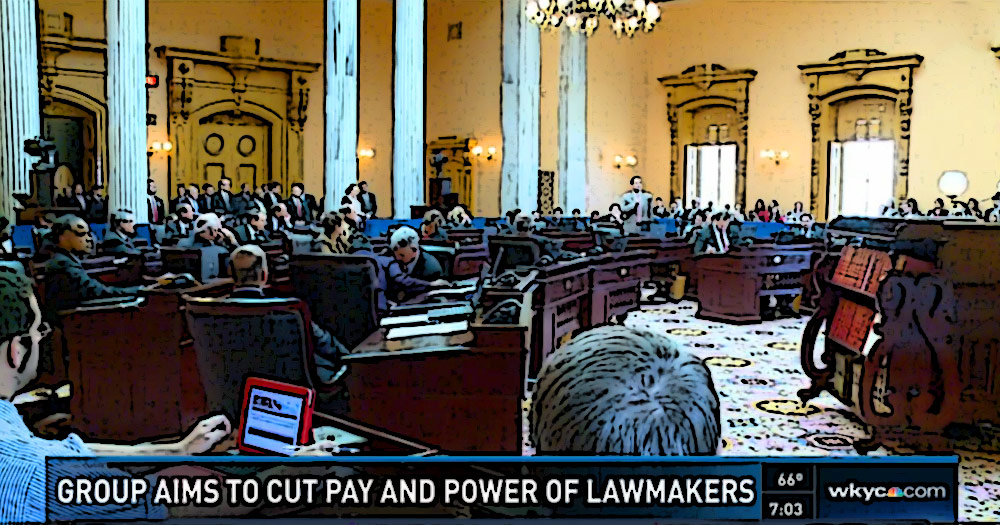
A group of Ohio citizens isn’t leaving the maintenance of ethical standards in government to the politicians. Smart. Forming a political committee, “Ethics First — You Decide Ohio,” the group filed an initiative to amend the state constitution unsurprisingly called, “Ethics First.”
What does the ballot measure do?
“Ethics proposal would cut state lawmaker’s pay and power,” said the segment on Cleveland’s NBC affiliate, WKYC-TV 3.
The initiative limits base pay for the state’s part-time legislators to the median household income of full-time Ohioans. Because Ohio is one of only six states in which legislators pay themselves more than median household income, the measure, if in effect today, would mandate cutting legislators’ base pay from $60,584 annually to $49,644.
“The purpose is not to cut their pay,” explained spokesman Jack Boyle. “The purpose is to make their pay related to what happens to all of us in Ohio. If we’re doing well, their pay will go up. If not, it will go down.”
What legislative “power” will be cut?
The amendment takes away four powers:
All the other powers of the legislature remain completely intact.
How would you vote: Yes or No?
This is Common Sense. I’m Paul Jacob.
Also, please consider showing your appreciation by dropping something in our tip jar (this link will take you to the Citizens in Charge donation page… and your contribution will go to the support of the Common Sense website). Maintaining this site takes time and money.
Your help in spreading the message of common sense and liberty is very much appreciated!

While the Ohio measure to legalize marijuana did not pass, this week, the Washington State measure to wrest tax limitations out of a recalcitrant legislature did indeed succeed, with a 54 percent win.
Win some, lose some.
But in both these cases, there is some evidence for a general smartening up of the voting public.
With Ohio’s Measure 103, the support for cannabis legalization, a few weeks before Election Day, seemed strong. But the more voters looked at the measure, the more they caught a whiff of stink — and it wasn’t skunk weed. It was crony capitalism and insider favoritism. So, while a solid majority reasonably favors legalization — even in Ohio — it strikes most reasonable people that the measure’s secondary provision of setting up a monopolistic/oligopolistic production cartel is as anti-freedom as the legalizations is pro.
Smart folks saw through the proposal. Cannabis legalization is proceeding, state by state. Better results for legalization next time?
Perhaps, provided a better measure is offered.
Washington’s I-1366, on the other hand, had several levels to it, too, but they worked together. Voters seeking a constitutional tax limit, got it — or, if the legislature balks at delivering it as a future referendum (as the measure instructs) then the initiative’s main feature would kick in and the sales tax would be lowered. Low-tax voters get low taxes either way, legislature cooperating or resisting.
As I’ve explained some time back, repeated legislative betrayal had forced Evergreen State super-activist Tim Eyman to concoct this rather clever ploy.
In both Ohio and Washington, what voters voted against was against politics-as-usual — and that is good, no?
This is Common Sense. I’m Paul Jacob.

Elections you win are better than elections you lose. But while the polls remain open, I say cast your ballot and savor the chance to win, make a decision, make needed changes. In other words, accept that fighting chance.
But no fighting, actually — it’s peaceful political action.
Today, I’m watching closely three contests.
First, Liberty Initiative Fund, where I work, has been a big supporter of pension reform in general and Cincinnati’s Issue 4 in particular. Ballotpedia, the nation’s best tracker of ballot measures, declared the Cincinnati issue one of the nation’s five most important being decided today.
Win or lose in Cincinnati, the pension problems of cities and states across the country won’t just go away — not without an engaged public to demand the issue be addressed. Pension reform ballot initiatives “end run” the can-kicking on city councils and in state houses.
Second, Citizens in Charge was a major backer of the petition drive that succeeded in earning a spot on today’s Washington State ballot for initiative 517, the “Protect the Initiative Act.” While 517’s supporters have been badly outspent by opponents, at least we’ve had a chance to take the idea to the people.
The third? Governance. In Vancouver, Washington, city officials blocked citizens from petitioning onto the ballot the issue of bringing in (and connecting with) the light rail system of twin city Portland, Oregon. After battling and losing a court case (with support from Citizens in Charge Foundation), citizens didn’t give up. They formed Vancouver Vitality and are supporting the ouster of several incumbents and their replacement with a clean slate of new candidates.
I only hope we can do more good when we go vote a year from now.
This is Common Sense. I’m Paul Jacob.