Categories
ideological culture public opinion too much government

Looking for Work

“Social sector” workers — described by Forbes as “nonprofit organizations and the social sector at-​large” — have been losing jobs because of budget cuts and corruption cuts.

Many newly unemployed are unhappy about having to job-​hunt. Some complain about having to take jobs from profit-​making businesses. Others lament sparse communication from prospective employers.

“When asked about barriers to finding employment, 85% of respondents cited lack of employer response as their primary challenge,” Aparna Rae’s not-​very-​shocking-​at-​all Forbes article elaborates. “The irony is stark: a sector built on human dignity subjects job seekers to dehumanizing ‘digital hiring mazes’ where qualified candidates are ghosted after final-​round interviews. The disconnect between mission and practice erodes the sector’s moral authority.”

Wow. Dehumanizing to have to … look for work (or customers)? Worse because your last job was all about dignity — unlike all those grubby profit-​sector jobs or, for that matter, jobs with nonprofits that rely only on voluntary private donations?

“I want to be seen and recognized as a human,” explains one representative job seeker. “The lack of communication and impersonal nature of the hiring process is demoralizing and makes job seekers feel devalued.”

Job hunting can be tough. It’d be nicer if qualified candidates who have been considered but lose out to other qualified candidates were always notified. Sure. But how does failure to do so represent a “disconnect” between mission and practice, and how does it “erode the [nonprofits’] moral authority”?

Job seekers might feel less demoralized if they didn’t take the impersonal aspects of the search so personally.

This is Common Sense. I’m Paul Jacob.


PDF for printing

Illustration created with NanoBanana and Firefly

See all recent commentary
(simplified and organized)
See recent popular posts

Categories
free trade & free markets regulation

Dining Out on Cause and Effect

Could a barren, charred, devastated landscape be the actual intended goal?

In California as in Washington, lawmakers and chief executives apparently have a long list of nice things to destroy and are crossing them off one by one, as if on the payroll of aliens from outer space wanting to conquer earth without doing very much conquest-​work themselves.

Part 99‑C of the plan is to price entry-​level labor and entry-​level restaurant dining out of the market by hiking the minimum wage of fast-​food workers even further beyond the market rate for the labor and its actual productive value to employers: now to $20 an hour.

Already, prices for restaurant meals are going up, and restaurant workers are being laid off.

The $20 minimum is a compromise that restaurant owners accepted in lieu of probably paying a $22 per hour minimum. Like letting burglars take only most of the silverware and letting them return at will.

Even more looting of employers is to come, if employee and activist Angelica Hernandez has her way. “We’re going to have to keep speaking up and striking to make sure we are heard.” She wants her dough and doesn’t care about the consequences for others. Policymakers rush to appease her and those like her.

So is omni-​destruction the actual intended goal?

Or is it that the mental powers of the crusaders and politicians and too many voters don’t extend so far as the relationship between cause and effect?

This is Common Sense. I’m Paul Jacob.


PDF for printing

Illustration created with PicFinder and Firefly

See all recent commentary
(simplified and organized)
See recent popular posts

Categories
Accountability general freedom nannyism national politics & policies political challengers porkbarrel politics responsibility too much government U.S. Constitution

How Bernie’s Like Trump

Yesterday I made fun of Bernie Sanders’ jobs guarantee idea. Today, let’s take it seriously.

Not as policy, mind you. As propaganda.

It’s not worth talking about as a policy because there is no policy yet. “It is not clear when Sanders will announce the plan,” Fox News relates, “and a Sanders spokesperson told the Post that it was still being crafted.” 

It is mere advocacy. A press release. Vaporware.

But that’s the key to it, really. The jobs guarantee isn’t policy. 

It’s a ploy.

Bernie Sanders knows there is hardly a hope of passing such a bill. He probably understands that the current fiscal mess precludes it. He might even understand that it is literally a horrible notion, the worst policy idea in the world, and he would still have reason to pitch for it relentlessly.

Because what he is really after is the hiking of the national minimum wage to $15/​hr. That is the next Democratic ratcheting up of government. And by insisting that the government guarantee $15/​hr jobs, he is readying everyone to accept, as a compromise, the hiking of the minimum wage to that very figure.

Yesterday I noted a link between socialism and slavery. But minimum wages link up not with slavery but unemployment.

Which Bernie knows all too well. Before he got in politics, he was a layabout, a bum.

Not like President Trump at all, that way.

But by fixing on one key, “anchor” concept ($15/​hr) and demanding the Moon, he might just get his mere lunacy, er, minimum wage hike.

And that is a Trumpian* ploy.

This is Common Sense. I’m Paul Jacob.


* Though Trump’s better. His “linguistic killshots” are far more memorable … because funny and (usually) visual.


PDF for printing


Categories
Accountability general freedom moral hazard nannyism national politics & policies privacy tax policy

Hey, It’s Your Money

I leave it up to you how to spend your own money. You decide, based on your own circumstances and priorities.

Oh, you don’t need my permission? 

Of course not.

But some people think that if you spend your own money on your own priorities in accordance with your own judgment, it is indeed a problem. At least when you get to keep more of your own money because of tax cuts.

President Trump has often suggested that recipients of new corporate tax cuts will spend the additional money mostly on increasing wages and hiring new workers. Yet some major corporations reportedly say that they will spend the additional money on paying dividends or buying back shares. Maybe others will buy more advertising, storage space or tools. Various commentators fret. But why should a firm hire new workers if other expenditures would be more productive at the moment?

Of course, in the long run, a company that is more profitable and successful can hire more people and can pay them more.

But wages are not the only expense that companies must cover in order to be successful in the long run. Managers do, and should, devote resources first to the improvements that they conclude are most urgent. That a company’s resources increase because of a tax cut doesn’t alter the necessity or reasonableness of pursuing economic goals in accordance with one’s best judgment. 

An approach that, to be sure, also benefits present employees as well as future ones.

This is Common Sense. I’m Paul Jacob.


PDF for printing


Categories
folly free trade & free markets general freedom meme national politics & policies

Robert Reich, Mythed Up

Consumer sovereignty is the idea that in markets consumers call the shots. In capitalism, most mass production is indeed for the masses, and the masses have a big say in what gets done. All profits and wages of successful businesses come from consumers.

But don’t take this too far.

Consumers don’t “create jobs,” for example.

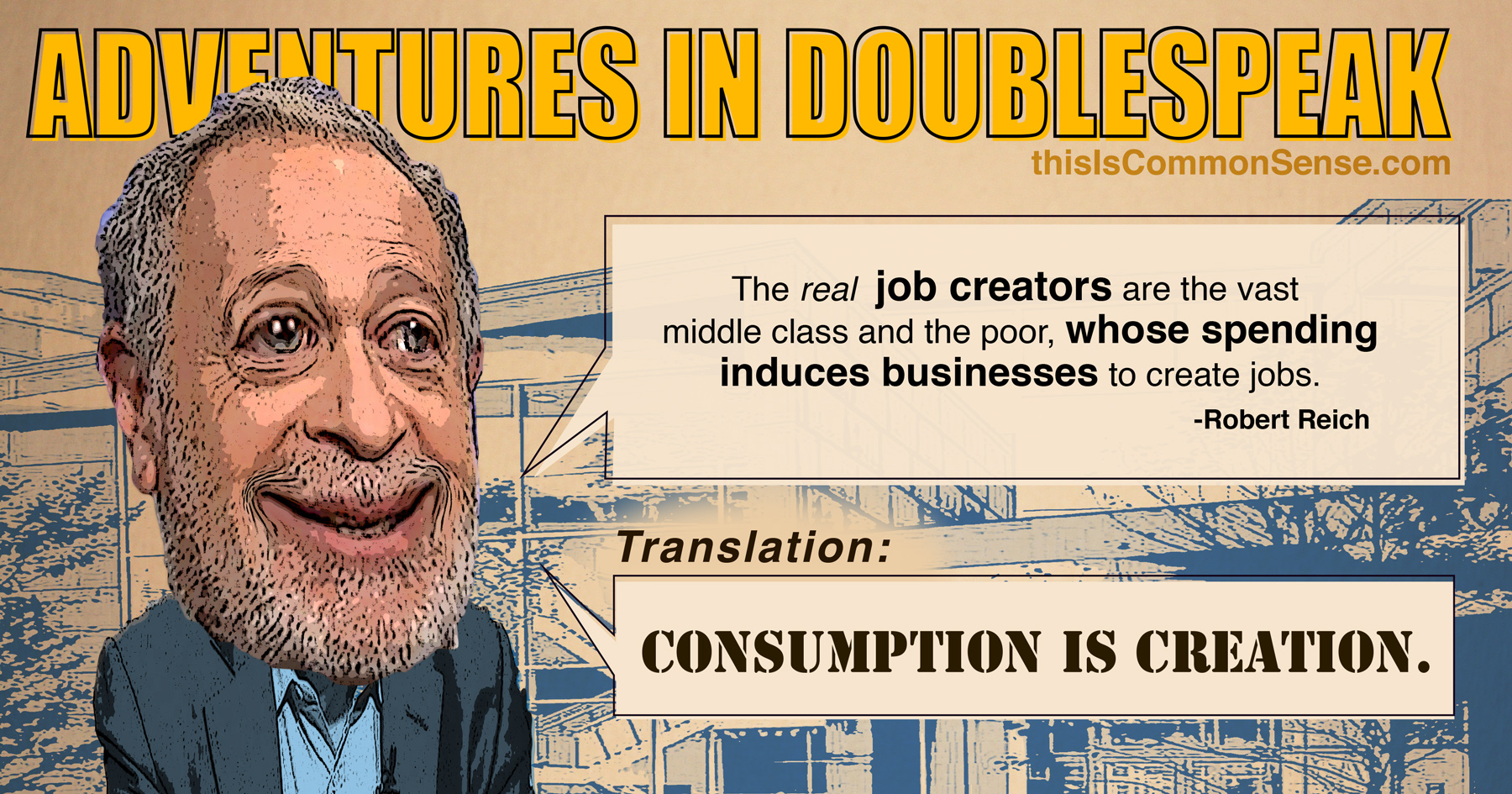
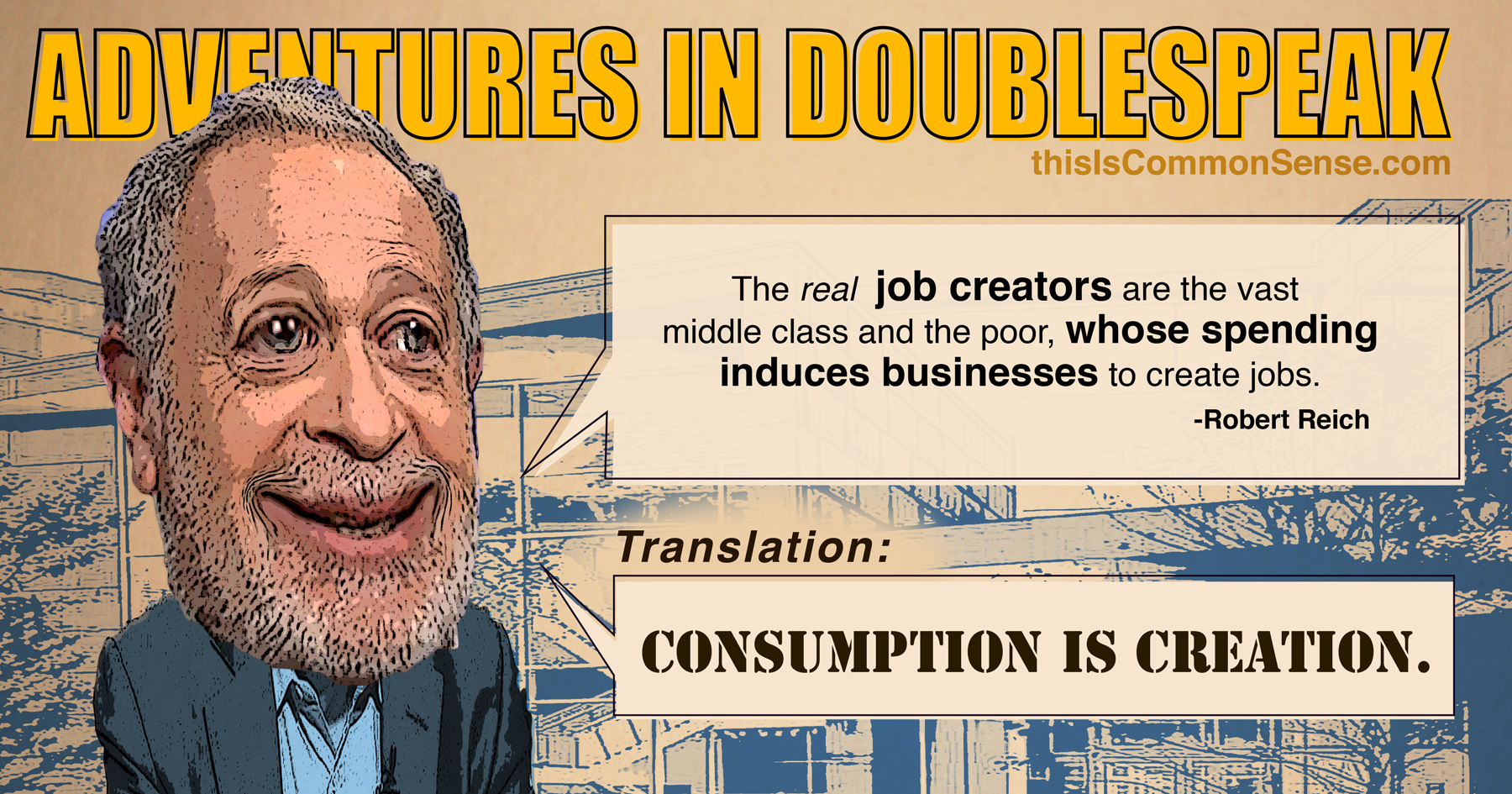
Recently, Clinton-​era Labor Secretary Robert Reich has been floating this bizarre notion. To his Facebook audience, last month, he wrote that it is a myth that “the ‘job creators’ are CEOs, corporations, and the rich, whose taxes must be low in order to induce them to create more jobs.

Rubbish. The real job creators are the vast middle class and the poor, whose spending induces businesses to create jobs. That is why raising the minimum wage, extending overtime protection, enlarging the Earned Income Tax Credit, and reducing middle-​class taxes are all necessary.”

So, we have people in roles of “producers” and “consumers,” and it is the consumers who “create jobs”? And they do this by “inducing” businesses to, wait, uh, “create jobs”?

Face it: businesses create jobs — out of capital from somebody’s invested savings. Entrepreneurs brace themselves to take big risks, fronting workers’ wages as well as hiring and purchasing capital goods and material.

Before a penny is spent by consumers.

Only when entrepreneurs guess right does the flow of money come full circle.

Reich repeated his quasi-​Keynesian rap yesterday: it’s spending consumers who “get businesses to expand and hire.”

Truth is, Reich doesn’t “get” basic economics. But he does understand political equations, which is why folks on the Democratic left think he’s a genius.

This is Common Sense. I’m Paul Jacob.


For a high resolution version of today’s picture (perfect for use as a screensaver), click on the image below to open in new window. Also, please do feel free to share with your friends.

Robert Reich Doublespeak


Categories
folly free trade & free markets moral hazard national politics & policies too much government

Trump’s Road Rage

There is no reason why the states shouldn’t handle their own infrastructure. Not only in funding, but in direction and method of production and “distribution.”

But politicians aiming for the presidency tend not to even consider that heresy. And journalists, of course, tend to rah-​rah for the nationalist planning notion, too. It’s easier to cover everything from Washington. I remember much talk of “our crumbling infrastructure” back in the 1980s.

Thankfully, Shikha Dalmia has not jumped onto that bandwagon. The Reason writer notes that Trump is trumping Obama’s fling with “shovel-​ready jobs,” demanding that the federal government spend up to a trillion in infrastructure “stimulus.”

Forget for the moment the obvious contradiction: pretending to be an outsider, Trump is pushing as “insiderish” a program as imaginable.

I wonder: is Trump playing the cuckoo here, placing an alien idea into his constituents’ nests? Are his supporters about to be “cucked”? (As alt-​rightists like to put it.)

Trump looks abroad for models of beautiful roads and bridges and trains and all the rest. If you travel “from Dubai, Qatar, and China,” he bemoans, our biggest cities give off a certain “Third World” vibe.

Dalmia blanches: “the countries Trump is praising as models for a better America are all autocracies that have made a complete hash of things.”

Boy, we do not need to find another way to make a complete hash of things here in the States. And our federal budgets are strained (and pushing us further into debt) as it is.

Besides, it is not written in stone, concrete, or even asphalt, that these United States’ roads and bridges must be made the federal government’s business.

This is Common Sense. I’m Paul Jacob.


Printable PDF

infrastructure, shovel ready, government, roads, illustration


Categories
folly ideological culture national politics & policies political challengers too much government

Fiorina Fires Back

Politicians love talking up job creation. Presidential candidates, especially, pretend to a Svengali-​like virtuosity in producing paychecks and, if only handed the keys to the White House, creating — presto! — a bunch more.

This year, Republican Carly Fiorina, the former CEO of Hewlett-​Packard, has been repeatedly attacked by Democrats, democratic socialists and her Republican opponents for firing 30,000 workers during her tenure running the company. As if she did so out of meanness.

Sunday, on Meet the Press, Chuck Todd went at her again.

“I find it very rich,” Fiorina fired back. “Barbara Boxer, Hillary Clinton, all the Democrats who are attacking me, they’ve never created a job, they’ve never saved a job, and their policies destroy jobs, including Mrs. Clinton’s latest position on Keystone Pipeline.”

Mrs. Fiorina offers context for her “failure”: “I led HP through a very difficult time. The NASDAQ dropped 80 percent. Some of our strongest competitors went out of business altogether, taking every job with them.” As she sees it, her team “saved 80,000 jobs. We went on to grow to 150,000 jobs. We quadrupled the growth rate of the company, quadrupled the cash flow of the company, tripled the rate of innovation of the company. And went from lagging behind to leading in every single product and every single market. I will run on that record all day long.”

I’m not endorsing Fiorina, either as candidate or as CEO. Just sayin’ that those attacking her on 30,000 jobs don’t know anything at all about actually creating even one real one.

This is Common Sense. I’m Paul Jacob.


Printable PDF

Fiorina, employment, HP, CEO, Hillary Clinton, Barbara Boxer, jobs, Presidential, collage, photomontage, illustration, JGill, Common Sense


Categories
free trade & free markets national politics & policies too much government

Nails & Ball-​Peen Hammers

When all you have is a hammer, every problem looks like a nail. When it comes to “jobs,” our politicians prove the truth of this adage over and over. They think that they have to “do something,” or at least “look busy” providing “leadership.”

Wrong — unless they take the lead to get out of the way.

Alas, few have the courage for that kind of leadership.

Republican politicians — fearing “looking bad” — are, even now, floating various “plans” to create “jobs.”

“I thought it was incumbent on me to at least say … ‘We’re working on a plan,’” says one incumbent.

Trouble is, whatever plan he or his colleagues put up to counter the president’s absurdities, odds are that it, too, will not work.

Why?

The trouble with markets right now is uncertainty. Several sectors went bust, and it’s not easy to get progress started again … especially when the government keeps cooking up game-​changers. Solutions. “Fixes.” Political machinations — subsidies or regulations or any of the usual tools in the politicians’ tool belt — just increase uncertainty, muddying up the recovery.

The neat thing about markets is that none of us need to know how, exactly, to order the “economy” for order to be discovered. It works out. This is old wisdom, but even actual experimentation has shown that this is the case.

The economy is not a mess of boards half-​nailed down. The last thing it needs is more hammering from politicians.

This is Common Sense. I’m Paul Jacob.

Categories
free trade & free markets national politics & policies too much government

Why Such Slow Growth

Why such slow growth, after the federal government spent trillions to spark recovery?

Could it be that binges of throwing borrowed money around don’t matter? Spending money can’t be the solution if the problem is low or dark expectations of the future — and the spending of borrowed money feeds that dark view.

So what is the solution? 

Well, take a step back. According to economic historian Robert Higgs, the key to economic growth is “private domestic business net investment.” And that’s down. 

The peak occurred in 2007. The next two years saw the very opposite of growth, a precipitous fall in investments in private business. Last year, Higgs tells us, “net private investment increased smartly for three quarters, reaching an annual rate of $270 billion in the third quarter, then contracted sharply — by almost 47 percent — to $144 billion in the fourth quarter,” which is about a third of what it was at peak in 2007.

“Jobs,” which everybody’s thinking about, don’t come from spending as such. New jobs happen when people who save take their unspent money and invest it in production processes that they hope will yield goods that consumers in the future will spend money on.

So, private investment depends on positive expectations, a kind of rational hope.

What could government do? 

Provide less reason for fear by putting a halt to doing things that elicit rational fear instead of rational hope.

Saner government, more productive economy.

This is Common Sense. I’m Paul Jacob.

Categories
free trade & free markets too much government U.S. Constitution

Not His Job

President Obama will address the State of the Union, today, speaking before Congress. These annual efforts are almost uniformly unbearable, with too much applause and too much rah-​rah-​boy politicking. And far too little thought.

Scuttlebutt has it that the president will concentrate on the economy, on “jobs.”

After the sea change of the last election, one might hope that he’d stay on topic and address constitutionally-​mandated issues of his office.

“Jobs” are none of his business. “Jobs” — by which I mean the number of people employed this way or that out there in the non-​governmental sector, and by which he means the number of jobs total, including those paid for out of taxpayer expense — should not be his chief worry.

No president in recent memory has excelled by fiddling with policy to micromanage “the economy.” No one knows this stuff. Not even college professors specializing in macroeconomics.

What government operatives know is how to get elected, stay in office. How to preen for television cameras, read a prompter.

You know, the essentials.

But they cannot possibly know enough to “run the economy.”

And yet, Obama talks about making the country “more competitive.” Oh, come on. Just open up trade — which promotes widespread co-​operation as well as competition — stop micromanaging the money supply through the Fed, make regulations fit a rule of law and not a vast bureaucratic command system, and let it go. Let individuals and businesses worry about “competiveness.”

This is Common Sense. I’m Paul Jacob.